Veganism and the Farm System Reform Act
A continued discussion on animal activism
Veganism and the Farm System Reform Act
A continued discussion on animal activism
Photo by roam in color on Unsplash
As I researched and began writing this piece, I realized how much it was built off my last article and also how much more I had to say than I could fit here. So this is effectively part two in a three-parter on animal ethics. You can find the other two pieces in my Animal Ethics list.
It’s frustrating so few legislative actions can be agreed upon, especially for those who invest so much time into a bill. In the US, a legislative bill must pass both bodies of Congress before it can be signed into law by the President, which cuts down about 96% of bills.
The Constitution intends for legislative change to be difficult. How difficult is up for debate but understanding how a bill becomes a law and following key legislative bills helps navigate the changing landscape of politics.
Captured from congress.gov
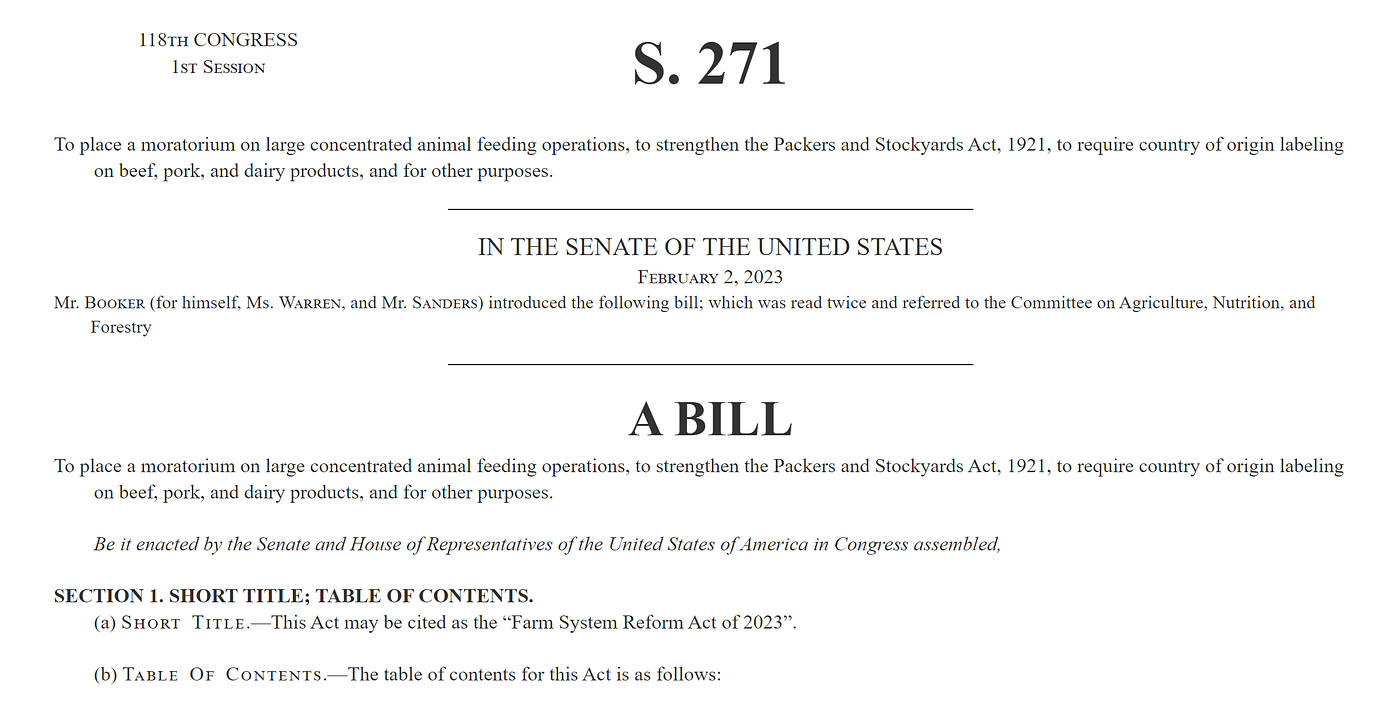
The Farm System Reform Act of 2023 can be best described by its long title:
“To place a moratorium on large concentrated animal feeding operations, to strengthen the Packers and Stockyards Act, 1921, to require country of origin labeling on beef, pork, and dairy products, and for other purposes.”
These three components correspond to the three titles in the bill and its parameters. Today we will look at Titles I and III, Animal Feeding Operations and Labeling of Meat and Dairy Products.
Title I: Animal Feeding Operations
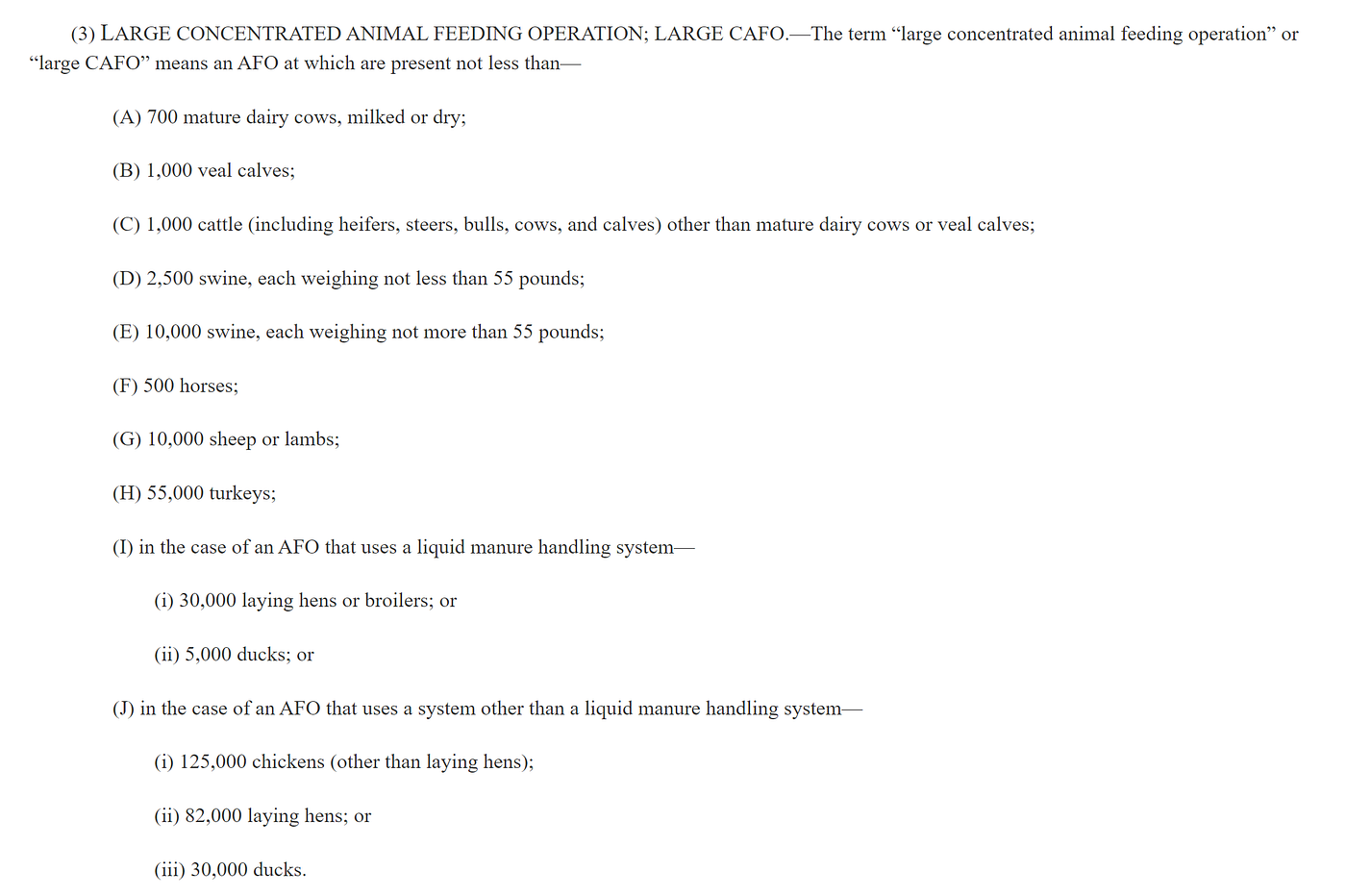
One goal of this bill is to end CAFOs in 18 years, by 2041. CAFOs, or Concentrated Animal Feeding Operations, are often decried for the unethical treatment of farm animals. To better understand how this bill defines a CAFO, let’s look at its definition of an AFO or Animal Feeding Operation:
“For at least 45 days a year, an area where animals are stabled and fed, not including a Stockyard.”
A CAFO then is an AFO containing a minimum number of animals depending on the species.
Captured from congress.gov
If enacted, the bill requires an immediate end to starting a new CAFO. Farms currently operating at this level must downgrade by 2041. Interestingly, CAFOs don’t have an area component to their definition. While limiting large numbers of animals, this might still fail to account for slightly smaller numbers of animals confined to a small area. To be fair, though, this bill is primarily going after large corporate farming operations, which probably account for the majority of unethically raised farm animals in the US.
To help with the transition for current CAFOs, the bill establishes a Voluntary Debt Forgiveness and Transition Assistance program. This program offers grants for “contract growers” or farmers (distinguished from their “integrators,” the companies that hire them for their meat).
Title I also requires these “integrators” to take responsibility for the waste, pollutants, and effects of the CAFO on neighboring communities. Large-scale farming operations come with a significant impact on the environment, contributing to greenhouse gasses and wastewater runoff. Rather than leave these negative externalities for the individual farmer to handle, the bill rightly addresses the need for the integrators to take responsibility.
On the farmer’s part, should they choose to enroll in the Debt Forgiveness program, the bill requires them to give a working land easement, which prohibits certain development on the farmland. A landowner’s rights on their property can be thought of as a “bundle of sticks.” Conditional to receiving the grant money, they may be required to hand over some of their sticks, such as the right to mine, build new structures, or subdivision their property. These practices help maintain some of the preexisting natural land growth.
Finally, Title I establishes $10 billion allocated from the Department of Treasury each year to fund the program. To put this in perspective, the entire Department of Agriculture spent $26.3 billion in 2022.
Title III: Labeling of Meat and Dairy Products
Title III is the shortest, and its purpose is to re-establish mandatory country-of-origin labeling for beef and pork (this had already been in effect for lamb) and adds dairy products. Additionally, any product wishing to use “Product of USA” or the like must use animals exclusively born, raised, and slaughtered in the US. This prevents integrators from outsourcing their meat to other countries that may be more lax on animal farming standards.
Photo by Leon Ephraïm on Unsplash
While many might see this bill as government interference in the farm industry, one has to ask, “Who are we going to hold accountable for the inhumane treatment of many farm animals, creatures often seen as little more than commodities?”
But the most concerning question for most will likely be, “Will this raise the price of meat in America?” I’m hard-pressed to say it wouldn’t. And this is one of the largest detractors against the bill, that it would negatively impact American citizens, especially those without flexible incomes. Like the current issues with gas prices, this is not a bill many would get behind. But like the issues we see with gas and its effect on the planet, how long can we continue to ignore it? With the concern for increased costs, an improvement to this bill would be a price buffer for those with lower incomes. The growing popularity of sustainable agriculture and humanely raised foods is evident that we are not sitting well with how some of our food comes to our plates. By addressing the disproportionate impact price could have, this bill would be easier to swallow.
The last noted activity on the Farm System Reform Act was its referrals to the subcommittees of the House and Senate in February of this year. It will probably find its way to the 96% of bills that don’t get passed. While the treatment of farm animals may not be the most pressing issue facing our country currently, we do need to address it.
Henry David Thoreau went to prison for not paying his taxes in protest of the Mexican-American War. Rosa Parks for refusing to be degraded to an inferior citizen based on her seat assignment on a bus. Parks and Thoreau were not leaders because they told others what to do. Rather, their actions suggested a path forward. They led by example.
Photo by Unseen Histories on Unsplash
Regardless of how rational we consider ourselves, when we’re told to do something, no matter how “right” it may be, we still feel we’re giving up a part of our autonomy. The power of suggestion creates a different power dynamic, however, and it’s here where veganism’s power lies. Scott Anderson speaks about his conception of veganism like this, where the power isn’t in shouting your values for the world to hear. Instead, sharing successes and difficulties with the vegan diet and making it more relatable helps other people consider the idea on its merit. This normalizing influence is met with less rigidity and more adoption by open and curious minds. While slow in uptake, wading into the waters of veganism shows others the possibilities awaiting within it.
We don’t need to stop eating farm animals to improve their lives. By decreasing our demand for them, we can set a new market equilibrium where smaller farms, not large CAFOs, might sustain our meat preferences. But removing animal products from your diet is becoming easier. Ultimately, the question comes down to whether killing animals for food is morally justifiable. What I’m more concerned with presently is how we can promote healthier lives for farm animals. But, as Stephen West says, it’s not hard to imagine a future where our descendants will think of us as backward for eating animals.
If we’re not eliminating animals from our diet, then we will need some verification of humane treatment, if there is such a thing. In today’s grocery stores, that mainly comes from labels. The last article in this series on the ethical treatment of animals will cover just that.
메타데이터
- post_id
- 4f0c8c3b8092
- slug
- veganism-and-the-farm-system-reform-act-4f0c8c3b8092
- url
- https://medium.com/@s_sowell/veganism-and-the-farm-system-reform-act-4f0c8c3b8092
- canonical_url
- https://medium.com/@s_sowell/veganism-and-the-farm-system-reform-act-4f0c8c3b8092
- author_url
- https://medium.com/@s_sowell
- status
- ok
- fetched_at
- 2026-07-25 08:20:34