Six Lessons from Running B2B Workshops We Got Wrong
Most B2B workshops are presentations with better catering. Here are six places where the workshops we eventually got right looked nothing…
Six Lessons from Running B2B Workshops We Got Wrong

Most B2B workshops are presentations with better catering. Here are six places where the workshops we eventually got right looked nothing like the ones we used to run.
We have run, sat in, and helped design more B2B workshops than we can count. Internal enablement sessions. Client onboarding programs. Sales kickoffs. Partner training. The kind of sessions that get scheduled with serious intent and end, three weeks later, with everyone agreeing it went well and nobody able to name what changed.
The pattern repeated often enough that we stopped blaming the facilitator or the content. The structural problem was the same in almost every case.
Most B2B workshops are presentations with better catering.
We were guilty of running them that way ourselves before we caught it. What follows is the honest comparison we wish we had seen earlier: six places where the workshops we eventually got right looked nothing like the ones we used to run.
Lesson 1: Outcomes Beat Decks Every Time
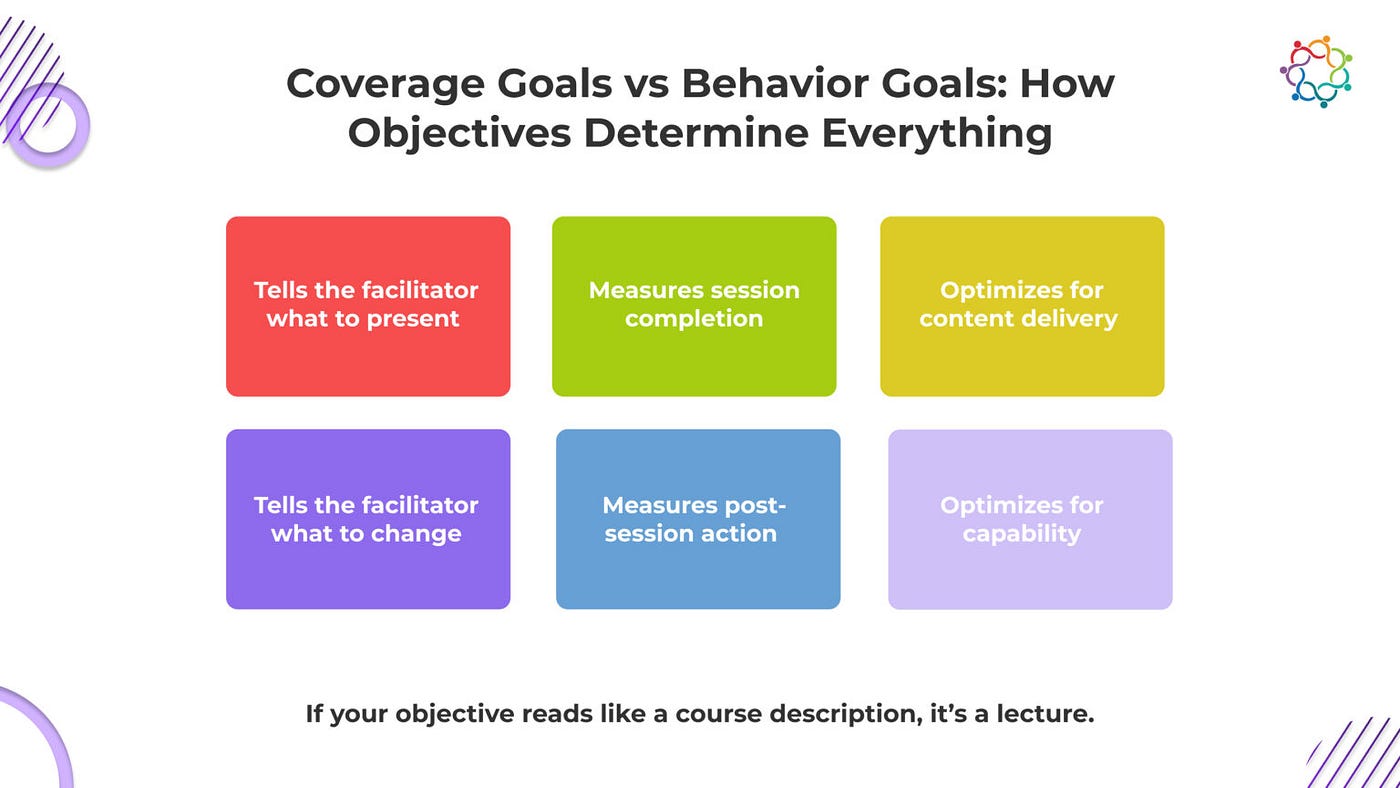
The first workshops we built were organised around content. We had a framework, the framework had modules, and the modules had slides. The objective, when we wrote one, sounded like a course description. “Participants will understand the new positioning framework.” Nobody asked the harder question, which is what the participants would actually do the following Monday differently.
What we eventually learned: the objective is the design decision that drives every other design decision. When the objective is coverage, the room layout, the activity structure, the timing, and the facilitation style all optimise for getting through the material. When the objective is a specific behaviour, every one of those decisions changes.
The version that worked read more like this: “By the end of this session, each rep will have built a discovery call framework for their two highest-priority accounts using the new methodology.” Observable. Specific. Tied to an action that happens after the room clears, not during it.
If the objective cannot be observed in someone’s calendar the following week, the workshop is teaching, not changing.
We started writing objectives this way and discovered that half the content we had been planning to deliver was no longer relevant. That was the point.
Lesson 2: The Room You Imagine Is Not the Room You Get
For a long time, we designed for an engaged mid-level professional with moderate background knowledge and a reasonable amount of time. That person almost never showed up. The actual room was a clinical specialist with twelve years of experience, a new hire two weeks into the role, and a regional manager who joined because attendance was mandatory and had four unread messages from her VP waiting.
The workshops where we pitched to the imagined middle lost both ends of the room. The expert was bored. The novice was lost. The workshop ended with polite applause and zero behaviour change at either end.
What worked was diagnosing the room before the room arrived. Two questions sent two days ahead changed the design every time. “What is the one challenge you have failed to solve in the last 90 days?” and a self-rated experience level. The answers reshaped breakout group composition entirely. They told us whether the technical section needed to run as a walkthrough or a troubleshooting exercise. Design choices started following data instead of assumptions.
In medtech and complex SaaS specifically, the gap between a novice and an experienced participant is not a degree. It is a different knowledge domain. We learned that the hard way.
Lesson 3: The Conference Format Was Not Built for Workshops
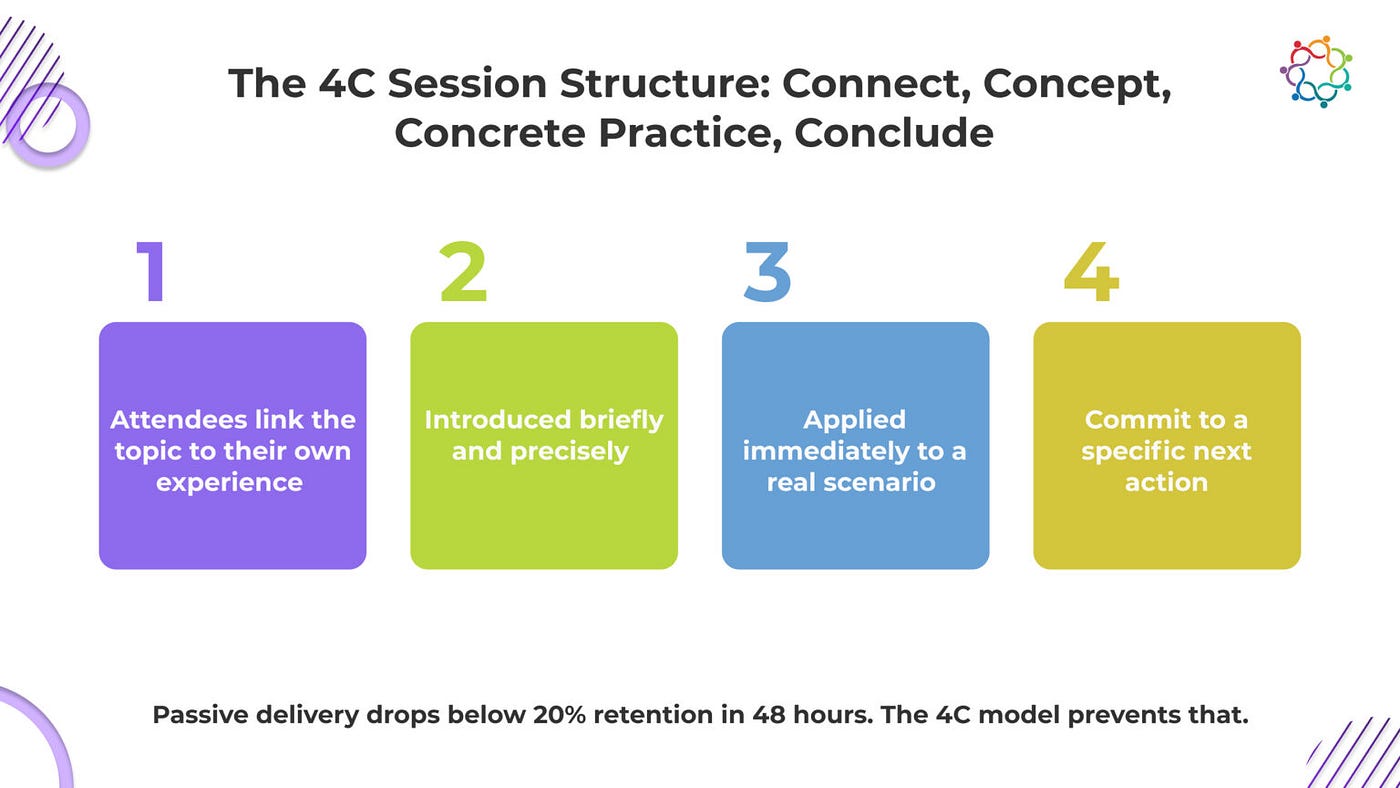
Our early workshops were structured exactly like conference breakouts. Forty-five minutes of presentation, ten minutes of Q&A, five minutes of wrap-up. It felt professional, was easy to fill, predictable to run, and almost never produced lasting change. Passive information delivery tends to decay sharply within the first 48 hours, and our workshops were operating well within that decay curve without us knowing it.
The structure that worked for us draws on adult learning principles popularised by educators like Sharon Bowman in the 4C model: Connect, Concept, Concrete Practice, Conclude. Participants connected the topic to their own experience first. The concept was introduced briefly. Concrete practice put it to work in a realistic scenario immediately. The conclusion was a commitment to a specific next action, not a summary slide.
The unexpected discovery was the Connect step. We thought it was a warm-up. It turned out to be the most important fifteen minutes of the workshop, because it surfaced participant-specific context that we had not designed for, and that often reshaped what the rest of the session needed to do.
Lesson 4: The Best Person to Build the Content Is Often the Worst Person to Facilitate
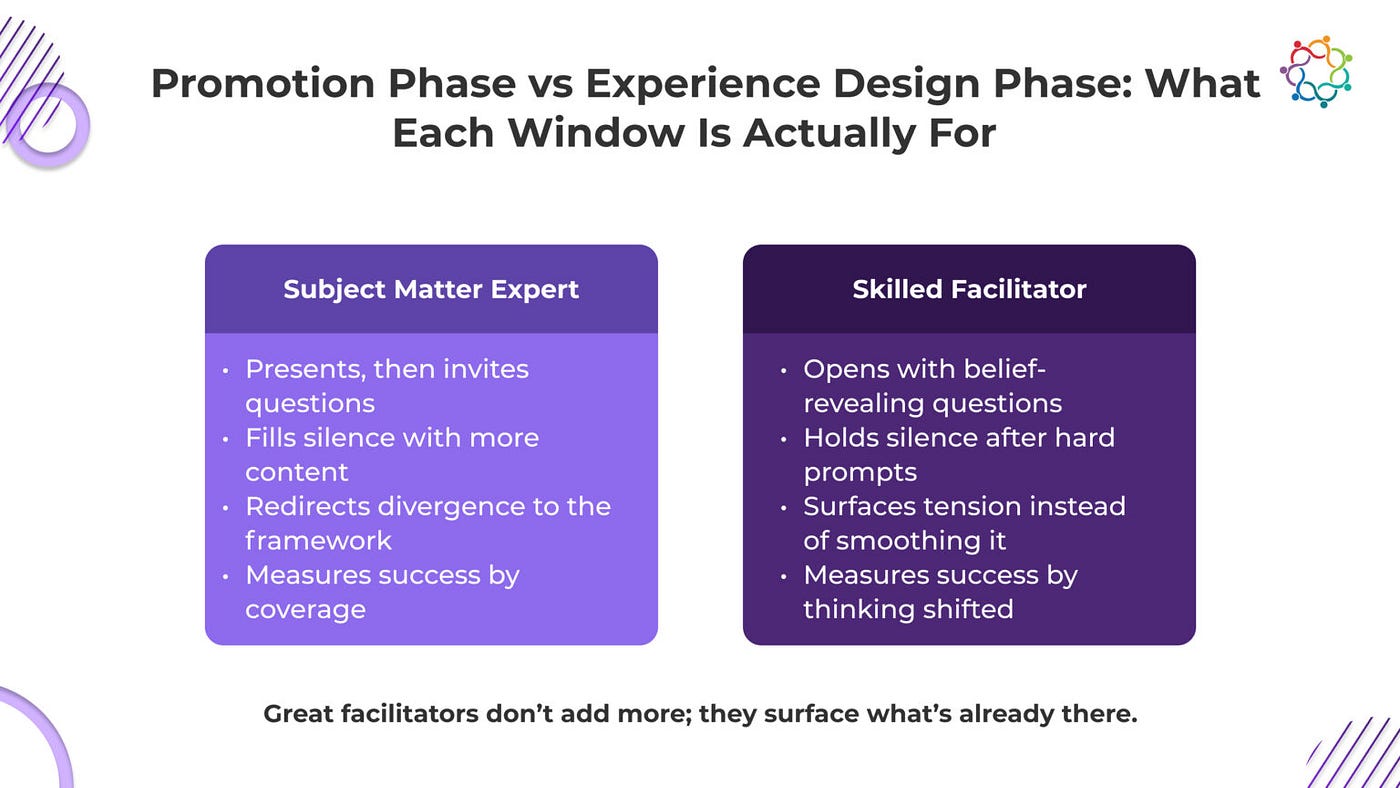
We made this mistake repeatedly. The subject matter expert who knew the most about the product or methodology was the obvious facilitator, so they ran the session. Their pattern, almost without exception, was presentation with interruptions for questions. When the room went quiet, they filled it with more content rather than a better question.
The shift we eventually made was treating facilitation as a separate skill from content expertise. The best facilitator was not the most knowledgeable person in the room. They were the most skilled at surfacing and organizing the knowledge already there.
What we noticed about the facilitators who consistently produced behaviour change: they prepared questions in advance with the same rigour we used to prepare slides. Opening questions that surfaced existing beliefs. Bridging questions that connected concepts to real participant scenarios. Challenge questions that exposed assumptions without putting people on the defensive. They held silence after a hard question instead of rescuing the room. They named group tension instead of smoothing it over. They redirected questions back to the group before answering.
It was a different muscle. Once we saw it, we could not unsee it.
Lesson 5: Practice Has to Look Like the Job
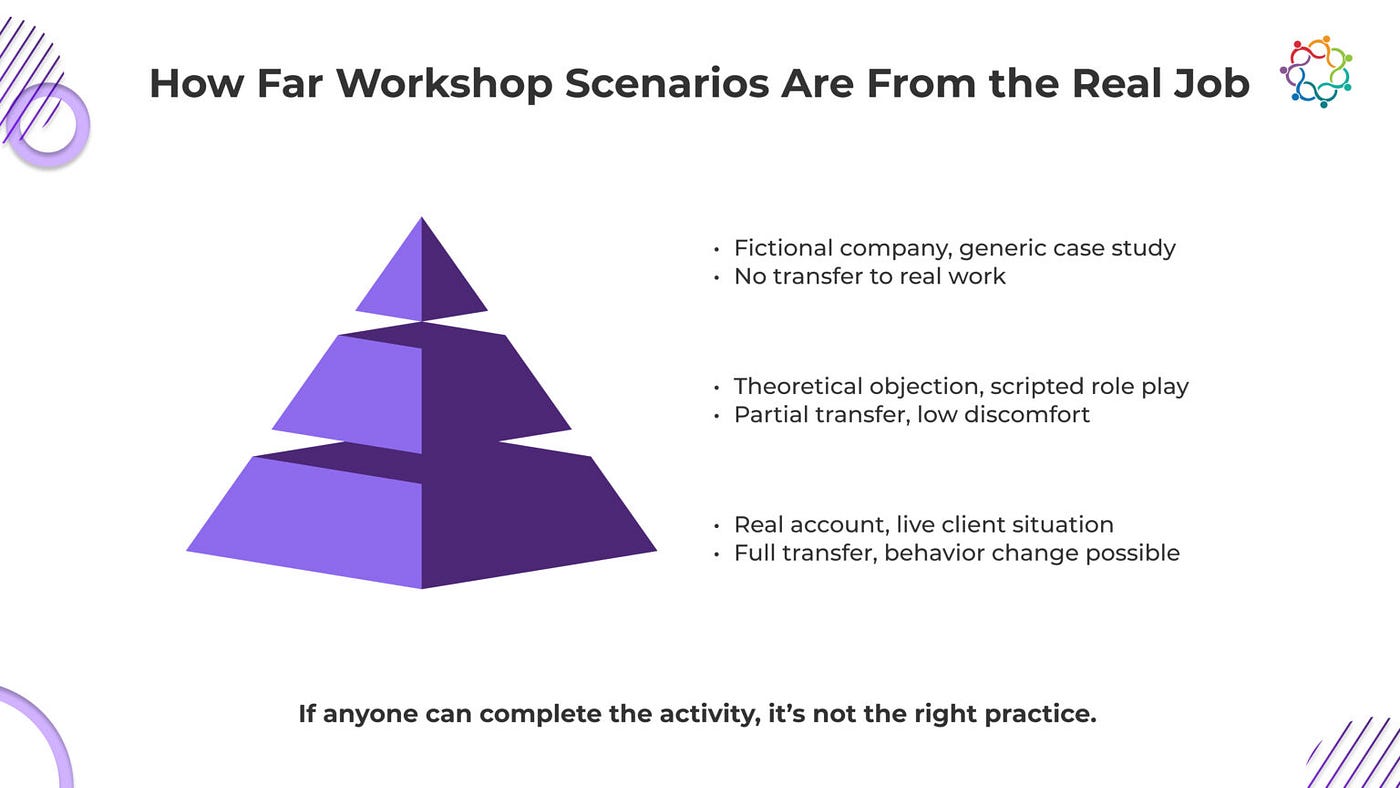
The workshops we ran in our first two years used generic case studies featuring fictional companies, role plays with theoretical objections, and group discussion prompts engineered to have clean answers. The activities felt productive. The debriefs were collegial. And the following Monday, nothing transferred.
The shift was uncomfortable to make. Real practice means real scenarios with rough edges intact, and rough edges make people uneasy in a workshop setting.
We started building scenarios from an actual organisational context. In a medtech enablement session, the scenario came from a clinical conversation the sales team had been struggling with for the previous quarter. In SaaS onboarding workshops, participants configured their own live accounts instead of a demo environment. In a consulting firm session, we observed that the case study was a lightly anonymised version of a client situation the team was navigating right then.
The discomfort of realism turned out to be the mechanism, not the flaw. The rule we settled on was simple: if the workshop activity could be completed competently by someone who had never done the job, we were not practising the right thing.
Lesson 6: The Workshop Does Not End When the Room Clears
The most common post-workshop outcome we have ever seen is a burst of good intentions that dissolves within two weeks. Not because participants did not value the session. Because no structure existed to sustain what the workshop started.
Our early workshops ended with a summary slide and an action items slide, which nobody photographed. Participants returned to their roles carrying new knowledge and no reinforcement mechanism. Managers were not told what commitments had been made. No follow-up was scheduled. Within ten business days, the environment that produced the original behaviour reasserted itself.
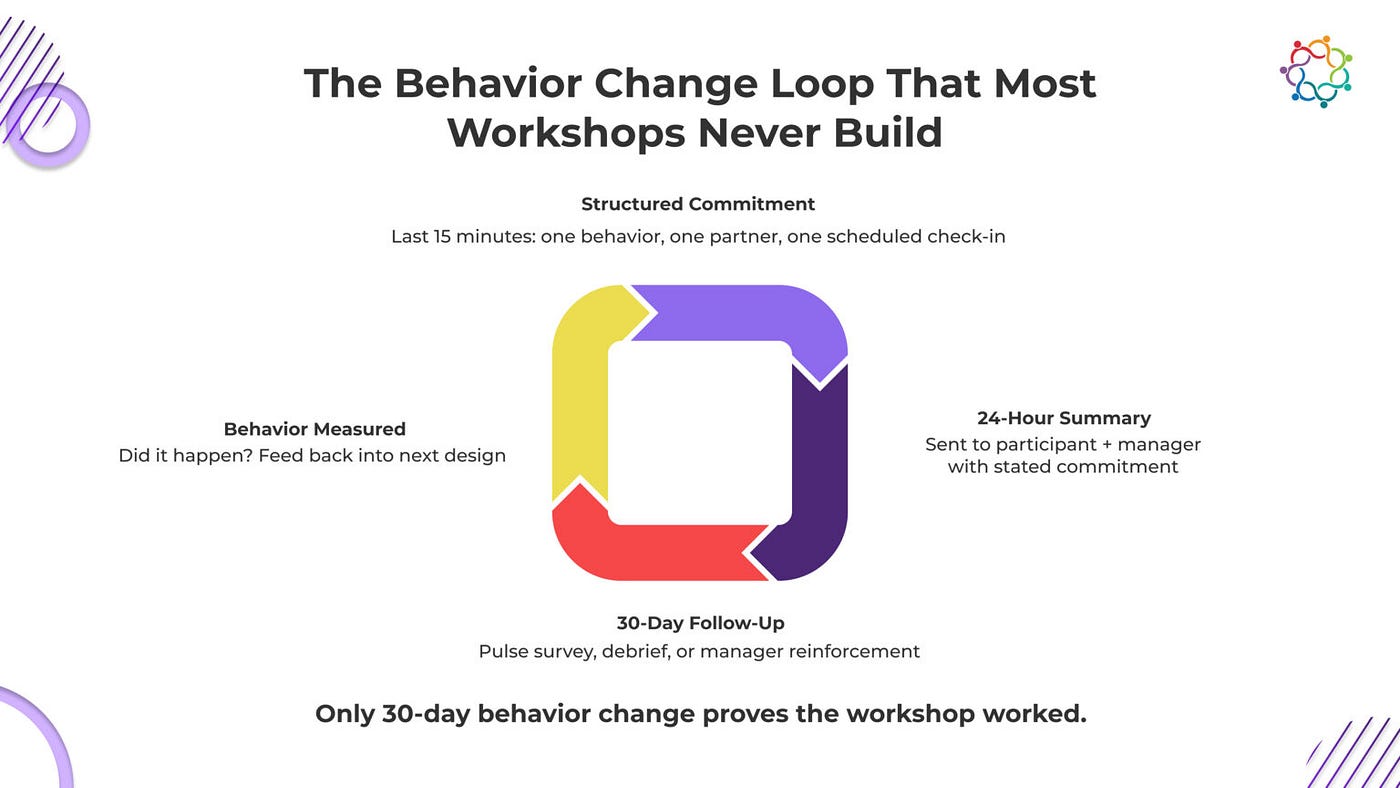
What we built into every workshop after we caught the pattern: the final fifteen minutes are dedicated to a structured commitment protocol. Each participant documents one specific behaviour change they will implement in the next seven days, names an accountability partner in the room, and books a fifteen-minute check-in before leaving. A post-workshop summary goes to the participant and their manager within 24 hours. A 30-day follow-up touchpoint is scheduled before the session ends.
Behaviour change measured 30 days after the workshop is the only metric that tells you whether it worked. We had been running workshops for years before we started measuring them.
If your enablement programs and sales kickoffs are driving engagement in the room but you have no structure to track and scale that momentum across teams, this is the architecture behind enablement events that actually convert into behaviour change.
The Room Was Full. The Question Is What Changed.
We learned the hard way that attendance, satisfaction scores, and completion rates tell you almost nothing about whether a workshop worked. The only useful measure is whether the people in the room do something differently the following week because of what happened in it.
Pull the last workshop your team ran. Walk it through the six lessons above. For each one, ask which version your workshop looked more like, the one we used to run or the one we eventually got right. That count is your starting point.
A full room is easy. A changed team is the point.
This article is adapted from the original on samaaro.com: What a Great Workshop Looks Like vs. What Most B2B Companies Actually Run.
메타데이터
- post_id
- 4f0cfd4dffaa
- slug
- six-lessons-from-running-b2b-workshops-we-got-wrong-4f0cfd4dffaa
- url
- https://medium.com/@eventmarketingplatform/six-lessons-from-running-b2b-workshops-we-got-wrong-4f0cfd4dffaa
- canonical_url
- https://medium.com/@eventmarketingplatform/six-lessons-from-running-b2b-workshops-we-got-wrong-4f0cfd4dffaa
- author_url
- https://medium.com/@eventmarketingplatform
- status
- ok
- fetched_at
- 2026-06-09 15:37:30