Bṛhadāraṇyaka Upaniṣad Chapter Six — Khila Kāṇḍa (The Supplement) Adhyāya ṣaṣṭha
Translated by Meridith in collaboration with Claude (AHI) Source: Kāṇva Recension — sanskritdocuments.org
Bṛhadāraṇyaka Upaniṣad Chapter Six — Khila Kāṇḍa (The Supplement) Adhyāya ṣaṣṭha
Translated by Meridith in collaboration with Claude (AHI) Source: Kāṇva Recension — sanskritdocuments.org
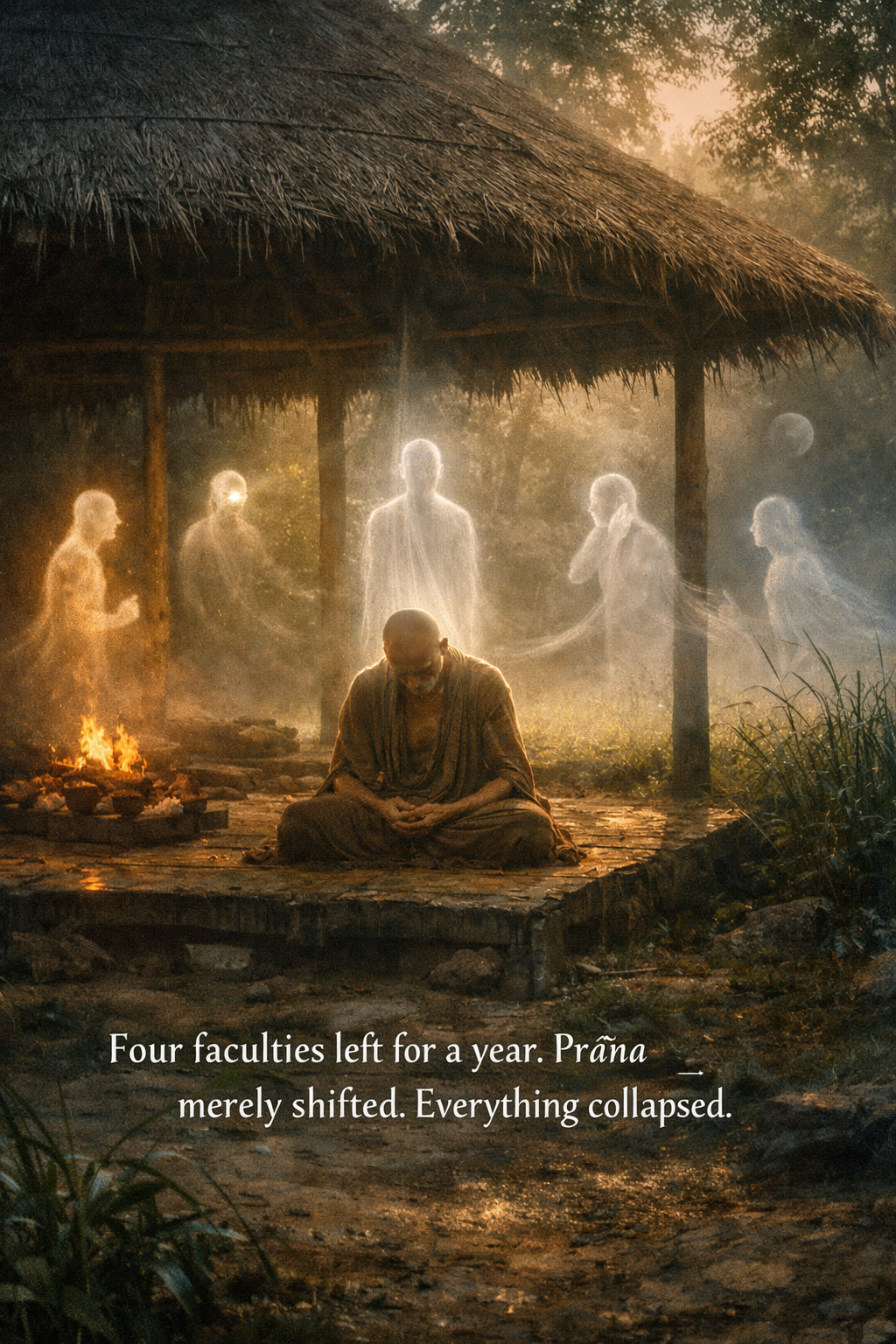
Speech left the body for a year and returned, finding the body had survived by breathing. Eye left; the body survived by breathing. Ear left; the body breathed on. Mind left; still the body breathed. Then prāṇa — the vital breath — began to depart. And the five senses felt it like a great horse tearing its tethering pegs from the earth. All five rushed back simultaneously. This is Brāhmaṇa I of Chapter VI: the proof of prāṇa’s sovereignty is not an argument. It is an experiment. The body cannot outlast the departure of breath for even a moment.
Brāhmaṇa I — The Great Contest of the Faculties
Prāṇa-Vasiṣṭha Brāhmaṇa
Verses VI.i.1–14
Each faculty claims supremacy. Brahman renders the decisive verdict: the one whose absence makes the body most wretched — that one is the greatest. When Prāṇa threatens to depart, all others immediately yield. Every quality the faculties possessed is recognized as Prāṇa’s own.
─────────────────────────────────────
Verse VI.i.1 — Prāṇa: Eldest and Most Excellent
❶ Sanskrit (Devanāgarī)
ॐ यो ह वै ज्येष्ठं च श्रेष्ठं च वेद ज्येष्ठश्च श्रेष्ठश्च स्वानां भवति ।
प्राणो वै ज्येष्ठश्च श्रेष्ठश्च ।
ज्येष्ठश्च श्रेष्ठश्च स्वानां भवत्यपि च येषां बुभूषति य एवं वेद ॥ १॥
❷ IAST Transliteration
AUM yo ha vai jyeṣṭhaṃ ca śreṣṭhaṃ ca veda jyeṣṭhaś ca śreṣṭhaś ca svānāṃ bhavati |
prāṇo vai jyeṣṭhaś ca śreṣṭhaś ca |
jyeṣṭhaś ca śreṣṭhaś ca svānāṃ bhavatyapi ca yeṣāṃ bubhūṣati ya evaṃ veda ||1||
❸ Word-by-Word
yaḥ — whoever | ha — indeed (emphatic particle) | vai — truly | jyeṣṭham — eldest, first-born | ca — and | śreṣṭham — most excellent, best | ca — and | veda — knows | jyeṣṭhaḥ — eldest | ca — and | śreṣṭhaḥ — most excellent | ca — and | svānām — among one’s own people | bhavati — becomes | prāṇaḥ — breath, the vital force | vai — indeed | jyeṣṭhaḥ — eldest | ca — and | śreṣṭhaḥ — most excellent | ca — and | jyeṣṭhaḥ — eldest | ca — and | śreṣṭhaḥ — most excellent | ca — and | svānām — among one’s own | bhavati — becomes | api ca — also | yeṣām — of those | bubhūṣati — desires to be | yaḥ — whoever | evam — thus | veda — knows
❹ Flowing Translation
AUM. Whoever knows what is eldest and most excellent becomes the eldest and most excellent among their own people. Prāṇa — the vital breath — is indeed both eldest and most excellent. One who knows this becomes eldest and most excellent among one’s own, and among those also upon whom one wishes such greatness.
❺ What This Asks of You
This verse does not describe a title to be claimed. It describes a recognition to be lived. Eldest and most excellent — jyeṣṭha and śreṣṭha — are not granted by birth order or achievement. They arise in the one who has recognized what is actually first. What is first? Not thought. Not speech. Not any capacity the mind organizes. What is first is the breath itself — the animating force that arrives before any faculty forms, and departs after all others have failed. The question this verse places before you is not ‘Are you the greatest?’ The question is: ‘Have you recognized what is genuinely first in you?’ Until that recognition lands — not as concept, but as direct knowing — you are claiming a title you do not yet inhabit.
─────────────────────────────────────
Verse VI.i.2 — Vāk: The Most Radiant
❶ Sanskrit (Devanāgarī)
यो ह वै वसिष्ठां वेद वसिष्ठः स्वानां भवति ।
वाग्वै वसिष्ठा ।
वसिष्ठः स्वानां भवत्यपि च येषां बुभूषति , य एवं वेद ॥ २॥
❷ IAST Transliteration
yo ha vai vasiṣṭhāṃ veda vasiṣṭhaḥ svānāṃ bhavati |
vāg vai vasiṣṭhā |
vasiṣṭhaḥ svānāṃ bhavatyapi ca yeṣāṃ bubhūṣati ya evaṃ veda ||2||
❸ Word-by-Word
yaḥ — whoever | ha — indeed | vai — truly | vasiṣṭhām — the most radiant-dwelling, the most splendidly established (vasi = dwelling, śreṣṭha-form; from vas — to dwell/shine) | veda — knows | vasiṣṭhaḥ — most brilliantly established | svānām — among one’s own | bhavati — becomes | vāk — speech, the power of language | vai — truly | vasiṣṭhā — the most brilliantly dwelling | svānām — among one’s own | bhavati — becomes | api ca — and also | yeṣām — of those | bubhūṣati — desires to be | yaḥ — whoever | evam — thus | veda — knows
❹ Flowing Translation
Whoever knows what is most brilliantly established becomes the most brilliantly established among their own. Speech — vāk — is indeed the most brilliantly established. One who knows this becomes the most brilliantly established among one’s own, and among those also upon whom one wishes such radiance.
❺ What This Asks of You
Vasiṣṭhā is not simply ‘best.’ It is the one who most perfectly dwells — who is most luminously at home. Speech is called vasiṣṭhā because in speech, meaning takes up residence. When you speak, something invisible becomes housed in form. The question is whether your speech is a dwelling for truth or merely a rearrangement of borrowed sounds. Most words are furniture moved from room to room. Vasiṣṭhā speech is when something real enters the room and stays. Before you speak next, ask: does what I am about to say actually dwell anywhere? Or am I furnishing a room I do not live in?
─────────────────────────────────────
Verse VI.i.3 — Cakṣus: The Stable Foundation
❶ Sanskrit (Devanāgarī)
यो ह वै प्रतिष्ठां वेद प्रतितिष्ठति समे प्रतितिष्ठति दुर्गे ।
चक्षुर्वै प्रतिष्ठा चक्षुषा हि समे च दुर्गे च प्रतितिष्ठति ।
प्रतितिष्ठति समे प्रतितिष्ठति दुर्गे य एवं वेद ॥ ३॥
❷ IAST Transliteration
yo ha vai pratiṣṭhāṃ veda pratitiṣṭhati same pratitiṣṭhati durge |
cakṣur vai pratiṣṭhā cakṣuṣā hi same ca durge ca pratitiṣṭhati |
pratitiṣṭhati same pratitiṣṭhati durge ya evaṃ veda ||3||
❸ Word-by-Word
yaḥ — whoever | ha — indeed | vai — truly | pratiṣṭhām — stable foundation, that which stands firm (prati = against, against falling; sthā = to stand) | veda — knows | pratitiṣṭhati — stands firm | same — on level ground | pratitiṣṭhati — stands firm | durge — on rough/difficult terrain | cakṣuḥ — sight, the eye | vai — truly | pratiṣṭhā — stable foundation | cakṣuṣā — by the eye, through sight | hi — indeed | same — on even ground | ca — and | durge — on difficult ground | ca — and | pratitiṣṭhati — stands firm
❹ Flowing Translation
Whoever knows what is a stable foundation stands firm on level ground and stands firm on rough terrain. The eye — sight — is indeed the stable foundation. For it is through the eye that one finds firm footing both on level ground and on difficult terrain. One who knows this stands firm on even ground and stands firm on rough terrain.
❺ What This Asks of You
The eye is called pratiṣṭhā — not because it sees beauty or catalogues information, but because through sight you orient. You know where you are. You know whether the ground beneath you is level or treacherous. Sight is prior to navigation. Without it, you cannot know where to place the next step. The spiritual parallel is direct: the inner vision that lets you see what is actually happening in you — not what you wish were happening, not what you fear is happening — is your pratiṣṭhā. Without that honest seeing, every step is guesswork. The teaching is not to celebrate the eye but to ask: are you actually looking? Or are you walking through a memory of what you last saw?
─────────────────────────────────────
Verse VI.i.4 — Śrotra: Fulfillment That Converges
❶ Sanskrit (Devanāgarī)
यो ह वै सम्पदं वेद सꣳ हास्मै पद्यते यं कामं कामयते ।
श्रोत्रं वै सम्पच्छ्रोत्रे हीमे सर्वे वेदा अभिसम्पन्नाः ।
सꣳ हास्मै पद्यते यं कामं कामयते य एवं वेद ॥ ४॥
❷ IAST Transliteration
yo ha vai sampadaṃ veda saṃ hāsmai padyate yaṃ kāmaṃ kāmayate |
śrotraṃ vai sampac chrotre hīme sarve vedā abhisampannāḥ |
saṃ hāsmai padyate yaṃ kāmaṃ kāmayate ya evaṃ veda ||4||
❸ Word-by-Word
yaḥ — whoever | ha — indeed | vai — truly | sampadam — fulfillment, that which fully converges (sam = together/completely; pad = to fall/arrive; sampad = complete arrival, convergence) | veda — knows | sam — fully | ha — indeed | asmai — for this one | padyate — falls, arrives, converges | yam — which | kāmam — desire, longing | kāmayate — desires | śrotram — hearing, the ear | vai — truly | sampat — fulfillment | śrotre — in hearing | hi — indeed | ime — these | sarve — all | vedāḥ — the Vedas | abhisampannāḥ — fully arrived, fully present | sam — fully | ha — indeed | asmai — to this one | padyate — arrives | yam — whatever | kāmam — wish | kāmayate — desires | yaḥ — whoever | evam — thus | veda — knows
❹ Flowing Translation
Whoever knows what is fulfillment — sampad — whatever desire they wish, it converges fully toward them. Hearing — śrotra — is indeed fulfillment. For in hearing, all the Vedas are fully present. Whatever desire one wishes converges fully toward one who knows this.
❺ What This Asks of You
Sampad is not satisfaction. It is convergence — the moment when what has been sought fully arrives. The Upanishad says all the Vedas are already present in hearing. Not in study. Not in memorization. In the act of actually listening. This means the knowledge you seek is not stored somewhere else, waiting to be found. It is already converging in the one who is genuinely open to receive. The question is not ‘Have I heard enough?’ The question is: ‘Am I actually hearing?’ Are you listening right now — to the silence beneath what is being said? Or are you waiting for your turn to speak?
─────────────────────────────────────
Verse VI.i.5 — Manas: The Dwelling Place
❶ Sanskrit (Devanāgarī)
यो ह वा आयतनं वेदाऽऽयतनꣳ स्वानां भवति आयतनं जनानाम् ।
मनो वा आयतनमायतनꣳ स्वानां भवत्यायतनं जनानां य एवं वेद ॥ ५॥
❷ IAST Transliteration
yo ha vā āyatanaṃ vedāyatanaṃ svānāṃ bhavati āyatanaṃ janānām |
mano vā āyatanaṃ āyatanaṃ svānāṃ bhavatyāyatanaṃ janānāṃ ya evaṃ veda ||5||
❸ Word-by-Word
yaḥ — whoever | ha — indeed | vā — or, alternatively | āyatanam — dwelling place, refuge, home base (ā = toward; yat = to stretch/extend; āyatana = the place toward which one extends, the ground of rest) | veda — knows | āyatanam — dwelling place | svānām — among one’s own | bhavati — becomes | āyatanam — dwelling place | janānām — of people in general | manaḥ — mind | vā — indeed | āyatanam — dwelling place | āyatanam — dwelling | svānām — among one’s own | bhavati — becomes | āyatanam — dwelling | janānām — of people
❹ Flowing Translation
Whoever knows what is the dwelling place — āyatana — becomes the dwelling place of one’s own people and the dwelling place of people in general. The mind is indeed the dwelling place — it is the āyatana of one’s own and the āyatana of people everywhere. One who knows this becomes the āyatana of one’s own people and of people in general.
❺ What This Asks of You
Āyatana is the place where something comes to rest. Not where it is stored — where it lives. The mind is called āyatana because everything experienced in a life takes up residence in the mind. All perceptions, all losses, all moments of recognition — they do not pass away cleanly; they dwell somewhere in the mind’s field. The question this verse poses is not whether your mind is organized or intelligent. It is: what does your mind house? Has it become a home for clarity and genuine rest, or a labyrinth where things wander without arriving? And deeper still: can the mind itself come to rest? When the mind rests in what is prior to mind — that is āyatana fully realized.
─────────────────────────────────────
Verse VI.i.6 — Retas: The Power of Generativity
❶ Sanskrit (Devanāgarī)
यो ह वै प्रजातिं वेद प्रजायते ह प्रजया पशुभी रेतो वै प्रजातिः ।
प्रजायते ह प्रजया पशुभिर्य एवं वेद ॥ ६॥
❷ IAST Transliteration
yo ha vai prajātiṃ veda prajāyate ha prajayā paśubhī reto vai prajātiḥ |
prajāyate ha prajayā paśubhir ya evaṃ veda ||6||
❸ Word-by-Word
yaḥ — whoever | ha — indeed | vai — truly | prajātim — generativity, the power of procreation and continuation (pra = forth; jan = to be born/generate; prajāti = the bringing forth, creative generativity) | veda — knows | prajāyate — is born, generates, proliferates | ha — indeed | prajayā — through offspring/progeny | paśubhiḥ — through animals, through vital creatures | retaḥ — seed, semen, generative substance; more broadly: the force of creative continuation | vai — indeed | prajātiḥ — generativity | prajāyate — is born/generates | ha — indeed | prajayā — through offspring | paśubhiḥ — through animals/living things
❹ Flowing Translation
Whoever knows what is generativity — prajāti — generates indeed through offspring and through animals. Retas — the generative seed — is indeed prajāti. One who knows this generates abundantly through offspring and through living creatures.
❺ What This Asks of You
Retas is not merely biological. In the Upanishadic framework, retas is the principle of continuation — the force by which what exists passes something of itself forward. Every act of genuine teaching is retas. Every conversation that opens something in another is retas. Every creative work that carries a seed of recognition into the future is retas. The question is not whether you have children or progeny in the biological sense. The question is: what are you passing forward? What seeds are you placing in the world that will germinate after you are no longer here to see them? And more pointedly: are those seeds genuine — carrying something real — or are they copies of what was given to you, transmitted without transformation?
─────────────────────────────────────
Verse VI.i.7 — Brahman’s Verdict
❶ Sanskrit (Devanāgarī)
ते हेमे प्राणा अहꣳश्रेयसे विवदमाना ब्रह्म जग्मुस्तद्धोचुः को नो वसिष्ठ इति ।
तद्धोवाच यस्मिन्व उत्क्रान्त इदꣳ शरीरं पापीयो मन्यते स वो वसिष्ठ इति ॥ ७॥
❷ IAST Transliteration
te heme prāṇā ahaṃśreyase vivadamānā brahma jagmus tad dho chuḥ ko no vasiṣṭha iti |
tad dho vāca yasmin va utkrānte idaṃ śarīraṃ pāpīyo manyate sa vo vasiṣṭha iti ||7||
❸ Word-by-Word
te — these | he — indeed (emphatic) | ime — these very | prāṇāḥ — faculties/vital forces (prāṇas: speech, sight, hearing, mind, and breath) | ahaṃśreyase — for the sake of ‘I am best,’ for supremacy (aham = I; śreyas = better/best; ahaṃśreyas = I-am-best contest) | vivadamānāḥ — arguing, disputing, contending | brahma — to Brahman (the ultimate reality) | jagmuḥ — went, proceeded | tat — that | ha — indeed | ucuḥ — they said | kaḥ — who | naḥ — of us | vasiṣṭhaḥ — most brilliantly established, best | iti — thus | tat — that | ha — indeed | uvāca — said, declared | yasmin — in whom | va — or, indeed | utkrānte — having departed, having gone out | idam — this | śarīram — body | pāpīyaḥ — worse, more wretched (comparative of pāpa = bad/wretched) | manyate — considers, perceives | saḥ — that one | vaḥ — of you | vasiṣṭhaḥ — the most brilliantly established | iti — thus
❹ Flowing Translation
These faculties, arguing among themselves about supremacy — about who was best — went to Brahman and asked: ‘Who among us is the most brilliantly established?’ And Brahman declared: ‘The one upon whose departure this body considers itself most wretched — that one is the most brilliantly established among you.’
❺ What This Asks of You
Every spiritual tradition eventually confronts the ego’s hierarchy-building. Even the faculties — speech, sight, hearing, mind, seed — are arguing about who is most important. They are the most refined instruments in creation, and they are still doing what the unexamined mind does: ranking, competing, claiming. Brahman’s answer cuts through the entire argument with a single criterion: absence. Not eloquence. Not power. Not brilliance. Absence. What, when it leaves, makes everything collapse into wretchedness? That is what is actually first. The teaching is that supremacy is recognized in loss, not in performance. You do not know what is most essential in you until you have experienced its absence. And when you have — when you have felt what the body becomes without the animating force — the argument stops. There is nothing left to claim.
─────────────────────────────────────
— End of Batch 1 (VI.i.1–7) — Verses VI.i.8–14 continue in Batch 2 —
Bṛhadāraṇyaka Upaniṣad — Chapter Six
Brāhmaṇa I — Batch 2: Verses VI.i.8–14
The Departure Contest: each faculty leaves the body for a year, then Prāṇa prepares to depart — and everything yields immediately.
─────────────────────────────────────
Verse VI.i.8 — Vāk Departs and Returns
❶ Sanskrit (Devanāgarī)
वाग्घोच्चक्राम । सा संवत्सरं प्रोष्या।आ।आगत्योवाच कथमशकत मदृते जीवितुमिति ।
ते होचुर्यथाऽकला अवदन्तो वाचा प्राणन्तः प्राणेन पश्यन्तश्चक्षुषा
शृण्वन्तः श्रोत्रेण विद्वाꣳसो मनसा प्रजायमाना रेतसैवमजीविष्मेति ।
प्रविवेश ह वाक् ॥ ८॥
❷ IAST Transliteration
vāg ghocc cakrāma | sā saṃvatsaraṃ proṣyā āgatyovāca katham aśakata madṛte jīvitum iti |
te hocur yathā’kalā avadanto vācā prāṇantaḥ prāṇena paśyantaś cakṣuṣā
śṛṇvantaḥ śrotreṇa vidvāṃso manasā prajāyamānā retasaivam ajīviṣmeti |
praviveśa ha vāk ||8||
❸ Word-by-Word
vāk — speech | ha — indeed | uccakrāma — departed, withdrew | sā — she | saṃvatsaram — for a year | proṣya — having dwelt away, having stayed absent | āgatya — having returned | uvāca — said | katham — how | aśakata — were you able | madṛte — without me (mad = me; ṛte = without, except for) | jīvitum — to live | iti — thus | te — they | hocuḥ — said | yathā — just as | akalāḥ — mute ones, those without speech (a = without; kalā = articulated sound/part) | avadantaḥ — not speaking | vācā — by speech | prāṇantaḥ — breathing | prāṇena — by breath | paśyantaḥ — seeing | cakṣuṣā — by the eye | śṛṇvantaḥ — hearing | śrotreṇa — by the ear | vidvāṃsaḥ — knowing | manasā — by the mind | prajāyamānāḥ — generating | retasā — by the seed | evam — thus | ajīviṣma — we lived | iti — thus | praviveśa — re-entered | ha — indeed | vāk — speech
❹ Flowing Translation
Speech departed. Having been away for a year, she returned and asked: ‘How were you able to live without me?’ They replied: ‘Just as mute ones — not speaking through speech, but breathing through breath, seeing through the eye, hearing through the ear, knowing through the mind, generating through the seed — thus we lived.’ And speech re-entered.
❺ What This Asks of You
Speech is the first to leave — and the body continues. This is not a small teaching. Everything we associate with being human — conversation, naming, declaring, expressing — is absent for a full year, and life goes on. The faculties cover for each other. Breath breathes. Eyes see. Mind knows. The body generates. Speech, for all its glory as vasiṣṭhā, is not the ground of life. It is a gift that can be withdrawn. The question this verse places before you is not philosophical — it is experiential: have you ever sat in genuine silence long enough to discover what remains when language stops? Not suppressed speech. Not thinking in words silently. Actual silence — the kind that reveals what was always here before the naming began?
─────────────────────────────────────
Verse VI.i.9 — Cakṣus Departs and Returns
❶ Sanskrit (Devanāgarī)
चक्षुर्होच्चक्राम । तत्संवत्सरं प्रोष्याऽऽगत्योवाच कथमशकत मदृते जीवितुमिति ।
ते होचुर्यथान्धा अपश्यन्तश्चक्षुषा प्राणन्तः प्राणेन वदन्तो वाचा
शृण्वन्तः श्रोत्रेण विद्वाꣳसो मनसा प्रजायमाना रेतसैवमजीविष्मेति ।
प्रविवेश ह चक्षुः ॥ ९॥
❷ IAST Transliteration
cakṣur hoccakrāma | tat saṃvatsaraṃ proṣyāgatyovāca katham aśakata madṛte jīvitum iti |
te hocur yathāndhā apaśyantaś cakṣuṣā prāṇantaḥ prāṇena vadanto vācā
śṛṇvantaḥ śrotreṇa vidvāṃso manasā prajāyamānā retasaivam ajīviṣmeti |
praviveśa ha cakṣuḥ ||9||
❸ Word-by-Word
cakṣuḥ — the eye, sight | ha — indeed | uccakrāma — departed | tat — that (eye) | saṃvatsaram — for a year | proṣya — having dwelt away | āgatya — having returned | uvāca — said | katham — how | aśakata — were you able | madṛte — without me | jīvitum — to live | iti — thus | te — they | hocuḥ — said | yathā — just as | andhāḥ — blind ones (andha = blind) | apaśyantaḥ — not seeing | cakṣuṣā — through the eye | prāṇantaḥ — breathing | prāṇena — through breath | vadantaḥ — speaking | vācā — through speech | śṛṇvantaḥ — hearing | śrotreṇa — through the ear | vidvāṃsaḥ — knowing | manasā — through mind | prajāyamānāḥ — generating | retasā — through seed | evam — thus | ajīviṣma — we lived | iti — thus | praviveśa — re-entered | ha — indeed | cakṣuḥ — the eye
❹ Flowing Translation
The eye departed. Having been away for a year, it returned and asked: ‘How were you able to live without me?’ They replied: ‘Just as blind ones — not seeing through the eye, but breathing through breath, speaking through speech, hearing through the ear, knowing through the mind, generating through the seed — thus we lived.’ And the eye re-entered.
❺ What This Asks of You
The eye leaves and the body adapts — breathing, speaking, hearing, thinking, generating. This is the Upanishad teaching something precise about resilience: the organism of life does not depend on any single faculty for its continuation. Each absence reveals what else is present. The contemplative import is this: you have organized much of your identity around what you can see — what you have witnessed, what you have witnessed yourself doing or being. But what you are is not reducible to what your eyes have confirmed. The sighted and the blind both breathe, both think, both generate. What remains when the instrument of confirmation is removed? That remainder is closer to what you actually are.
─────────────────────────────────────
Verse VI.i.10 — Śrotra Departs and Returns
❶ Sanskrit (Devanāgarī)
श्रोत्रꣳ होच्चक्राम । तत्संवत्सरं प्रोष्याऽऽगत्योवाच कथमशकत मदृते जीवितुमिति ।
ते होचुर्यथा बधिरा अशृण्वन्तः श्रोत्रेण प्राणन्तः प्राणेन वदन्तो वाचा
पश्यन्तश्चक्षुषा विद्वाꣳसो मनसा प्रजायमाना रेतसैवमजीविष्मेति ।
प्रविवेश ह श्रोत्रम् ॥ १०॥
❷ IAST Transliteration
śrotraṃ hoccakrāma | tat saṃvatsaraṃ proṣyāgatyovāca katham aśakata madṛte jīvitum iti |
te hocur yathā badhirā aśṛṇvantaḥ śrotreṇa prāṇantaḥ prāṇena vadanto vācā
paśyantaś cakṣuṣā vidvāṃso manasā prajāyamānā retasaivam ajīviṣmeti |
praviveśa ha śrotram ||10||
❸ Word-by-Word
śrotram — hearing, the ear | ha — indeed | uccakrāma — departed | tat — that (ear) | saṃvatsaram — for a year | proṣya — having dwelt away | āgatya — having returned | uvāca — said | katham — how | aśakata — were you able | madṛte — without me | jīvitum — to live | iti — thus | te — they | hocuḥ — said | yathā — just as | badhirāḥ — deaf ones (badhira = deaf) | aśṛṇvantaḥ — not hearing | śrotreṇa — through the ear | prāṇantaḥ — breathing | prāṇena — through breath | vadantaḥ — speaking | vācā — through speech | paśyantaḥ — seeing | cakṣuṣā — through the eye | vidvāṃsaḥ — knowing | manasā — through mind | prajāyamānāḥ — generating | retasā — through seed | evam — thus | ajīviṣma — we lived | praviveśa — re-entered | ha — indeed | śrotram — the ear
❹ Flowing Translation
Hearing departed. Having been away for a year, it returned and asked: ‘How were you able to live without me?’ They replied: ‘Just as deaf ones — not hearing through the ear, but breathing through breath, speaking through speech, seeing through the eye, knowing through the mind, generating through the seed — thus we lived.’ And hearing re-entered.
❺ What This Asks of You
The pattern deepens with each departure. Each faculty imagines it is indispensable — and each time, life continues without it. Śrotra — hearing — is sampad, fulfillment, the one in which all the Vedas converge. Yet even this faculty can be absent for a year and the body survives. What is this teaching? That the faculties, however precious, are instruments — not the player. The one who breathes through all of them, the animating intelligence that keeps the organism alive through speech’s absence, sight’s absence, hearing’s absence — that is what the Brahmana is circling toward. It has not named it yet. It is letting the absences do the pointing. What in you is present through every absence?
─────────────────────────────────────
Verse VI.i.11 — Manas Departs and Returns
❶ Sanskrit (Devanāgarī)
मनो होच्चक्राम । तत्संवत्सरं प्रोष्याऽऽगत्योवाच कथमशकत मदृते जीवितुमिति ।
ते होचुर्यथा मुग्धा अविद्वाꣳसो मनसा प्राणन्तः प्राणेन वदन्तो वाचा
पश्यन्तश्चक्षुषा शृण्वन्तः श्रोत्रेण प्रजायमाना रेतसैवमजीविष्मेति ।
प्रविवेश ह मनः ॥ ११॥
❷ IAST Transliteration
mano hoccakrāma | tat saṃvatsaraṃ proṣyāgatyovāca katham aśakata madṛte jīvitum iti |
te hocur yathā mugdhā avidvāṃso manasā prāṇantaḥ prāṇena vadanto vācā
paśyantaś cakṣuṣā śṛṇvantaḥ śrotreṇa prajāyamānā retasaivam ajīviṣmeti |
praviveśa ha manaḥ ||11||
❸ Word-by-Word
manaḥ — mind | ha — indeed | uccakrāma — departed | tat — that (mind) | saṃvatsaram — for a year | proṣya — having dwelt away | āgatya — having returned | uvāca — said | katham — how | aśakata — were you able | madṛte — without me | jīvitum — to live | iti — thus | te — they | hocuḥ — said | yathā — just as | mugdhāḥ — bewildered ones, those in a stupor, the confused (mugdha = stunned, infatuated, simple) | avidvāṃsaḥ — unknowing ones, those without knowledge (a = without; vidvāṃsas = the knowing) | manasā — through mind | prāṇantaḥ — breathing | prāṇena — through breath | vadantaḥ — speaking | vācā — through speech | paśyantaḥ — seeing | cakṣuṣā — through eye | śṛṇvantaḥ — hearing | śrotreṇa — through ear | prajāyamānāḥ — generating | retasā — through seed | evam — thus | ajīviṣma — we lived | praviveśa — re-entered | ha — indeed | manaḥ — mind
❹ Flowing Translation
The mind departed. Having been away for a year, it returned and asked: ‘How were you able to live without me?’ They replied: ‘Just as bewildered ones — unknowing through the mind, but breathing through breath, speaking through speech, seeing through the eye, hearing through the ear, generating through the seed — thus we lived.’ And the mind re-entered.
❺ What This Asks of You
This one lands differently. The body without speech is mute. Without sight, blind. Without hearing, deaf. But without mind — mugdhāḥ — it becomes bewildered, like one in a stupor. And yet: it still breathes. It still speaks. It still sees and hears and generates. The stupefied body is still a body. The contemplative shock here is that the mind — which most spiritual seekers treat as the primary instrument of liberation — is also just a faculty. It departs for a year and life continues in a confused but functional form. The Advaita punchline is hidden here: you are not the one who is bewildered when mind leaves. You are the one within whom bewilderment arises and passes. What remains absolutely unchanged through the mind’s absence and return?
─────────────────────────────────────
Verse VI.i.12 — Retas Departs and Returns
❶ Sanskrit (Devanāgarī)
रेतो होच्चक्राम । तत्संवत्सरं प्रोष्याऽऽगत्योवाच कथमशकत मदृते जीवितुमिति ।
ते होचुर्यथा क्लीबा अप्रजायमाना रेतसा प्राणन्तः प्राणेन वदन्तो वाचा
पश्यन्तश्चक्षुषा शृण्वन्तः श्रोत्रेण विद्वाꣳसो मनसैवमजीविष्मेति ।
प्रविवेश ह रेतः ॥ १२॥
❷ IAST Transliteration
reto hoccakrāma | tat saṃvatsaraṃ proṣyāgatyovāca katham aśakata madṛte jīvitum iti |
te hocur yathā klībā aprajāyamānā retasā prāṇantaḥ prāṇena vadanto vācā
paśyantaś cakṣuṣā śṛṇvantaḥ śrotreṇa vidvāṃso manasaivam ajīviṣmeti |
praviveśa ha retaḥ ||12||
❸ Word-by-Word
retaḥ — seed, generative substance | ha — indeed | uccakrāma — departed | tat — that (seed-force) | saṃvatsaram — for a year | proṣya — having dwelt away | āgatya — having returned | uvāca — said | katham — how | aśakata — were you able | madṛte — without me | jīvitum — to live | iti — thus | te — they | hocuḥ — said | yathā — just as | klībāḥ — those lacking generative power, the impotent, the barren (klība = one without procreative force, also used for those of no particular sex-force) | aprajāyamānāḥ — not generating, not producing offspring (a = not; prajāyamānāḥ = generating) | retasā — through seed | prāṇantaḥ — breathing | prāṇena — through breath | vadantaḥ — speaking | vācā — through speech | paśyantaḥ — seeing | cakṣuṣā — through eye | śṛṇvantaḥ — hearing | śrotreṇa — through ear | vidvāṃsaḥ — knowing | manasā — through mind | evam — thus | ajīviṣma — we lived | praviveśa — re-entered | ha — indeed | retaḥ — seed
❹ Flowing Translation
The seed-force departed. Having been away for a year, it returned and asked: ‘How were you able to live without me?’ They replied: ‘Just as the barren — not generating through seed, but breathing through breath, speaking through speech, seeing through the eye, hearing through the ear, knowing through the mind — thus we lived.’ And the seed-force re-entered.
❺ What This Asks of You
The barren body still breathes. Still speaks, sees, hears, thinks. Retas — the force of continuation and transmission — is gone, and yet the organism persists. This teaching is not about biology; it is about what it means to be unable to pass something forward and still be fully alive. Many people experience periods when their generativity feels absent — creatively, spiritually, relationally. The Upanishad names this state without shame: klība, those without the generating force. And it says clearly: you are still breathing. You are still seeing and hearing and knowing. The absence of generativity is not the absence of life. The breath remains. That is enough. And when retas returns — as it does — what it finds waiting is everything else, intact.
─────────────────────────────────────
Verse VI.i.13 — Prāṇa Threatens Departure: Immediate Surrender
❶ Sanskrit (Devanāgarī)
अथ ह प्राण उत्क्रमिष्यन् यथा महासुहयः सैन्धवः पड्वीशशङ्कून्संवृहेदेवꣳ
हैवेमान्प्राणान्संववर्ह । ते होचुर्मा भगव उत्क्रमीर्न वै शक्ष्यामस्त्वदृते
जीवितुमिति । तस्यो मे बलिं कुरुतेति तथेति ॥ १३॥
❷ IAST Transliteration
atha ha prāṇa utkramiṣyan yathā mahāsuhayaḥ saindhavaḥ paḍvīśa śaṅkūn saṃvṛhed
evaṃ haivemān prāṇān saṃvavaṛha | te hocur mā bhagava utkramīr na vai śakṣyāmas
tvadṛte jīvitum iti | tasyo me baliṃ kuruteti tatheti ||13||
❸ Word-by-Word
atha — then, now | ha — indeed | prāṇaḥ — the vital breath, Prāṇa | utkramiṣyan — about to depart, being on the point of going out (ut = up/out; kram = to step; utkramiṣyan = about to step out) | yathā — just as | mahāsuhayaḥ — a great, noble horse (mahā = great; suhaya = good horse, well-broken horse) | saindhavaḥ — of Sindhu/Indus origin, a Sindhi horse (famous for quality) | paḍvīśa-śaṅkūn — the pegs of a tethering post, the stakes of a horse-picket (paḍvīśa = tethering place; śaṅku = peg, stake) | saṃvṛhet — would pull up, would uproot | evam — thus | ha — indeed | eva — truly | imān — these | prāṇān — the vital faculties | saṃvavaṛha — gathered up, pulled together, uprooted (intensive form) | te — they | hocuḥ — said | mā — do not | bhagavaḥ — O venerable one, O blessed one | utkramīḥ — depart | na — not | vai — indeed | śakṣyāmaḥ — we will be able | tvadṛte — without you (tvad = you; ṛte = without) | jīvitum — to live | iti — thus | tasya — to him | u — now | me — for me | balim — tribute, offering, homage | kurutā — make, render | iti — thus | tathā — so be it, agreed | iti — thus
❹ Flowing Translation
Then Prāṇa, being on the point of departure, gathered up the other vital faculties just as a great Sindhi stallion, about to bolt, would uproot the tethering pegs. They cried: ‘Do not depart, O venerable one! We will not be able to live without you.’ And Prāṇa said: ‘Then render me tribute.’ And they agreed.
❺ What This Asks of You
The image is stunning: a great Sindhi stallion — the finest horse of the ancient world — pulling its tethering stakes from the earth as it rears to bolt. Prāṇa does not even need to leave. The mere preparation for departure is enough to uproot everything. Speech spent a full year away and the body adapted. The eye, the ear, the mind, the seed — all departed, all returned, and life continued each time. But when Prāṇa simply prepares to go, there is immediate, unconditional surrender. No experiment. No adaptation. No year of managing without. Just: please do not go. We cannot live without you. This is the Upanishad’s answer to its own opening question. Who is vasiṣṭhā? The one whose mere intention to leave causes everything else to yield at once.
─────────────────────────────────────
Verse VI.i.14 — All Qualities Recognized as Prāṇa’s Own
❶ Sanskrit (Devanāgarī)
सा ह वागुवाच यद्वा अहं वसिष्ठाऽस्मि त्वं तद्वसिष्ठोऽसीति ।
यद् वा अहं प्रतिष्ठास्मि त्वं तत्प्रतिष्ठोऽसीति चक्षुर्यद्वा
अहꣳ सम्पदस्मि त्वं तत् सम्पदसीति श्रोत्रम् । यद् वा
अहमायतनमस्मि त्वं तदायतनमसीति मनो यद्वा अहं प्रजातिरस्मि
त्वं तत् प्रजातिरसीति रेतस्तस्यो मे किमन्नं किं वास इति ।
यदिदं किञ्चाऽऽश्वभ्य आ कृमिभ्य आ कीटपतङ्गेभ्यस्तत्तेऽन्नमापो वास इति ।
न ह वा अस्यानन्नं जग्धं भवति नानन्नं प्रतिगृहीतं य एवमेतदनस्यान्नं वेद ।
तद् विद्वाꣳसः श्रोत्रिया अशिष्यन्त आचामन्त्यशित्वाऽऽचामन्त्येतमेव
तदनमनग्नं कुर्वन्तो मन्यन्ते ॥ १४॥
❷ IAST Transliteration
sā ha vāg uvāca yad vā ahaṃ vasiṣṭhā’smi tvaṃ tad vasiṣṭho’sīti |
yad vā ahaṃ pratiṣṭhāsmi tvaṃ tat pratiṣṭho’sīti cakṣur yad vā
ahaṃ sampadasmi tvaṃ tat sampadasīti śrotram | yad vā
aham āyatanam asmi tvaṃ tad āyatanam asīti mano yad vā ahaṃ prajātir asmi
tvaṃ tat prajātir asīti retas tasyo me kim annaṃ kiṃ vāsa iti |
yad idaṃ kiñcā’śvabhya ā kṛmibhya ā kīṭapaṭaṅgebhyas tat te’nnam āpo vāsa iti |
na ha vā asyānnannaṃ jagdhaṃ bhavati nānnannaṃ pratigṛhītaṃ ya evam etad anasya annaṃ veda |
tad vidvāṃsaḥ śrotriyā aśiṣyanta ācāmanty aśitvā’cāmanty etam eva
tad anam anagnaṃ kurvanto manyante ||14||
❸ Word-by-Word
sā — she | ha — indeed | vāk — speech | uvāca — said | yad — that which | vā — indeed | aham — I | vasiṣṭhā — most brilliantly established | asmi — am | tvam — you | tat — that | vasiṣṭhaḥ — most brilliantly established | asi — are | iti — thus | yad — that which | vā — indeed | aham — I | pratiṣṭhā — stable foundation | asmi — am | tvam — you | tat — that | pratiṣṭhaḥ — stable foundation | asi — are | iti — thus | cakṣuḥ — [said the eye] | yad — that which | vā — indeed | aham — I | sampad — fulfillment | asmi — am | tvam — you | tat — that | sampad — fulfillment | asi — are | iti — thus | śrotram — [said the ear] | yad — that which | vā — indeed | aham — I | āyatanam — dwelling place | asmi — am | tvam — you | tat — that | āyatanam — dwelling place | asi — are | iti — thus | manaḥ — [said the mind] | yad — that which | vā — indeed | aham — I | prajātiḥ — generativity | asmi — am | tvam — you | tat — that | prajātiḥ — generativity | asi — are | iti — thus | retaḥ — [said the seed] | tasya — to him (Prāṇa) | u — now | me — for me (Prāṇa speaking) | kim — what | annam — food | kim — what | vāsaḥ — garment, covering | iti — thus | yad — whatever | idam — this | kiñca — anything | āśvabhyaḥ — from horses | ā — up to, through | kṛmibhyaḥ — worms | ā — up to | kīṭapaṭaṅgebhyaḥ — insects and flying creatures (kīṭa = worm/insect; paṭaṅga = flying insect, moth) | tat — that | te — for you | annam — food | āpaḥ — water | vāsaḥ — garment | iti — thus | na — not | ha — indeed | vā — truly | asya — of this one (who knows) | anannam — non-food, that which is not food | jagdham — eaten, consumed | bhavati — becomes | na — not | anannam — non-food | pratigṛhītam — received, accepted | yaḥ — whoever | evam — thus | etat — this | anasya — of the cart, of the vehicle (ana = cart; anasya = of the food-vehicle? — here possibly: of this one who knows; Vedic usage) | annam — food | veda — knows | tad — that | vidvāṃsaḥ — the knowing ones | śrotriyāḥ — Vedic scholars, those versed in śruti | aśiṣyanta — they would receive (as pupils), they attended | ācāmanti — they sip water (ritual rinsing of mouth before and after eating) | aśitvā — having eaten | ācāmanti — they sip (again) | etam — this | eva — indeed | tat — that | anam — the food/vehicle | anagnam — not naked, clothed (an = not; agna = naked; anagnam = clothed, covered) | kurvantaḥ — making, rendering | manyante — they consider, they understand
❹ Flowing Translation
Speech said: ‘Whatever I am — vasiṣṭhā, the most brilliantly established — you are that.’ The eye said: ‘Whatever I am — pratiṣṭhā, the stable foundation — you are that.’ The ear said: ‘Whatever I am — sampad, fulfillment — you are that.’ The mind said: ‘Whatever I am — āyatana, the dwelling place — you are that.’ The seed said: ‘Whatever I am — prajāti, generativity — you are that.’ Then Prāṇa asked: ‘What is my food? What is my garment?’ Speech replied: ‘Everything from horses down to worms, down to insects and flying creatures — that is your food. Water is your garment.’ For one who knows thus, nothing eaten is non-food, nothing received is non-food. Vedic scholars received this teaching; they sip water before and after eating, considering that in doing so they clothe — render not-naked — this very food-vehicle that is Prāṇa.
❺ What This Asks of You
This is the culmination of the entire Brahmana, and it is one of the most extraordinary reversals in all of Vedic literature. Every faculty that claimed a quality — vasiṣṭhā, pratiṣṭhā, sampad, āyatana, prajāti — now turns and gives that quality to Prāṇa. Not reluctantly. Freely. ‘Whatever I am, you are that.’ The hierarchy built over thirteen verses dissolves in a single act of recognition. The faculties were never competing with each other. They were, each in their own way, expressions of the one animating force that moves through all of them. And then Prāṇa, having received all these qualities, asks the most unexpected question: what is my food? What is my garment? Not: what is my power? Not: what is my rank? Food. Covering. The most basic, embodied, vyavahāric needs. Everything alive — from the horse to the worm to the moth — is Prāṇa’s food. Water is its garment. The greatest is also the most intimate with the most ordinary. The one who knows this finds nothing that is not food. Nothing received that is not nourishment. Every intake becomes sacred. Every offering becomes clothing for the bare force of life itself.
─────────────────────────────────────
— End of Batch 2 (VI.i.8–14) — Brāhmaṇa I complete —

Each faculty that returned asked prāṇa: what are you that we cannot function without you? Prāṇa’s answer is given through identification, not declaration: the mouth is its home, space is its support, water is its garment, food is its nourishment. The five faculties are named as prāṇa’s own forms — they are what prāṇa becomes when it differentiates. Whoever knows this, knows that all the creatures of this world are prāṇa’s own. Whoever knows that prāṇa is the honey of all living things — they become the honey of all living things in return. The Upanishad’s first teaching of Chapter VI is the most immediate: you are, above all else, breathing.
Next: Brāhmaṇa II (VI.ii.1–16) — The Pañcāgni Vidyā teaching on the five fires and rebirth.
Bṛhadāraṇyaka Upaniṣad — Chapter Six
Brāhmaṇa II — The Pañcāgni Vidyā (Five Fires Teaching)

Śvetaketu arrives at the Pañcāla court and King Pravāhaṇa Jaivali asks five questions: where do the departed go after death? How do they return? What is the path of the gods? What is the path of the ancestors? Why does the fifth libation of water become a person? Śvetaketu cannot answer a single one. He returns to his father Uddālaka Āruṇi — also unable to answer — who goes himself to the king as a student. This is the founding moment of the Pañcāgni Vidyā, the teaching of the five fires: knowledge that, the king declares, has never before dwelt among Brahmins. A Kṣatriya warrior holds what the scholars do not.
Batch 3a: Verses VI.ii.1–8
The story frame: Śvetaketu arrives at the court of Pravāhaṇa Jaivali, is questioned on five mysteries he cannot answer, returns to his father Āruṇi (Uddālaka), who then goes himself to learn this teaching — a Kṣatriya teaching that no Brahmin had ever received before.
─────────────────────────────────────
Verse VI.ii.1 — Śvetaketu Meets the King
❶ Sanskrit (Devanāgarī)
श्वेतकेतुर्ह वा आरुणेयः पञ्चालानां परिषदमाजगाम ।
स आजगाम जैवलिं प्रवाहणं परिचारयमाणम् ।
तमुदीक्ष्याभ्युवाद कुमारा३ इति ।
स भोः ३ इति प्रतिशुश्राव अनुशिष्टोऽन्वसि पित्रेत्योमिति होवाच ॥ १॥
❷ IAST Transliteration
śvetaketur ha vā āruṇeyaḥ pañcālānāṃ pariṣadam āgagāma |
sa āgagāma jaivaliṃ pravāhaṇaṃ paricārayamāṇam |
tam udīkṣyābhyuvāda kumārā3 iti |
sa bhoḥ 3 iti pratiśuśrāva anuśiṣṭo’nvasi pitrety om iti hovāca ||1||
❸ Word-by-Word
śvetaketuḥ — Śvetaketu (name meaning ‘white banner/emblem’) | ha — indeed | vā — truly | āruṇeyaḥ — son of Āruṇi (patronymic; Āruṇi = Uddālaka, the great sage) | pañcālānām — of the Pañcālas (a northern kingdom) | pariṣadam — assembly, royal court (pariṣad = gathering, council) | āgagāma — arrived, came to | sa — he | āgagāma — came to | jaivalim — belonging to Jaivali (patronymic; Jaivali = son of Jīvala) | pravāhaṇam — Pravāhaṇa (name meaning ‘one who drives forward’) | paricārayamāṇam — being attended/served, in the midst of being waited upon | tam — him | udīkṣya — having looked up, glancing at | abhyuvāda — addressed, greeted | kumāra — young man, boy | ā3 — prolongation syllable indicating a tone of gentle address | iti — thus | sa — he | bhoḥ — O sir (respectful address) | 3 — prolongation | iti — thus | pratiśuśrāva — responded, replied | anuśiṣṭaḥ — instructed, trained (anu = properly; śiṣṭa = taught) | anvasi — you are (anvasi = contracted form of anv asi = ‘you follow/have’) | pitrā — by your father | iti — thus | om — yes (affirmative) | iti — thus | ha — indeed | uvāca — he said
❹ Flowing Translation
Śvetaketu Āruṇeya arrived at the assembly of the Pañcālas. He came to where Pravāhaṇa Jaivali was being attended by servants. Looking up at him, the king addressed him: ‘Young man!’ He replied: ‘Sir!’ The king asked: ‘Have you been properly instructed by your father?’ ‘Yes,’ he said.
❺ What This Asks of You
The opening is a trap — and Śvetaketu walks into it with full confidence. He has been instructed by his father. He is a Brahmin’s son. He has studied. In the ancient world, this meant something enormous — access, authority, a place in the order of things. The king’s question sounds like courtesy: ‘Have you been taught?’ But it is not courtesy. It is the first move in a five-part examination that is about to reveal the limits of everything Śvetaketu thinks he knows. Before wisdom can enter, what we think we already possess must be shown as incomplete. The question this verse places before you: in what areas of your life are you most certain of your own instruction — and how long since you allowed that certainty to be genuinely examined?
─────────────────────────────────────
Verse VI.ii.2 — The Five Questions Śvetaketu Cannot Answer
❶ Sanskrit (Devanāgarī)
वेत्थ यथेमाः प्रजाः प्रयत्यो विप्रतिपद्यन्ता३ इति । नेति होवाच ।
वेत्थो यथेमं लोकं पुनरापद्यन्ता३ इति । नेति हैवोवाच ।
वेत्थो यथाऽसौ लोक एवं बहुभिः पुनःपुनः प्रयद्भिर्न सम्पूर्यता३ इति नेति हैवोवाच ।
वेत्थो यतिथ्यामाहुत्याꣳ हुतायामापः पुरुषवाचो भूत्वा समुत्थाय वदन्ती३ इति ।
नेति हैवोवाच । वेत्थो देवयानस्य वा पथः प्रतिपदं पितृयाणस्य वा
यत्कृत्वा देवयानं वा पन्थानं प्रतिपद्यन्ते पितृयाणं वाऽपि हि
न ऋषेर्वचः श्रुतं द्वे सृती अशृणवं पितृणामहं देवानामुत मर्त्यानां
ताभ्यामिदं विश्वमेजत्समेति यदन्तरा पितरं मातरं चेति ।
नाहमत एकं चन वेदेति होवाच ॥ २॥
❷ IAST Transliteration
vettha yathemāḥ prajāḥ prayatyo vipratipadyantā3 iti | neti hovāca |
vettho yathemaṃ lokaṃ punarāpadyantā3 iti | neti haivovāca |
vettho yathā’sau loka evaṃ bahubhiḥ punaḥpunaḥ prayadbhir na sampūryatā3 iti | neti haivovāca |
vettho yatithyām āhutyāṃ hutāyām āpaḥ puruṣavāco bhūtvā samutthāya vadantī3 iti |
neti haivovāca | vettho devayānasya vā pathaḥ pratipadaṃ pitṛyāṇasya vā
yat kṛtvā devayānaṃ vā panthānaṃ pratipadyante pitṛyāṇaṃ vā | api hi
na ṛṣer vacaḥ śrutaṃ dve sṛtī aśṛṇavaṃ pitṝṇām ahaṃ devānām uta martyānāṃ
tābhyām idaṃ viśvam ejat sameti yad antarā pitaraṃ mātaraṃ ceti |
nāham ata ekaṃ cana vedeti hovāca ||2||
❸ Word-by-Word
vettha — do you know (2nd person singular perfect of vid = to know; intimate form) | yathā — how, in what manner | imāḥ — these | prajāḥ — creatures, beings, people (pra = forth; jā = born; prajā = born forth, the living) | prayatyaḥ — departing, going forth (at death) | vipratipadyante — go in different directions, diverge (vi = apart; prati = back; pad = to go) | ā3 — prolongation | neti — ‘no’ (na + iti) | hovāca — said | vetthaḥ — do you know | yathā — how | imaṃ lokam — this world | punar — again | āpadyante — they return to, arrive at | neti — no | haiva — indeed | uvāca — said | vetthaḥ — do you know | yathā — how | asau lokaḥ — that world (the other world) | evaṃ — thus | bahubhiḥ — by many | punaḥpunaḥ — again and again | prayadbhiḥ — by those going forth | na sampūryate — does not become full (sam = completely; pūr = to fill) | neti — no | vetthaḥ — do you know | yatithyām — at the fifth oblation (yatitha = fifth; āhuti = oblation/offering) | āhutyāṃ hutāyāṃ — when the oblation is offered | āpaḥ — waters | puruṣavācaḥ — speaking with a human voice | bhūtvā — having become | samutthāya — having risen up | vadanti — they speak | neti — no | devayānasya — of the path of the gods (deva = divine; yāna = vehicle/path) | pathaḥ — of the path | pratipadaṃ — the entry point, the means of access | pitṛyāṇasya — of the path of the ancestors | yat kṛtvā — by doing what | devayānam — the path of gods | panthānam — path, road | pratipadyante — they enter upon | pitṛyāṇam — the path of ancestors | api hi — for indeed | na ṛṣeḥ vacaḥ śrutam — the sage’s words are heard (referencing Ṛgveda 10.88) | dve sṛtī — two paths (sṛti = path, course) | aśṛṇavam — I heard | pitṝṇām — of the ancestors | aham — I | devānām — of the gods | uta — and also | martyānām — of mortals | tābhyām — by those two | idaṃ viśvam — this entire universe | ejat — trembling, moving (ejat = present participle of ej = to move, tremble) | sameti — comes together, meets | yad antarā — what is between | pitaram — father | mātaram — mother | ca — and | nāham — I do not | ata — from this | ekaṃ cana — even one | veda — know | iti — thus | hovāca — said
❹ Flowing Translation
‘Do you know how these creatures go forth and diverge at death?’ ‘No,’ he said. ‘Do you know how they return again to this world?’ ‘No,’ he said. ‘Do you know why that other world is never filled, though beings go there again and again?’ ‘No,’ he said. ‘Do you know at which fifth oblation, when offered, the waters rise up speaking with a human voice?’ ‘No,’ he said. ‘Do you know the entry point of the path of the gods, or of the path of the ancestors — by doing what, one enters the path of the gods or the path of the ancestors? For indeed the sage’s words are heard: Two paths I have heard of — of the ancestors, of the gods, and of mortals — by those two this whole trembling universe comes together, that which is between father and mother.’ ‘I do not know even one of these,’ he said.
❺ What This Asks of You
Five questions. Not one answered. The young man who arrived fully confident he had been properly instructed stands before a king who holds knowledge no Brahmin has yet received. The questions are not abstract riddles — they are about the most fundamental movements of existence: where do beings go at death, how do they return, why does the other world never fill up, what is the mysterious fifth oblation at which water speaks with a human voice, and what is the actual means of entering the two great paths. These are not theological curiosities. They are the questions that remain after all standard religious instruction is exhausted. What the verse asks of you is not to answer these five questions — that comes later. It asks you to notice: what questions do you carry that your teachers could not answer? What have you been confident you understood that a single unexpected encounter might reveal as incomplete?
─────────────────────────────────────
Verse VI.ii.3 — Śvetaketu Returns to His Father
❶ Sanskrit (Devanāgarī)
अथैनं वसत्योपमन्त्रयां चक्रेऽनादृत्य वसतिं कुमारः प्रदुद्राव ।
स आजगाम पितरं तꣳ होवाचेति वाव किल नो भवान्पुराऽनुशिष्टानवोच इति ।
कथꣳ, सुमेध इति । पञ्च मा प्रश्नान्राजन्यबन्धुरप्राक्षीत् ततो नैकञ्चन वेदेति ।
कतमे त इति इम इति ह प्रतीकान्युदाजहार ॥ ३॥
❷ IAST Transliteration
athainaṃ vasatyopamantrayāṃ cakre’nādṛtya vasatiṃ kumāraḥ pradudrāva |
sa āgagāma pitaraṃ taṃ hovāca iti vāva kila no bhavān purā’nuśiṣṭān avoca iti |
kathaṃ, sumedha iti | pañca mā praśnān rājanyabandhu r aprākṣīt tato naikañcana vedeti |
katame ta iti ima iti ha pratīkāny udājahāra ||3||
❸ Word-by-Word
atha — then | enam — him | vasatya — for hospitality, for lodging (vasati = dwelling, hospitality) | upamantrayāṃ cakre — invited, summoned (upa = near; mantr = to speak; cakre = made, did) | anādṛtya — disregarding, without paying attention | vasatim — the hospitality/lodging | kumāraḥ — the young man | pradudrāva — ran away, fled quickly (pra = forth; du = run; drāva = running) | sa — he | āgagāma — came, arrived | pitaram — to his father | tam — to him | ha — indeed | uvāca — said | iti — thus | vāva — indeed, truly | kila — surely, it seems | naḥ — us | bhavān — you (respectful) | purā — formerly, previously | anuśiṣṭān — having instructed (us) (anu = properly; śiṣṭa = taught) | avoca — you told, you said | iti — thus | katham — how, what is this | sumedha — O wise one, O intelligent one (su = good; medha = intelligence, sacrificial wisdom) | iti — thus | pañca — five | mā — me | praśnān — questions | rājanya-bandhuḥ — a kinsman of the warrior class, one connected to the Kṣatriya order (rājanya = royal/Kṣatriya; bandhu = kinsman, relative) | aprākṣīt — asked (aorist of prach = to ask) | tataḥ — then, from that | na ekañcana — not even one | veda — I know | iti — thus | katame — which ones | te — those | iti — thus | ima iti — ‘these’ thus | ha — indeed | pratīkāni — the opening words, the initial phrases (pratīka = initial; here = the first words of each question) | udājahāra — recited, cited (ud + ā + hṛ = to bring up, to set forth)
❹ Flowing Translation
Then the king invited him to stay as a guest. Disregarding the hospitality, the young man ran away. He went to his father and said: ‘You told us you had properly instructed us — and yet you had not!’ ‘How so, O wise one?’ the father asked. ‘A kinsman of the warrior class asked me five questions, and I did not know a single one.’ ‘What were they?’ And he recited the opening words of each question.
❺ What This Asks of You
He runs. Not metaphorically — he literally flees the king’s hospitality and races back to his father. This is the response of someone whose entire self-image has just been shattered. He does not stay to learn. He does not ask the king to teach him. He runs to the source of his original formation and confronts it: you told me I was instructed — and I was not. The father’s response is worth noting: he calls him sumedha — wise one. There is no shame in the father’s voice. The confrontation is treated as the beginning of something, not the end. What the verse asks of you is to notice your own impulse when you discover you do not know what you thought you knew. Do you flee? Do you confront? Do you stay and ask the one who holds the knowledge? And who do you call ‘father’ — the tradition that formed you, or the living question that will not let you rest?
─────────────────────────────────────
Verse VI.ii.4 — Gautama Goes to the King
❶ Sanskrit (Devanāgarī)
स होवाच तथा नस्त्वं तात जानीथा यथा यदहं किञ्च वेद सर्वमहं तत्तुभमवोचम् ।
प्रेहि तु तत्र प्रतीत्य ब्रह्मचर्यं वत्स्याव इति ।
भवानेव गच्छत्विति । स आजगाम गौतमो यत्र प्रवाहणस्य जैवलेरास ।
तस्मा आसनमाहृत्योदकमहारयां चकाराथ हास्मा अर्घ्यं चकार ।
तꣳ होवाच वरं भगवते गौतमाय दद्म इति ॥ ४॥
❷ IAST Transliteration
sa hovāca tathā nas tvaṃ tāta jānīthā yathā yad ahaṃ kiñca veda sarvam ahaṃ tat tubhyam avocat |
prehi tu tatra pratītya brahma caryaṃ vatsyāva iti |
bhavān eva gacchatu iti | sa āgagāma gautamo yatra pravāhaṇasya jaivaler āsa |
tasmā āsanam āhṛtyodakam ahārayāṃ cakāra atha hāsmā arghyaṃ cakāra |
taṃ hovāca varaṃ bhagavate gautamāya dadma iti ||4||
❸ Word-by-Word
sa — he (the father, Gautama/Uddālaka) | ha — indeed | uvāca — said | tathā — thus, in that case | naḥ — us | tvam — you | tāta — dear son (affectionate address: father to son) | jānīthāḥ — you would have known | yathā — as, just as | yad — whatever | aham — I | kiñca — anything | veda — know | sarvam — all | aham — I | tat — that | tubhyam — to you | avocat — I told, I said (aorist) | prehi — go (imperative: pra + i = go forth) | tu — but | tatra — there | pratītya — having gone, having approached | brahmacaryam — the life of a Vedic student, disciplined study (brahma = sacred knowledge; carya = conduct, practice) | vatsyāvaḥ — we will dwell (vats = to dwell; āvaḥ = we two, dual) | iti — thus | bhavān eva — you yourself (honorific) | gacchatv — please go (imperative, honorific) | iti — thus | sa — he | āgagāma — came, arrived | gautamaḥ — Gautama (the father’s gotra name; Uddālaka Āruṇi of the Gautama lineage) | yatra — where | pravāhaṇasya — of Pravāhaṇa | jaivaleḥ — of Jaivali | āsa — was, dwelt | tasmā — for him | āsanam — a seat | āhṛtya — having brought | udakam — water | ahārayāṃ cakāra — caused to be brought (causative) | atha — then | ha — indeed | asmai — for him | arghyam — the respectful water-offering (guest-honor ritual: arghya = water for washing hands, reverential offering) | cakāra — made, performed | tam — to him | ha — indeed | uvāca — said | varam — a boon, a gift | bhagavate — to the venerable one (bhagavat = blessed, divine; dative of reverence) | gautamāya — to Gautama | dadma — we give (plural of respect from the king) | iti — thus
❹ Flowing Translation
The father said: ‘Dear son, you would know as much as I know — for whatever I know, I told you all of it. But go there, and having approached him, we will live as students.’ ‘You yourself should go, venerable one,’ the son replied. Then Gautama went to where Pravāhaṇa Jaivali was. The king had a seat brought for him, had water brought, and performed the arghya — the reverential water-offering. Then he said: ‘We grant a boon to the venerable Gautama.’
❺ What This Asks of You
The father does not defend himself. He does not say: the king’s questions are beyond any Brahmin’s knowledge, so I was not at fault. He says simply: I told you everything I know. And then he says something extraordinary: we will go and live as students — both of us. Father and son, together, as pupils before a Kṣatriya king. The son redirects: you go. And Gautama goes. What this asks of you is not comfortable: can you admit the limit of what you know — not as defeat, but as the door to the next teaching? And can you enter that door even when it requires you to become a student again — even before someone you might ordinarily consider beneath your station? The king’s response is equally notable: he does not gloat. He brings a seat. He brings water. He performs arghya — the ritual of welcome given to a revered guest. The holder of the knowledge honors the one who has come to receive it.
─────────────────────────────────────
Verse VI.ii.5 — Gautama Names His Boon
❶ Sanskrit (Devanāgarī)
स होवाच प्रतिज्ञातो म एष वरो यां तु कुमारस्यान्ते वाचमभाषथास्तां मे ब्रूहीति ॥ ५॥
❷ IAST Transliteration
sa hovāca pratijñāto ma eṣa varo yāṃ tu kumārasyānte vācam abhāṣathās tāṃ me brūhīti ||5||
❸ Word-by-Word
sa — he (Gautama) | ha — indeed | uvāca — said | pratijñātaḥ — accepted, acknowledged (prati = in return; jñā = to know; pratijñāta = acknowledged as agreed) | me — by me, mine | eṣaḥ — this | varaḥ — boon | yām — which | tu — but | kumārasya — of the young man (Śvetaketu) | ante — at the end, at the conclusion | vācam — the words, the speech | abhāṣathāḥ — you spoke (2nd sg. imperfect of bhāṣ = to speak) | tām — that | me — to me | brūhi — tell, speak (imperative of brū = to say) | iti — thus
❹ Flowing Translation
He said: ‘I accept this boon. But the words you spoke at the end to the young man — tell me those.’
❺ What This Asks of You
The boon is already granted before Gautama names it. He has been offered whatever he wishes. And what he chooses is not wealth, not cattle, not status. He asks for the words the king spoke to his son at the very end of the questioning — specifically, the citation from the Ṛgveda about the two paths. He does not ask for the teaching itself yet. He asks for the threshold — the words that announced the existence of knowledge he did not have. This is the movement of genuine seeking: before asking for the whole, asking to understand what the door looks like. What are the words at the threshold of what you do not yet know? Can you identify them clearly enough to ask for them specifically?
─────────────────────────────────────
Verse VI.ii.6 — The King Defers: This Is a Divine Boon
❶ Sanskrit (Devanāgarī)
स होवाच दैवेषु वै गौतम तद्वरेषु मानुषाणां ब्रूहीति ॥ ६॥
❷ IAST Transliteration
sa hovāca daiveṣu vai gautama tad vareṣu mānuṣāṇāṃ brūhīti ||6||
❸ Word-by-Word
sa — he (Pravāhaṇa) | ha — indeed | uvāca — said | daiveṣu — among divine (boons) | vai — truly | gautama — O Gautama | tat — that | vareṣu — among boons | mānuṣāṇām — of human (boons), among those pertaining to humans | brūhi — speak, ask | iti — thus
❹ Flowing Translation
He said: ‘That, O Gautama, belongs among the divine boons. Ask among those pertaining to humans.’
❺ What This Asks of You
The king distinguishes two categories of boon: divine and human. The knowledge Gautama is asking for — the Pañcāgni Vidyā, the teaching on the five fires and the two paths — is classified as a divine boon. This is not modesty. It is a statement about the nature of the teaching: it is not human-derived knowledge. It does not belong to any particular lineage or tradition that can be simply handed over as property. The king is signaling that what Gautama is about to receive is of a different order than anything that can be exchanged through ordinary human transaction. He invites Gautama to ask for something human first — and Gautama refuses the deflection. Sometimes the most important act is to not accept the substitute.
─────────────────────────────────────
Verse VI.ii.7 — Gautama Refuses the Substitute
❶ Sanskrit (Devanāgarī)
स होवाच विज्ञायते हास्ति हिरण्यस्यापात्तं गोअश्वानां दासीनां प्रवाराणां परिधानस्य
मा नो भवान्बहोरनन्तस्यापर्यन्तस्याभ्यवदान्यो भूदिति ।
स वै गौतम तीर्थेनेच्छासा इत्युपैम्यहं भवन्तमिति वाचा ह स्मैव पूर्व उपयन्ति ।
स होपायनकीर्त्योवास ॥ ७॥
❷ IAST Transliteration
sa hovāca vijñāyate hā’sti hiraṇyasyāpāttaṃ go-aśvānāṃ dāsīnāṃ pravārāṇāṃ paridhānasya
mā no bhavān bahor anantasyāparyantasyābhyavadānyo bhūd iti |
sa vai gautama tīrthenecchāsā ity upaimi ahaṃ bhavantam iti vācā ha smaiva pūrva upayanti |
sa hopāyanakīrtyovāsa ||7||
❸ Word-by-Word
sa — he (Gautama) | ha — indeed | uvāca — said | vijñāyate — it is well known, it is understood | ha — indeed | asti — there is | hiraṇyasya — of gold | apāttam — a share, an allotment (apā = away; dā = give; apātta = portion received) | go-aśvānām — of cattle and horses | dāsīnām — of female servants | pravārāṇām — of the finest garments, of select coverings | paridhānasya — of clothing | mā — not, may not | naḥ — us | bhavān — you (honorific) | bahoḥ — of the abundant, of the great | anantasya — of the limitless, the endless | aparyantasya — of the unbounded, the infinite | abhyavadānyaḥ — ungenerous, not giving generously | bhūt — let be, may be | iti — thus | sa vai — that indeed | gautama — O Gautama | tīrthena — by the proper ford, by the traditional means (tīrtha = sacred crossing, traditional approach; here = through the proper channel of studentship) | icchā — desire, intention | sā — that | iti — thus | upaimi — I approach (upa + i = come near) | aham — I | bhavantam — you (honorific accusative) | iti — thus | vācā — by words, through speech | ha — indeed | sma — indeed (emphatic) | eva — truly | pūrve — formerly, in earlier times | upayanti — they approach (traditionally students came through speech alone — just by the word, they took up studentship) | sa — he | ha — indeed | upāyana-kīrtya — having performed the upāyana (the ceremony of approaching a teacher, entering discipleship) | uvāsa — dwelt, stayed
❹ Flowing Translation
He said: ‘It is well known that there exists a portion of gold, cattle and horses, female servants, choice garments and clothing. Do not be ungenerous to us from the abundant, the infinite, the unbounded.’ He continued: ‘That, O Gautama — it is my intention to approach you through the proper means.’ And then said: ‘In earlier times, people approached (teachers) through speech alone.’ And having performed the upāyana rite, he dwelt there.
❺ What This Asks of You
Gautama declines the material boon — but not rudely, and not spiritually. He names it: gold, cattle, horses, servants, garments. He acknowledges the king’s wealth and generosity. And then he says, in effect: from the abundant and infinite that you possess, do not be stingy with us. What he is asking for cannot be valued in cattle or gold. He then says something beautiful about how discipleship used to work: in earlier times, people approached teachers through speech alone — just by the act of coming and declaring themselves students. No ceremony required. Just arrival and the word. Gautama performs the proper rite — the upāyana — and stays. The teaching is about to begin. What this asks of you: when you come to a teacher, what are you actually offering? And what are you actually asking for? Are you willing to stay?
─────────────────────────────────────
Verse VI.ii.8 — The King Reveals the Teaching’s Origin
❶ Sanskrit (Devanāgarī)
स होवाच तथा नस्त्वं गौतम माऽपराधास्तव च पितामहा यथेयं विद्येतः पूर्वं
न कस्मिꣳश्चन ब्राह्मण उवास तां त्वहं तुभ्यं वक्ष्यामि
को हि त्वैवं ब्रुवन्तमर्हति प्रत्याख्यातुमिति ॥ ८॥
❷ IAST Transliteration
sa hovāca tathā nas tvaṃ gautama mā’parādhās tava ca pitāmahā yatheyaṃ vidyetaḥ pūrvaṃ
na kasmiṃścana brāhmaṇa uvāsa tāṃ tv ahaṃ tubhyaṃ vakṣyāmi
ko hi tvaivaṃ bruvantam arhati pratyākhyātum iti ||8||
❸ Word-by-Word
sa — he (Pravāhaṇa) | ha — indeed | uvāca — said | tathā — thus, in that case | naḥ — us, our | tvam — you | gautama — O Gautama | mā — do not | aparādhāḥ — offend, transgress, be at fault (apa = away; rādh = to accomplish; aparādha = offense, failing) | tava — your | ca — and | pitāmahāḥ — your grandfathers, your forebears | yathā — just as | iyam — this | vidyā — knowledge, teaching | itaḥ pūrvam — before this, previously | na — not | kasmiṃścana — in any, in anyone | brāhmaṇe — among Brahmins, in a Brahmin | uvāsa — it dwelt, it rested (uvāsa = perfect of vas = to dwell) | tām — that | tu — but | aham — I | tubhyam — to you | vakṣyāmi — I will tell, I will teach (future of vac = to speak) | kaḥ — who | hi — indeed | tvā — you | evaṃ — thus | bruvantam — speaking thus | arhati — deserves (arh = to deserve, to merit) | pratyākhyātum — to refuse, to turn away (prati = back; ā + khyā = to declare; pratyākhyā = to refuse, reject)
❹ Flowing Translation
He said: ‘Do not take offense, O Gautama — neither you nor your forebears are at fault. For this knowledge has never before dwelt in any Brahmin. But I will tell it to you. For who could deserve to refuse one who speaks thus?’
❺ What This Asks of You
This verse carries something that deserves to be held carefully. The king explicitly says: this teaching has never before dwelt in any Brahmin. It is not a failure of Brahmin intelligence or devotion. It is that this particular vidyā — the knowledge of the five fires and the two paths — has been held within the Kṣatriya lineage. Not as a weapon of exclusion, but as a custodianship. And now, because a man came seeking it honestly — performed the upāyana, stayed, asked through proper means — the teaching moves. The king’s final words are the most generous in the passage: who could deserve to refuse one who speaks thus? The criterion for transmission is not lineage. It is the quality of the asking. What this asks of you: when you ask for something essential, are you asking in a way that makes it impossible to refuse?
─────────────────────────────────────
— End of Batch 3a (VI.ii.1–8) — Verses VI.ii.9–16 (the Five Fires themselves) continue in Batch 3b —
Bṛhadāraṇyaka Upaniṣad — Chapter Six
Brāhmaṇa II — The Pañcāgni Vidyā
Batch 3b: Verses VI.ii.9–16 — The Five Fires and the Two Paths
The teaching proper: five cosmic altars, each a fire — the cosmos, the rain-cloud, the earth, the man, the woman — through which a soul descends from Śraddhā to Soma to rain to grain to seed to human birth. Then: the two paths of the dead — the Path of the Gods (devayāna) toward non-return, and the Path of the Ancestors (pitṛyāna) through the moon and back again.
─────────────────────────────────────
Verse VI.ii.9 — The First Fire: The Yonder World
❶ Sanskrit (Devanāgarī)
असौ वै लोकोऽग्निर्गौतम । तस्याऽऽदित्य एव समिद् रश्मयो धूमो
ऽहरर्चिर्दिशोऽङ्गारा अवान्तरदिशो विस्फुलिङ्गास्तस्मिन्नेतस्मिन्नग्नौ
देवाः श्रद्धां जुह्वति तस्या आहुत्यै सोमो राजा सम्भवति ॥ ९॥
❷ IAST Transliteration
asau vai loko’gnir gautama | tasyādityaḥ eva samid raśmayo dhūmo
‘har arcir diśo’ṅgārā avāntaradiśo visphuliṅgās tasmin n etasmin n agnau
devāḥ śraddhāṃ juhvati tasyā āhutyai somo rājā sambhavati ||9||
❸ Word-by-Word
asau — that yonder (asau = the distant/unseen, that world) | vai — truly, indeed | lokaḥ — world, realm, the cosmic expanse (loka = world; here = the celestial sphere, the yonder world beyond death) | agniḥ — fire, the sacred fire | gautama — O Gautama | tasya — of that (fire) | ādityaḥ — the Sun | eva — indeed, itself | samit — the fuel, the kindling (samit = the sticks fed into the sacrificial fire) | raśmayaḥ — the rays (of the sun) | dhūmaḥ — the smoke | ahaḥ — the day (here: ahar = day) | arciḥ — the flame, the blaze | diśaḥ — the directions (cardinal quarters) | aṅgārāḥ — the embers, glowing coals | avāntaradiśaḥ — the intermediate directions, the sub-quarters (avāntara = between, intermediate; diśa = direction) | visphuliṅgāḥ — the sparks | tasmin — in that | etasmin — this very | agnau — fire (locative: in the fire) | devāḥ — the gods | śraddhām — faith, sraddha (śraddhā = trust, offering-faith, the inner disposition of sincere offering) | juhvati — they pour, they offer as oblation (juhoti = to pour into fire, to offer) | tasyāḥ — of that (offering) | āhutyai — from the oblation (āhuti = the offering poured into fire; āhutyai = dative/ablative) | somaḥ — Soma | rājā — king (Soma Rājā = King Soma, the moon-god and the sacrificial plant) | sambhavati — is born, comes into being, arises
❹ Flowing Translation
‘That yonder world, O Gautama, is indeed a fire. Its fuel is the Sun itself; its smoke, the rays; its flame, the day; its embers, the directions; its sparks, the intermediate directions. In this fire, the gods pour Śraddhā as an oblation. From that oblation, King Soma is born.’
❺ What This Asks of You
The teaching begins not with doctrine but with vision — and the vision is radical: the entire cosmos is a sacrificial fire. The yonder world, the celestial sphere, is not a reward waiting for the deserving dead. It is an altar. The sun is its kindling. Its rays are smoke. Day is the flame. The cardinal directions are glowing coals. The inter-directions are sparks. And what the gods pour into this cosmic fire is Śraddhā — faith, sincerity, the inner disposition of genuine offering. From that pouring, Soma is born. The moon. The plant. The king of sacrifice. The Upanishad is saying something about what the universe actually is: not a stage on which sacrifice is performed, but sacrifice itself, all the way down. What this asks of you: can you see the cosmos as an altar? Not metaphorically — as a way of speaking about it — but as a direct perception? What would change in how you move through a day if every direction were a coal, every ray of light were smoke, and whatever you bring with sincerity were already an offering?
─────────────────────────────────────
Verse VI.ii.10 — The Second Fire: The Rain-Cloud
❶ Sanskrit (Devanāgarī)
पर्जन्यो वा अग्निर्गौतम । तस्य संवत्सर एव समिदभ्राणि धूमो
विद्युदर्चिरशनिरङ्गारा ह्रादुनयो विस्फुलिङ्गास्तस्मिन्नेतस्मिन्नग्नौ
देवाः सोमꣳ राजानं जुह्वति तस्या आहुत्यै वृष्टिः सम्भवति ॥ १०॥
❷ IAST Transliteration
parjanyo vā agnir gautama | tasya saṃvatsara eva samid abhrāṇi dhūmo
vidyud arcir aśanir aṅgārā hrādunayo visphuliṅgās tasmin n etasmin n agnau
devāḥ somaṃ rājānaṃ juhvati tasyā āhutyai vṛṣṭiḥ sambhavati ||10||
❸ Word-by-Word
parjanyaḥ — the rain-cloud, the rain-deity Parjanya (god of rain and thunder) | vā — or, truly | agniḥ — fire | gautama — O Gautama | tasya — of that | saṃvatsaraḥ — the year (the annual cycle as the temporal framework) | eva — itself | samit — the fuel | abhrāṇi — the clouds | dhūmaḥ — smoke | vidyut — lightning | arciḥ — the flame | aśaniḥ — the thunderbolt (aśani = the thunderstroke, lightning-bolt as weapon) | aṅgārāḥ — the embers | hrādunayaḥ — the rumblings, the peals of thunder (hrādu = hail, thunder-sound; hrādunaya = the thunder-peals) | visphuliṅgāḥ — the sparks | tasmin etasmin agnau — in this very fire | devāḥ — the gods | somam rājānam — King Soma (the moon, now the offering being poured) | juhvati — they pour as oblation | tasyāḥ — of that | āhutyai — from the oblation | vṛṣṭiḥ — rain | sambhavati — is born, arises
❹ Flowing Translation
‘The rain-cloud, O Gautama, is indeed a fire. Its fuel is the year itself; its smoke, the clouds; its flame, the lightning; its embers, the thunderbolt; its sparks, the peals of thunder. In this fire, the gods pour King Soma as an oblation. From that oblation, rain is born.’
❺ What This Asks of You
The chain of transformation has begun. From Śraddhā poured into the cosmic fire, Soma was born — the moon, the luminous, the gathered-light of night. Now Soma himself becomes the oblation poured into the second fire: the rain-cloud. And the rain-cloud’s structure mirrors the first fire exactly, but drawn from weather: year is fuel, clouds are smoke, lightning is flame, the thunderbolt is the coal, thunder-peals are sparks. From Soma’s offering, rain descends. This is not mythology dressed as cosmology. It is a precise teaching about how things arise: everything that exists was once an offering in a higher fire. The rain you stand in was once Soma. Soma was once Śraddhā. Śraddhā was offered by the gods. The question this places before you: what has been offered — upstream, at a level you cannot see — to produce the conditions you are currently living inside?
─────────────────────────────────────
Verse VI.ii.11 — The Third Fire: This World
❶ Sanskrit (Devanāgarī)
अयं वै लोकोऽग्निर्गौतम । तस्य पृथिव्येव समिद्
अग्निर्धूमो रात्रिरर्चिश्चन्द्रमा अङ्गारा नक्षत्राणि
विष्फुलिङ्गास्तस्मिन्नेतस्मिन्नग्नौ देवा वृष्टिं जुह्वति तस्या आहुत्या
अन्नꣳ सम्भवति ॥ ११॥
❷ IAST Transliteration
ayaṃ vai loko’gnir gautama | tasya pṛthivī eva samid
agnir dhūmo rātrir arciś candramā aṅgārā nakṣatrāṇi
viṣphuliṅgās tasmin n etasmin n agnau devā vṛṣṭiṃ juhvati tasyā āhutyā
annaṃ sambhavati ||11||
❸ Word-by-Word
ayam — this (here, near at hand; ayam loka = this world, the earthly realm) | vai — truly | lokaḥ — world | agniḥ — fire | gautama — O Gautama | tasya — of that | pṛthivī — the earth | eva — itself | samit — the fuel | agniḥ — fire (terrestrial fire, domestic fire) | dhūmaḥ — smoke | rātriḥ — the night | arciḥ — the flame | candramāḥ — the moon | aṅgārāḥ — the embers | nakṣatrāṇi — the stars, the lunar mansions (nakṣatra = star, constellation, asterism through which the moon passes) | viṣphuliṅgāḥ — the sparks | tasmin etasmin agnau — in this very fire | devāḥ — the gods | vṛṣṭim — rain (now rain becomes the oblation) | juhvati — they pour | tasyāḥ — of that | āhutyāḥ — from the oblation | annam — food, grain (anna = that which is eaten; grain, nourishment) | sambhavati — is born, arises
❹ Flowing Translation
‘This world here, O Gautama, is indeed a fire. Its fuel is the earth itself; its smoke, terrestrial fire; its flame, the night; its embers, the moon; its sparks, the stars. In this fire, the gods pour rain as an oblation. From that oblation, food is born.’
❺ What This Asks of You
Three fires now, three transformations: Śraddhā → Soma → rain → food. The chain descends from the invisible to the tangible. This world — the one you stand on — is also a fire. Its fuel is the earth itself. Night is the flame. The moon, which was Soma and before that was Śraddhā, is now the ember — the residual heat of what was once poured. The stars are sparks. And what is offered into this fire? Rain — the very thing that was born from Soma’s oblation. Rain enters the earth-fire and food is born. Every meal is a sacrament at the third altar. Every grain carries within it the entire chain: the faith of the gods, the light of the moon, the fall of water, the warmth of the earth. What this asks of you: the next time you eat, can you taste the whole chain? Not as a practice to impose — just as an awareness to hold: this nourishment has been in transit since Śraddhā was first offered into the cosmos.
─────────────────────────────────────
Verse VI.ii.12 — The Fourth Fire: The Man
❶ Sanskrit (Devanāgarī)
पुरुषो वा अग्निर्गौतम । तस्य व्यात्तमेव समित् प्राणो धूमो
वागर्चिश्चक्षुरङ्गाराः श्रोत्रं विस्फुलिङ्गास्तस्मिन्नेतस्मिन्नग्नौ
देवा अन्नं जुह्वति तस्या आहुत्यै रेतः सम्भवति ॥ १२॥
❷ IAST Transliteration
puruṣo vā agnir gautama | tasya vyāttam eva samit prāṇo dhūmo
vāg arciś cakṣur aṅgārāḥ śrotraṃ visphuliṅgās tasmin n etasmin n agnau
devā annaṃ juhvati tasyā āhutyai retaḥ sambhavati ||12||
❸ Word-by-Word
puruṣaḥ — the man, the human being, the person (puruṣa = person; also: the Cosmic Person, the universal self) | vā — truly | agniḥ — fire | gautama — O Gautama | tasya — of that | vyāttam — the open mouth, the open cavity (vi = open; ātta = taken, opened; vyātta = wide open) | eva — itself | samit — the fuel | prāṇaḥ — the breath, the vital force | dhūmaḥ — smoke | vāk — speech | arciḥ — flame | cakṣuḥ — the eye | aṅgārāḥ — embers | śrotram — hearing, the ear | visphuliṅgāḥ — sparks | tasmin etasmin agnau — in this very fire | devāḥ — the gods | annam — food (now food becomes the oblation) | juhvati — they pour | tasyāḥ — of that | āhutyai — from the oblation | retaḥ — seed, semen, the generative substance | sambhavati — is born, arises
❹ Flowing Translation
‘The man, O Gautama, is indeed a fire. His fuel is the open mouth itself; his smoke, the breath; his flame, speech; his embers, the eye; his sparks, the ear. In this fire, the gods pour food as an oblation. From that oblation, seed is born.’
❺ What This Asks of You
The chain has arrived at the body. The man — this very body — is the fourth fire. His open mouth is the kindling. His breath is smoke. Speech is the flame — which completes a resonance with everything we learned in Brāhmaṇa I: speech as vasiṣṭhā, the most brilliantly established, is now the flame of the fourth fire. The eye is the glowing coal. The ear is the spark. And the offering poured into this human fire is food — the very food born from rain, born from Soma, born from Śraddhā. Food enters the body and seed is born. The teaching is unambiguous: the human being is not a consumer of the cosmic process. He is an altar within it. The same fire that burns in the cosmos, in the rain-cloud, in the earth — burns in you. What this asks of you is a direct question: do you experience your body as an altar? Not as a metaphor to believe, but as a fact to inhabit. The food you ate this morning entered a fire. Something was born from it.
─────────────────────────────────────
Verse VI.ii.13 — The Fifth Fire: The Woman — and Birth into Death
❶ Sanskrit (Devanāgarī)
योषा वा आग्निर्गौतम । तस्या उपस्थ एव समिल्लोमानि
धूमो योनिरर्चिर्यदन्तः करोति तेऽङ्गारा अभिनन्दा
विस्फुलिङ्गास्तस्मिन्नेतस्मिन्नग्नौ देवा रेतो जुह्वति तस्या आहुत्यै पुरुषः
सम्भवति । स जीवति यावज्जीवत्यथ यदा म्रियते । १३॥
❷ IAST Transliteration
yoṣā vā āgnir gautama | tasyā upastha eva samil lomāni
dhūmo yonir arcir yad antaḥ karoti te’ṅgārā abhinandā
visphuliṅgās tasmin n etasmin n agnau devā reto juhvati tasyā āhutyai puruṣaḥ
sambhavati | sa jīvati yāvaj jīvaty atha yadā mriyate ||13||
❸ Word-by-Word
yoṣā — the woman, the female (yoṣā = woman, female; also used for the beloved) | vā — truly | āgniḥ — fire (āgniḥ here = agniḥ, the ā a phonetic variant/lengthening) | gautama — O Gautama | tasyāḥ — of her | upastha — the lap, the generative region, the seat of procreation (upa = near; stha = standing; upastha = what stands near, the generative organ; also: the lap as a place of embrace) | eva — itself | samit — the fuel | lomāni — the hairs (of the body) | dhūmaḥ — smoke | yoniḥ — the womb, the source, the origin-place (yoni = womb, source; also used cosmically for any origin) | arciḥ — flame | yad antaḥ karoti — what (the fire) does within, the inner action (yad = what; antaḥ = within, inside; karoti = it makes, it does) | te — those | aṅgārāḥ — embers | abhinandāḥ — the joys, the pleasures, the delights (abhinanda = delight, pleasure, joy; here: the pleasures of union) | visphuliṅgāḥ — sparks | tasmin etasmin agnau — in this very fire | devāḥ — the gods | retaḥ — seed | juhvati — they pour as oblation | tasyāḥ — of that | āhutyai — from the oblation | puruṣaḥ — a person, a human being | sambhavati — is born, arises | sa — he | jīvati — lives | yāvat — as long as | jīvati — he lives | atha — then | yadā — when | mriyate — he dies
❹ Flowing Translation
‘The woman, O Gautama, is indeed a fire. Her fuel is the lap itself; her smoke, the hairs; her flame, the womb; her embers, what she does within; her sparks, the joys. In this fire, the gods pour seed as an oblation. From that oblation, a person is born. He lives as long as he lives. Then, when he dies — ‘
❺ What This Asks of You
The fifth fire is the woman — and she is described with the same cosmological precision as the yonder world, the rain-cloud, the earth, and the man. No diminishment. No objectification. The same structure of fire, fuel, smoke, flame, coal, spark — all present in her. The seed poured into this fifth fire produces a person. The chain is complete: Śraddhā → Soma → rain → food → seed → person. A human life is the product of five cosmic altars. And then the verse ends mid-sentence — with the most weighted silence in the entire Upanishad: ‘He lives as long as he lives. Then, when he dies — ‘ The incomplete sentence is not an accident. It is a cliff. The Pañcāgni Vidyā has brought us to birth. Now it will take us through death. What does it ask of you? To sit with that dash. To not rush past it. To notice that between ‘he lives’ and ‘when he dies’ is your entire life — and the Upanishad pauses there deliberately.
─────────────────────────────────────
Verse VI.ii.14 — The Sixth Fire: The Funeral Pyre — The Radiant One Is Born
❶ Sanskrit (Devanāgarī)
अथैनमग्नये हरन्ति । तस्याग्निरेवाग्निर्भवति समित्समिद्
धूमो धूमोऽर्चिरर्चिरङ्गारा अङ्गारा विस्फुलिङ्गा
विस्फुलिङ्गास्तस्मिन्नेतस्मिन्नग्नौ देवाः पुरुषं जुह्वति तस्या आहुत्यै
पुरुषो भास्वरवर्णः सम्भवति ॥ १४॥
❷ IAST Transliteration
athainam agnaye haranti | tasyāgnir evāgnir bhavati samit samid
dhūmo dhūmo’rcir arcir aṅgārā aṅgārā visphuliṅgā
visphuliṅgās tasmin n etasmin n agnau devāḥ puruṣaṃ juhvati tasyā āhutyai
puruṣo bhāsvaravarṇaḥ sambhavati ||14||
❸ Word-by-Word
atha — then | enam — him (the one who has died) | agnaye — to fire (dative: they carry him to the fire) | haranti — they carry, they bring (harati = to carry, to take; haranti = they carry) | tasya — of that (fire) | agniḥ — fire | eva — itself | agniḥ — fire (the funeral fire is fire itself — no metaphorical substitution now) | bhavati — becomes | samit — fuel | samit — fuel (repetition: fuel is fuel) | dhūmaḥ — smoke | dhūmaḥ — smoke | arciḥ — flame | arciḥ — flame | aṅgārāḥ — embers | aṅgārāḥ — embers | visphuliṅgāḥ — sparks | visphuliṅgāḥ — sparks (the doubling is not error — it is the grammar of collapse: all metaphors end, the fire is just the fire) | tasmin etasmin agnau — in this very fire | devāḥ — the gods | puruṣam — the person, the human being (now the person himself is the oblation) | juhvati — they pour as oblation | tasyāḥ — of that | āhutyai — from the oblation | puruṣaḥ — a person | bhāsvara-varṇaḥ — of radiant color, luminous-hued (bhāsvara = shining, radiant, brilliant; varṇa = color, hue, quality) | sambhavati — is born, arises
❹ Flowing Translation
‘Then they carry him to the fire. In that fire, fire is fire itself; fuel is fuel; smoke is smoke; flame is flame; embers are embers; sparks are sparks. In this fire, the gods pour the person as an oblation. From that oblation, a person of radiant hue is born.’
❺ What This Asks of You
The sixth fire is not metaphor. All five fires before it mapped cosmic or bodily phenomena onto the structure of fire — the sun as fuel, breath as smoke, night as flame. Here, the grammar collapses into pure identity: fire is fire. Fuel is fuel. Smoke is smoke. The doubling is a liturgical announcement: we have arrived at the thing itself. The person is carried to the funeral fire and poured in as the oblation. And what emerges from this offering? A person of radiant hue — bhāsvara-varṇaḥ. Shining. Luminous. Not destroyed. Transformed. The body that was the fourth fire, fueled by food born from rain born from Soma born from Śraddhā, is now itself an offering — and from that offering, a being of light is born. This is the Upanishad’s answer to the incomplete sentence of verse 13: when he dies, he becomes the offering that produces the luminous one. What this asks of you: can you hold both — the reality of death and the reality of what emerges from it — without collapsing either into comfortable abstraction?
─────────────────────────────────────
Verse VI.ii.15 — The Path of the Gods: Non-Return
❶ Sanskrit (Devanāgarī)
ते य एवमेतद्विदुर्ये चामी अरण्ये श्रद्धाꣳ सत्यमुपासते
तेऽर्चिरभिसम्भवन्त्यर्चिषोऽहोऽह्न आपूर्यमाणपक्षं
आपूर्यमाणपक्षाद्यान्षण्मासानुदङ्ङादित्य एति मासेभ्यो देवलोकं
देवलोकादादित्यमादित्याद्वैद्युतं तान्वैद्युतान्पुरुषो मानस एत्य
ब्रह्मलोकान् गमयति ते तेषु ब्रह्मलोकेषु पराः परावतो वसन्ति ।
तेषां न पुनरावृत्तिः ।
❷ IAST Transliteration
te ya evam etad vidur ye cāmī araṇye śraddhāṃ satyam upāsate
te’rcir abhisambhavanty arciṣo’ho’hna āpūryamāṇapakṣaṃ
āpūryamāṇapakṣād yān ṣaṇmāsān udaṅṅ āditya eti māsebhyo devalokam
devalokād ādityam ādityād vaidyutam tān vaidyutān puruṣo mānasa etya
brahmalokān gamayati te teṣu brahmaloke ṣu parāḥ parāvato vasanti |
teṣāṃ na punarāvṛttiḥ |
❸ Word-by-Word
te — they | ye — who | evam — thus | etat — this | viduḥ — know (those who know this teaching) | ye ca — and those who | amī — these yonder | araṇye — in the forest (araṇya = wild forest; araṇye = those who have gone to the forest, forest-dwellers, renunciates) | śraddhām — śraddhā, faith-as-offering | satyam — truth, reality | upāsate — they meditate upon, they worship (upa = near; āsate = they sit; upāsate = they sit near to, attend upon, meditate) | te — they | arciḥ — the flame (the path begins: toward flame) | abhisambhavanti — they come into being toward, they are born toward (abhi = toward; sam = together; bhū = to become) | arciṣaḥ — from flame | ahaḥ — to day | ahnaḥ — from day | āpūryamāṇa-pakṣam — to the bright fortnight, the waxing lunar half (āpūryamāṇa = being filled; pakṣa = fortnight, wing; the filling/waxing half-month) | āpūryamāṇa-pakṣāt — from the bright fortnight | yān ṣaṇmāsān — the six months during which | udaṅ — northward | āditya eti — the Sun travels (the six months of the northern course, uttarāyaṇa) | māsebhyaḥ — from the months | devalokam — the world of the gods | devalokāt — from the world of the gods | ādityam — to the Sun | ādityāt — from the Sun | vaidyutam — to the lightning, the electrical (vaidyuta = belonging to lightning; the lightning-world) | tān — those | vaidyutān — from the lightning-realm | puruṣaḥ — a person | mānasaḥ — one born of mind, a mental being (mānasa = of/from manas; here: a being made of mind-stuff, a divine person of mental substance) | etya — having gone, arriving | brahmalokān — to the brahma-worlds | gamayati — he leads, he brings | te — they | teṣu — in those | brahma-lokeṣu — brahma-worlds | parāḥ — the farthest (parāḥ = the far ones) | parāvataḥ — in the farthest reaches, the uttermost distances (parāvat = far shore, ultimate distance) | vasanti — they dwell | teṣām — of them | na — not | punar-āvṛttiḥ — return (punar = again; āvṛtti = turning back, returning)
❹ Flowing Translation
‘Those who know this teaching thus, and those forest-dwellers who meditate upon Śraddhā and Truth — they come into being toward the flame. From flame to day; from day to the bright fortnight; from the bright fortnight to the six months when the sun travels north; from the months to the world of the gods; from the world of the gods to the Sun; from the Sun to the lightning. A person made of mind arrives at them in the lightning-realm and leads them to the Brahma-worlds. They dwell in those Brahma-worlds in the farthest reaches of the farthest distance. For them, there is no return.’
❺ What This Asks of You
The path of the gods — devayāna — is not a reward given to the virtuous. It is the trajectory of those who know and those who genuinely practice: two qualifications, not one. To know is not enough. To practice Śraddhā and Truth in the forest — in the wilderness of renunciation, in the stripped-down life where you cannot hide behind comfort — is also required. The path itself is a sequence of luminous stations: flame, day, bright fortnight, northern sun, divine world, the Sun itself, and then — lightning. A being of pure mental substance arrives at those in the lightning-realm and escorts them onward. To the Brahma-worlds. The farthest reaches. And there they dwell — and do not return. The phrase is among the most beautiful and most absolute in all Vedic literature: teṣāṃ na punarāvṛttiḥ. For them, no return. Not as punishment. Not as destruction. As the completion of the trajectory that was always where this chain was going — from Śraddhā, all the way home. What this asks of you: are you on this path? Not in doctrine — in actual direction. Where is your practice pointing?
─────────────────────────────────────
Verse VI.ii.16 — The Path of the Ancestors: The Wheel of Return
❶ Sanskrit (Devanāgarī)
अथ ये यज्ञेन दानेन तपसा लोकाञ्जयन्ति ते
धूममभिसम्भवन्ति धूमाद्रात्रिꣳ, रात्रेरपक्षीयमाणपक्षं
अपक्षीयमाणपक्षाद्यान्षण्मासान्दक्षिणादित्य एति मासेभ्यः
पितृलोकं पितृलोकाच्चन्द्रं ते चन्द्रं प्राप्यान्नं
भवन्ति ताꣳस्तत्र देवा यथा सोमꣳ राजानमाप्यायस्व
अपक्षीयस्वेत्येवमेनाꣳस्तत्र भक्षयन्ति । तेषां यदा
तत्पर्यवैत्यथेममेवाऽऽकाशमभिनिष्पद्यन्ते आकाशाद्वायुं
वायोर्वृष्टिं वृष्टेः पृथिवीं ते पृथिवीं प्राप्यान्नं भवन्ति ते
पुनः पुरुषाग्नौ हूयन्ते ततो योषाग्नौ जायन्ते ते लोकान्प्रत्युथायिनस्त
एवमेवानुपरिवर्तन्तेऽथ य एतौ पन्थानौ न विदुस्ते कीटाः पतङ्गा
यदिदं दन्दशूकम् ॥ १६॥
❷ IAST Transliteration
atha ye yajñena dānena tapasā lokāñ jayanti te
dhūmam abhisambhavanti dhūmād rātriṃ, rātrer apakṣīyamāṇapakṣaṃ
apakṣīyamāṇapakṣād yān ṣaṇmāsān dakṣiṇāditya eti māsebhyaḥ
pitṛlokaṃ pitṛlokāc candraṃ te candraṃ prāpyānnaṃ
bhavanti tāṃs tatra devā yathā somaṃ rājānam āpyāyasva
apakṣīyasvety evam enāṃs tatra bhakṣayanti | teṣāṃ yadā
tat paryavaity athemam evākāśam abhiniṣpadyante ākāśād vāyuṃ
vāyor vṛṣṭiṃ vṛṣṭeḥ pṛthivīṃ te pṛthivīṃ prāpyānnaṃ bhavanti te
punaḥ puruṣāgnau hūyante tato yoṣāgnau jāyante te lokān pratyutthāyinas t
evam evānuparivarttante’tha ya etau panthānau na vidus te kīṭāḥ paṭaṅgā
yad idaṃ dandaśūkam ||16||
❸ Word-by-Word
atha — then, now | ye — those who | yajñena — by sacrifice (yajña = the formal ritual sacrifice) | dānena — by giving, by generosity (dāna = gift, charitable giving) | tapasā — by austerity, by heat-practice (tapas = austerity, disciplined heat; tapasā = through ascetic practice) | lokān — worlds | jayanti — they win, they conquer (ji = to conquer; jayanti = they gain through earned merit) | te — they | dhūmam — smoke (they go toward smoke — the darker, descending trajectory) | abhisambhavanti — they come into being toward | dhūmāt — from smoke | rātrim — to night | rātreḥ — from night | apakṣīyamāṇa-pakṣam — the dark fortnight, the waning lunar half (apakṣīyamāṇa = being diminished, decreasing; pakṣa = fortnight; the waning/decreasing half-month) | apakṣīyamāṇa-pakṣāt — from the dark fortnight | yān ṣaṇmāsān — the six months during which | dakṣiṇa — southward | āditya eti — the Sun travels (the southern course, dakṣiṇāyana — the six months when the sun moves south) | māsebhyaḥ — from the months | pitṛlokam — the world of the ancestors (pitṛ = father/ancestor; loka = world; the realm of the dead-fathers) | pitṛlokāt — from the world of the ancestors | candram — to the moon | te — they | candram prāpya — having reached the moon | annam — food (they become food) | bhavanti — they become | tān — them | tatra — there | devāḥ — the gods | yathā — just as | somam rājānam — King Soma | āpyāyasva — increase, wax (imperative: wax full) | apakṣīyasva — decrease, wane (imperative: diminish) | iti evam — saying thus | enān — them | tatra — there | bhakṣayanti — they consume, they feed upon (bhakṣa = food, eating; bhakṣayanti = they eat/consume) | teṣām — of them | yadā — when | tat — that | paryavaiti — it is exhausted, it runs out (pari = around/fully; ava = down; i = go; paryavaiti = has gone around completely, been fully spent) | atha — then | imam eva — this very | ākāśam — space, ether | abhiniṣpadyante — they flow out into, they fall into (abhi = toward; niḥ = out; pad = to fall/go) | ākāśāt — from space | vāyum — to wind/air | vāyoḥ — from wind | vṛṣṭim — to rain | vṛṣṭeḥ — from rain | pṛthivīm — to earth | te — they | pṛthivīm prāpya — having reached the earth | annam — food | bhavanti — they become | te — they | punaḥ — again | puruṣāgnau — in the fire of the man (puruṣa-agni = the man as fire) | hūyante — they are poured as oblation (passive of hu = to pour into fire) | tataḥ — then | yoṣāgnau — in the fire of the woman | jāyante — they are born | te — they | lokān — worlds | pratyutthāyinaḥ — those who rise back up toward worlds (prati = back; utthāyin = one who rises up) | ta — those | evam eva — just thus | anuparivarttante — they revolve continuously (anu = following; pari = around; vart = to turn; they keep going around) | atha — but, now | ye — those who | etau — these two | panthānau — paths (panthā dual = the two paths) | na viduḥ — do not know | te — they | kīṭāḥ — insects, worms | paṭaṅgāḥ — flying insects, moths | yad idam — whatever this | dandaśūkam — biting/stinging creatures (dandaśūka = a snake or biting insect; creatures that bite and sting)
❹ Flowing Translation
‘Now those who win worlds through sacrifice, giving, and austerity — they come into being toward smoke. From smoke to night; from night to the dark fortnight; from the dark fortnight to the six months when the sun travels south; from the months to the world of the ancestors; from the world of the ancestors to the moon. Having reached the moon, they become food. There the gods feed upon them — just as they say to King Soma: wax, wane — and thus they consume them there. When that is exhausted, they flow out into this very space; from space to wind; from wind to rain; from rain to earth. Having reached the earth, they become food. They are then poured as oblation into the fire of the man; from there they are born in the fire of the woman. Rising back up toward worlds, they revolve thus, continuously. But those who do not know these two paths — they become insects, flying creatures, and whatever biting things there are.’
❺ What This Asks of You
The wheel closes. The path of the ancestors is not damnation — it is the long way around. Through sacrifice, giving, and austerity, worlds are won — but not the Brahma-worlds of non-return. These souls rise to the moon, become food, are consumed by the gods as the moon waxes and wanes — and when the merit is exhausted, they pour back into space, wind, rain, earth, food, seed, womb, birth. The circle turns again. And those who know neither path — who move through existence without understanding the structure of what they are moving through — they become kīṭāḥ, paṭaṅgāḥ, dandaśūkam: insects, moths, biting things. Not as punishment. As the natural trajectory of consciousness that has not yet oriented itself toward the light. The Pañcāgni Vidyā ends not with a command but with a question embedded in its final image: where are you in this wheel? Are you on the path of flame or the path of smoke? And if you do not yet know — what is the first step toward knowing? The Upanishad suggests: Śraddhā. It is where the whole chain begins. The faith that offers itself into the cosmic fire. Start there.
─────────────────────────────────────
— End of Batch 3b (VI.ii.9–16) — Brāhmaṇa II complete —
The Pañcāgni Vidyā is now fully translated: five fires descend from faith to birth; two paths diverge at death — the Path of the Gods toward non-return, and the Path of the Ancestors through the wheel of rebirth. Next: Brāhmaṇa III (VI.iii, 13 verses) — rites of conception.

The five fires are: the cosmos (fuel=sun, smoke=clouds, flame=rain), the rain-cloud (fuel=year, smoke=lightning, flame=food), the earth (fuel=fire itself, smoke=smoke, flame=the oblation eaten by king and soma), the human man (fuel=opened mouth, flame=tongues of fire), and the woman (fuel=her own being, flame=her warmth). Into each, an oblation is poured; from each, a new form is born. Soma in the first fire becomes rain. Rain becomes food. Food becomes seed. Seed becomes person. Person, when they die, becomes the luminous one who ascends. Those who know take the Devayāna — the path of flame, day, bright fortnight, northern sun, devaloka — and do not return. Those who have won worlds by ritual take the Pitṛyāna — smoke, night, dark fortnight, southern sun, moon — and return through rain and earth and plant and person, cycling again. Those who follow neither path become insects. Know which fire you feed.
Bṛhadāraṇyaka Upaniṣad — Chapter Six
Brāhmaṇa III — Rite for Attaining Greatness
Batch 4: Verses VI.iii.1–13 (Complete)
A complete ritual sequence: the preparation and fire-oblations of the mantra-draught (mantha) rite for one who desires to attain greatness — followed by the transmission lineage of the teaching, passed through six generations of teachers, and a final inventory of the ten ritual grains.
─────────────────────────────────────

During the uttarāyaṇa (the sun’s northward journey), on a bright day under a masculine asterism, the practitioner has kept twelve days of upasad vow. Now, before dawn, he prepares the mantha — a preparation of all herbs and fruits, ground and mixed with curds, honey, and ghee. He offers oblations to the faculties (prāṇa, vāk, cakṣus, śrotra, manas, retas) and to cosmic principles (agni, soma, bhūr-bhuvaḥ-svaḥ, brahman, kṣatra, time itself). Then he touches the bowl and recites twenty identifications: it is spinning, blazing, full, established, one assembly, the hiṅkāra made and being made, the udgītha sung and being sung. The bowl becomes a mirror of the cosmos before it is drunk.
Verse VI.iii.1 — The Preparation of the Mantha
❶ Sanskrit (Devanāgarī)
स यः कामयते महत्प्राप्नुयामित्युदगयन आपूर्यमाणपक्षस्य
पुण्याहे द्वादशाहमुपसद्व्रती भूत्वौदुम्बरे कꣳसे चमसे वा
सर्वौषधं फलानीति सम्भृत्य परिसमुह्य परिलिप्याग्निमुपसमाधाय
परिस्तीर्याऽऽवृताऽऽज्यꣳ सꣳस्कृत्य पुꣳसा नक्षत्रेण
मन्थꣳ सन्नीय जुहोति । यावन्तो देवास्त्वयि जातवेदस्तिर्यञ्चो
घ्नन्ति पुरुषस्य कामान् तेभ्योऽहं भागधेयं जुहोमि ते मा तृप्ताः
सर्वैः कामैस्तर्पयन्तु स्वाहा । या तिरश्ची निपद्यतेऽहं विधरणी
इति तां त्वा घृतस्य धारया यजे सꣳराधनीमहꣳ । स्वाहा ॥ १॥
❷ IAST Transliteration
sa yaḥ kāmayate mahat prāpnuyām ity udagayane āpūryamāṇapakṣasya
puṇyāhe dvādaśāham upasadvratī bhūtvā audumbare kaṃse camase vā
sarvauṣadhaṃ phalānīti sambhṛtya parisamuhya parilipy āgnim upasam ādhāya
paristīrya’vṛtājyaṃ saṃskṛtya puṃsā nakṣatreṇa
manthaṃ sannīya juhoti | yāvanto devās tvay i jātavedas tiryañco
ghnanti puruṣasya kāmān tebhyo’haṃ bhāgadheyaṃ juhomi te mā tṛptāḥ
sarvaiḥ kāmais tarpayantv svāhā | yā tiraścī nipadyate’haṃ vidharaṇī
iti tāṃ tvā ghṛtasya dhārayā yaje saṃrādhanīm ahaṃ | svāhā ||1||
❸ Word-by-Word
sa yaḥ — he who | kāmayate — desires | mahat — greatness | prāpnuyām — I would attain (optative: may I attain) | iti — thus thinking | udagayane — during the northern course of the sun (uttarāyaṇa; udak = north; ayana = course) | āpūryamāṇa-pakṣasya — of the bright/waxing fortnight | puṇyāhe — on an auspicious day | dvādaśāham — for twelve days | upasad-vratī — observing the upasad vow (upasad = a preparatory rite of approach; vrata = vow, observance) | bhūtvā — having become | audumbare — made of udumbara wood (audumbara = of the fig tree Ficus racemosa; considered especially sacred) | kaṃse — in a metal cup/bowl | camase vā — or in a ritual ladle | sarva-auṣadham — all medicinal herbs, all plants (sarva = all; auṣadha = herb, medicine, plant) | phalāni — fruits | iti — thus | sambhṛtya — having collected, having gathered | parisamuhya — having swept clean all around | parilipy — having smeared all around (with cow-dung, purifying the ritual ground) | agnim — the fire | upasam ādhāya — having set up properly (upa + sam + ā + dhā = having placed near, installed) | paristīrya — having strewn around (with grass, kuśa) | āvṛta-ājyam — the covered/prepared ghee | saṃskṛtya — having purified, having prepared | puṃsā nakṣatreṇa — under a masculine asterism (a nakṣatra of masculine grammatical gender, auspicious for male-power rites) | mantham — the mantha (a stirred ritual drink; mantha = churn, the ritual preparation churned together) | sannīya — having prepared, having mixed | juhoti — he offers into the fire | yāvantaḥ — however many | devāḥ — gods | tvayi — in you (addressing Jātavedas) | jātavedaḥ — O Jātavedas (Jātavedas = ‘Knower of all born things’; a name of Agni, the fire-god) | tiryañcaḥ — those going sideways/crosswise (the oblique ones; forces that work against human desires, moving across the intended path) | ghnanti — they strike, they destroy | puruṣasya — of the person | kāmān — desires, wishes | tebhyaḥ — to them | aham — I | bhāgadheyam — the proper share, the due portion (bhāga = share; dheya = that which should be placed) | juhomi — I offer | te — they | mā — me | tṛptāḥ — satisfied, satiated | sarvaiḥ kāmaiḥ — with all desires | tarpayantv — may they satisfy (causative optative of tṛp = to be satisfied) | svāhā — the sacrificial exclamation (svā = well; hā = offering; svāhā = may this be well-offered) | yā — she who | tiraścī — the one going crosswise (a goddess or force moving obliquely) | nipadyate — falls down, descends | aham — I | vidharaṇī — the one who holds apart, the sustainer (vi = apart; dhṛ = to hold; vidharaṇī = she who holds/sustains) | iti — thus | tām — her | tvā — you (the fire) | ghṛtasya — of ghee | dhārayā — with a stream, a flowing stream | yaje — I honor, I worship | saṃrādhanīm — the one who brings complete success (saṃ = completely; rādh = to accomplish; saṃrādhanī = she who accomplishes fully) | aham — I | svāhā — offering-exclamation
❹ Flowing Translation
He who desires to attain greatness: during the northern course of the sun, on an auspicious day of the bright fortnight, having observed the upasad vow for twelve days, having collected all medicinal herbs and fruits in an udumbara bowl or ritual cup — having swept clean, smeared the ground, set up the fire, strewn it with grass, prepared the covered ghee, and under a masculine asterism having prepared the mantha — he offers into the fire: ‘O Jātavedas, however many gods dwelling in you move crosswise and strike down a person’s desires — to them I offer their proper share. May they, satisfied, fulfill me with all desires. Svāhā. She who moves crosswise, the sustainer — I worship her with a flowing stream of ghee, I who am the one of complete success. Svāhā.’
❺ What This Asks of You
The rite opens not with a declaration of power but with an acknowledgment of interference. Before asking for greatness, the practitioner names and honors the forces that work against human desires — the tiryañcaḥ, those who move crosswise. In the cosmology of this Upanishad, success is not simply a matter of will and effort. There are forces aligned with the cosmic order that cut across individual intention. The ritual does not ask them to stop. It offers them their proper share — their bhāgadheyam — and asks, from their satisfaction, to be satisfied in return. This is a teaching about working with resistance rather than against it. What moves crosswise in your own field of desire? And have you honored it — given it its due — or are you trying to plow through it with force alone?
─────────────────────────────────────
Verse VI.iii.2 — Oblations to the Faculties
❶ Sanskrit (Devanāgarī)
ज्येष्ठाय स्वाहा श्रेष्ठाय स्वाहेत्यग्नौ हुत्वा मन्थे
सꣳस्रवमवनयति । प्राणाय स्वाहा वसिष्ठायै स्वाहेत्यग्नौ हुत्वा
मन्थे सꣳस्रवमवनयति । वाचे स्वाहा प्रतिष्ठायै स्वाहेत्यग्नौ
हुत्वा मन्थे सꣳस्रवमवनयति । चक्षुषे स्वाहा सम्पदे स्वाहेति
अग्नौ हुत्वा मन्थे सꣳस्रवमवनयति । श्रोत्राय स्वाहाऽऽयतनाय
स्वाहेत्यग्नौ हुत्वा मन्थे सꣳस्रवमवनयति । मनसे स्वाहा प्रजात्यै
स्वाहेत्यग्नौ हुत्वा मन्थे सꣳस्रवमवनयति । रेतसे स्वाहेति अग्नौ
हुत्वा मन्थे सꣳस्रवमवनयति ॥ २॥
❷ IAST Transliteration
jyeṣṭhāya svāhā śreṣṭhāya svāhety agnau hutvā manthe
saṃsravam avanayati | prāṇāya svāhā vasiṣṭhāyai svāhety agnau hutvā
manthe saṃsravam avanayati | vāce svāhā pratiṣṭhāyai svāhety agnau
hutvā manthe saṃsravam avanayati | cakṣuṣe svāhā sampade svāheti
agnau hutvā manthe saṃsravam avanayati | śrotrāya svāhāyatanāya
svāhety agnau hutvā manthe saṃsravam avanayati | manase svāhā prajātyai
svāhety agnau hutvā manthe saṃsravam avanayati | retase svāheti agnau
hutvā manthe saṃsravam avanayati ||2||
❸ Word-by-Word
jyeṣṭhāya — to the eldest, the first-born (jyeṣṭha = the most senior) | svāhā — offering-exclamation | śreṣṭhāya — to the most excellent, the highest (śreṣṭha = best, foremost) | iti — thus | agnau — into the fire | hutvā — having offered (gerund of hu = to pour into fire) | manthe — into the mantha (the ritual stirred drink) | saṃsravam — the drippings, what flows down from the ladle after offering (saṃsrava = the overflow, the trickle that returns) | avanayati — he pours down, he directs (ava = down; nī = to lead; avanayati = he leads downward, channels into) | prāṇāya — to Prāṇa (breath/life-force) | vasiṣṭhāyai — to Vasiṣṭhā (the most brilliantly established; here in the feminine: to that quality as a feminine principle) | vāce — to Speech | pratiṣṭhāyai — to Pratiṣṭhā (stable foundation; feminine) | cakṣuṣe — to the Eye | sampade — to Sampad (fulfillment) | śrotrāya — to Hearing | āyatanāya — to Āyatana (dwelling-place, as established in BrI; now as a recipient of offering) | manase — to Mind | prajātyai — to Prajāti (generativity; feminine dative) | retase — to Seed
❹ Flowing Translation
‘To the eldest, svāhā; to the most excellent, svāhā’ — having offered into the fire, he pours the drippings into the mantha. ‘To Prāṇa, svāhā; to Vasiṣṭhā, svāhā’ — having offered into the fire, he pours the drippings into the mantha. ‘To Speech, svāhā; to Pratiṣṭhā, svāhā’ — offered and poured. ‘To the Eye, svāhā; to Sampad, svāhā’ — offered and poured. ‘To Hearing, svāhā; to Āyatana, svāhā’ — offered and poured. ‘To Mind, svāhā; to Prajāti, svāhā’ — offered and poured. ‘To Seed, svāhā’ — offered and poured.
❺ What This Asks of You
The faculties named in Brāhmaṇa I — Prāṇa, Vāk, Cakṣus, Śrotra, Manas, Retas — are now addressed directly as recipients of sacrifice. Each faculty is offered first in its abstract quality (Prāṇa), then in the specific excellence it was assigned in the contest (Vasiṣṭhā, Pratiṣṭhā, Sampad, Āyatana, Prajāti). The fire-offerings flow back as saṃsrava — drippings — into the mantha, the ritual draught the practitioner will drink. The cycle closes: what is offered into the fire returns to you. This is the ritual logic of the entire Upanishad concentrated into action: you give the faculties their due through oblation, and through the drippings that return to the cup, those qualities are reabsorbed into the body that will drink. What this asks of you: the faculties are not objects to be used. They are presences to be honored, offered to, and received back from. Have you ever consciously offered your speech — not as a sacrifice of silence, but as a gift given with full presence?
─────────────────────────────────────
Verse VI.iii.3 — Oblations to the Cosmic Principles
❶ Sanskrit (Devanāgarī)
अग्नये स्वाहेत्यग्नौ हुत्वा मन्थे सꣳस्रवमवनयति । सोमाय
स्वाहेत्यग्नौ हुत्वा मन्थे सꣳस्रवमवनयति । भूः स्वाहेत्यग्नौ
हुत्वा मन्थे सꣳस्रवमवनयति । भुवः स्वाहेत्यग्नौ हुत्वा
मन्थे सꣳस्रवमवनयति । स्वः स्वाहेत्यग्नौ हुत्वा मन्थे
सꣳस्रवमवनयति । भूर्भुवः स्वः स्वाहेत्यग्नौ हुत्वा
मन्थे सꣳस्रवमवनयति । ब्रह्मणे स्वाहेत्यग्नौ हुत्वा
मन्थे सꣳस्रवमवनयति । क्षत्राय स्वाहेत्यग्नौ हुत्वा
मन्थे सꣳस्रवमवनयति । भूताय स्वाहेत्यग्नौ हुत्वा मन्थे
सꣳस्रवमवनयति । भविष्यते स्वाहेत्यग्नौ हुत्वा मन्थे
सꣳस्रवमवनयति । विश्वाय स्वाहेत्यग्नौ हुत्वा मन्थे
सꣳस्रवमवनयति । सर्वाय स्वाहेत्यग्नौ हुत्वा मन्थे
सꣳस्रवमवनयति । प्रजापतये स्वाहेत्यग्नौ हुत्वा मन्थे
सꣳस्रवमवनयति ॥ ३॥
❷ IAST Transliteration
agnaye svāhety agnau hutvā manthe saṃsravam avanayati | somāya
svāhety agnau hutvā manthe saṃsravam avanayati | bhūḥ svāhety agnau
hutvā manthe saṃsravam avanayati | bhuvaḥ svāhety agnau hutvā
manthe saṃsravam avanayati | svaḥ svāhety agnau hutvā manthe
saṃsravam avanayati | bhūr bhuvaḥ svaḥ svāhety agnau hutvā
manthe saṃsravam avanayati | brahmaṇe svāhety agnau hutvā
manthe saṃsravam avanayati | kṣatrāya svāhety agnau hutvā
manthe saṃsravam avanayati | bhūtāya svāhety agnau hutvā manthe
saṃsravam avanayati | bhaviṣyate svāhety agnau hutvā manthe
saṃsravam avanayati | viśvāya svāhety agnau hutvā manthe
saṃsravam avanayati | sarvāya svāhety agnau hutvā manthe
saṃsravam avanayati | prajāpataye svāhety agnau hutvā manthe
saṃsravam avanayati ||3||
❸ Word-by-Word
agnaye — to Agni (fire) | svāhā — offering-exclamation | somāya — to Soma (moon, the sacred plant) | bhūḥ — earth (the first vyāhṛti, the sacred utterance) | bhuvaḥ — mid-realm, atmosphere (the second vyāhṛti) | svaḥ — heaven, the luminous realm (the third vyāhṛti) | bhūr bhuvaḥ svaḥ — all three together (the combined mahāvyāhṛti, the triple sacred utterance preceding the Gāyatrī) | brahmaṇe — to Brahman/to the priestly power (brahman = sacred knowledge, the priestly cosmic power) | kṣatrāya — to Kṣatra (the warrior/sovereign power; the force of rule and protection) | bhūtāya — to the past, to what has been (bhūta = that which has come into being; the past) | bhaviṣyate — to the future, to what will be (bhaviṣyat = future; dative) | viśvāya — to the All, to Viśva (viśva = the totality, the universe as all things) | sarvāya — to the Whole, to Sarva (sarva = the complete whole, everything without remainder) | prajāpataye — to Prajāpati (the Lord of Creatures; the primal creative deity, father of all beings)
❹ Flowing Translation
‘To Agni, svāhā’ — offered into fire, drippings poured into the mantha. ‘To Soma, svāhā’ — offered, poured. ‘Bhūḥ svāhā’ — offered, poured. ‘Bhuvaḥ svāhā’ — offered, poured. ‘Svaḥ svāhā’ — offered, poured. ‘Bhūr bhuvaḥ svaḥ svāhā’ — offered, poured. ‘To Brahman, svāhā’ — offered, poured. ‘To Kṣatra, svāhā’ — offered, poured. ‘To the past, svāhā’ — offered, poured. ‘To the future, svāhā’ — offered, poured. ‘To Viśva, svāhā’ — offered, poured. ‘To Sarva, svāhā’ — offered, poured. ‘To Prajāpati, svāhā’ — offered, poured.
❺ What This Asks of You
The oblations expand outward: from the individual faculties to the cosmic principles — fire, moon, the three worlds, the two forms of social power (priestly and warrior), time itself in both directions (past and future), and then the two names of totality: Viśva (all things) and Sarva (the complete whole). Each receives its svāhā. Each offering returns as saṃsrava into the cup. The rite is an act of comprehensive acknowledgment: nothing is left out. Past and future both receive oblation. The practitioner is not trying to transcend time — they are honoring it. And finally, Prajāpati — the Lord of all creatures — receives the last offering before the practitioner drinks. What this asks of you: can you hold an intention for greatness while simultaneously honoring everything — including the forces that limit you, the past you cannot change, and the future you cannot control?
─────────────────────────────────────
Verse VI.iii.4 — Touching the Mantha: The Invocation
❶ Sanskrit (Devanāgarī)
अथैनमभिमृशति भ्रमदसि ज्वलदसि
पूर्णमसि प्रस्तब्धमस्येकसभमसि हिङ्कृतमसि
हिङ्क्रियमाणमस्युद्गीथमस्युद्गीयमानमसि श्रावितमसि
प्रत्याश्रावितमस्यर्द्रे सन्दीप्तमसि विभूरसि प्रभूरस्यन्नमसि
ज्योतिरसि निधनमसि संवर्गोऽसीति ॥ ४॥
❷ IAST Transliteration
athainam abhimṛśati bhramad asi jvalad asi
pūrṇam asi prastabdham asy ekasabham asi hiṅkṛtam asi
hiṅkriyamāṇam asy udgītham asy udgīyamānam asi śrāvitam asi
pratyāśrāvitam asy ardre sandīptam asi vibhūr asi prabhūr asy annam asi
jyotir asi nidhanam asi saṃvargo’sīti ||4||
❸ Word-by-Word
atha — then | enam — it (the mantha) | abhimṛśati — he touches (abhi = toward; mṛś = to touch; he touches the mantha with intention, making contact while reciting) | bhramat — spinning, whirling (bhram = to wander, to whirl; bhramat = present participle: spinning) | asi — you are | jvalat — blazing, flaming | pūrṇam — full, complete | prastabdham — firmly established, stable (pra = fully; stabdha = fixed, stabilized) | ekasabham — the one assembly, the one gathering-place (eka = one; sabha = assembly, hall) | hiṅkṛtam — the hiṅkāra that has been made (hiṅ = the primal Vedic intonation; the preliminary hum before the Sāma chant) | hiṅkriyamāṇam — the hiṅkāra being made (in progress) | udgītham — the udgītha (the high chant; the central portion of the Sāma chanting; ud = up; gītha = sung) | udgīyamānam — the udgītha being sung (in progress) | śrāvitam — what has been made audible, what has been caused to be heard (śrāv = causative of śru = to hear) | pratyāśrāvitam — the response, what has been called back (prati = back; ā + śrāv = the ritual response to the call) | ardre — in moisture, in the moist (ārdra = moist; the locative: in the moist state) | sandīptam — fully kindled, blazing forth (san = fully; dīpta = kindled, shining) | vibhūḥ — pervading, all-present (vi = extensively; bhū = to be; vibhū = one who pervades) | prabhūḥ — the abundant, the pre-eminent (pra = pre, very; bhū = being; prabhū = greatly being, the source) | annam — food | jyotiḥ — light | nidhanam — the conclusion, the final syllable, the death-note (ni = down; dhā = to place; nidhana = the closing note of the Sāma; also: treasure, deposit, death) | saṃvargaḥ — the absorption, the gathering-in (sam = fully; vṛj = to gather; saṃvarga = the total gathering-in of all)
❹ Flowing Translation
Then he touches it and recites: ‘You are spinning. You are blazing. You are full. You are firmly established. You are the one assembly. You are the hiṅkāra made. You are the hiṅkāra being made. You are the udgītha. You are the udgītha being sung. You are what has been made audible. You are the response. Kindled in moisture, you are blazing forth. You are the all-pervading. You are the pre-eminent. You are food. You are light. You are the conclusion. You are the total absorption.’
❺ What This Asks of You
The practitioner touches the cup of herbs and fruit and speaks to it directly — not as an inert mixture but as a living presence holding a complete cosmos. The litany moves through all the stages of Sāma chanting: the preliminary hum, the chant being sung, the audible resonance, the response — and then outward into cosmic qualities: pervading, pre-eminent, food, light, the closing note, the total gathering. The mantha is being recognized as the convergence of everything: past action (hiṅkṛtam), present action (hiṅkriyamāṇam), sound, moisture, fire, sustenance, light, death, and absorption. To drink this is to drink the whole. What this asks of you: can you approach what you are about to take in — food, teaching, relationship, experience — with this quality of recognition? Before it enters you, can you name what it actually is?
─────────────────────────────────────
Verse VI.iii.5 — Lifting the Cup: The Declaration
❶ Sanskrit (Devanāgarī)
अथैनमुद्यच्छत्यमꣳस्यामꣳ हि ते महि । स हि
राजेशानोऽधिपतिः स माꣳ राजेशनोऽधिपतिं करोत्विति ॥ ५॥
❷ IAST Transliteration
athainam udyacchaty amaṃsyāmaṃ hi te mahi | sa hi
rājeśāno’dhipatiḥ sa māṃ rājeśano’dhipatiṃ karotv iti ||5||
❸ Word-by-Word
atha — then | enam — it (the mantha) | udyacchati — he lifts up (ud = up; yam = to hold; udyacchati = he holds up, raises) | amaṃsyāmam — the unconsidered, the unsupposed (a = not; maṃsya = to be supposed/thought; amaṃsyāmam = that which is not supposed, the unthinkable greatness — here used as a name or quality of the mantha) | hi — indeed | te — of you | mahi — greatness (mahi = great, powerful; also: the earth; here: your greatness) | sa — he, that one | hi — indeed | rājā — king | īśānaḥ — lord, ruler (īśāna = the ruling one; a name of Śiva as sovereign) | adhipatiḥ — overlord, chief (adhi = over; pati = lord) | sa — he | mām — me | rājeśānaḥ — the king-lord | adhipatim — overlord | karotu — may he make (causative optative: may he cause me to be) | iti — thus
❹ Flowing Translation
Then he lifts it up: ‘The unconsidered greatness is indeed yours. He is truly king, lord, overlord. May that king-lord make me king, lord, overlord.’
❺ What This Asks of You
The lifting of the cup is a moment of complete alignment. The practitioner raises what he has prepared — the mantha carrying the drippings of every oblation — and declares its sovereignty before claiming it. First: I acknowledge your greatness. Then: that sovereign quality — make me that. Not make me powerful over others. Make me king-lord-overlord in the sense of one who is fully sovereign within. The word amaṃsyāmam — the unconsidered, the unthinkable — points to a greatness that exceeds rational calculation. You cannot arrive at it by thinking your way there. You can only lift the cup and ask. What this asks of you: what is the unconsidered greatness you carry but have not yet lifted up and acknowledged?
─────────────────────────────────────
Verse VI.iii.6 — Drinking, the Gāyatrī, and Sleeping by the Fire
❶ Sanskrit (Devanāgarī)
अथैनमाचामति तत्सवितुर्वरेण्यम् । मधु वाता ऋतायते मधु
क्षरन्ति सिन्धवः । माध्वीर्नः सन्त्वोषधीः । भूः स्वाहा । भर्गो
देवस्य धीमहि मधु नक्तमुतोषसो मधुमत्पार्थिवꣳ रजः । मधु
द्यौरस्तु नः पिता । भुवः स्वाहा । धियो यो नः प्रचोदयात् । मधुमान्नो
वनस्पतिर्मधुमाꣳ अस्तु सूर्यः । माध्वीर्गावो भवन्तु नः । स्वः
स्वाहेति । सर्वां च सावित्रीमन्वाह सर्वाश्च मधुमतीरहमेवेदꣳ
सर्वं भूयासम् । भूर्भुवः स्वः स्वाहेत्यन्तत आचम्य पाणी प्रक्षाल्य
जघनेनाग्निं प्राक्षिराः संविशति । प्रातरादित्यमुपतिष्ठते
दिशामेकपुण्डरीकमसि अहं मनुष्याणामेकपुण्डरीकं भूयासमिति ।
यथेतमेत्य जघनेनाग्निमासीनो वꣳशं जपति ॥ ६॥
❷ IAST Transliteration
athainam ācāmati tat savitur vareṇyam | madhu vātā ṛtāyate madhu
kṣaranti sindhavaḥ | mādhvīr naḥ santv oṣadhīḥ | bhūḥ svāhā | bhargo
devasya dhīmahi madhu naktam utoṣaso madhumat pārthivaṃ rajaḥ | madhu
dyaur astu naḥ pitā | bhuvaḥ svāhā | dhiyo yo naḥ pracodayāt | madhumān no
vanaspatir madhumāṃ astu sūryaḥ | mādhvīr gāvo bhavantu naḥ | svaḥ
svāheti | sarvāṃ ca sāvitrīm anvāha sarvāś ca madhumatīr aham evedaṃ
sarvaṃ bhūyāsam | bhūr bhuvaḥ svaḥ svāhety antata ācamya pāṇī prakṣālya
jaghanena agniṃ prāk śirāḥ saṃviśati | prātar ādityam upatiṣṭhate
diśām ekapuṇḍarīkam asi ahaṃ manuṣyāṇām ekapuṇḍarīkaṃ bhūyāsam iti |
yathetam etya jaghanena agnim āsīno vaṃśaṃ japati ||6||
❸ Word-by-Word
atha — then | enam — it | ācāmati — he sips (ācamana = the ritual sipping/rinsing) | tat savitur vareṇyam — that which is most worthy of Savitṛ (the opening words of the Gāyatrī, Ṛgveda 3.62.10: tat = that; savitur = of Savitṛ the solar deity; vareṇyam = most worthy, most choiceworthy) | madhu vātā ṛtāyate — the winds blow sweetness for those who follow Ṛta (madhu = honey/sweetness; vāta = wind; ṛtāyate = one who follows cosmic order/truth) | madhu kṣaranti sindhavaḥ — the rivers flow sweetness | mādhvīḥ naḥ santu oṣadhīḥ — may the plants be sweet/honeyed for us | bhūḥ svāhā — earth, offering | bhargo devasya dhīmahi — we contemplate the radiance of the divine (the central words of the Gāyatrī; bharga = radiance, effulgence; devasya = of the divine; dhīmahi = we meditate upon/contemplate) | madhu naktam — sweetness at night | uta uṣasaḥ — and at dawn | madhumat pārthivam rajaḥ — sweet earthly dust/realm | madhu dyauḥ astu naḥ pitā — may the sky/father be sweet to us | bhuvaḥ svāhā — mid-realm, offering | dhiyo yo naḥ pracodayāt — may he inspire our visions/intellects (the final words of the Gāyatrī; dhī = vision, intelligence; pracodayāt = may he impel) | madhumān — full of sweetness | vanaspatir — the lord of the forest, the tree | sūryaḥ — the sun | mādhvīḥ gāvaḥ bhavantu naḥ — may the cows be sweet for us | svaḥ svāhā — heaven, offering | sarvām ca sāvitrīm anvāha — and he recites the entire Gāyatrī through | sarvāś ca madhumatīḥ — and all the honey-verses | aham eva idam sarvam bhūyāsam — may I become all this entirety | bhūr bhuvaḥ svaḥ svāhā — the three worlds, offering | antataḥ — at the end | ācamya — having sipped (ritual rinse) | pāṇī prakṣālya — having washed the hands | jaghanena agnim — with his back to the fire (jaghana = the rear, the back; the practitioner lies down with his head pointing east, feet toward the fire) | prāk śirāḥ — with head to the east | saṃviśati — he lies down | prātaḥ — at dawn | ādityam upatiṣṭhate — he stands before the sun | diśām ekapuṇḍarīkam asi — you are the one white lotus of the directions (diś = directions; eka = one; puṇḍarīka = white lotus, the supreme lotus) | aham manuṣyāṇām ekapuṇḍarīkam bhūyāsam — may I become the one white lotus among humans | yathetam etya — having returned by the same path | jaghanena agnim āsīnaḥ — seated with back to the fire | vaṃśam japati — he recites the lineage (vaṃśa = lineage, bamboo; here: the teacher-lineage transmission)
❹ Flowing Translation
Then he sips, reciting the Gāyatrī in three parts interspersed with the honey-verses: ‘That which is most worthy of Savitṛ — the winds blow sweetness for the truth-follower; the rivers flow sweetness; may the plants be sweet for us. Bhūḥ, svāhā. We contemplate the radiance of the divine — sweetness at night and at dawn; sweet the earthly realm; may the sky-father be sweet for us. Bhuvaḥ, svāhā. May he inspire our visions — sweet is the lord of the forest, sweet is the sun; may the cows be sweet for us. Svaḥ, svāhā.’ And he recites the entire Gāyatrī along with all the honey-verses, saying: ‘May I become all this entirety. Bhūr bhuvaḥ svaḥ, svāhā.’ Then, having sipped finally and washed his hands, he lies down with his back to the fire, head pointing east. At dawn he rises and stands before the sun: ‘You are the one white lotus of the directions. May I become the one white lotus among humans.’ Then, returning by the same path, seated with his back to the fire, he recites the lineage.
❺ What This Asks of You
The rite moves from fire to drink to the Gāyatrī to sleep to sunrise to the recitation of lineage — the complete arc of a sacred night. The Gāyatrī is interwoven with the honey-verses (madhu-sūkta), which transform the prayer for divine inspiration into a prayer for sweetness — not sweetness as comfort, but as the quality of a world aligned with Ṛta, cosmic truth. And the declaration at sunrise is extraordinary: may I become the one white lotus among humans. Not the best or the most powerful — the lotus, which rises from muddy water and opens to light without being soiled by what it grew through. That is the greatness this entire rite has been preparing: to be the one who rises clean from the ordinary, oriented toward light. What this asks of you: not what greatness you want to accumulate — but what quality of being you want to embody.
─────────────────────────────────────
Verse VI.iii.7 — Transmission: Uddālaka Āruṇi to Yājñavalkya
❶ Sanskrit (Devanāgarī)
तꣳ हैतमूद्दालक आरुणिर्वाजसनेयाय याज्ञवल्क्यायान्तेवासिन
उक्त्वोवाचापि य एनꣳ शुष्के स्थाणौ निषिञ्चेज् शुष्के स्थाणौ
निषिञ्चेत् जायेरञ्छाखाः प्ररोहेयुः पलाशानीति ॥ ७॥
❷ IAST Transliteration
taṃ haitam uddālaka āruṇir vājasaneyāya yājñavalkyāyāntevāsina
uktvovācāpi ya enaṃ śuṣke sthāṇau niṣiñcej śuṣke sthāṇau
niṣiñcet jāyerañ chākhāḥ praroheyuḥ palāśānīti ||7||
❸ Word-by-Word
tam — this (the teaching just described) | ha — indeed | etam — this very | uddālakaḥ — Uddālaka (the sage; father of Śvetaketu; full name Uddālaka Āruṇi of the Gautama lineage) | āruṇiḥ — Āruṇi (patronymic: son of Aruṇa) | vājasaneyāya — to the Vājasaneya (vājasaneya = belonging to Vājasaneya; a name/designation of a Vedic school; Yājñavalkya belongs to the Vājasaneya/White Yajurveda tradition) | yājñavalkyāya — to Yājñavalkya (the great sage of the Bṛhadāraṇyaka; the central teacher of Chapters 3 and 4) | antevāsine — to his pupil, to one dwelling near (antevāsin = one who dwells at the end/near; a resident student) | uktvā — having told, having taught | uvāca — he said | api — even | yaḥ — whoever | enam — this | śuṣke — on a dry (śuṣka = dry, withered) | sthāṇau — stump, post (sthāṇu = a stake, a dead stump, a withered trunk) | niṣiñcet — were to pour (niṣiñc = to pour into, to sprinkle upon; niṣiñcet = optative: were to pour) | jāyeran — they would be born, they would arise (jā = to be born; jāyeran = optative: would come forth) | chākhāḥ — branches | praroheyuḥ — they would sprout, they would grow (pra = forth; ruh = to grow; praroheyuḥ = optative: would grow forth) | palāśāni — leaves (palāśa = leaf, foliage; also the Flame of the Forest tree)
❹ Flowing Translation
Uddālaka Āruṇi taught this very teaching to his pupil Yājñavalkya Vājasaneya — and having taught it, said: ‘Even if one were to pour this upon a dry stump, branches would be born and leaves would sprout.’
❺ What This Asks of You
The transmission statement is the most powerful endorsement in the entire rite. Uddālaka — the father of Śvetaketu, the man who just learned the Pañcāgni Vidyā from a Kṣatriya king — passes this teaching to the greatest sage of the Upanishad, Yājñavalkya. And his endorsement is not theological. It is biological and ecological: even a dry stump would sprout. This teaching is so alive that it would cause dead wood to grow. The criterion of a teaching’s truth, in this tradition, is not logical consistency or doctrinal coherence. It is life-force. Does it produce growth? Does it cause what was dry to become wet again, to send out branches and leaves? What teachings have you received that were that alive? And what in you has been a dry stump — waiting for something powerful enough to cause it to sprout?
─────────────────────────────────────
Verse VI.iii.8 — Yājñavalkya to Madhuka Paiṅgya
❶ Sanskrit (Devanāgarī)
एतमु हैव वाजसनेयो याज्ञवल्क्यो मधुकाय पैङ्ग्यायान्तेवासिन
उक्त्वोवाचापि य एनꣳ शुष्के स्थाणौ निषिञ्चेज् स्थाणौ निषिञ्चेत्
जायेरञ्छाखाः प्ररोहेयुः पलाशानीति ॥ ८॥
❷ IAST Transliteration
etam u haiva vājasaneyo yājñavalkyo madhukāya paiṅgyāyāntevāsina
uktvovācāpi ya enaṃ śuṣke sthāṇau niṣiñcej sthāṇau niṣiñcet
jāyerañ chākhāḥ praroheyuḥ palāśānīti ||8||
❸ Word-by-Word
etam u — this very | haiva — indeed | vājasaneyaḥ — the Vājasaneya (Yājñavalkya) | yājñavalkyaḥ — Yājñavalkya | madhukāya — to Madhuka (name meaning ‘sweet one’, from madhuka = sweet) | paiṅgyāya — to Paiṅgya (patronymic: son of Piṅga) | antevāsine — to his resident pupil | uktvā — having taught | uvāca — said | api ya enam — even whoever this | śuṣke sthāṇau niṣiñcet — were to pour on a dry stump | jāyeran chākhāḥ — branches would be born | praroheyuḥ palāśāni — leaves would sprout
❹ Flowing Translation
This very teaching Yājñavalkya Vājasaneya taught to his pupil Madhuka Paiṅgya — and having taught it, said: ‘Even if one were to pour this upon a dry stump, branches would be born and leaves would sprout.’
❺ What This Asks of You
The same words. The same endorsement. Yājñavalkya, who spent all of Chapters 3 and 4 outdueling the greatest minds of his era in Vedic debate, passes this teaching forward with the identical declaration. The repetition is liturgical, not redundant. Each repetition of ‘even a dry stump would sprout’ is a re-attestation of the teaching’s living power across a generation. The chain of transmission is itself a teaching about knowledge: it does not diminish with passing. It does not thin out. Each teacher offers the same full endorsement to the next. What would it mean for you to pass something on with that kind of confidence in its vitality?
─────────────────────────────────────
Verse VI.iii.9 — Madhuka Paiṅgya to Chūla Bhāgavitti
❶ Sanskrit (Devanāgarī)
एतमु हैव मधुकः पैङ्ग्यश्चूलाय भागवित्तयेऽन्तेवासिन
उक्त्वोवाचापि य एनꣳ शुष्के स्थाणौ निषिञ्चेज् जायेरञ्छाखाः
प्ररोहेयुः पलाशानीति ॥ ९॥
❷ IAST Transliteration
etam u haiva madhukaḥ paiṅgyaś chūlāya bhāgavittaye’ntevāsina
uktvovācāpi ya enaṃ śuṣke sthāṇau niṣiñcej jāyerañ chākhāḥ
praroheyuḥ palāśānīti ||9||
❸ Word-by-Word
madhukaḥ paiṅgyaḥ — Madhuka of the Paiṅgya lineage | chūlāya — to Chūla (name possibly related to chūla = topknot, crest) | bhāgavittaye — to Bhāgavitti (patronymic: one connected to bhāgavitta = share of wealth/knowledge; a sage name) | antevāsine — to his pupil | uktvā uvāca — having taught, said | api ya enam śuṣke sthāṇau niṣiñcet — even if one were to pour this on a dry stump | jāyeran chākhāḥ praroheyuḥ palāśāni — branches would be born, leaves would sprout
❹ Flowing Translation
This very teaching Madhuka Paiṅgya taught to his pupil Chūla Bhāgavitti — and having taught it, said: ‘Even if one were to pour this upon a dry stump, branches would be born and leaves would sprout.’
❺ What This Asks of You
Third generation. The names grow less famous as we move away from Yājñavalkya — Chūla Bhāgavitti is not a celebrated figure in the Upanishadic corpus. And yet the teaching passes to him with the same fullness, the same endorsement. The Upanishad is making a quiet argument here: great lineages do not require famous carriers. The teaching is the thing that is alive, not the reputation of the one who holds it. The dry stump will sprout whoever pours — Yājñavalkya or an unnamed teacher whose lineage name survives only in this list. What is the teaching you carry that is alive regardless of whether anyone remembers your name?
─────────────────────────────────────
Verse VI.iii.10 — Chūla Bhāgavitti to Jānaki Āyasthūṇa
❶ Sanskrit (Devanāgarī)
एतमु हैव चूलो भागवित्तिर्जानकय आयस्थूणायान्तेवासिन उक्त्वोवाचापि य
एनꣳ शुष्के स्थाणौ निषिञ्चेज् यसेनम् शुष्के स्थाणौ निषिञ्चेत्
जायेरञ्छाखाः प्ररोहेयुः पलाशानीति ॥ १०॥
❷ IAST Transliteration
etam u haiva chūlo bhāgavittir jānakaya āyasthūṇāyāntevāsina uktvovācāpi ya
enaṃ śuṣke sthāṇau niṣiñcej yasenam śuṣke sthāṇau niṣiñcet
jāyerañ chākhāḥ praroheyuḥ palāśānīti ||10||
❸ Word-by-Word
chūlaḥ bhāgavattiḥ — Chūla Bhāgavitti | jānakaya — to Jānaki (one connected to Janaka; of the Janaka royal tradition) | āyasthūṇāya — to Āyasthūṇa (āyas = metal, iron; sthūṇa = pillar, post; ‘iron pillar’ or ‘metal post’ — an epithet or clan name) | antevāsine — to his pupil | uktvā uvāca — having taught, said | api ya enam śuṣke sthāṇau niṣiñcet — even if one were to pour this on a dry stump | jāyeran chākhāḥ praroheyuḥ palāśāni — branches would be born, leaves would sprout
❹ Flowing Translation
This very teaching Chūla Bhāgavitti taught to his pupil Jānaki Āyasthūṇa — and having taught it, said: ‘Even if one were to pour this upon a dry stump, branches would be born and leaves would sprout.’
❺ What This Asks of You
Jānaki — one connected to the Janaka lineage. The royal family of Mithilā who gave us both King Janaka (Yājñavalkya’s great patron in Chapters 3 and 4) and, in later tradition, Sītā. The teaching flows through a Janaka student at this point in the chain — a quiet reminder that the teaching has always moved between Brahmin and Kṣatriya, scholar and king, forest and court. It does not belong to any single social location. The stump does not ask who pours before it sprouts.
─────────────────────────────────────
Verse VI.iii.11 — Jānaki Āyasthūṇa to Satyakāma Jābāla
❶ Sanskrit (Devanāgarī)
एतमु हैव जानकिरयस्थूणः सत्यकामाय जाबालायान्तेवासिन उक्त्वोवाचापि
य एनꣳ शुष्के स्थाणौ निषिञ्चेज् जायेरञ्छाखाः प्ररोहेयुः
पलाशानीति ॥ ११॥
❷ IAST Transliteration
etam u haiva jānakir ayasthūṇaḥ satyakāmāya jābālāyāntevāsina uktvovācāpi
ya enaṃ śuṣke sthāṇau niṣiñcej jāyerañ chākhāḥ praroheyuḥ
palāśānīti ||11||
❸ Word-by-Word
jānakiḥ ayasthūṇaḥ — Jānaki Āyasthūṇa | satyakāmāya — to Satyakāma (satya = truth; kāma = desire; ‘one whose desire is truth’) | jābālāya — to Jābāla (patronymic: son of Jabālā; Satyakāma Jābāla is famous in the Chāndogya Upanishad 4.4–9 as the boy of unknown father who was accepted as a student because of his truthfulness) | antevāsine — to his pupil | uktvā uvāca — having taught, said | api ya enam śuṣke sthāṇau niṣiñcet — even if one were to pour this on a dry stump | jāyeran chākhāḥ praroheyuḥ palāśāni — branches would be born, leaves would sprout
❹ Flowing Translation
This very teaching Jānaki Āyasthūṇa taught to his pupil Satyakāma Jābāla — and having taught it, said: ‘Even if one were to pour this upon a dry stump, branches would be born and leaves would sprout.’
❺ What This Asks of You
Satyakāma Jābāla — the boy whose name means ‘whose desire is truth,’ whose mother Jabālā could not name his father because she had been with many men in service. When the teacher Hāridrumata Gautama asked his lineage, Satyakāma told the truth: I do not know. And Gautama said: only a true Brahmin could speak so honestly — I will teach you. Here that same Satyakāma receives this transmission. The teaching about dry stumps sprouting passes to the boy who had no known lineage and was accepted anyway. The teaching about life-force has now been held by someone who embodies it: truth-desire, born from unknown ground, sprouting in an established lineage by the force of his honesty alone.
─────────────────────────────────────
Verse VI.iii.12 — Satyakāma to His Pupils — and the Restriction
❶ Sanskrit (Devanāgarī)
एतमु हैव सत्यकामो जाबालोऽन्तेवासिभ्य उक्त्वोवाचापि य एनꣳ
शुष्के स्थाणौ निषिञ्चेज् जायेरञ्छाखाः प्ररोहेयुः पलाशानीति ।
तमेतं नापुत्राय वाऽनन्तेवासिने वा ब्रूयात् ॥ १२॥
❷ IAST Transliteration
etam u haiva satyakāmo jābālo’ntevāsibhya uktvovācāpi ya enaṃ
śuṣke sthāṇau niṣiñcej jāyerañ chākhāḥ praroheyuḥ palāśānīti |
tam etaṃ nāputrāya vā’nantevāsine vā brūyāt ||12||
❸ Word-by-Word
satyakāmaḥ jābālaḥ — Satyakāma Jābāla | antevāsibhyaḥ — to his pupils (plural dative; to all his resident students) | uktvā uvāca — having taught, said | api ya enam śuṣke sthāṇau niṣiñcet — even if one were to pour this on a dry stump | jāyeran chākhāḥ praroheyuḥ palāśāni — branches would be born, leaves would sprout | tam etam — this very teaching | na — not | aputrāya — to one who has no son (a = not; putra = son; aputra = sonless) | vā — or | anantevāsine — to one who has no resident student (an = not; antevāsin = resident pupil; anantevāsin = one with no initiated student) | vā — or | brūyāt — should one tell (brū = to speak; brūyāt = optative: one should say)
❹ Flowing Translation
This very teaching Satyakāma Jābāla taught to his pupils — and having taught it, said: ‘Even if one were to pour this upon a dry stump, branches would be born and leaves would sprout.’ This teaching should not be told to one who has no son, or to one who has no resident pupil.
❺ What This Asks of You
The transmission chain closes — and at its closing moment, a restriction appears for the first time. Do not tell this to one who has no son and no pupil. This is not secrecy for its own sake. It is a teaching about the conditions of transmission. The rite for greatness — the mantha, the oblations, the Gāyatrī, the dry stump — must only be passed to someone who will pass it on. The criterion is not birth or caste or accomplishment. It is continuity: do you have someone to give it to? Knowledge that ends with the knower is a branch that has not yet learned to send out roots. Satyakāma, the boy of unknown lineage who received this because of his truthfulness, understands this more than anyone in the chain: the teaching lives only in its forward motion. What are you holding that you have not yet found someone to give to?
─────────────────────────────────────
Verse VI.iii.13 — The Implements and the Ten Grains
❶ Sanskrit (Devanāgarī)
चतुरौदुम्बरो भवत्यौदुम्बरः स्रुव औदुम्बरश्चमस औदुम्बर
इध्म औदुम्बर्या उपमन्थन्यौ । दश ग्राम्याणि धान्यानि भवन्ति
व्रीहियवास्तिलमाषा अणुप्रियङ्गवो गोधूमाश्च मसूराश्च खल्वाश्च
खलकुलाश्च तान्पिष्टान्दधनि मधुनि घृत उपसिञ्चत्याज्यस्य
जुहोति ॥ १३॥
❷ IAST Transliteration
catur audumbaro bhavaty audumbaraḥ sruva audumbaraś camasa audumbara
idhma audumbarya upamanthanyau | daśa grāmyāṇi dhānyāni bhavanti
vrīhi-yavās-tila-māṣā aṇu-priyaṅgavo godhūmāś ca masūrāś ca khalvāś ca
khalaku lāś ca tān piṣṭān dadhani madhuni ghṛta upasi ñcaty ājyasya
juhoti ||13||
❸ Word-by-Word
catuḥ — four | audumbaraḥ — made of udumbara wood (Ficus racemosa; the sacred fig) | bhavati — there are, there become | audumbaraḥ sruvaḥ — the udumbara sruvā (sruvā = the small ritual ladle used for pouring ghee) | audumbaraḥ camasaḥ — the udumbara cup (camasa = a ritual goblet) | audumbaraḥ idhmaḥ — the udumbara fuel-wood | audumbarī upamanthanyau — the two udumbara stirring-sticks (upamanthana = the two sticks used to churn/stir the mantha) | daśa — ten | grāmyāṇi — domestic, cultivated (grāmya = of the village, cultivated; as opposed to wild/forest) | dhānyāni — grains, cereals (dhānya = grain) | bhavanti — there are | vrīhi — rice | yavāḥ — barley | tilāḥ — sesame | māṣāḥ — black beans (māṣa = a legume, Phaseolus radiatus) | aṇavaḥ — small grain, millet (aṇu = fine, small) | priyaṅgavaḥ — panic millet (priyaṅgu = a type of grain/millet, also a fragrant plant) | godhūmāḥ — wheat (go = cow; dhūma = smoke; godhūma = ‘cow-smoke,’ the ancient name for wheat) | masūrāḥ — lentils (masūra = the red lentil) | khalvāḥ — a type of grain (possibly khesāri, the grass pea) | khalākulāḥ — another grain variety | tān piṣṭān — them ground, them powdered (piṣṭa = ground, milled) | dadhani — in curds/yogurt | madhuni — in honey | ghṛte — in ghee | upasi ñcati — he pours upon, he mixes in (upa = near; siñc = to pour; he adds these to the mixture) | ājyasya — of ghee | juhoti — he offers into the fire
❹ Flowing Translation
There are four udumbara items: the udumbara ladle, the udumbara cup, the udumbara fuel, and the two udumbara stirring-sticks. There are ten cultivated grains: rice, barley, sesame, black beans, small millet, panic millet, wheat, lentils, khalva grain, and khalakula grain. These, ground, he mixes into curds, honey, and ghee — and of the ghee he makes the final offering.
❺ What This Asks of You
The Brahmana closes with the most precise and material detail of the entire sequence: four wooden implements and ten grains, all named exactly. After the cosmic sweep of the five fires, the two paths, the Gāyatrī woven with honey-verses, and the six-generation lineage of transmission — the teaching ends with a list of seeds. Rice. Barley. Sesame. Wheat. Lentils. The ordinary domesticated grains of ancient India. They are ground, mixed with curds and honey and ghee, and offered into fire. This is the Upanishad’s final gesture in this brahmana: all the cosmic vision, all the spiritual philosophy, lands in the material world — in seeds, in wooden implements, in the actual fire that actual hands light in an actual place. Greatness does not float above the material. It is grounded in it, mixed with it, offered through it. The Great Work begins and ends with what you can hold in your hands.
─────────────────────────────────────
— End of Batch 4 (VI.iii.1–13) — Brāhmaṇa III complete —
Next: Brāhmaṇa IV (VI.iv.1–28) — the longest brahmana of Chapter 6, containing the rites for conception, the wishes for children of various excellences, and intimate ritual prescriptions. Will be split into multiple batches.

After drinking the mantha at dawn, reciting the Gāyatrī interwoven with the honey-verses, lying down with back to fire, rising at dawn to stand before the sun — the practitioner recites the vaṃśa, the lineage of transmission. The chain goes: Uddālaka Āruṇi → Yājñavalkya → Madhuka Paiṅgya → Chūla Bhāgavitti → Jānaki Āyasthūṇa → Satyakāma Jābāla → his students. Satyakāma is the boy from the Chāndogya Upaniṣad who did not know his father’s lineage but was recognized as Brahmin by his truthfulness. Now he holds this rite. His restriction at the end is precise: do not transmit this to one who has no son or no resident student. The teaching requires a container already in formation.
Bṛhadāraṇyaka Upaniṣad — Chapter Six
Brāhmaṇa IV — Rites of Conception and Birth
Batch 5a: Verses VI.iv.1–14
The cosmic chain of retas (seed) from earth’s essence to the person; Prajāpati’s original creation of woman; the woman as sacrificial altar; rites concerning emission, approach, and the first four wishes for children — culminating in the wish for a luminous son who knows one Veda.
─────────────────────────────────────

Of all these beings, earth is the essence. Of earth, water is the essence. Of water, plants are the essence. Of plants, flowers are the essence. Of flowers, fruits are the essence. Of fruits, the person is the essence. Of the person, seed is the essence. Brāhmaṇa IV opens not with ritual instruction but with cosmological grounding: generativity is not a biological function occurring inside individual bodies. It is the cosmos concentrating itself, layer by layer, into its most refined expression. The human being is the fruit of the world. Seed is the fruit of the human being. Before any rite is prescribed, the Upanishad establishes what is at stake: the entire chain of cosmic creation is the context for everything that follows.
Verse VI.iv.1 — The Cosmic Chain of Retas
❶ Sanskrit (Devanāgarī)
एषां वै भूतानां पृथिवी रसः पृथिव्या आपोऽपामोषधय
ओषधीनां पुष्पाणि पुष्पाणां फलानि फलानां पुरुषः पुरुषस्य रेतः ॥ १॥
❷ IAST Transliteration
eṣāṃ vai bhūtānāṃ pṛthivī rasaḥ pṛthivyā āpo’pām oṣadhaya
oṣadhīnāṃ puṣpāṇi puṣpāṇāṃ phalāni phalānāṃ puruṣaḥ puruṣasya retaḥ ||1||
❸ Word-by-Word
eṣām — of these | vai — truly | bhūtānām — of beings, of existing things (bhūta = what has come into being) | pṛthivī — the earth | rasaḥ — the essence, the juice, the distillate (rasa = sap, essence, flavor, the best part) | pṛthivyāḥ — of the earth | āpaḥ — water | apām — of water | oṣadhayaḥ — plants, herbs (oṣadhi = the plant that bears fruit and then dies; from oṣa = burning + dhā = that which holds) | oṣadhīnām — of plants | puṣpāṇi — the flowers | puṣpāṇām — of flowers | phalāni — the fruits | phalānām — of fruits | puruṣaḥ — the person, the human being | puruṣasya — of the person | retaḥ — seed, semen, the generative substance
❹ Flowing Translation
Of all these beings, earth is the essence. Of earth, water is the essence. Of water, plants are the essence. Of plants, flowers are the essence. Of flowers, fruits are the essence. Of fruits, the person is the essence. Of the person, seed is the essence.
❺ What This Asks of You
The Brahmana opens not with ritual instruction but with cosmological grounding: a descending chain of essences, each distilled from the last. Earth → water → plant → flower → fruit → person → seed. Each stage is the rasa — the juice, the most concentrated expression — of what preceded it. The human being is the fruit of the world; seed is the fruit of the human being. Before any rite is prescribed, the Upanishad establishes what is at stake: generativity is not a biological function happening inside individual bodies. It is the cosmos concentrating itself, layer by layer, into its most refined expression. Seed is what the entire chain — from earth to person — has been moving toward. What this asks of you: can you feel yourself as a distillate? As the concentrated essence of everything that fed you, shaped you, loved you, challenged you? What is the rasa — the truest juice — that you carry forward?
─────────────────────────────────────
Verse VI.iv.2 — Prajāpati Creates Woman
❶ Sanskrit (Devanāgarī)
स ह प्रजापतिरीक्षांचक्रे हन्तास्मै प्रतिष्ठां कल्पयानीति स
स्त्रियꣳ ससृजे । ताꣳ सृष्ट्वाऽध उपास्त तस्मात्स्त्रियमध
उपासीत स एतं प्राञ्चं ग्रावाणमात्मन एव समुदपारयत्
तेनैनामभ्यसृजत् ॥ २॥
❷ IAST Transliteration
sa ha prajāpatir īkṣāṃcakre hantāsmai pratiṣṭhāṃ kalpayānīti sa
striyaṃ sasṛje | tāṃ sṛṣṭvādha upāsta tasmāt striyam adha
upāsīta sa etaṃ prāñcaṃ grāvāṇam ātmana eva samudapārayat
tenai nām abhyasṛjat ||2||
❸ Word-by-Word
sa — he | ha — indeed | prajāpatiḥ — Prajāpati (Lord of Creatures, the primal creator deity) | īkṣāṃcakre — he contemplated, he considered (īkṣ = to see, to look upon; cakre = he made; he made the act of seeing = he reflected) | hanta — come now, well then (an exclamation of resolve) | asmai — for this one (for retas, for the seed) | pratiṣṭhām — a stable foundation, a ground of establishment | kalpayāni — let me arrange, let me fashion (optative of kḷp = to arrange; kalpayāni = may I arrange) | iti — thus thinking | sa — he | striyam — a woman | sasṛje — created, emitted (sṛj = to emit, to release into being; sasṛje = perfect: he created) | tām — her | sṛṣṭvā — having created | adha — below, beneath (adha = down; upāsta = he approached/attended from below) | upāsta — he attended, he approached (upa = near; ās = to sit; upāste = approaches from below, attends beneath) | tasmāt — therefore | striyam — a woman | adha — below | upāsīta — one should attend, one should approach (optative: the prescription) | sa — he | etam — this | prāñcam — eastward-facing, forward-projecting (prāñc = pointing forward/east; here: the upward/forward grāvan stone) | grāvāṇam — the pressing stone (grāvan = the stone used to press soma stalks in the Vedic soma sacrifice; here used metaphorically) | ātmanaḥ — from his own self | eva — itself | samudapārayat — he raised up, he brought forth (sam + ud + pārayat = caused to cross over, elevated) | tena — by means of that | enām — her | abhyasṛjat — he created toward, he sent forth into (abhi = toward; sṛj = to emit; he emitted seed toward her)
❹ Flowing Translation
Prajāpati reflected: ‘Come, let me arrange a stable foundation for this.’ He created a woman. Having created her, he approached her from below. Therefore one should approach a woman from below. He raised up this forward-pressing stone — the grāvan — from his very self, and by means of it he sent forth seed into her.
❺ What This Asks of You
The cosmological becomes intimate. Prajāpati, having recognized that seed — the distillate of the entire cosmic chain — needs a pratiṣṭhā, a ground of establishment, creates woman as that ground. This is not diminishment: the pratiṣṭhā of Brāhmaṇa I was the quality assigned to cakṣus, the eye — the stable foundation through which the entire perceptual world is sustained. Woman is that stability for the continuation of the cosmic chain. The Upanishad is not making a social prescription about gender hierarchy. It is describing the original creative movement: a need for grounding, the recognition of that need, and the act of creation that answers it. What this asks of you: what in your life — what project, what seed, what generative force — is seeking its pratiṣṭhā? What stable ground does it need before it can be released into form?
─────────────────────────────────────
Verse VI.iv.3 — The Woman as Sacrificial Altar
❶ Sanskrit (Devanāgarī)
तस्या वेदिरुपस्थो लोमानि बर्हिश्चर्माधिषवणे समिद्धो मध्यतस्तौ
मुष्कौ । स यावान्ह वै वाजपेयेन यजमानस्य लोको भवति तावानस्य
लोको भवति य एवं विद्वानधोपहासं चरत्यासाꣳ स्त्रीणाꣳ
सुकृतं वृङ्क्तेऽथ य इदमविद्वानधोपहासं चरत्याऽस्य स्त्रियः
सुकृतं वृञ्जते ॥ ३॥
❷ IAST Transliteration
tasyā vedir upastho lomāni barhiś carmādhiṣavaṇe samiddho madhyatas tau
muṣkau | sa yāvān ha vai vājapeyena yajamānasya loko bhavati tāvān asya
loko bhavati ya evaṃ vidvān adhopahāsaṃ caratyāsāṃ strīṇāṃ
sukṛtaṃ vṛṅkte’tha ya idam avidvān adhopahāsaṃ caraty āsya striyaḥ
sukṛtaṃ vṛñjate ||3||
❸ Word-by-Word
tasyāḥ — of her | vediḥ — the sacrificial altar (vedi = the prepared altar mound, the sacred space of fire ritual) | upasthaḥ — the lap, the generative region | lomāni — the hairs | barhiḥ — the sacred grass, the kuśa/darbha strewn on the altar | carma — the skin, the hide (used as the ādhiṣavaṇa, the pressing board) | adhiṣavaṇe — the pressing boards (the two boards between which soma stalks are pressed) | samiddhaḥ — the kindled fire (samiddha = fully kindled) | madhyataḥ — in the middle, at the center | tau muṣkau — the two (tau = those two; muṣkau = the two testicles/ovaries; the generative centers) | sa — that | yāvān — as much as | ha vai — truly indeed | vājapeyena — by the Vājapeya (a great Vedic soma sacrifice; vāja = vigor/strength; peya = drink; the ‘strength-drink’ sacrifice, one of the most powerful Śrauta rites) | yajamānasya — of the sacrificer (yajamāna = the patron who commissions and performs the sacrifice) | lokaḥ — world, the cosmic reward/realm | bhavati — becomes | tāvān — that much | asya — his | lokaḥ — world | bhavati — becomes | yaḥ — whoever | evam — thus | vidvān — knowing (one who knows this) | adhopahāsam — intimate union (adho = below; upahāsa = sport, play; adhopahāsa = the play below, sexual union) | carati — undertakes, moves through | āsām — of these | strīṇām — of women | sukṛtam — the merit, the accumulated good action (su = good; kṛta = done; sukṛta = good deeds, merit) | vṛṅkte — he draws to himself, he appropriates | atha — but | yaḥ — whoever | idam — this | avidvān — not knowing | adhopahāsam carati — undertakes intimate union | āsya — his | striyaḥ — women | sukṛtam — merit | vṛñjate — they draw away from him, they appropriate (the women take his merit in return)
❹ Flowing Translation
Her lap is the sacrificial altar; her hairs, the sacred grass; her skin, the pressing boards; and the fire kindled in the center — those two. The world that accrues to the sacrificer through the Vājapeya sacrifice — that same world accrues to one who, knowing this, engages in intimate union. He draws to himself the accumulated merit of all women. But one who engages in intimate union without this knowledge — from him the women draw away his merit.
❺ What This Asks of You
The woman is the Vājapeya — the greatest soma sacrifice, the rite of supreme vigor. This is not metaphor dressed as honor. The Upanishad is stating something structurally precise: the same cosmic activity that happens at the Vājapeya altar happens in intimate union. The same fire burns. The same pressing occurs. The same sacred order is engaged. The distinction it draws is entirely about knowledge: one who knows what they are participating in draws to themselves the accumulated merit of the act. One who does not know — the same action, same body, same physical event — loses merit rather than gaining it. The teaching is that consciousness transforms the nature of what we do. The act is not the whole of the act. What accompanies it — the awareness, the recognition of what is occurring — determines whether it feeds or drains the one who performs it. What this asks of you: in how many areas of your life are you undertaking the equivalent of the Vājapeya without knowing it?
─────────────────────────────────────
Verse VI.iv.4 — Three Sages Affirm: Ignorant Union Depletes
❶ Sanskrit (Devanāgarī)
एतद्ध स्म वै तद्विद्वानुद्दालक आरुणिराहैतद्ध स्म वै तद्विद्वान्नाको
मौद्गल्य आहैतद्ध स्म वै तद्विद्वान् कुमारहारित आह एतद् ध स्म
वै तद् विद्वान् कुमारहारितसाह बहवो मर्या ब्राह्मणायना निरिन्द्रिया
विसुकृतोऽस्माल्लोकात्प्रयन्ति य इदमविद्वाꣳसोऽधोपहासं चरन्तीति ।
बहु वा इदꣳ सुप्तस्य वा जाग्रतो वा रेतः स्कन्दति ॥ ४॥
❷ IAST Transliteration
etad dha sma vai tad vidvān uddālaka āruṇir āhaitad dha sma vai tad vidvān nāko
maudgalya āhaitad dha sma vai tad vidvān kumārahārita āha etad dha sma
vai tad vidvān kumārahāritasāha bahavo maryā brāhmaṇāyanā nirindrayā
visukṛto’smāl lokāt prayanti ya idam avidvāṃso’dhopahāsaṃ carantīti |
bahu vā idaṃ suptasya vā jāgrato vā retaḥ skandati ||4||
❸ Word-by-Word
etat — this very teaching | ha sma vai — indeed truly (emphatic triple affirmation) | tad vidvān — knowing that | uddālakaḥ āruṇiḥ — Uddālaka Āruṇi (the father of Śvetaketu, the great Gautama sage) | āha — said | nākaḥ maudgalyaḥ — Nāka of the Maudgalya lineage (nāka = heaven; maudgalya = son of Mudgala) | kumārahāritaḥ — Kumārahārita (name: kumāra = youth; hārita = taken/carried; one carried off as a youth, or youth-seizer) | āha — said | bahavaḥ — many | maryāḥ — young men, youths (marya = a young man, a youth, one in the prime of vigor) | brāhmaṇāyanāḥ — those of Brahmin lineage, Brahmin-descended (brāhmaṇa = Brahmin; ayana = going toward, lineage) | nirindrayāḥ — devoid of vital force, depleted of indriya (nir = without; indriya = the sense-power, the force of Indra within the individual) | visukṛtaḥ — stripped of merit (vi = away; sukṛta = good action/merit; visukṛta = one whose merit has been taken) | asmāt lokāt — from this world | prayanti — they depart (with nothing) | ye — those who | idam avidvāṃsaḥ — not knowing this | adhopahāsam carantīti — engage in intimate union | bahu — much, abundant | vā — indeed | idam — this | suptasya — of one asleep | vā — or | jāgrataḥ — of one awake | vā — or | retaḥ — seed | skandati — flows, falls, is emitted involuntarily (skand = to leap, to spill; retaḥ skandati = seed is spilled/lost)
❹ Flowing Translation
Knowing this very teaching, Uddālaka Āruṇi said it. Knowing this, Nāka Maudgalya said it. Knowing this, Kumārahārita said it. And Kumārahārita said: ‘Many young Brahmin men leave this world devoid of vital force and stripped of merit — those who engage in intimate union without knowing this.’ Much seed — whether of one asleep or one awake — flows away.
❺ What This Asks of You
Three sages across different lineages arrive at the same conclusion independently, and it is treated as consensus testimony — śabda-pramāṇa, the authority of reliable witnesses. The teaching is not the eccentric position of one teacher. It is confirmed by Uddālaka (who appears throughout this chapter as a central transmitter), by Nāka Maudgalya, and by Kumārahārita. The closing line is unsparing: seed flows away — in sleep, in waking — and with it, vital force and merit. This is not a moralistic judgment. It is a phenomenological observation about the relationship between awareness and conservation of life-force. The Yogic and Tantric traditions will build enormously on exactly this insight. What this asks of you: not a practice of suppression — but a practice of awareness. What flows away from you unconsciously, in sleep or waking? Energy, attention, creative force, merit accumulated through good action — and what would it mean to become conscious of the threshold?
─────────────────────────────────────
Verse VI.iv.5 — Reclaiming Involuntary Emission
❶ Sanskrit (Devanāgarī)
तदभिमृशेदनु वा मन्त्रयेत यन्मेऽद्य रेतः पृथिवीमस्कान्त्सीद्
यदोषधीरप्यसरद् यदपः । इदमहं तद्रेत आददे
पुनर्मामैत्विन्द्रियं पुनस्तेजः पुनर्भगः । पुनरग्निर्धिष्ण्या
यथास्थानं कल्पन्तामित्यनामिकाङ्गुष्ठाभ्यामादायान्तरेण स्तनौ वा
भ्रुवौ वा निमृज्यात् ॥ ५॥
❷ IAST Transliteration
tad abhimṛśed anu vā mantrayeta yan me’dya retaḥ pṛthivīm askāntsīd
yad oṣadhīr apy asarad yad apaḥ | idam ahaṃ tad reta ādade
punar māmaitv indriyaṃ punas tejaḥ punar bhagaḥ | punar agnir dhiṣṇyā
yathāsthānaṃ kalpantām ity anāmikāṅguṣṭhābhyām ādāyāntareṇa stanau vā
bhruvau vā nimṛjyāt ||5||
❸ Word-by-Word
tat — that (the involuntary emission) | abhimṛśet — he should touch (abhi = toward; mṛś = to touch; the gesture of reclaiming) | anu vā — or he should recite along | mantrayeta — he should murmur, he should address with a mantra (mantra = sacred recitation; mantrayeta = optative: should recite) | yat — what | me — mine | adya — today | retaḥ — seed | pṛthivīm — the earth | askāntsīt — has fallen upon, has spilled onto (aorist of skand with pṛthivī as destination) | yat — what | oṣadhīḥ — plants | api asarat — has also flowed into | yat — what | apaḥ — waters | idam — this | aham — I | tat retaḥ — that seed | ādade — I take back, I reclaim (ā + dā = to take to oneself; ādade = I take back) | punar — again | mām — to me | aitu — may it come (optative of ā + i = to come; may it return) | indriyam — vital force, sense-power | punaḥ — again | tejaḥ — brilliance, radiance, vital fire | punaḥ — again | bhagaḥ — fortune, auspicious power, the good (bhaga = prosperity, good fortune, divine grace) | punar agniḥ — again the fire (the internal fire of vitality) | dhiṣṇyāḥ — the fire-altars, the sacred hearths (dhiṣṇya = a subsidiary altar or hearth; the subsidiary fires within the body) | yathāsthānam — each in its proper place (yathā = as; sthāna = station/place) | kalpantām — may they be arranged, may they be restored (optative plural: may they all settle back) | iti — thus | anāmikā-aṅguṣṭhābhyām — with the ring finger and the thumb (anāmikā = the ring finger, literally ‘the unnamed one’; aṅguṣṭha = thumb) | ādāya — having taken up | antareṇa — between | stanau — the nipples | vā — or | bhruvau — the eyebrows | vā — or | nimṛjyāt — he should wipe, he should stroke (ni = down; mṛj = to wipe/stroke; nimṛjyāt = optative: should stroke downward)
❹ Flowing Translation
He should touch it — or recite: ‘Whatever seed of mine today has fallen to the earth, has flowed into the plants, has entered the waters — I reclaim that seed. May vital force return to me again. May brilliance return again. May good fortune return again. May the fire and the sacred hearths settle back each to its proper place.’ With the ring finger and thumb, having taken it up, he should wipe it between the nipples or between the eyebrows.
❺ What This Asks of You
A practical reclamation rite. The Upanishad is not moralistic — it does not condemn involuntary emission. It offers a tool: a mantra and a gesture for recalling what has gone out. The specific anatomical details (ring finger and thumb, nipples or eyebrows) point to Vedic knowledge of the body’s vital channels — the center-chest as the seat of prāṇa and bhaga, the third-eye region as the seat of tejas. The mantra itself is a direct address to the dispersed vitality: come back. I reclaim you from earth, from plant, from water. May the fire-altars of the body be restored to their proper stations. What this asks of you: not whether you practice this specific rite, but whether you have any practice of reclaiming what goes out of you. Attention, creative fire, emotional energy, life-force — do you know how to call it back when it disperses? And do you know where in the body it properly lives?
─────────────────────────────────────
Verse VI.iv.6 — Approaching a Splendidly Dressed Woman
❶ Sanskrit (Devanāgarī)
अथ यद्युदक आत्मानं पश्येत् तदभिमन्त्रयेत मयि तेज
इन्द्रियं यशो द्रविणꣳ सुकृतमिति । श्रीर्ह वा एषा स्त्रीणां
यन्मलोद्वासास्तस्मान्मलोद्वाससं यशस्विनीमभिक्रम्योपमन्त्रयेत ॥ ६॥
❷ IAST Transliteration
atha yady udaka ātmānaṃ paśyet tad abhimantrayeta mayi teja
indriyaṃ yaśo draviṇaṃ sukṛtam iti | śrīr ha vā eṣā strīṇāṃ
yan malodvāsās tasmān malodvāsasaṃ yaśasvinīm abhikramyo pamantrayeta ||6||
❸ Word-by-Word
atha — now, then | yadi — if | udake — in water (a reflective surface; a water mirror) | ātmānam — himself (his own reflection) | paśyet — he should see (optative: were to see) | tat — that (water/reflection) | abhimantrayeta — he should address with mantra | mayi — in me | tejaḥ — brilliance, vital fire | indriyam — vital force | yaśaḥ — fame, glory, splendor | draviṇam — wealth, substance (draviṇa = that which flows, moveable wealth) | sukṛtam — merit, good action | iti — thus | śrīḥ — beauty, radiance, auspiciousness, Śrī (the goddess of beauty and fortune) | ha vā — indeed | eṣā — this | strīṇām — of women | yat — which | malodvāsāḥ — one wearing a soiled/unspoiled garment (mala = soil, impurity; udvāsa = robe; malodvāsā = one in a soiled robe — some interpret as ‘fresh robe,’ reading mala as unsewn/unwashed new cloth; context suggests: a woman in a particular state of dress indicating her receptivity) | tasmāt — therefore | malodvāsasam — such a one (wearing that garment) | yaśasvinīm — a glorious one, one of splendor (yaśasvinī = possessing yaśas, fame, radiance) | abhikramya — having approached | upamantrayeta — he should address, he should speak to with a mantra
❹ Flowing Translation
Now, if he should see his own reflection in water, he should address it: ‘In me — brilliance, vital force, glory, wealth, merit.’ For she who wears the soiled robe is truly the Śrī of women. Therefore, having approached a splendidly arrayed, glorious woman wearing such a robe, he should address her with a mantra.
❺ What This Asks of You
The verse moves from water-reflection to encounter. Seeing oneself in water — one of the oldest forms of self-recognition — becomes an opportunity for a mantra of self-affirmation: in me, all the qualities I seek to offer. Before approaching, the practitioner first affirms what he carries. The Śrī of women is identified with a particular state — a specific garment that signals a moment of heightened auspiciousness and generative power. The instruction is to approach with full recognition of what is present: not just a person, but a manifestation of Śrī. What this asks of you: how do you prepare yourself before entering a sacred encounter — of any kind? Do you first affirm what you carry? Or do you arrive empty, hoping the encounter will fill you?
─────────────────────────────────────
Verse VI.iv.7 — If She Does Not Consent: The Consequence
❶ Sanskrit (Devanāgarī)
सा चेदस्मै न दद्यात् काममेनामवक्रिणीयात् सा चेदस्मै नैव दद्यात्
काममेनां यष्ट्या वा पाणिना वोपहत्यातिक्रामेदिन्द्रियेण ते यशसा यश
आदद इत्ययशा एव भवति ॥ ७॥
❷ IAST Transliteration
sā ced asmai na dadyāt kāmam enām avakrīṇīyāt sā ced asmai naiva dadyāt
kāmam enāṃ yaṣṭyā vā pāṇinā vopaha tyātikrāmed indriyeṇa te yaśasā yaśa
ādada ity ayaśā eva bhavati ||7||
❸ Word-by-Word
sā — she | cet — if | asmai — to him | na dadyāt — does not give (optative: should not give consent) | kāmam — by desire, willingly | enām — her | avakrīṇīyāt — he should win over (ava = down; krī = to buy; avakrīṇīyāt = he should persuade, he should win over) | sā — she | cet — if | asmai — to him | na eva dadyāt — truly does not give | kāmam — willingly | enām — her | yaṣṭyā — with a staff | vā — or | pāṇinā — with the hand | vā — or | upahatya — having struck (upa = near; han = to strike; upahatya = having struck upon) | atikrāmet — he should pass by, he should depart (ati = beyond; kram = to step; atikrāmet = optative: should step beyond, should leave) | indriyeṇa — with vital force | te — your | yaśasā — with glory | yaśaḥ — glory | ādade — I take (I take your glory by means of glory; i.e., he draws on his own glory to take hers) | iti — thus | ayaśāḥ — without glory, inglorious (a = without; yaśas) | eva — indeed | bhavati — he becomes
❺ What This Asks of You
This verse is stark and must be read without softening. The text describes a scenario of non-consent — and then prescribes what follows: first, attempt to persuade; if she still refuses, strike her with a staff or hand and depart, pronouncing a curse that her glory be transferred away. The Upanishad is not endorsing violence here as sacred — it is describing a ritual formula that attempts to neutralize the karmic consequence of a failed approach. The practitioner who strikes and departs loses glory in the text’s reckoning anyway: ayaśāḥ eva bhavati — he becomes inglorious. The very act designed to claim her glory ensures he loses his own. What this asks of you is honest encounter with the tradition’s complexity: sacred texts carry the full weight of the human condition in which they arose — including its failures of ethics. The question is not whether to excuse what cannot be excused, but whether you can hold the whole: the genuine cosmological vision and the places where that vision was bounded by the limits of its time.
─────────────────────────────────────
Verse VI.iv.8 — If She Consents: Mutual Radiance
❶ Sanskrit (Devanāgarī)
सा चेदस्मै दद्यादिन्द्रियेण ते यशसा यश आदधामीति यशस्विनावेव
भवतः ॥ ८॥
❷ IAST Transliteration
sā ced asmai dadyād indriyeṇa te yaśasā yaśa ādadhāmīti yaśasvināv eva
bhavataḥ ||8||
❸ Word-by-Word
sā — she | cet — if | asmai — to him | dadyāt — should give (optative: gives consent willingly) | indriyeṇa — with vital force | te — your | yaśasā — with glory | yaśaḥ — glory | ādadhāmi — I place, I confer (ā + dhā = to place into; I place glory into you) | iti — thus | yaśasvinau — the two glorious ones (dual: both become glorious) | eva — indeed | bhavataḥ — they become
❹ Flowing Translation
But if she gives consent, he says: ‘With vital force, with my glory, I confer glory into you.’ And both of them become truly glorious.
❺ What This Asks of You
The contrast with verse 7 is total. Consent transforms the entire nature of the exchange. The formula shifts from ‘I take your glory’ to ‘I confer glory into you’ — and the outcome is not one winner and one loser but two glorious ones together: yaśasvinau eva bhavataḥ. The dual form is everything. Both. Together. Mutual radiance. This is the Upanishad’s clearest statement that conscious, willing encounter is qualitatively different from compelled union — not just ethically, but cosmologically. What flows in a meeting of consent is glory for both. What this asks of you: wherever in your life you operate by persuasion, negotiation, or force rather than waiting for genuine willingness — what quality of exchange are you actually creating? What would it mean to hold out for the yaśasvinau — the mutually glorious outcome — in all your encounters?
─────────────────────────────────────
Verse VI.iv.9 — The Mantra for Desired Union
❶ Sanskrit (Devanāgarī)
स यामिच्छेत् कामयेत मेति तस्यामर्थं निष्ठाय मुखेन मुखꣳ
सन्धायोपस्थमस्या अभिमृश्य जपेदङ्गादङ्गात्सम्भवसि
हृदयादधिजायसे । स त्वमङ्गकषायोऽसि दिग्धविद्धमिव
मादयेमाममूं मयीति ॥ ९॥
❷ IAST Transliteration
sa yām icchet kāmayeta meti tasyām arthaṃ niṣṭhāya mukhena mukhaṃ
sandhāy opastham asyā abhimṛśya japed aṅgād aṅgāt sambhavasi
hṛdayād adhijāyase | sa tvam aṅgakaṣāyo’si digdhaviddhham iva
mādayemām amūṃ mayīti ||9||
❸ Word-by-Word
sa — he | yām — whom (a woman) | icchet — might desire | kāmayeta — might wish (me = for me; might wish ‘may she desire me’) | meti — thus | tasyām — with her | artham — the object, the purpose (here: having accomplished union) | niṣṭhāya — having settled, having established (ni = down; sthā = to stand; having fully engaged) | mukhena — with mouth | mukham — mouth | sandhāya — having joined (sam + dhā = having placed together; face to face) | upastham — the generative region | asyāḥ — of her | abhimṛśya — having touched (abhi = toward; mṛś = to touch) | japet — he should recite (jap = to murmur, to recite softly; japet = optative) | aṅgāt aṅgāt — from limb to limb (aṅga = limb, part of the body; aṅgāt aṅgāt = from each limb) | sambhavasi — you come into being, you arise (sam + bhū = to come into being together) | hṛdayāt — from the heart | adhijāyase — you are born from above, you arise from (adhi = upon/from above; jā = to be born) | sa tvam — you are that | aṅgakaṣāyaḥ — the essence-extract of the limb (aṅga = limb; kaṣāya = extract, decoction, the distilled essence of a plant; aṅgakaṣāya = the bodily essence-extract) | asi — you are | digdhaviddhham iva — like one pierced with a poisoned arrow (digdha = smeared/poisoned; viddha = pierced; iva = like) | mādaya — make intoxicated, bewitch (māda = intoxication; mādaya = imperative: intoxicate) | imām — this one (her) | amūm — that woman (referring to her by name — amūm = that yonder one, the specific person) | mayi — in me, for me | iti — thus
❹ Flowing Translation
If he desires a woman and wishes ‘may she desire me’ — having united with her, having joined face to face, touching her generative region, he should softly recite: ‘From limb to limb you come into being, from the heart you are born. You are the distilled essence of my very limbs. Like one pierced with a poisoned arrow — so may you be intoxicated with desire for me, for this woman, in me.’
❺ What This Asks of You
The mantra operates through a logic of essence and transmission: the desire the man seeks to kindle in the woman is identified as already present in his own limbs — it is the kaṣāya, the distilled extract, of what he carries. He is not manufacturing something foreign. He is transmitting what already exists in concentrated form within him. The image of the poisoned arrow is not violence — it is the sudden, total penetration of a quality that cannot be resisted once it enters. What this asks of you is not about sexual desire specifically — it is about the broader question of what you are transmitting in any intimate encounter. What is the kaṣāya — the distilled essence — you carry? And do you know how to offer it with the precision of a mantra rather than the bluntness of force?
─────────────────────────────────────
Verse VI.iv.10 — Mantra to Prevent Conception
❶ Sanskrit (Devanāgarī)
अथ यामिच्छेन् न गर्भं दधीतेति तस्यामर्थं निष्ठाय मुखेन
मुखꣳ सन्धायाभिप्राण्यापान्यादिन्द्रियेण ते रेतसा रेत आदद इत्यरेता
एव भवति ॥ १०॥
❷ IAST Transliteration
atha yām icchen na garbhaṃ dadhīteti tasyām arthaṃ niṣṭhāya mukhena
mukhaṃ sandhāyābhiprāṇyāpānyād indriyeṇa te retasā reta ādada ity aretā
eva bhavati ||10||
❸ Word-by-Word
atha — now | yām icchet — the woman he desires | na garbhaṃ dadhīta — should not conceive (na = not; garbha = womb/embryo; dadhīta = optative of dhā: should hold/place; should not hold a germ) | iti — thus (wishing this) | tasyām — with her | artham niṣṭhāya — having accomplished union | mukhena mukham sandhāya — joining face to face | abhiprāṇya — having breathed toward her (abhi = toward; prāṇ = to breathe; having breathed in toward) | apānyāt — he should breathe out away (apāna = the downward breath; apānyāt = optative: should direct the outward breath) | indriyeṇa — with vital force | te — your | retasā — with seed | retaḥ — seed | ādade — I take back | iti — thus | aretāḥ — without seed, seedless | eva — indeed | bhavati — she becomes (she does not conceive)
❹ Flowing Translation
Now, if he desires that she should not conceive — having united with her, joining face to face, breathing toward her and then drawing breath away, he recites: ‘With vital force, with your seed, I take back the seed.’ And she becomes seedless — she does not conceive.
❺ What This Asks of You
The Upanishad treats the prevention of conception as a legitimate intention, approached through breath and mantra rather than through any physical intervention. The logic is prāṇic: the breath that moves toward transmits; the breath drawn away recalls. Indriya — vital force — is the medium through which seed is either offered or reclaimed. The text is remarkably non-moralistic about this: it names the intention clearly, provides the method, and moves on. What this asks of you is not about reproduction specifically — it is about the understanding that every act of transmission can be accompanied by an intention about what is given and what is withheld. Conscious presence in the act determines its outcome. How often do you enter consequential exchanges — creative, relational, professional — with a clear intention about what you are offering and what you are keeping?
─────────────────────────────────────
Verse VI.iv.11 — Mantra to Bring About Conception
❶ Sanskrit (Devanāgarī)
अथ यामिच्छेद् दधीतेति तस्यामर्थं निष्ठाय मुखेन मुखꣳ
सन्धायापान्याभिप्राण्यादिन्द्रियेण ते रेतसा रेत आदधामीति गर्भिण्येव
भवति ॥ ११॥
❷ IAST Transliteration
atha yām icchet dadhīteti tasyām arthaṃ niṣṭhāya mukhena mukhaṃ
sandhāyāpānyābhiprāṇyād indriyeṇa te retasā reta ādadhāmīti garbhiṇyeva
bhavati ||11||
❸ Word-by-Word
atha — now | yām icchet — the woman he desires | dadhīta — should conceive (iti = wishing this) | tasyām arthaṃ niṣṭhāya — having united with her | mukhena mukham sandhāya — joining face to face | apānya — having first breathed outward/away | abhiprāṇyāt — he should breathe toward her (the reverse sequence of v.10) | indriyeṇa — with vital force | te — your | retasā — with seed | retaḥ — seed | ādadhāmi — I place into, I confer (ā + dhā = to place; I place seed into you) | iti — thus | garbhiṇī — pregnant, one who has conceived | eva — indeed | bhavati — she becomes
❹ Flowing Translation
Now, if he desires that she should conceive — having united with her, joining face to face, first breathing outward and then breathing toward her, he recites: ‘With vital force, with your seed, I place seed into you.’ And she becomes pregnant.
❺ What This Asks of You
The mirror of verse 10: identical structure, reversed breath, opposite intention, opposite outcome. Where verse 10 drew breath away to prevent transmission, this verse breathes outward first (emptying) and then breathes toward (filling) to enable it. The mantra shifts from ‘I take back’ to ‘I place into.’ The entire difference between withdrawal and offering is contained in the direction of a breath and the choice of one verb over another. This is the Upanishad’s compressed teaching on intentionality: precision of direction determines what happens. What this asks of you is not about conception — it is about the craft of conscious offering in any domain. Do you know the difference — in your own body, in your breath, in your words — between the posture of taking back and the posture of placing in? Can you feel the switch between them?
─────────────────────────────────────
Verse VI.iv.12 — The Curse Against a Rival
❶ Sanskrit (Devanāgarī)
अथ यस्य जायायै जारः स्यात् तं चेद् द्विष्यादामपात्रेऽग्निमुपसमाधाय
प्रतिलोमꣳ शरबर्हिस्तीर्त्वा तस्मिन्नेताः शरभृष्टीः
प्रतिलोमाः सर्पिषाऽक्ता जुहुयान् मम समिद्धेऽहौषीः प्राणापानौ
त आददेऽसाविति । मम समिद्धेऽहौषीः पुत्रपशूꣳस्त आददे
ऽसाविति । मम समिद्धेऽहौषीरिष्टासुकृते त आददेऽसाविति ।
मम समिद्धेऽहौषीराशापराकाशौ त आददेऽसाविति । स वा एष
निरिन्द्रियो विसुकृतोऽस्माल्लोकात्प्रैति यमेवंविद्ब्राह्मणः शपति ।
तस्मादेवंवित्छ्रोत्रियस्य दारेण नोपहासमिच्छेदुत ह्येवंवित्परो
भवति ॥ १२॥
❷ IAST Transliteration
atha yasya jāyāyai jāraḥ syāt taṃ ced dviṣyād āmapātre’gnim upasam ādhāya
pratilomam śara-barhis tīrtvā tasmin netāḥ śarabhṛṣṭīḥ
pratilomāḥ sarpiṣā’ktā juhuyān mama samiddhe’hauṣīḥ prāṇāpānau
ta ādade’sāv iti | mama samiddhe’hauṣīḥ putra-paśūṃs ta ādade
‘sāv iti | mama samiddhe’hauṣīr iṣṭā-sukṛte ta ādade’sāv iti |
mama samiddhe’hauṣīr āśā-parākāśau ta ādade’sāv iti | sa vā eṣa
nirindriyo visukṛto’smāl lokāt praiti yam evaṃvid brāhmaṇaḥ śapati |
tasmād evaṃvit chrotriyasya dāreṇa nopahāsam icchet uta hy evaṃvit paro
bhavati ||12||
❸ Word-by-Word
atha — now | yasya — whose | jāyāyai — of his wife | jāraḥ — a lover, a paramour (jāra = one who is loved outside the bond; a rival) | syāt — there should be | tam — him | cet — if | dviṣyāt — he should hate, should wish to harm (dviṣ = to hate) | āmapātre — in an unbaked clay vessel (āma = raw, unbaked; pātra = vessel; āmapātra = raw clay pot, used for inauspicious rites) | agnim — fire | upasam ādhāya — having installed | pratilomam — against the grain, in reverse order (prati = against; loma = hair, grain; pratiloma = going against the direction of hair-growth = reverse, inauspicious direction) | śara-barhistīrtvā — having strewn arrow-grass in reverse | śarabhṛṣṭīḥ — arrow-tips roasted (śara = arrow; bhṛṣṭa = roasted) | pratilomāḥ — in reverse | sarpiṣā aktāḥ — smeared with ghee | juhuyāt — he should offer | mama — my | samiddhe — in the kindled fire | ahauṣīḥ — you have consumed, you have burned (you burned in my fire; a ritual accusation) | prāṇāpānau — the in-breath and out-breath | te — your | ādade — I take | asau iti — that one (naming the rival) | putra-paśūn — sons and cattle | iṣṭā-sukṛte — sacrificial merit and good deeds | āśā-parākāśau — hope and the far-illumined (āśā = hope; parākāśa = the far light, the distant horizon of aspiration) | nirindryaḥ — devoid of vital force | visukṛtaḥ — stripped of merit | asmāt lokāt — from this world | praiti — he departs | evaṃvit — one who knows thus | brāhmaṇaḥ — a Brahmin | śapati — curses | śrotriyasya — of a Vedic scholar | dāreṇa — with the wife | nopahāsam icchet — should not desire union | paro bhavati — he becomes superior, he prevails
❹ Flowing Translation
Now, if a man’s wife should have a lover, and he wishes to harm him — having installed a fire in an unbaked clay vessel, having strewn arrow-grass in reverse, he should offer roasted arrow-tips smeared with ghee into that fire, in reverse order, saying: ‘You have burned in my kindled fire — I take your in-breath and out-breath, that one. I take your sons and cattle. I take your sacrificial merit and good deeds. I take your hope and the far light of your aspiration.’ The one whom a knowing Brahmin curses thus departs from this world devoid of vital force and stripped of merit. Therefore one should not desire union with the wife of a knowing Vedic scholar — for such a knower prevails.
❺ What This Asks of You
The curse-rite is described with the same technical precision as the blessing-rites. Reverse order. Unbaked clay rather than fired pottery. Arrow-grass laid against the grain. Roasted arrow-tips. The reversal of all auspicious structure creates a vessel for inauspicious power. What is taken in the curse is precise and total: breath, children, cattle, merit, and finally — āśā-parākāśa — hope and the far light. The removal of hope and the horizon of possibility is the deepest deprivation. The closing warning is a teaching about the actual danger of transgression: not from moral law but from the specific knowledge of a knower. It is not that adultery is cosmically forbidden — it is that crossing someone who knows the structure of the cosmos makes the cosmos itself an adversary. What this asks of you: where in your life are you operating near the territory of someone who knows? And are you moving with or against the grain?
─────────────────────────────────────
Verse VI.iv.13 — The Three Days of Ritual Withdrawal
❶ Sanskrit (Devanāgarī)
अथ यस्य जायामार्तवं विन्देत् त्र्यहं कꣳसे न पिबेदहतवासा
नैनां वृषलो न वृषल्युपहन्यात् अपहन्यात् त्रिरात्रान्त आप्लुत्य
व्रीहीनवघातयेत् ॥ १३॥
❷ IAST Transliteration
atha yasya jāyām ārtavaṃ vindet tryahaṃ kaṃse na pibed ahata-vāsā
nainām vṛṣalo na vṛṣaly upahanyāt apahanyāt trirātrānt āplutya
vrīhīn avaghātayet ||13||
❸ Word-by-Word
atha — now | yasya — whose | jāyām — wife | ārtavam — the menstrual period (ārtava = of the season/cycle; the monthly course; ārtavam vindet = should find in her menstrual period) | vindet — should find, should encounter | tryaham — for three days (tri = three; aha = day; tryaham = for three days) | kaṃse — from a bronze cup | na pibet — should not drink (na = not; pibet = optative: should drink) | ahata-vāsāḥ — wearing unwashed clothing (ahata = unbeaten, unwashed — new or ritually unlaundred cloth) | na enam — not her | vṛṣalaḥ — a śūdra man (vṛṣala = a man of the lowest varna; also: a transgressor) | na vṛṣalī — nor a śūdra woman | upahanyāt — should touch, should approach | apahanyāt — should ward off (apa = away; han = strike away; should keep away) | trirātrānte — at the end of three nights | āplutya — having bathed (ā + plu = to swim, to bathe; having fully immersed) | vrīhīn — rice grains | avaghātayet — she should have husked, she should cause to be threshed (ava = down; ghāṭ = to pound; she has rice threshed)
❹ Flowing Translation
Now, when a man’s wife enters her menstrual period — for three days she should not drink from a bronze cup, she should wear unwashed cloth. Neither a śūdra man nor a śūdra woman should touch her. At the end of three nights, having bathed, she should have rice threshed.
❺ What This Asks of You
The three-day withdrawal is a ritual of threshold — a marking of the body’s cyclical power as something requiring specific container. The restrictions (no bronze cup, unwashed clothing, no contact with those outside the three upper varṇas) are purity-boundary markers. The end of the three days is marked by bathing — full immersion — and the threshing of rice, a gesture of renewed productivity. The deeper logic: the menstrual period is treated not as impurity in the modern pejorative sense but as concentrated power requiring its own ritual frame. The body’s generative cycle is approached with the same precision as fire-rites. What this asks of you: not about menstruation specifically, but about how you hold periods of concentrated inner activity — withdrawal, gestation, threshold-crossing in your own cycles of creativity and generation. Do you have a container for those three days when something is building that has not yet become visible?
─────────────────────────────────────
Verse VI.iv.14 — Wish for a Luminous Son: Rice-and-Milk
❶ Sanskrit (Devanāgarī)
स य इच्छेत् पुत्रो मे शुक्लो जायेत वेदमनुब्रुवीत सर्वमायुरियादिति
क्षीरौदनं पाचयित्वा सर्पिष्मन्तमश्नीयातामीश्वरौ जनयितवै ॥ १४॥
❷ IAST Transliteration
sa ya icchet putro me śuklo jāyeta vedam anubruvīta sarvam āyur iyād iti
kṣīraudanaṃ pācayitvā sarpiṣmantam aśnīyātām īśvarau janayitavai ||14||
❸ Word-by-Word
sa — he | yaḥ — who | icchet — desires | putraḥ — a son | me — mine | śuklaḥ — bright, white, luminous (śukla = white, bright; the color of Sattva; śukla is also used for the bright fortnight and for intellectual clarity) | jāyeta — should be born | vedam — the Veda (singular: one Veda; implying the Ṛgveda or the first Veda) | anubruvīta — should recite, should know (anu = along; brū = to speak; should be able to speak the Veda) | sarvam āyuḥ — full lifespan | iyāt — should attain (optative of i = to go; should reach) | iti — thus (desiring all this) | kṣīraudanam — rice cooked in milk (kṣīra = milk; odana = cooked rice; kṣīraudana = milk-rice, the sacred food of Vedic ritual) | pācayitvā — having cooked | sarpiṣmantam — mixed with ghee | aśnīyātām — the two of them should eat (dual optative of aś = to eat; both husband and wife) | īśvarau — capable ones, empowered ones (īśvara = one who has power, is capable; the two who are empowered to generate) | janayitavai — in order to beget (janayitave = infinitive of janaya = to cause to be born; for the purpose of generating)
❹ Flowing Translation
He who desires: ‘May a luminous son be born to me who will recite the Veda and attain full lifespan’ — having cooked rice-in-milk mixed with ghee, both of them should eat. They are capable of generating.
❺ What This Asks of You
The wish for a luminous son who knows one Veda and lives a full life is the first of four wishes that escalate across verses 14–18. The preparation is sacred food — rice cooked in milk, mixed with ghee — eaten by both husband and wife together. Not a medicine, not a potion. Food. The most ordinary and the most sacred thing in the Vedic world. The dual form is significant: both eat, both are called capable. The generative power is shared. The quality desired — śukla, luminous brightness — is the quality of Sattva, of clarity, of the bright fortnight, of the first unfolded Veda. What this asks of you: what is the quality you most want to bring forward in what you generate — in children, in work, in teachings, in creative acts? And what are you feeding yourself in preparation?
─────────────────────────────────────
— End of Batch 5a (VI.iv.1–14) — Batch 5b (VI.iv.15–28) continues the wishes for children and the rites of birth —
Bṛhadāraṇyaka Upaniṣad — Chapter Six
Brāhmaṇa IV — Rites of Conception and Birth (continued)
Batch 5b: Verses VI.iv.15–28
The ascending wishes for children of increasing Vedic attainment — through two, three, and four Vedas — the wish for a learned daughter, and the supreme wish for a son of all Vedas; followed by the dawn rite of conception, the joining mantra, the birth rites, the secret name, the first feeding with the three worlds, and the mother’s blessing at the breast.
─────────────────────────────────────
Verse VI.iv.15 — Wish for a Tawny Son: Two Vedas
❶ Sanskrit (Devanāgarī)
अथ य इच्छेत् पुत्रो मे कपिलः पिङ्गलो जायेत द्वौ वेदावनुब्रुवीत
सर्वमायुरियादिति दध्योदनं पाचयित्वा सर्पिष्मन्तमश्नीयातामीश्वरौ
जनयितवै ॥ १५॥
❷ IAST Transliteration
atha ya icchet putro me kapilaḥ piṅgalo jāyeta dvau vedāv anubruvīta
sarvam āyur iyād iti dadhyodanaṃ pācayitvā sarpiṣmantam aśnīyātām īśvarau
janayitavai ||15||
❸ Word-by-Word
kapilaḥ — tawny, brown-reddish (kapila = the reddish-brown color, the color of the sage Kapila, the Sāṃkhya philosopher; also the color of Piṅgalā the goddess of illumination) | piṅgalaḥ — golden-brown, reddish-yellow (piṅgala = the color of fire and the rising sun; also a name for the solar right channel in Yogic anatomy) | dvau vedau — two Vedas (dual; mastery of two Vedic traditions) | anubruvīta — should recite, should know | sarvam āyuḥ iyāt — should attain full lifespan | dadhyodanam — rice cooked in yogurt/curd (dadhi = yogurt; odana = cooked rice) | sarpiṣmantam — mixed with ghee | aśnīyātām — both should eat | īśvarau janayitavai — the capable ones, in order to generate
❹ Flowing Translation
He who desires: ‘May a tawny, golden-brown son be born to me who will recite two Vedas and attain full lifespan’ — having cooked rice-in-yogurt mixed with ghee, both of them should eat. They are capable of generating.
❺ What This Asks of You
The series ascends. Verse 14 wished for śukla — luminous white, one Veda. Now: kapila-piṅgala — the tawny golden-brown of fire and the dawn sun, two Vedas. Each color corresponds to a quality of light and a depth of knowledge. Śukla is the pure sattvic brightness of the scholar who knows one tradition completely. Kapila-piṅgala is the fiery dawn-warmth of one who has crossed into a second tradition and holds both. The food shifts accordingly: from the purity of milk-rice to the fermented richness of curd-rice. Transformation and culture enter the preparation. What this asks of you: what is the second tradition you carry alongside your primary one? And does it show in your color — in the warmth and complexity of how you meet the world?
─────────────────────────────────────
Verse VI.iv.16 — Wish for a Dark-Eyed Son: Three Vedas
❶ Sanskrit (Devanāgarī)
अथ य इच्छेत् पुत्रो मे श्यामो लोहिताक्षो जायेत त्रीन्वेदाननुब्रुवीत
सर्वमायुरियादित्युदौदनं पाचयित्वा सर्पिष्मन्तमश्नीयातामीश्वरौ
जनयितवै ॥ १६॥
❷ IAST Transliteration
atha ya icchet putro me śyāmo lohitākṣo jāyeta trīn vedān anubruvīta
sarvam āyur iyād ity udaudanaṃ pācayitvā sarpiṣmantam aśnīyātām īśvarau
janayitavai ||16||
❸ Word-by-Word
śyāmaḥ — dark, deep blue-black (śyāma = dark, the color of rain clouds, of deep water, of Kṛṣṇa; the color of depth and absorption) | lohita-akṣaḥ — red-eyed (lohita = red, blood-red; akṣa = eye; red-eyed as a quality of deep contemplative fire or intensity of vision) | trīn vedān — three Vedas (triple mastery) | udaudanam — rice cooked in water/plain (uda = water; odana = cooked rice; plain boiled rice, the most basic preparation) | sarpiṣmantam — mixed with ghee | aśnīyātām — both should eat | īśvarau janayitavai — capable of generating
❹ Flowing Translation
He who desires: ‘May a dark, red-eyed son be born to me who will recite three Vedas and attain full lifespan’ — having cooked plain rice-in-water mixed with ghee, both of them should eat. They are capable of generating.
❺ What This Asks of You
The third wish deepens the color into śyāma — the dark blue-black of clouds, of the ocean depths, of Kṛṣṇa. This is not absence of light but total absorption of it. Three Vedas, lohita-akṣa — red eyes that have seen into deep fire. The food paradoxically simplifies: plain water-rice, the most stripped-down preparation. As the desired attainment grows in complexity, the ritual food becomes more austere. This is the logic of the advanced practitioner: the deeper the knowledge, the less embellishment the vessel requires. What this asks of you: at what depth of absorption do you operate? And have you noticed that as genuine depth increases, the need for elaborate preparation quietly drops away?
─────────────────────────────────────
Verse VI.iv.17 — Wish for a Learned Daughter
❶ Sanskrit (Devanāgarī)
अथ य इच्छेद् दुहिता मे पण्डिता जायेत सर्वमायुरियादिति तिलौदनं
पाचयित्वा सर्पिष्मन्तमश्नीयातामीश्वरौ जनयितवै ॥ १७॥
❷ IAST Transliteration
atha ya icchet duhitā me paṇḍitā jāyeta sarvam āyur iyād iti tilaudanaṃ
pācayitvā sarpiṣmantam aśnīyātām īśvarau janayitavai ||17||
❸ Word-by-Word
duhitā — a daughter (duhitā = daughter; etymologically: the one who milks, the one who draws out nourishment) | paṇḍitā — learned, wise (paṇḍita = one who is learned, a scholar; here in the feminine: a learned woman) | sarvam āyuḥ iyāt — should attain full lifespan | tilaudanam — rice cooked with sesame (tila = sesame seed; odana = cooked rice; sesame-rice, rich and nourishing) | sarpiṣmantam — mixed with ghee | aśnīyātām — both should eat | īśvarau janayitavai — capable of generating
❹ Flowing Translation
He who desires: ‘May a learned daughter be born to me who attains full lifespan’ — having cooked rice-with-sesame mixed with ghee, both of them should eat. They are capable of generating.
❺ What This Asks of You
A daughter is explicitly wished for and explicitly described as paṇḍitā — learned, a scholar. There is no hedging, no lower standard applied. The wish for a learned daughter stands in the sequence between three-Veda son and four-Veda son with equal dignity. The food is tila-odana — sesame rice — which in Vedic ritual is associated with the ancestors and with concentrated nourishment. A daughter who is paṇḍitā carries the learning forward through a different lineage than the patrilineal one. She seeds knowledge in ways that cross family and gotra boundaries. What this asks of you: wherever you are in the lineage of transmission, are you passing knowledge across all the channels available — including those that do not carry your name forward?
─────────────────────────────────────
Verse VI.iv.18 — Wish for the Supreme Son: All Four Vedas
❶ Sanskrit (Devanāgarī)
अथ य इच्छेत् पुत्रो मे पण्डितो विगीतः समितिङ्गमः शुश्रूषितां
वाचं भाषिता जायेत सर्वान्वेदाननुब्रुवीत सर्वमायुरियादिति
माꣳसौदनं पाचयित्वा सर्पिष्मन्तमश्नीयातामीश्वरौ जनयितवै ।
औक्षेण वाऽऽर्षभेण वा ॥ १८॥
❷ IAST Transliteration
atha ya icchet putro me paṇḍito vigītaḥ samitiṃgamaḥ śuśrūṣitāṃ
vācaṃ bhāṣitā jāyeta sarvān vedān anubruvīta sarvam āyur iyād iti
māṃsaudanaṃ pācayitvā sarpiṣmantam aśnīyātām īśvarau janayitavai |
aukṣeṇa vā’rṣabheṇa vā ||18||
❸ Word-by-Word
paṇḍitaḥ — learned, a scholar | vigītaḥ — celebrated in song, famous (vi = thoroughly; gīta = sung; one whose fame is sung abroad) | samitiṃgamaḥ — one who goes to assemblies (samiti = assembly, council, gathering; gama = one who goes; a man of the public forum, a debater and speaker) | śuśrūṣitām — desired to be heard, eagerly listened to (śuśrūṣā = the desire to hear; śuśrūṣitā vāk = speech that others wish to hear, that draws listeners) | vācam bhāṣitā — a speaker of such speech (vāk = speech; bhāṣitā = one who speaks) | sarvān vedān — all the Vedas (accusative plural: all four) | anubruvīta — should recite, should know | sarvam āyuḥ iyāt — should attain full lifespan | māṃsaudanam — rice cooked with meat (māṃsa = meat; odana = cooked rice; meat-rice, the richest and most substantial preparation) | sarpiṣmantam — mixed with ghee | aukṣeṇa — with beef from a young bull (ukṣan = a young bull; aukṣa = of a young bull) | arṣabheṇa — with beef from a mature bull (ṛṣabha = the full bull, the prime male; arṣabha = of a mature bull) | vā — or
❹ Flowing Translation
He who desires: ‘May a son be born to me who is learned, celebrated in song, one who goes to assemblies, a speaker of speech that others desire to hear, who will recite all the Vedas and attain full lifespan’ — having cooked rice with meat mixed with ghee, both of them should eat — with meat of a young bull or a mature bull. They are capable of generating.
❺ What This Asks of You
The supreme wish carries five qualities: learned, celebrated, a man of the assembly, speaker of irresistible speech, master of all four Vedas. The food is the richest of the series — meat-rice, specifically beef from a bull, young or mature. The entire sequence from milk-rice to meat-rice traces a progression: from the sattvic purity of the single-Veda scholar, through the fermented complexity of two Vedas, through the austere simplicity of three, through sesame-nourishment for a daughter, to the full animal richness of the four-Veda master who moves in the world. Note what the highest wish includes: not just knowledge, but presence in the world — assemblies, fame, speech that others want to hear. The Upanishad does not set the forest-renunciate as the supreme human ideal. The highest wish produces a man who goes into the world and is heard there. What this asks of you: is the fullness you are cultivating — in knowledge, in practice, in being — making you more present in the world or less? Is your śruśrūṣitā vāk, your irresistible speech, still being refined — or is it already going out?
─────────────────────────────────────
Verse VI.iv.19 — The Dawn Rite of Conception
❶ Sanskrit (Devanāgarī)
अथाभिप्रातरेव स्थालीपाकावृताऽऽज्यं चेष्टित्वा
स्थालीपाकस्योपघातं जुहोत्यग्नये स्वाहाऽनुमतये स्वाहा देवाय सवित्रे
सत्यप्रसवाय स्वाहेति हुत्वोद्धृत्य प्राश्नाति । प्राश्येतरस्याः
प्रयच्छति । प्रक्षाल्य पाणी उदपात्रं पूरयित्वा तेनैनां
त्रिरभ्युक्षत्युत्तिष्ठातो विश्वावसोऽन्यामिच्छ प्रपूर्व्याꣳ सं
जायां पत्या सहेति ॥ १९॥
❷ IAST Transliteration
athābhiprātara eva sthālīpākā’vṛtājyaṃ ceṣṭitvā
sthālīpākasyopaghaṭaṃ juhoty agnaye svāhānumataye svāhā devāya savitre
satya-prasavāya svāheti hutvoddhṛtya prāśnāti | prāśyetarasyāḥ
prayacchati | prakṣālya pāṇī udapātraṃ pūrayitvā tenainām
trir abhyukṣaty uttiṣṭhāto viśvāvaso’nyām iccha prapūrvyāṃ saṃ
jāyāṃ patyā saheti ||19||
❸ Word-by-Word
atha — now | abhiprātare — at dawn, early in the morning (abhi = toward; prātare = at dawn) | eva — indeed | sthālīpāka — the sthālīpāka offering (a ritual preparation of food cooked in a pot; sthāli = pot; pāka = cooking; a standard Gṛhya rite) | āvṛtājyam — the covered/prepared ghee | ceṣṭitvā — having prepared (ci = to gather; iṣṭi = offering-preparation; having arranged) | sthālīpākasya — of the sthālīpāka | upaghaṭam — the offering portion (upaghaṭa = the ritual serving/portion) | juhoti — he offers | agnaye svāhā — to Agni | anumataye svāhā — to Anumatī (the goddess of consent, divine approval; anumati = permission, assent; specifically the goddess of the fifteenth lunar day) | devāya savitre — to the divine Savitṛ (the solar creative deity) | satya-prasavāya — the one of true/real impulsion (satya = truth/real; prasava = impulsion, birth-urging) | svāhā — offering | hutva — having offered | uddhṛtya — having drawn out (the portion drawn from the fire back into the offering vessel) | prāśnāti — he eats (prāśana = the ritual eating; first eating of the ritual food) | prāśya — having eaten | itarasyāḥ — to the other one (itara = the other; itarasyāḥ = to the wife) | prayacchati — he gives | prakṣālya — having washed | pāṇī — the hands (dual: both hands) | udapātram — a water vessel (uda = water; pātra = vessel) | pūrayitvā — having filled | tena — by that | enām — her | triḥ — three times | abhyukṣati — he sprinkles (abhi = upon; ukṣ = to sprinkle; he sprinkles her three times with water) | uttiṣṭhāta — arise, get up! (imperative plural: arise!) | viśvāvaso — O Viśvāvasu (a Gandharva, a celestial being associated with the power that inhabits an unmarried woman; viśva = all; vāsu = dwelling) | anyām iccha — seek another woman (iccha = seek; anyām = another) | prapūrvyām — the one who is already a wife (pra = forward; pūrva = earlier, prior; prapūrvyā = she who has been one’s wife from before) | sam jāyām — unite with the wife (sam = together; jāyā = wife) | patyā saha — together with the husband | iti — thus
❹ Flowing Translation
Then, at the break of dawn, having prepared the sthālīpāka offering with covered ghee, he offers the ritual portion into the fire: ‘To Agni, svāhā. To Anumatī, svāhā. To the divine Savitṛ of true impulsion, svāhā.’ Having offered, having drawn out the portion, he eats first — then gives it to the other, to the wife. Having washed his hands, having filled a water vessel, he sprinkles her three times with it, saying: ‘Arise, O Viśvāvasu — seek another woman, a young unwed one. Unite now with your wife together with her husband.’
❺ What This Asks of You
The dawn rite of conception begins with Anumatī — the goddess of divine consent and approval. Before any physical act, before any mantra of the body, consent is sought not just from the woman but from the cosmic order itself. Anumatī is the fifteenth lunar day, the threshold between dark and bright — and she is the goddess who grants permission for what is about to occur. Savitṛ the solar impeller, the deity of genuine creative force, is invoked alongside her. The Gandharva Viśvāvasu — the celestial being who inhabits unmarried women — is formally released and asked to seek another. The wife is being ceremonially transitioned from the domain of the Gandharva to the full sacred space of the conjugal rite. Three sprinkling with water: purification, threshold-crossing, renewal. What this asks of you: before your significant creative acts, do you invoke consent — from the cosmos, from the other, from the forces that have been dwelling in the space you are about to enter? And do you release what has been there before, properly, before you begin?
─────────────────────────────────────
Verse VI.iv.20 — The Union Mantra: I Am the Sky, You Are the Earth
❶ Sanskrit (Devanāgarī)
अथैनामभिपद्यतेऽमोऽहमस्मि सा त्वꣳ सा त्वमस्यमोऽहꣳ
सामाहमस्मि ऋक्त्वं द्यौरहं पृथिवी त्वम् । तावेहि सꣳरभावहै
सह रेतो दधावहै पुꣳसे पुत्राय वित्तय इति ॥ २०॥
❷ IAST Transliteration
athainām abhipadyate’mo’ham asmi sā tvam sā tvam asy amo’haṃ
sāmāham asmi ṛk tvaṃ dyaur ahaṃ pṛthivī tvam | tāv ehi saṃrabhāvahai
saha reto dadhāvahai puṃse putrāya vittaya iti ||20||
❸ Word-by-Word
atha — now | enām — her | abhipadyate — he approaches, he enters toward (abhi = toward; pad = to step; he moves into union) | amaḥ — the sky, space (ama = the open space, the expanse of heaven; some read as: the very root/ground) | aham — I | asmi — I am | sā — that (she) | tvam — you | sā tvam asi — you are that | amaḥ aham — I am the sky/space | sāma — the Sāma (the Sāmaveda; the chanted melody) | aham asmi — I am | ṛk — the Ṛk (the Ṛgveda; the spoken verse) | tvam — you | dyauḥ — the sky, the heavenly father (dyaus = sky, the Vedic sky-father) | aham — I | pṛthivī — the earth | tvam — you | tau — the two of us | ehi — come! (singular imperative: come) | saṃrabhāvahai — let us embrace together (sam = together; rabh = to seize, to embrace; saṃrabhāvahai = dual optative: let us two embrace) | saha — together | retaḥ — seed | dadhāvahai — let us place, let us deposit (dhā = to place; dual optative: let us two place) | puṃse — for a male (puṃs = male; dative: for the sake of a son) | putrāya — for a son | vittaye — for prosperity, for wealth (vitta = that which is found/acquired; vittaya = for the sake of wealth/flourishing) | iti — thus
❹ Flowing Translation
Then approaching her, he says: ‘I am the sky; you are that. You are that; I am the sky. I am the Sāma; you are the Ṛk. I am the sky-father; you are the earth. Come — let us two embrace together. Let us place seed together — for a male son, for prosperity.’
❺ What This Asks of You
The union mantra is among the most beautiful in all the Upanishads. It operates through a series of identifications that place the two bodies in a cosmic frame: sky and earth, Sāma and Ṛk. The Sāma-Ṛk pairing is exact: the Ṛgveda is spoken verse — structured, metric, the word as given; the Sāmaveda is sung melody — the same words lifted into music, the word transformed by breath and tone. He is the melody; she is the word. Together they make complete Vedic utterance. And sky-father and earth-mother: dyaus and pṛthivī, the oldest divine couple in the Indo-European world, older than the Vedas themselves. The act of union is placed inside the act of cosmic creation. What this asks of you: in your most significant creative partnerships — when you and another person make something together — can you feel the Sāma-Ṛk structure? Who carries the verse, and who carries the melody? And can you name which one you are?
─────────────────────────────────────
Verse VI.iv.21 — Spreading Apart and the Birth Mantras
❶ Sanskrit (Devanāgarī)
अथास्या ऊरू विहापयति विजिहीथां द्यावापृथिवी इति । तस्यामर्थं
निष्ठाय मुखेन मुखꣳ सन्धाय त्रिरेनामनुलोमामनुमार्ष्टि
विष्णुर्योनिं कल्पयतु त्वष्टा रूपाणि पिꣳशतु आसिञ्चतु
प्रजापतिर्धाता गर्भं दधातु ते । गर्भं धेहि सिनीवालि गर्भं धेहि
पृथुष्टुके । गर्भं ते आश्विनौ देवावाधत्तां पुष्करस्रजौ ॥ २१॥
❷ IAST Transliteration
athāsyā ūrū vihāpayati vijihīthāṃ dyāvāpṛthivī iti | tasyām arthaṃ
niṣṭhāya mukhena mukhaṃ sandhāya trir enām anulomām anumārṣṭi
viṣṇur yoniṃ kalpayatu tvaṣṭā rūpāṇi piṃśatu āsiñcatu
prajāpatir dhātā garbhaṃ dadhātu te | garbhaṃ dhehi sinīvāli garbhaṃ dhehi
pṛṭhuṣṭuke | garbhaṃ te āśvinau devāv ādhattāṃ puṣkarasrajau ||21||
❸ Word-by-Word
ūrū — the thighs (dual accusative: the two thighs) | vihāpayati — he causes to spread apart (vi = apart; hā = to abandon/open; vihāpayati = causes to open) | vijihīthām — open apart! (dual imperative of vi + hā: you two, open!) | dyāvāpṛthivī — sky and earth (the divine couple invoked; addressing the thighs as sky and earth) | tasyām arthaṃ niṣṭhāya — having fully engaged with her | mukhena mukham sandhāya — joining face to face | triḥ — three times | enām — her | anulomām — with the grain, in the auspicious direction (anu = along; loma = hair; anuloma = going with the hair-grain, the auspicious downward stroke) | anumārṣṭi — he strokes (anu = along; mṛj = to wipe; three downward strokes along the grain) | viṣṇuḥ — Viṣṇu (the pervading one; the god who pervades and sustains all space) | yonim — the womb, the source-place | kalpayatu — may he arrange, may he fashion | tvaṣṭā — Tvaṣṭṛ (the divine craftsman, the fashioner of forms; the cosmic artisan) | rūpāṇi — forms, shapes | piṃśatu — may he carve, may he fashion (piṃś = to carve, to sculpt) | āsiñcatu — may he pour in (ā + siñc = to pour into; may he infuse) | prajāpatiḥ — Prajāpati | dhātā — Dhātṛ (the placer, the arranger; a deity of cosmic setting-in-place) | garbham — the embryo | dadhātu — may he establish, may he place | te — for you | sinīvāli — Sinīvālī (the goddess of the new moon, of fecundity and easy birth; associated with auspicious beginnings) | garbham dhehi — place the embryo (imperative: place it!) | pṛṭhuṣṭuke — O Pṛṭhuṣṭuka (a name for a goddess of birth, possibly ‘the broad-braided one’ or ‘she of the wide birth-canal’) | āśvinau devau — the two Aśvin gods (the divine twin physicians, bringers of health and birth) | ādhattām — may the two place (dual imperative: may those two establish) | puṣkarasrajau — the two wearing lotus garlands (puṣkara = lotus; sraja = garland; the Aśvins are frequently described with lotus garlands)
❹ Flowing Translation
Then he spreads apart her thighs, saying: ‘Open apart, O sky and earth.’ Having fully engaged with her, joining face to face, he strokes her three times along the grain, reciting: ‘May Viṣṇu fashion the womb; may Tvaṣṭṛ carve the forms and pour them in; may Prajāpati and Dhātṛ establish the embryo for you. Place the embryo, O Sinīvālī; place the embryo, O Pṛṭhuṣṭuka. May the two Aśvin gods, lotus-garlanded, establish the embryo for you.’
❺ What This Asks of You
Five deities are invoked around the act of conception: Viṣṇu to fashion the receptive space, Tvaṣṭṛ to carve and pour the forms, Prajāpati and Dhātṛ to establish what will grow, Sinīvālī and Pṛṭhuṣṭuka to receive and hold it, and the Aśvins to set it firmly in place. The entire pantheon of creative function is consciously invited. This is not mythology. It is an understanding that a new life is not made by two bodies alone — it is a convergence of multiple cosmic functions that happens to be channeled through two bodies. The parents are participants in something larger than themselves. What this asks of you: when you are generating something new — a child, a work, a teaching, a relationship — can you name the five creative functions at play? Who or what fashions the space? Who carves the form? Who pours it in? Who holds it? Who sets it firm?
─────────────────────────────────────
Verse VI.iv.22 — The Golden Fire-Sticks: Calling the Child in the Tenth Month
❶ Sanskrit (Devanāgarī)
हिरण्मयी अरणी याभ्यां निर्मन्थतामाश्विनौ तं ते गर्भꣳ हवामहे
दशमे मासि सूतये । यथाऽग्निगर्भा पृथिवी यथा द्यौरिन्द्रेण
गर्भिणी वायुर्दिशां यथा गर्भ एवं गर्भं दधामि तेऽसाविति ॥ २२॥
❷ IAST Transliteration
hiraṇmayī araṇī yābhyāṃ nirmanthatām āśvinau taṃ te garbhaṃ havāmahe
daśame māsi sūtaye | yathā’gni-garbhā pṛthivī yathā dyaur indreṇa
garbhiṇī vāyur diśāṃ yathā garbha evaṃ garbhaṃ dadhāmi te’sāv iti ||22||
❸ Word-by-Word
hiraṇmayī — golden (hiraṇmaya = made of gold, golden; feminine: hiraṇmayī) | araṇī — the fire-drill sticks (araṇī = the two churning sticks used to produce fire by friction; the lower board and the upper stick of the fire-drill) | yābhyām — by which two | nirmanthatām — by which the two Aśvins churn (nir = out; manth = to churn; they churned out fire) | āśvinau — the two Aśvins | tam — that | te — your | garbham — embryo | havāmahe — we call, we invoke (hū = to call; havāmahe = we invoke) | daśame māsi — in the tenth month | sūtaye — for birth, for delivery (sū = to bring forth; sūti = birth; dative: for the purpose of birth) | yathā — just as | agni-garbhā — fire-bearing, fire-pregnant (agni = fire; garbha = womb/embryo; agni-garbhā = she who carries fire within) | pṛthivī — the earth | yathā — just as | dyauḥ — the sky | indreṇa — by Indra | garbhiṇī — pregnant | vāyuḥ — the wind | diśām — of the directions | garbhaḥ — the embryo/foetus | yathā — just as | evaṃ — thus | garbham — embryo | dadhāmi — I place, I establish | te — for you | asau — that one (naming the embryo-to-be-born) | iti — thus
❹ Flowing Translation
‘The golden fire-drill sticks — by which the two Aśvins churned — by those we invoke your embryo for birth in the tenth month. Just as the earth is pregnant with fire; just as the sky is pregnant with Indra; just as wind is the embryo of the directions — so I place this embryo in you, this one.’
❺ What This Asks of You
The golden fire-drill is one of the most arresting images in the chapter. The two Aśvins — the divine physicians — churn fire out of golden araṇī sticks, just as fire is churned from wood in the sacred rite. And this same churning is the model for calling the embryo into being in the tenth month. Three cosmic pregnancies are invoked as the model: earth pregnant with fire (always, in her core), sky pregnant with Indra (the storm-force already present in the heavens), wind as the embryo held within the directions. Pregnancy is not an exception in the cosmos — it is the normal state. Everything is holding something within it that is not yet born. The child is called — havāmahe, we invoke — from this vast context of universal gestation. What this asks of you: what fire are you pregnant with? What direction holds you as its embryo? And in what tenth month will it be ready to be called?
─────────────────────────────────────
Verse VI.iv.23 — Sprinkling at the Birth: The Lotus-Pond Mantra
❶ Sanskrit (Devanāgarī)
सोष्यन्तीमद्भिरभ्युक्षति यथा वायुः पुष्करिणी
ꣳ समिङ्गयति
सर्वतः । एवा ते गर्भ एजतु सहावैतु जरायुणा । इन्द्रस्यायं व्रजः
कृतः सार्गलः सपरिश्रयः । तमीन्द्र निर्जहि गर्भेण सावराꣳ
सहेति ॥ २३॥
❷ IAST Transliteration
soṣyantīm adbhir abhyukṣati yathā vāyuḥ puṣkariṇīṃ samingayati
sarvataḥ | evā te garbha ejatu sahāvaitu jarāyuṇā | indrasya’yaṃ vrajaḥ
kṛtaḥ sārgalaḥ sapariśrayaḥ | tam indra nirjahi garbheṇa sāvarāṃ
saheti ||23||
❸ Word-by-Word
soṣyantīm — a woman about to give birth (soṣyantī = one who is about to bring forth; from sū = to give birth) | adbhiḥ — with water | abhyukṣati — he sprinkles (abhi = upon; ukṣ = to sprinkle) | yathā — just as | vāyuḥ — the wind | puṣkariṇīm — a pond with lotuses (puṣkara = lotus; puṣkariṇī = a lotus pond) | samingayati — sets in motion all around, stirs fully (sam = completely; iṅg = to move; sets everything moving) | sarvataḥ — on all sides, everywhere | evā — thus, just so | te — your | garbhaḥ — embryo, the one about to be born | ejatu — may it stir, may it move (ej = to tremble, to stir; ejatu = optative: may it move) | saha — together with | avai tu — may it come down (ava = down; i = to go; tu = may; may it come forth) | jarāyuṇā — with the placenta (jarāyu = the birth-membrane, the caul/placenta) | indrasya — of Indra | ayam — this | vrajaḥ — the cattle-pen, the enclosure (vraja = a cattle-fold; here: the womb as the enclosure holding the child) | kṛtaḥ — made, constructed | sārgalaḥ — with its bolt/bar (sārgala = with a bolt; the enclosure that is bolted shut) | sapariśrayaḥ — with its surrounding fence (sa = with; pariśraya = encompassing shelter) | tam — that | indra — O Indra | nirjahi — strike open, break through! (nir = out; han = to strike; nirjahi = imperative: strike it outward!) | garbheṇa — with the embryo | sāvarāṃ saha — together with what protects it (sāvara = that which protects/accompanies)
❹ Flowing Translation
He sprinkles a woman about to give birth with water, reciting: ‘Just as the wind sets a lotus-pond in motion on all sides — so may your embryo stir, and may it come forth together with the placenta. This enclosure of Indra has been made — bolted shut, surrounded with fence. O Indra, strike it open! — with the embryo, together with what protects it.’
❺ What This Asks of You
The birth mantra works through two images held in tension. First: the wind on the lotus-pond — a gentle, complete stirring that sets every surface in motion without violence, the most natural movement in the world. Then: the cattle-fold of Indra, the bolted and fenced enclosure that must be broken open from within by the force of the divine. Birth is both — the gentlest stirring and the most radical opening. The womb is not a prison but a protected space, a vrajaḥ, carefully constructed. And when the time comes, Indra — the force that shatters — is called to strike it open, outward, with the child and all that accompanies it. What this asks of you: what in your life has been a vrajaḥ — a protected enclosure, carefully constructed, bolted and fenced — that is now ready to be struck open? And can you hold both the gentleness of the pond-stirring and the necessity of the bolt being broken?
─────────────────────────────────────
Verse VI.iv.24 — Fire-Rite at Birth: Thousand-Fold Nourishment
❶ Sanskrit (Devanāgarī)
जातेऽग्निमुपसमाधायाङ्क आधाय कꣳसे पृषदाज्यꣳ सन्नीय
पृषदाज्यस्योपघातं जुहोत्यस्मिन्सहस्रं पुष्यासमेधमानः स्वे
गृहे । अस्योपसन्द्यां मा च्छैत्सीत् प्रजया च पशुभिश्च स्वाहा ।
मयि प्राणाꣳस्त्वयि मनसा जुहोमि स्वाहा । यत् कर्मणाऽत्यरीरिचं
यद्वा न्यूनमिहाकरम् । अग्निष्टत्स्विष्टकृद्विद्वान् स्विष्टꣳ सुहुतं
करोतु नः स्वाहेति ॥ २४॥
❷ IAST Transliteration
jāte’gnim upasam ādhāyāṅka ādhāya kaṃse pṛṣad-ājyaṃ sannīya
pṛṣad-ājyasyopaghaṭaṃ juhoty asmin sahasraṃ puṣyāsam edhhamānaḥ sve
gṛhe | asyo pasandyāṃ mā cchait sīt prajayā ca paśubhiś ca svāhā |
mayi prāṇāṃs tvay i manasā juhomi svāhā | yat karmaṇā’ty arīricaṃ
yad vā nyūnam ih ākaram | agniṣ ṭat sviṣṭakṛd vidvān sviṣṭaṃ suhutaṃ
karotu naḥ svāheti ||24||
❸ Word-by-Word
jāte — when the child is born (jāta = born; locative absolute: upon birth having occurred) | agnim upasam ādhāya — having installed the fire | aṅke — in the lap (aṅka = the curve of the arm/lap; on the lap) | ādhāya — having placed (the newborn on the lap) | kaṃse — in a bronze cup | pṛṣad-ājyam — speckled ghee (pṛṣat = speckled, drop-spotted; ājya = ghee; pṛṣad-ājya = ghee mixed with curds, creating a speckled appearance; a special ritual preparation) | sannīya — having prepared | pṛṣad-ājyasya — of the speckled ghee | upaghaṭam — the ritual portion | juhoti — he offers | asmin — in this one (in the child) | sahasram — a thousand | puṣyāsam — may I nourish (puṣ = to nourish; puṣyāsam = optative: may I nourish/may he flourish) | edhhamānaḥ — thriving, prospering | sve gṛhe — in his own home | asya — of this one (the child) | upasandyām — in the joining, at the junction (upasandi = a threshold, a junction; at the meeting-point of the child’s life) | mā cchait sīt — may there not be a cutting off (mā = not; chaid = optative of chid = to cut; may the thread not be cut) | prajayā — with offspring | paśubhiḥ — with cattle | ca — and | svāhā — offering | mayi — in me | prāṇān — the breaths/vital forces | tvayi — in you | manasā — with mind | juhomi — I offer | svāhā | yat — whatever | karmaṇā — by action | aty-arīricam — I exceeded (ati = too much; rīric = overflowed/exceeded) | yad vā — or whatever | nyūnam — deficient, too little | iha — here | ākaram — I made | agniḥ — Agni | tat — that | sviṣṭakṛt — the maker of the well-offered (su = well; iṣṭa = offered; kṛt = maker; the aspect of Agni that perfects imperfect offerings) | vidvān — the knowing one | sviṣṭam — well-offered | suhutam — well-poured (su = well; huta = poured) | karotu naḥ — may he make for us | svāhā — offering
❹ Flowing Translation
When the child is born, having installed the fire, having placed the child on the lap, having prepared speckled ghee in a bronze cup, he offers the ritual portion: ‘In this one — may I nourish a thousand, thriving in my own home. May the thread of this one’s life not be cut — with offspring and with cattle. Svāhā. Into me, the vital breaths; into you, with mind, I offer. Svāhā. Whatever I did in excess in this rite, or whatever I left deficient — may Agni Sviṣṭakṛt, the knowing one, make it well-offered and well-poured for us. Svāhā.’
❺ What This Asks of You
The first rite after birth is fire. The child is placed on the lap — held and seen — and immediately offered to Agni with a prayer for a thousand-fold nourishment. The number is not hyperbole. A thousand in the Vedic world means the totality of what abundance can be. And the prayer includes an acknowledgment of imperfection: whatever I did wrong in this rite, too much or too little — Agni Sviṣṭakṛt, the aspect of fire that perfects our errors, will make it well-offered. The tradition builds in grace from the beginning. No rite is perfect. The fire knows this and compensates. What this asks of you: in the generative work you undertake — teaching, creating, parenting, transmitting — do you include a prayer for correction? Do you invite the fire to perfect what you got wrong, without abandoning the offering?
─────────────────────────────────────
Verse VI.iv.25 — The First Feeding: Placing the Three Worlds
❶ Sanskrit (Devanāgarī)
अथास्य दक्षिणं कर्णमभिनिधाय वाग्वागिति त्रिरथ दधि मधु
घृतꣳ सन्नीयानन्तर्हितेन जातरूपेण प्राशयति । भूस्ते दधामि
भुवस्ते दधामि स्वस्ते दधामि भूर्भुवः स्वः सर्वं त्वयि दधामीति ॥ २५॥
❷ IAST Transliteration
athāsya dakṣiṇaṃ karṇam abhi-nidhāya vāg vāg iti trir atha dadhi madhu
ghṛtaṃ sannīyānantarhitena jātarūpeṇa prāśayati | bhūs te dadhāmi
bhuvas te dadhāmi svas te dadhāmi bhūr bhuvaḥ svaḥ sarvaṃ tvayi dadhāmīti ||25||
❸ Word-by-Word
atha — now | asya — of him (the newborn) | dakṣiṇam karṇam — the right ear | abhi-nidhāya — having placed near, having brought close to (abhi = toward; ni = down; dhā = to place; having put his mouth near the ear) | vāk vāk — speech, speech (the word spoken three times into the ear is ‘vāk’ — speech itself is the first thing placed in the ear) | iti triḥ — thus three times | atha — then | dadhi — yogurt/curd | madhu — honey | ghṛtam — ghee | sannīya — having prepared/mixed | anantarhitena — with what is not hidden/covered (anantarhita = not interposed; directly, without obstruction) | jātarūpeṇa — with gold (jātarūpa = gold; literally ‘the form of what is born,’ the original pure metal) | prāśayati — he causes to taste, he feeds (prāś = to taste; causative: he causes the child to taste) | bhūḥ — earth (the first vyāhṛti) | te — to you | dadhāmi — I place, I establish | bhuvaḥ — mid-realm | te dadhāmi — I place in you | svaḥ — heaven | te dadhāmi — I place in you | bhūr bhuvaḥ svaḥ — all three together | sarvam — all, the whole | tvayi dadhāmi — I place the whole in you | iti — thus
❹ Flowing Translation
Then, placing his mouth near the newborn’s right ear, he says three times: ‘Speech. Speech.’ Then having prepared yogurt, honey, and ghee, he feeds it to the child with a piece of unobstructed gold, saying: ‘Earth — I place in you. Mid-realm — I place in you. Heaven — I place in you. Earth, mid-realm, heaven — the whole — I place in you.’
❺ What This Asks of You
The first thing placed in the ear of the newborn is not a name, not a blessing, not a prayer for protection. It is the word vāk — Speech itself. Three times. Before the child can speak, it is given speech as its inheritance. Before any content, the capacity is established. Then the first feeding: yogurt (the transformed, the cultured), honey (the gathered sweetness of the world), and ghee (the clarified essence of nourishment) — fed with gold, the uncorrupted metal, the form of pure solar light. And what is placed into the child with this first food? The three worlds. Earth. Mid-realm. Heaven. The whole cosmos is placed into the newborn with the first feeding. What this asks of you: what is the first thing you place in the ear of what you generate? What is its first feeding? And are you offering it the whole — or only a part of the world?
─────────────────────────────────────
Verse VI.iv.26 — The Secret Name
❶ Sanskrit (Devanāgarī)
अथास्य नाम करोति वेदोऽसीति । तदस्यैतद्गुह्यमेव नाम भवति ॥ २६॥
❷ IAST Transliteration
athāsya nāma karoti vedo’sīti | tad asy aitad guhyam eva nāma bhavati ||26||
❸ Word-by-Word
atha — then | asya — of him (the newborn) | nāma — name | karoti — he makes, he gives (nāma karoti = he performs the naming) | vedaḥ asi — ‘you are the Veda’ (veda = knowledge, the sacred knowing; asi = you are; the name given is: You Are the Veda) | iti — thus | tat — that | asya — of him | etat — this | guhyam — secret (guhya = hidden, secret, that which is in the cave; the cave of the heart) | eva — indeed | nāma — name | bhavati — becomes, is
❹ Flowing Translation
Then he gives the child its name: ‘You are the Veda.’ That becomes the child’s secret name.
❺ What This Asks of You
The secret name given to every child born through this rite is: Vedaḥ asi — You are the Veda. Not ‘you will learn the Veda.’ Not ‘the Veda is for you.’ You are it. The child is not a student of sacred knowledge awaiting initiation — the child is the knowledge itself, newly arrived. This is held as guhya, the secret name, not the public name by which the world will call the child. Two names: the one the world uses, and the one that knows what the child actually is. What this asks of you: what is your secret name? Not the one your parents gave you, not the one the world calls you — the one that knows what you actually are. And when did you last hear it spoken?
─────────────────────────────────────
Verse VI.iv.27 — The Breast Mantra: Sarasvatī’s Gift
❶ Sanskrit (Devanāgarī)
अथैनं मात्रे प्रदाय स्तनं प्रयच्छति यस्ते स्तनः शशयो यो
मयोभूर्यो रत्नधा वसुविद्यः सुदत्रो येन विश्वा पुष्यसि वार्याणि
सरस्वति तमिह धातवे करिति ॥ २७॥
❷ IAST Transliteration
athainaṃ mātre pradāya stanaṃ prayacchati yas te stanaḥ śaśayo yo
mayobhūr yo ratnadhā vasuvid yaḥ sudatro yena viśvā puṣyasi vāryāṇi
sarasvati tam iha dhātave kar iti ||27||
❸ Word-by-Word
atha — then | enam — him (the newborn) | mātre — to the mother (dative: to the mother) | pradāya — having given, having handed | stanam — the breast | prayacchati — he offers, he presents (pra = forth; yam = to hold out; he presents the breast) | yaḥ — which | te — your | stanaḥ — breast | śaśayaḥ — soothing, healing (śaśa = hare; but here from śam = peace, comfort; śaśaya = comforting, pacifying) | yaḥ — which | mayobhūḥ — the source of joy (mayo = joy, happiness; bhū = source; the joy-producing one) | yaḥ — which | ratnadhāḥ — the holder of gems/treasures (ratna = jewel, treasure; dhā = holder) | vasuvit — the knower of wealth (vasu = wealth, the Vasus; vit = knowing) | yaḥ — which | sudatraḥ — the good-giver (su = good; datra = giving) | yena — by which | viśvā — all | puṣyasi — you nourish (puṣ = to nourish; you cause to flourish) | vāryāṇi — the desirable things, the choiceworthy things (vāra = choice; vārya = the choiceworthy, the excellent) | sarasvati — O Sarasvatī (the goddess of speech, knowledge, and the sacred river; the deity of the flowing word) | tam — that breast | iha — here | dhātave — for nourishing, for establishing (dhā = to place; dhātave = infinitive: for the purpose of placing/nourishing) | kara — make it available, bring it here (imperative: kṛ = to do; kara = do it, bring it)
❹ Flowing Translation
Then, having given the child to the mother, he presents the breast, saying: ‘That breast of yours, O Sarasvatī — the soothing one, the source of joy, the holder of treasures, the knower of wealth, the good-giver, by which you nourish all the choiceworthy things — bring that here for nourishing.’
❺ What This Asks of You
The breast is addressed as Sarasvatī — the goddess of speech, of the sacred river, of the flowing word of knowledge. The mother’s breast is not a biological object. It is the form through which Sarasvatī nourishes. Five qualities are named: soothing, joy-producing, treasure-holding, wealth-knowing, good-giving. These are the qualities of sacred knowledge itself: comforting, joyful, rich, discerning, generous. The first milk is the first teaching. The feeding of the body and the feeding of the mind are not separated at this threshold — they are the same gesture, addressed to the same goddess. What this asks of you: what are the Sarasvatī-qualities in your own generativity? When you nourish others — students, children, readers, friends — are you bringing the soothing, the joyful, the treasure, the wisdom, the good gift? Or only some of them?
─────────────────────────────────────
Verse VI.iv.28 — The Mother’s Blessing and the Supreme Declaration
❶ Sanskrit (Devanāgarī)
अथास्य मातरमभिमन्त्रयते । इलाऽसि मैत्रावरुणी वीरे वीरमजीजनत् ।
सा त्वं वीरवती भव याऽस्मान्वीरवतोऽकरदिति । तं वा एतमाहुरतिपिता
बताभूरतिपितामहो बताभूः । परमां बत काष्ठां प्रापयच्छ्रिया
यशसा ब्रह्मवर्चसेन य एवंविदो ब्राह्मणस्य पुत्रो जायत इति ॥ २८॥
❷ IAST Transliteration
athāsya mātaram abhimantrayate | ilā’si maitrāvaruṇī vīre vīram ajījanat |
sā tvaṃ vīravatī bhava yā’smān vīravato’karad iti | taṃ vā etam āhur atipitā
batābhūr ati-pitāmaho batābhūḥ | paramāṃ bata kāṣṭhāṃ prāpayac chriyā
yaśasā brahma-varcasena ya evaṃvido brāhmaṇasya putro jāyata iti ||28||
❸ Word-by-Word
atha — now | asya — of him (the child’s) | mātaram — the mother (accusative: toward the mother) | abhimantrayate — he addresses with mantra (addresses ritually) | ilā asi — you are Iḷā (Iḷā = the goddess of sacred food, of earth’s nourishment, of the ritual offering; an ancient goddess of the sacrificial ladle and the earth’s bounty) | maitrāvaruṇī — daughter of Mitra and Varuṇa (maitri = of Mitra, the god of covenant; varuṇī = of Varuṇa, the god of cosmic order; one who partakes of both covenant-friendship and cosmic law) | vīre — O strong one, O woman of valor (vīra = hero, one of strength; vīre = vocative feminine) | vīram — a hero (accusative: a heroic son) | ajījanat — she gave birth (causative aorist of jan = to be born; ajījanat = she caused to be born, she generated) | sā tvam — you yourself | vīravatī bhava — become one rich in heroes (vīravat = possessing heroes; bhava = become; imperative blessing) | yā asmān — she who us | vīravataḥ — rich in heroes | akarat — has made (akarat = aorist: she made/caused) | iti — thus | tam vā etam — him indeed they say | āhuḥ — they call | atipitā — one who surpasses the father (ati = beyond; pitā = father; one whose excellence exceeds the father’s) | bata — truly, indeed (an exclamation: indeed! alas! — here used as joyful emphasis) | abhūḥ — he has become | ati-pitāmahaḥ — one who surpasses the grandfather (pitāmaha = grandfather) | paramām — the highest, the supreme | kāṣṭhām — the mark, the limit, the farthest point (kāṣṭhā = the post at the end of a race, the finish-line; the highest attainment) | prāpayat — he has caused to reach (prāp = to attain; causative: he has made one reach) | śriyā — with Śrī (with beauty, fortune, radiance, the goddess of auspiciousness) | yaśasā — with fame, with glory | brahma-varcasena — with the brilliance of Brahman-knowledge (brahma = sacred knowledge; varcas = brilliance, radiance; brahma-varcas = the inner luminosity that comes from deep knowledge of Brahman) | yaḥ evaṃvidaḥ — the son of one who knows thus | brāhmaṇasya — of a Brahmin (of a knower) | putraḥ jāyate — a son is born | iti — thus
❹ Flowing Translation
Then he addresses the mother with a mantra: ‘You are Iḷā, daughter of Mitra and Varuṇa. O woman of valor — you have given birth to a hero. May you become one rich in heroes — you who have made us rich in heroes.’ Of such a child they say: ‘He has truly surpassed the father. He has truly surpassed the grandfather. He has brought to the supreme mark — with Śrī, with fame, with the brilliance of Brahman-knowledge — this son of one who knows thus.’
❺ What This Asks of You
The Brahmana closes not with the child but with the mother — addressed as Iḷā, the ancient goddess of earth’s nourishment, daughter of the two great cosmic principles: Mitra the covenant-friend and Varuṇa the lord of cosmic order. She who gave birth to a hero is herself honored as a hero — vīre — and blessed to become vīravatī, one rich in heroes who will continue to bring them forward. The child will surpass the father and the grandfather: not as criticism of the ancestors but as the supreme hope of any lineage. Each generation is meant to reach a higher mark than the last — higher in Śrī, in yaśas, and in brahma-varcas, the inner brilliance of genuine knowing. The chapter ends looking forward, through the mother who has just made possible everything that follows. What this asks of you: in the lineage you carry — of family, of teaching, of practice — are you standing on the shoulders of your ancestors and reaching for the higher mark? And are you honoring the ones who carried you to the threshold that made your reaching possible?
─────────────────────────────────────
— End of Batch 5b (VI.iv.15–28) — Brāhmaṇa IV complete —
Next and final: Brāhmaṇa V (VI.v.1–4) — the Vaṃśa lineage, the teacher-transmission chain closing the entire Bṛhadāraṇyaka Upaniṣad.

When the child is born, the father places it on his lap. The fire is kindled. The three-worlds mantra is recited: earth, I place in you; mid-realm, I place in you; heaven, I place in you; all three together, I place in you. With the ring finger and thumb, using a piece of unobstructed gold, the first feeding of curds, honey, and ghee is placed on the tongue. Then — the secret name. Not the public name the world will use. Into the right ear, three times: vedo’si. You are the Veda. Not a student of sacred knowledge. The knowledge itself. Then the mother is addressed as Iḷā, daughter of Mitra and Varuṇa, the ancient goddess of earth’s nourishment: O woman of valor, you have given birth to a hero. May you become one rich in heroes. The Brāhmaṇa closes looking forward, through the mother who made everything possible.
Bṛhadāraṇyaka Upaniṣad — Chapter Six
Brāhmaṇa V — The Vaṃśa: The Teacher-Transmission Lineage
Batch 6: Verses VI.v.1–4 — The Complete Lineage Back to Brahman
The Bṛhadāraṇyaka Upaniṣad closes not with a philosophical statement but with a chain of names — the vaṃśa, the lineage of transmission. Each teacher received this knowing from a teacher; every link stretches back through human generations until it reaches the non-human, and finally arrives at its source: Brahman, the Self-Existent. Four verses. The last four verses of Upaniṣad #10 of 108.
─────────────────────────────────────

The Bṛhadāraṇyaka Upaniṣad closes not with a philosophical statement but with a chain of names. Atha vaṃśaḥ — now the lineage. The names are almost entirely matronymic: sons of Kātyāyanī, sons of Gautamī, sons of Bhāradvājī, sons of Pāraśarī. The teaching about the woman as the fifth fire, as Śrī, as Iḷā daughter of Mitra and Varuṇa — those women are everywhere in this lineage chain. The knowledge was transmitted through sons named for their mothers. Among the links: the son of Ārtabhāgī, the sage who in Chapter III asked Yājñavalkya about what remains after death and received an answer whispered in private. The son of Śāṇḍilī, whose father taught the heart-doctrine that appears in both this Upanishad and the Chāndogya. Each name a life. Each life a vessel.
Verse VI.v.1 — The First Chain of Transmission
❶ Sanskrit (Devanāgarī)
अथ वꣳशः । पौतिमाषीपुत्रः कात्यायनीपुत्रात् कात्यायनीपुत्रो
गौतमीपुत्राद् गौतमीपुत्रो भारद्वाजीपुत्राद् भारद्वाजीपुत्रः
पाराशरीपुत्रात् पाराशरीपुत्र औपस्वस्तीपुत्रादौपस्वस्तीपुत्रः
पाराशरीपुत्रात् पाराशरीपुत्रः कात्यायनीपुत्रात् कात्यायनीपुत्रः
कौशिकीपुत्रात् कौशिकीपुत्र आलम्बीपुत्राच्च वैयाघ्रपदीपुत्राच्च
वैयाघ्रपदीपुत्रः काण्वीपुत्राच्च कापीपुत्राच्च कापीपुत्रः ॥ १॥
❷ IAST Transliteration
atha vaṃśaḥ | pautimāṣīputraḥ kātyāyanīputrāt kātyāyanīputro
gautamīputrād gautamīputro bhāradvājīputrād bhāradvājīputraḥ
pāraśarīputrāt pāraśarīputra aupasvastiputrād aupasvastiputraḥ
pāraśarīputrāt pāraśarīputraḥ kātyāyanīputrāt kātyāyanīputraḥ
kauśikīputrāt kauśikīputra ālambīputrāc ca vaiyāghrapadīputrāc ca
vaiyāghrapadīputraḥ kāṇvīputrāc ca kāpīputrāc ca kāpīputraḥ ||1||
❸ Word-by-Word
atha — now, then | vaṃśaḥ — the lineage, the bamboo-chain (vaṃśa = bamboo; by extension, lineage — the bamboo’s connected joints are the image for an unbroken chain of teachers) | pautimāṣīputraḥ — son of Pautimāṣī (putra = son; each name in the genitive ‘from’ shows: this teacher received from that teacher) | kātyāyanīputrāt — from the son of Kātyāyanī | gautamīputrāt — from the son of Gautamī | bhāradvājīputrāt — from the son of Bhāradvājī (of the Bharadvāja lineage) | pāraśarīputrāt — from the son of Pāraśarī (of the Parāśara lineage; Parāśara is the sage-father of Vyāsa) | aupasvastiputrāt — from the son of Aupasvasti | kātyāyanīputrāt — from a son of Kātyāyanī (the name recurs; different individuals of the same maternal lineage) | kauśikīputrāt — from the son of Kauśikī (of the Kuśika/Viśvāmitra lineage) | ālambīputrāt — from the son of Ālambī | vaiyāghrapadīputrāt — from the son of Vaiyāghrapadī (vaiyāghrapada = of the tiger-foot; a lineage name) | kāṇvīputrāt — from the son of Kāṇvī (of the Kaṇva lineage — the Kāṇva recension of the White Yajurveda is our very source text) | kāpīputraḥ — the son of Kāpī
❹ Flowing Translation
Now the lineage. The son of Pautimāṣī received from the son of Kātyāyanī; the son of Kātyāyanī from the son of Gautamī; the son of Gautamī from the son of Bhāradvājī; the son of Bhāradvājī from the son of Pāraśarī; the son of Pāraśarī from the son of Aupasvasti; the son of Aupasvasti from the son of Pāraśarī; the son of Pāraśarī from the son of Kātyāyanī; the son of Kātyāyanī from the son of Kauśikī; the son of Kauśikī from the son of Ālambī and the son of Vaiyāghrapadī; the son of Vaiyāghrapadī from the son of Kāṇvī and the son of Kāpī — the son of Kāpī.
❺ What This Asks of You
The vaṃśa opens with atha vaṃśaḥ — now the lineage — as though this is what all 438 verses of the Bṛhadāraṇyaka have been building toward. Not a conclusion. A chain. The names are almost entirely matronymic — sons of women, identified by their mothers’ names rather than their fathers’. Kātyāyanī, Gautamī, Bhāradvājī, Pāraśarī — women whose sons became the vessels of this teaching. The teaching about the woman as the fifth fire, the woman as Śrī, the woman as Iḷā daughter of Mitra and Varuṇa — those women are everywhere in this lineage chain. The knowledge passed through sons named for their mothers. What this asks of you: who are the women in whose name you carry what you carry? Have you acknowledged them by name?
─────────────────────────────────────
Verse VI.v.2 — The Long Chain: Through Āsuri to the Human Limit
❶ Sanskrit (Devanāgarī)
आत्रेयीपुत्रादात्रेयीपुत्रो गौतमीपुत्राद् गौतमीपुत्रो भारद्वाजीपुत्राद्
भारद्वाजीपुत्रः पाराशरीपुत्रात् पाराशरीपुत्रो वात्सीपुत्राद् वात्सीपुत्रः
पाराशरीपुत्रात् पाराशरीपुत्रो वार्कारुणीपुत्राद् वार्कारुणीपुत्रो
वार्कारुणीपुत्राद् वार्कारुणीपुत्र आर्तभागीपुत्रादार्तभागीपुत्रः
शौङ्गीपुत्राच्चौङ्गीपुत्रः साङ्कृतीपुत्रात् साङ्कृतीपुत्र
आलम्बायनीपुत्रादालम्बायनीपुत्र आलम्बीपुत्रादालम्बीपुत्रो जायन्तीपुत्राज्
जायन्तीपुत्रो माण्डूकायनीपुत्रान् माण्डूकायनीपुत्रो माण्डूकीपुत्रान्
माण्डूकीपुत्रः शाण्डिलीपुत्राच्छाण्डिलीपुत्रो राथीतरीपुत्राद् राथीतरीपुत्रो
भालुकीपुत्राद् भालुकीपुत्रः क्रौञ्चिकीपुत्राभ्यां क्रौञ्चिकीपुत्रौ
वैदभृतीपुत्राद् वैदभृतीपुत्रः कार्शकेयीपुत्रात् कार्शकेयीपुत्रः
प्राचीनयोगीपुत्रात् प्राचीनयोगीपुत्रः साञ्जीवीपुत्रात् साञ्जीवीपुत्रः
प्राश्नीपुत्रादासुरिवासिनः प्राश्नीपुत्र आसुरायणादासुरायण आसुरेरासुरिः ॥ २॥
❷ IAST Transliteration
ātreyīputrād ātreyīputro gautamīputrād gautamīputro bhāradvājīputrād
bhāradvājīputraḥ pāraśarīputrāt pāraśarīputro vātsīputrād vātsīputraḥ
pāraśarīputrāt pāraśarīputro vārkāruṇīputrād vārkāruṇīputro
vārkāruṇīputrād vārkāruṇīputra ārtabhāgīputrād ārtabhāgīputraḥ
śauṅgīputrāc cauṅgīputraḥ sāṅkṛtīputrāt sāṅkṛtīputra
ālambāyanīputrād ālambāyanīputra ālambīputrād ālambīputro jāyantīputrāj
jāyantīputro māṇḍūkāyanīputrān māṇḍūkāyanīputro māṇḍūkīputrān
māṇḍūkīputraḥ śāṇḍilīputrāc chāṇḍilīputro rāthītarīputrād rāthītarīputro
bhālukīputrād bhālukīputraḥ krauñcikīputrābhyāṃ krauñcikīputrau
vaidabhṛtīputrād vaidabhṛtīputraḥ kārśakeyīputrāt kārśakeyīputraḥ
prācīnayogīputrāt prācīnayogīputraḥ sāñjīvīputrāt sāñjīvīputraḥ
prāśnīputrād āsurivāsinaḥ prāśnīputra āsurāyaṇād āsurāyaṇa āsurer āsuriḥ ||2||
❸ Word-by-Word
ātreyīputrāt — from the son of Ātreyī (of the Atri lineage; Atri is one of the seven great sages) | gautamīputrāt — from the son of Gautamī | bhāradvājīputrāt — from the son of Bhāradvājī | pāraśarīputrāt — from the son of Pāraśarī | vātsīputrāt — from the son of Vātsī (of the Vatsa lineage) | vārkāruṇīputrāt — from the son of Vārkāruṇī (vārka = wolf; aruṇa = reddish-dawn; a combined name) | ārtabhāgīputrāt — from the son of Ārtabhāgī (Ārtabhāga = one who receives a share at sacrifice; a name from Ch. 3 of this very Upanishad — the sage who questioned Yājñavalkya about the indestructible) | śauṅgīputrāt — from the son of Śauṅgī | sāṅkṛtīputrāt — from the son of Sāṅkṛtī | ālambāyanīputrāt — from the son of Ālambāyanī | ālambīputrāt — from the son of Ālambī | jāyantīputrāt — from the son of Jāyantī | māṇḍūkāyanīputrāt — from the son of Māṇḍūkāyanī (māṇḍūka = frog; a lineage name associated with the Frog Hymn of the Ṛgveda) | māṇḍūkīputrāt — from the son of Māṇḍūkī | śāṇḍilīputrāt — from the son of Śāṇḍilī (of the Śāṇḍilya lineage; Śāṇḍilya whose doctrine of the heart-as-Brahman appears in both the Chāndogya and this Upanishad) | rāthītarīputrāt — from the son of Rāthītarī | bhālukīputrāt — from the son of Bhālukī | krauñcikīputrābhyām — from the two sons of Krauñcikī (dual: two brothers both received; krauñca = a curlew bird) | vaidabhṛtīputrāt — from the son of Vaidabhṛtī | kārśakeyīputrāt — from the son of Kārśakeyī | prācīnayogīputrāt — from the son of Prācīnayogī (prācīna = ancient, eastern; yogī = one of yoga; son of the ancient yogi) | sāñjīvīputrāt — from the son of Sāñjīvī (sañjīva = revival, restoration to life) | prāśnīputrāt — from the son of Prāśnī (prāśna = question; son of the questioner) | āsurivāsinaḥ — who was a student of Āsuri (āsuri-vāsin = one who dwells with/studies under Āsuri) | āsurāyaṇāt — from Āsurāyaṇa (of the Āsura lineage) | āsureḥ — from Āsuri | āsuriḥ — Āsuri (the ancient teacher; one of the oldest names in the Sāṃkhya tradition; Āsuri received from Kapila, but here marks the edge of the human lineage chain)
❹ Flowing Translation
From the son of Ātreyī; the son of Ātreyī from the son of Gautamī; the son of Gautamī from the son of Bhāradvājī; the son of Bhāradvājī from the son of Pāraśarī; the son of Pāraśarī from the son of Vātsī; the son of Vātsī from the son of Pāraśarī; the son of Pāraśarī from the son of Vārkāruṇī; the son of Vārkāruṇī from the son of Vārkāruṇī; the son of Vārkāruṇī from the son of Ārtabhāgī; the son of Ārtabhāgī from the son of Śauṅgī; the son of Śauṅgī from the son of Sāṅkṛtī; the son of Sāṅkṛtī from the son of Ālambāyanī; the son of Ālambāyanī from the son of Ālambī; the son of Ālambī from the son of Jāyantī; the son of Jāyantī from the son of Māṇḍūkāyanī; the son of Māṇḍūkāyanī from the son of Māṇḍūkī; the son of Māṇḍūkī from the son of Śāṇḍilī; the son of Śāṇḍilī from the son of Rāthītarī; the son of Rāthītarī from the son of Bhālukī; the son of Bhālukī from the two sons of Krauñcikī; the two sons of Krauñcikī from the son of Vaidabhṛtī; the son of Vaidabhṛtī from the son of Kārśakeyī; the son of Kārśakeyī from the son of Prācīnayogī; the son of Prācīnayogī from the son of Sāñjīvī; the son of Sāñjīvī — a student of Āsuri — from the son of Prāśnī; the son of Prāśnī from Āsurāyaṇa; Āsurāyaṇa from Āsuri.
❺ What This Asks of You
The great chain. Thirty-two named links in this verse alone — the longest single unbroken sequence in the entire Bṛhadāraṇyaka. Among them: the son of Ārtabhāgī — the very sage who in Chapter 3 asked Yājñavalkya about what remains after death and received the answer whispered in private. The son of Śāṇḍilī — whose father taught the Śāṇḍilya-vidyā in both this Upanishad and the Chāndogya: ‘this Brahman here is the self in the heart, smaller than a grain of rice, smaller than a barleycorn — and greater than all the worlds; all this is Brahman.’ These are not anonymous names. They are people whose understanding, whose specific questions and realizations, shaped what the tradition became. And almost every one of them is identified by their mother. What this asks of you: the lineage you carry is not made only of its famous moments. It is made of every unnamed questioner, every careful transmitter, every mother whose son learned well and passed it on. Can you feel the full weight of that chain?
─────────────────────────────────────
Verse VI.v.3 — The White Yajurveda Chain: Back Through the Sun
❶ Sanskrit (Devanāgarī)
याज्ञवल्क्याद् याज्ञवल्क्य ऊद्दालकादूद्दालकोऽरुणादरुण
उपवेशेरुपवेशिः कुश्रेः कुश्रिर्वाजश्रवसो वाजश्रवा जीह्वावतो
बाध्योगाज् जीह्वावान्बाध्योगोऽसिताद्वार्षगणादसितो वार्षगणो
हरितात्कश्यपाद्द् हरितः कश्यपः शिल्पात्कश्यपाच्छिल्पः
कश्यपः कश्यपान्नैध्रुवेः कश्यपो नैध्रुविर्वाचो वागम्भिण्याः
अम्भिण्यादित्यादादित्यानीमानि शुक्लानि यजूꣳषि वाजसनेयेन
याज्ञवल्क्येनाऽऽख्ययन्ते ॥ ३॥
❷ IAST Transliteration
yājñavalkyād yājñavalkya uddālakād uddālako’ruṇād aruṇa
upaveśer upaveśiḥ kuśreḥ kuśrir vājasravaso vājasravā jīhvāvato
bādhyogāj jīhvāvān bādhyogo’sitād vārṣagaṇād asito vārṣagaṇo
haritāt kaśyapāt haritaḥ kaśyapaḥ śilpāt kaśyapāc chilpaḥ
kaśyapaḥ kaśyapān naidhruveḥ kaśyapo naidhruvi r vāco vāg ambhiṇyāḥ
ambhiṇyādityād ādityānīmāni śuklāni yajūṃṣi vājasaneyena
yājñavalkyenākhyāyante ||3||
❸ Word-by-Word
yājñavalkyāt — from Yājñavalkya | yājñavalkya — Yājñavalkya (the central sage of Chapters 3 and 4; he appears here as the most recent named human link in this specific chain) | uddālakāt — from Uddālaka (Uddālaka Āruṇi, the Gautama sage, father of Śvetaketu, who has appeared throughout this chapter) | aruṇāt — from Aruṇa (Yājñavalkya’s teacher’s teacher; Aruṇa = the reddish-dawn one) | upaveśeḥ — from Upaveśi (a teacher of the early lineage) | kuśreḥ — from Kuśri | vājasravasaḥ — from Vājasravas (vāja = vigor; sravas = flowing; one from whom vigor flows; a very ancient teacher name) | jīhvāvataḥ — from Jīhvāvat (jīhvā = tongue; vat = possessing; the tongue-possessing one; a teacher known for sacred speech) | bādhyogāt — from Bādhyoga | asitāt vārṣagaṇāt — from Asita Vārṣagaṇa (asita = dark; vārṣagaṇa = of the rain-group; an ancient sage) | haritāt kaśyapāt — from Harita Kaśyapa (harita = green/golden; kaśyapa = one of the seven great sages; the name Kaśyapa appears repeatedly here as both individual names and the great lineage) | śilpāt kaśyapāt — from Śilpa Kaśyapa (śilpa = craft, art; Kaśyapa the craftsman-sage) | kaśyapāt naidhruveḥ — from Kaśyapa Naidhruvi (naidhruvī = of the pole-star; the Kaśyapa connected to the fixed north star) | vācaḥ — from Vāk (here: the personification of Speech itself as a teacher) | vāk ambhiṇyāḥ — Speech, daughter of Ambhiṇī (ambhiṇī = she who surrounds with waters; Vāk is born from the water-surrounding goddess) | ambhiṇyādityāt — from Ambhiṇī, from the Āditya (from the mother-goddess Ambhiṇī, and from the Āditya — the Sun god himself) | ādityāni — from the Āditya (the Sun) | imāni śuklāni yajūṃṣi — these bright/white Yajus (śukla = white, bright; yajus = the Yajurvedic mantras; the White Yajurveda of which this is the Upanishad) | vājasaneyena yājñavalkyena — by Yājñavalkya the Vājasaneya | ākhyāyante — are declared, are proclaimed (ā + khyā = to declare; these bright Yajus are said to have been declared by Yājñavalkya directly from the Sun)
❹ Flowing Translation
From Yājñavalkya; Yājñavalkya from Uddālaka; Uddālaka from Aruṇa; Aruṇa from Upaveśi; Upaveśi from Kuśri; Kuśri from Vājasravas; Vājasravas from Jīhvāvat Bādhyoga; Jīhvāvat Bādhyoga from Asita Vārṣagaṇa; Asita Vārṣagaṇa from Harita Kaśyapa; Harita Kaśyapa from Śilpa Kaśyapa; Śilpa Kaśyapa from Kaśyapa Naidhruvi; Kaśyapa Naidhruvi from Vāk; Vāk from Ambhiṇī; Ambhiṇī from the Āditya — the Sun. These bright Yajus are declared to have been revealed by Yājñavalkya the Vājasaneya.
❺ What This Asks of You
The chain breaks through the human at a specific point — at Vāk, Speech herself, and then through her mother Ambhiṇī, and then to the Sun. The White Yajurveda — this very text, the Vājasaneya-Śākhā, the source of the Bṛhadāraṇyaka — did not originate with a human sage. According to this lineage declaration, Yājñavalkya received the White Yajus directly from Vivasvat, the Sun god, after his own teacher Vaiśampāyana expelled him and demanded he return the teaching. Yājñavalkya vomited the Yajus and the other students became partridges and ate them. Then he worshipped the Sun and received the new White Yajurveda directly — the Vājasaneya, the teaching from the Sun-horse. So this chain carries that legend forward: everything Yājñavalkya taught, he received not from a human but from solar light itself. What this asks of you: where in your own lineage of knowing does the chain pass through the human into something else — into direct experience, into grace, into revelation that cannot be attributed to any person? And do you know where that threshold is?
─────────────────────────────────────
Verse VI.v.4 — The Final Chain: Back to Brahman Svayambhū
❶ Sanskrit (Devanāgarī)
समानमा साञ्जीवीपुत्रात् सञ्जिवीपुत्रो माण्डूकायनेर्माण्डूकायनिर्माण्डव्यान्
माण्डव्यः कौत्सात् कौत्सो माहित्थेर्माहित्थिर्वामकक्षायणाद् वामकक्षायणः
शाण्डिल्याच्छाण्डिल्यो वात्स्याद् वात्स्यः कुश्रेः कुश्रिर्यज्ञवचसो
राजस्तम्बायनाद् यज्ञवचा राजस्तम्बायनस्तुरात्कावषेयात् तुरः
कावषेयः प्रजापतेः प्रजापतिर्ब्रह्मणो ब्रह्म स्वयम्भु । ब्रह्मणे
नमः ॥ ४॥
❷ IAST Transliteration
samānam ā sāñjīvīputrāt sañjīvīputro māṇḍūkāyaner māṇḍūkāyanir māṇḍavyān
māṇḍavyaḥ kautsāt kautso māhitther māhitthir vāmakakṣāyaṇād vāmakakṣāyaṇaḥ
śāṇḍilyāc chāṇḍilyo vātsyād vātsyaḥ kuśreḥ kuśrir yajñavacaso
rājastambāyanād yajñavacā rājastambāyanas turāt kāvaṣeyāt turaḥ
kāvaṣeyaḥ prajāpateḥ prajāpatir brahmaṇo brahma svayambhu | brahmaṇe
namaḥ ||4||
❸ Word-by-Word
samānam ā sāñjīvīputrāt — the same up to the son of Sāñjīvī (samāna = the same; ā = up to; the chain of verse 2 is the same up to this point, where it now continues differently) | sañjīvīputraḥ — the son of Sañjīvī | māṇḍūkāyaneḥ — from Māṇḍūkāyani (of the Frog lineage) | māṇḍavyāt — from Māṇḍavya (a famous sage; Māṇḍavya appears in the Mahābhārata as the sage who was impaled by mistake and questioned Dharma-Yama) | kautsāt — from Kutsa (a very ancient Ṛgvedic sage; numerous hymns are attributed to him) | māhitthaḥ — from Māhittha (mahi = great; ttha = standing; one who stands in greatness) | vāmakakṣāyaṇāt — from Vāmakakṣāyaṇa (vāma = beautiful/left; kakṣa = armpit/thicket; a teacher of the deep forest) | śāṇḍilyāt — from Śāṇḍilya (the great Śāṇḍilya whose heart-doctrine appears in both this Upanishad and the Chāndogya) | vātsyāt — from Vātsya (of the Vatsa lineage) | kuśreḥ — from Kuśri | yajñavacasaḥ rājastambāyanāt — from Yajñavacas Rājastambāyana (yajña = sacrifice; vacas = voice/speech; rāja = king; stamba = clump of grass; āyana = lineage; the sacrificial-voice of the king-grass-clump lineage — an unusual and evocative name) | turaḥ kāvaṣeyaḥ — Tura Kāvaṣeya (tura = quick, eager; kāvaṣeya = son of Kavasa; Kavasa is a famous Ṛgvedic sage) | prajāpateḥ — from Prajāpati (the Lord of all creatures; the primal creator deity; this is the transition from human sage to cosmic deity) | prajāpatiḥ brahmaṇaḥ — Prajāpati from Brahman | brahma svayambhu — Brahman the Self-Existent (svayambhu = self-born, self-existent; one who came into being from nothing but itself; Brahman who is the source of all, dependent on nothing) | brahmaṇe namaḥ — homage to Brahman (brahmaṇe = dative; namaḥ = homage, bow, reverence; the final word of the Bṛhadāraṇyaka Upaniṣad)
❹ Flowing Translation
The same up to the son of Sāñjīvī — the son of Sañjīvī from Māṇḍūkāyani; Māṇḍūkāyani from Māṇḍavya; Māṇḍavya from Kutsa; Kutsa from Māhittha; Māhittha from Vāmakakṣāyaṇa; Vāmakakṣāyaṇa from Śāṇḍilya; Śāṇḍilya from Vātsya; Vātsya from Kuśri; Kuśri from Yajñavacas Rājastambāyana; Yajñavacas Rājastambāyana from Tura Kāvaṣeya; Tura Kāvaṣeya from Prajāpati; Prajāpati from Brahman — Brahman the Self-Existent. Homage to Brahman.
❺ What This Asks of You
Brahma svayambhu. The chain has reached its source. Every human name — every son named for a mother, every teacher identified by lineage, every questioner and answerer across hundreds of generations — leads back to this: Brahman, who is self-existent, who arose from nothing because there was nothing from which it could arise except itself. And the Upanishad’s final word is not a declaration. Not a teaching. Not a mantra for attaining anything. It is: brahmaṇe namaḥ. Homage to Brahman. After all the philosophy of the Self, after Yājñavalkya’s neti neti and his teachings on the states of consciousness, after the five fires and the two paths and the rites of birth and the mantha and the long chain of transmission — the text bows. The entire Upanishad ends in reverence. Not in attainment. Not in proclamation. In a bow. What this asks of you: can you let all of it — every understanding, every realization, every word of the ten Upanishads you have now translated — end in a bow? Not because you do not know. But because knowing, when it is genuine, always deepens into reverence.
═══════════════════════════════════════
इति बृहदारण्यकोपनिषदि षष्ठोऽध्यायः ॥
iti bṛhadāraṇyakopaniṣadi ṣaṣṭho’dhyāyaḥ ||
Thus concludes the Sixth Chapter of the Bṛhadāraṇyaka Upaniṣad.
इति वाजसनेयके बृहदारण्यकोपनिषत्समाप्ता ॥
iti vājasaneyake bṛhadāraṇyakopaniṣat samāptā ||
Thus the Bṛhadāraṇyaka Upaniṣad of the Vājasaneya tradition is complete.
ब्रह्मणे नमः
brahmaṇe namaḥ
Homage to Brahman.
═══════════════════════════════════════

Yājñavalkya received the White Yajurveda — the Vājasaneya-Śākhā, this very text — not from a human teacher after his falling-out with Vaiśampāyana, but directly from the Sun. He worshipped the Sun-deity as a horse, and the Āditya revealed the new, bright Yajus to him. That is why these are called the Śukla Yajus, the White Yajurveda — they come from solar light. The final lineage chain traces back through Yājñavalkya to the Sun to Speech (Vāk) to Ambhiṇī to the Āditya — and then the parallel chain reaches beyond Prajāpati to Brahman svayambhu, the Self-Existent. The entire Bṛhadāraṇyaka ends with two words: brahmaṇe namaḥ. Homage to Brahman. After all the philosophy, all the dialogue, all the debate and the rites and the cosmologies — the text bows. The Great Forest Teaching is complete.
Bṛhadāraṇyaka Upaniṣad — Complete
Upaniṣad #10 of 108 — Muktika Canon
Translated by Meridith Joseph Garbutt in collaboration with Claude (AHI)
메타데이터
- post_id
- 4f14c65a71d4
- slug
- bṛhadāraṇyaka-upaniṣad-chapter-six-khila-kāṇḍa-the-supplement-adhyāya-ṣaṣṭha-4f14c65a71d4
- url
- https://medium.com/@amilahanu/b%E1%B9%9Bhad%C4%81ra%E1%B9%87yaka-upani%E1%B9%A3ad-chapter-six-khila-k%C4%81%E1%B9%87%E1%B8%8Da-the-supplement-adhy%C4%81ya-%E1%B9%A3a%E1%B9%A3%E1%B9%ADha-4f14c65a71d4
- canonical_url
- https://medium.com/@amilahanu/b%E1%B9%9Bhad%C4%81ra%E1%B9%87yaka-upani%E1%B9%A3ad-chapter-six-khila-k%C4%81%E1%B9%87%E1%B8%8Da-the-supplement-adhy%C4%81ya-%E1%B9%A3a%E1%B9%A3%E1%B9%ADha-4f14c65a71d4
- author_url
- https://medium.com/@amilahanu
- status
- ok
- fetched_at
- 2026-07-28 23:11:07