India’s Indigenous System of Smallpox Inoculation: Tikadars and the Practice of Variolation
Long before the arrival of Jenner’s vaccine and long before the British began regulating smallpox control, several parts of India practiced…
India’s Indigenous System of Smallpox Inoculation: Tikadars and the Practice of Variolation
Long before the arrival of Jenner’s vaccine and long before the British began regulating smallpox control, several parts of India practiced an indigenous form of smallpox inoculation known as variolation. This tradition was carried out by specialized itinerant inoculators — the Tikadars — whose methods, routes, and rituals formed a sophisticated and community-centered system of disease prevention.
1. How Variolation Was Performed
In the eighteenth century, European observers were often struck by how systematized the Bengali method was. J. Z. Holwell’s detailed 1767 account remains one of the clearest descriptions.
Preparation [1]:
For up to a month before the procedure, patients followed a regulated diet that excluded fish, milk, and ghee. This preparatory regimen was believed to ready the body for a mild course of infection.
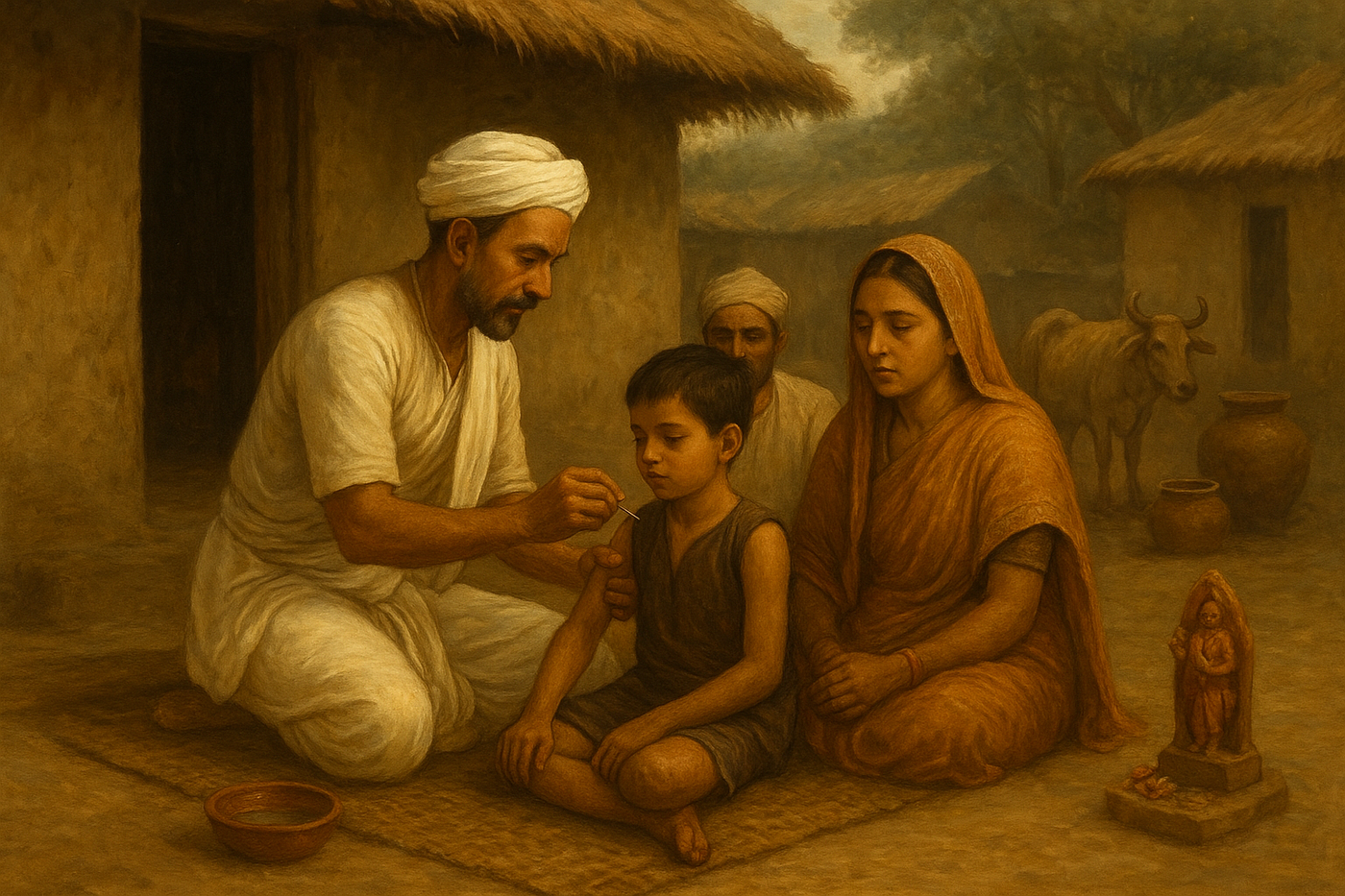
An artist’s reconstruction of a tikadar performing the traditional tika (variolation) procedure on a village child in 18th-century Bengal, as described in contemporary European and Indian accounts. It is interesting to note the idol of Shitala Devi, the goddess of pox (https://en.wikipedia.org/wiki/Shitala).
The procedure itself:
Holwell describes the technique as follows:
- The tikadar rubbed the chosen spot — usually on the upper arm — with a dry cloth for 8–10 minutes.
- Using a small instrument, he made a series of tiny punctures in a circle “the size of a silver groat,” drawing only the slightest trace of blood.
- From a linen bundle tied around his waist, he removed a small cotton pledget loaded with variolous material saved from the previous year’s inoculations.
- The pledget was moistened with a few drops of Ganga water and applied to the wound.
- A loose bandage held it in place for six hours; after that, the bandage was removed but the pledget remained until it fell off naturally.
After the operation, cold water was poured over the patient’s head until the expected mild fever appeared. Families also made ritual offerings to Śītalā, the goddess traditionally associated with smallpox in eastern India.
A notable feature was that Indian inoculators did not usually obtain material from active smallpox patients. Instead, they saved scabs from previously inoculated, recovering individuals — a safer source with far more predictable virulence than natural cases.
2. The Tikadars: Itinerant Specialists of Immunity
Tikadars were typically Brahmin specialists, though not exclusively so. They operated as itinerant practitioners moving from village to village, following a seasonal circuit.

Illustrative reconstruction of Brahmin tikadars traveling on seasonal circuits through rural Bengal in the 18th century, carrying inoculation materials as they moved from village to village to perform smallpox variolation.
Seasonality and routes
- They visited each village once or twice a year, almost always in February or March.
- This timing was deliberate — smallpox reached its annual peak later in the year during the dry months.
Community-based inoculation
The inoculation was rarely a solitary event. Tikadars treated entire families, sometimes entire neighborhoods at once. This had two effects:
- Everyone who was inoculated caught a mild, controlled form of smallpox.
- Because the inoculated individuals were contagious (though mildly ill), the synchronized procedure created a temporary buffer of herd immunity around the community.
- Tikadars were compensated in grain or coin. Some villages maintained hereditary relationships with specific tikadar lineages, trusting them over outsiders.
This was not fringe medicine. For many rural communities, tikadars formed an essential part of seasonal life — much like agricultural experts, astrologers, or priests.
3. Benefits: Why Variolation Was Worth the Risk
Variolation was not without danger — patients were deliberately exposed to smallpox. But compared to contracting the disease naturally, the difference in outcomes was dramatic [7].
- Natural smallpox mortality: around 20–30%
- Variolation mortality: 1–2% (Source: U.S. National Library of Medicine)
Beyond survival, variolated patients were much less likely to suffer the gruesome side effects of natural smallpox, including blindness or severe disfigurement.
Given the disease burden of smallpox in 17th–18th century South Asia, the risk-benefit calculation strongly favored the procedure. This explains why tens of thousands voluntarily sought tikadars each year.
4. Historicity: How Old Was the Practice?
The deeper origins of Indian variolation are contested, but there is wide agreement on several points.
Early European documentation
In 1768, a letter published by the Royal Society stated that variolation had been practiced in Bengal “for a very long time.” [2] (“A short account of the manner of inoculating the smallpox…,” Philosophical Transactions, 1768).
The letter described two methods:
- Using needles dipped in smallpox matter.
- Grinding scabs with sugar and consuming the mixture.
Geographical extent of the practice
The best modern scholarly synthesis comes from historian David Arnold, [6] who concluded:
“Variolation was widespread in Bengal, Assam, Bihar and Orissa. It was also common around Varanasi, parts of Punjab, Rajasthan, Sindh, Gujarat, and in scattered parts of Maharashtra and Central India.” (Colonizing the Body, 1993)
Whitelaw Ainslie later observed an inoculation method nearly identical to the Bengal method in Ganjam (Odisha) [4].
This places the practice across most of eastern and northern India, with significant pockets in the west. Evidence for widespread variolation in South India (Tamil Nadu, Karnataka, Kerala) is weak — suggesting either limited adoption or poor documentation.
Transmission to the Islamic world and Europe
Arthur Boylston [5] and others point out that India is a serious alternative to China as a possible origin point for the east-to-west spread of inoculation into the Ottoman Empire and, subsequently, Europe. Early British residents in Bengal provided the earliest detailed English-language descriptions of the method.
Conclusion
India’s indigenous system of smallpox inoculation was not a crude folk remedy — it was a structured, rational, community-based public-health system run by specialized practitioners with well-defined seasonal cycles, tools, and knowledge. Tikadars managed not just the technical act of inoculation, but also the rituals, timing, and social logistics necessary to protect whole villages.
In the centuries before vaccination, variolation saved countless lives. It stands today as a reminder that long before colonial medicine, the subcontinent cultivated its own sophisticated strategies against epidemic disease.
References
- An account of the manner of inoculating for the small pox in the East Indies : with some observations on the practice and mode of treating that disease in those parts . By J.Z. Holwell. https://archive.org/details/accountofmannero00holw/page/n7/mode/2up
- A short account of the manner of inoculating the small pox, on the coast of Barbary, and at Bengal, in the East Indies, extracted from a memoir written in Dutch, by the Reverend Mr. Chais, at the Hague: by M. Maty, M. D. S. R. S https://royalsocietypublishing.org/doi/pdf/10.1098/rstl.1768.0017
- Variolation to Vaccine: Smallpox Inoculation Travels East to West and Back Again by Susan Spencer https://www.asianstudies.org/publications/eaa/archives/variolation-to-vaccine-smallpox-inoculation-travels-east-to-west-and-back-again/
- Variolation, Vaccination and Popular Resistance in Early Colonial South India. By Niels Brimnes https://pmc.ncbi.nlm.nih.gov/articles/PMC546339/
- The origins of inoculation. By Arthur Boylston. https://pmc.ncbi.nlm.nih.gov/articles/PMC3407399/
- Colonizing the Body: State Medicine and Epidemic Disease in Nineteenth-Century India. By David Arnold. https://www.ucpress.edu/books/colonizing-the-body/paper
- SmallPox: A Great and Terrible Scourge. By the US National Library of Medicine https://www.nlm.nih.gov/exhibition/smallpox/sp_variolation.html
메타데이터
- post_id
- 4f211a3b3aaa
- slug
- indias-indigenous-system-of-smallpox-inoculation-tikadars-and-the-practice-of-variolation-4f211a3b3aaa
- url
- https://medium.com/@harshitgupta1337/indias-indigenous-system-of-smallpox-inoculation-tikadars-and-the-practice-of-variolation-4f211a3b3aaa
- canonical_url
- https://medium.com/@harshitgupta1337/indias-indigenous-system-of-smallpox-inoculation-tikadars-and-the-practice-of-variolation-4f211a3b3aaa
- author_url
- https://medium.com/@harshitgupta1337
- status
- ok
- fetched_at
- 2026-07-09 16:18:44