The Rise of Kimi K2: Moonshot AI’s Open-Source Marvel
Discover how China’s Moonshot AI built Kimi K2, a powerful LLM rivaling GPT-4, and how you can fine-tune it with Unsloth tools.
The Rise of Kimi K2: Moonshot AI’s Open-Source Marvel
Discover how China’s Moonshot AI built Kimi K2, a powerful LLM rivaling GPT-4, and how you can fine-tune it with Unsloth tools.

The release of new open-source LLM KIMI K2. Screenshot from the official webpage.
The LLM Revolution — From Chatbots to Agents
From the babbling baby steps of early chatbots to today’s agent-powered task executioners, the evolution of LLMs has been nothing short of turbo-charged. What began with basic conversational models quickly expanded into super coding assistants and full-stack engineers.
And now? These models don’t just respond — they act. With built-in tools, memory, retrieval capabilities, and agentic behavior, LLMs are effectively stepping into full-blown autonomous intern territory. You give a goal, they figure out how to get there. If you’ve been blinking, you’ve probably missed three paradigm shifts already.
The Rise of Kimi K2 — China’s MoE Powerhouse
One of the latest shake-ups in the open-source LLM world is Kimi K2, a model developed by Moonshot AI, a team based in China. Built on a Mixture-of-Experts (MoE) architecture, Kimi K2 activates 32 billion parameters per inference and boasts a whopping 1 trillion total parameters. Trained using the Muon optimizer on 15.5 trillion tokens with zero training instability, the model’s training loss curve is smoother than a freshly iced cake.
Performance-wise, it’s blowing minds across the board — beating heavyweights like GPT‑4.1, Qwen3, and DeepSeek in agentic coding benchmarks like SWE-bench Verified, as well as in math challenges like AIME 2024 and STEM tasks such as GPQA-Diamond. It’s not just good at reasoning and coding — it’s dangerously good.

Performance ranking between various LLMs. Kimi K2 supasses almost all test fields.
When “General” Isn’t Good Enough — Limitations in Niche Domains
As powerful as LLMs like Kimi K2 are, it’s important to remember they’re still general-purpose models. That’s both a strength and a weakness. In high-stakes or domain-specific applications, general intelligence can fall short. Some real-world examples:
- Medical Diagnosis: A general LLM might misinterpret subtle clinical cues, misidentify symptoms, or hallucinate treatment plans. You wouldn’t want it deciding your cancer protocol based on a Reddit post.
- Legal Analysis: Laws require pinpoint precision in interpretation. LLMs may conflate jurisdictions, misread legal definitions, or fail to follow logical precedence. One wrong clause, and your contract goes kaboom.
- Financial Forecasting: Markets are driven by nuance, regulation, and sentiment. A general model might mistake meme stocks for stable investments — definitely not ideal for managing your portfolio.
All this underscores the importance of fine-tuning — customizing a base model to excel in a particular domain, improving its reliability, accuracy, and trustworthiness.

Beginner guide published on Unsloth.ai to teach users some basic steps and knowledge on using AI LLMs.
Fine-Tuning Kimi K2 — Highlights from Unsloth.ai
Thankfully, Unsloth.ai has released one of the most accessible and detailed guides for fine-tuning LLMs, including Kimi K2. Here are some curated highlights:
- Pick the Right Strategy:
- For lower resource use, QLoRA (4-bit + LoRA) is recommended.
- For maximum accuracy and if you’ve got the compute budget, go for full model fine-tuning.
- Tweak Your Hyperparameters:
- Start with
max_seq_length = 2048, and only scale to 8192 if your tasks involve long documents. - Set
load_in_4bit = Trueto enable quantized loading;full_finetuning = Trueif you're updating all weights.
- Training Data Matters:
- Structured QA pairs help. For example, medical fine-tuning might involve real case vignettes and validated answers.
- Coding tasks can often work with raw code snippets and descriptions — keep it clean, focused, and contextual.
- Deployment Gotchas:
- Kimi K2 uses a specific chat template (
<|im_user|>,<|im_assistant|>etc.)—don’t skip this part! - Suggested inference settings:
temperature = 0.6for less repetition,min_p = 0.01to filter out unlikely tokens. - The tokenizer is almost identical to GPT-4o’s, with optimizations for Chinese character segmentation.
Whether you’re training a medical assistant, legal analyst, or AI coding buddy, these tools make it feasible to bring Kimi K2 into a finely tuned production role.
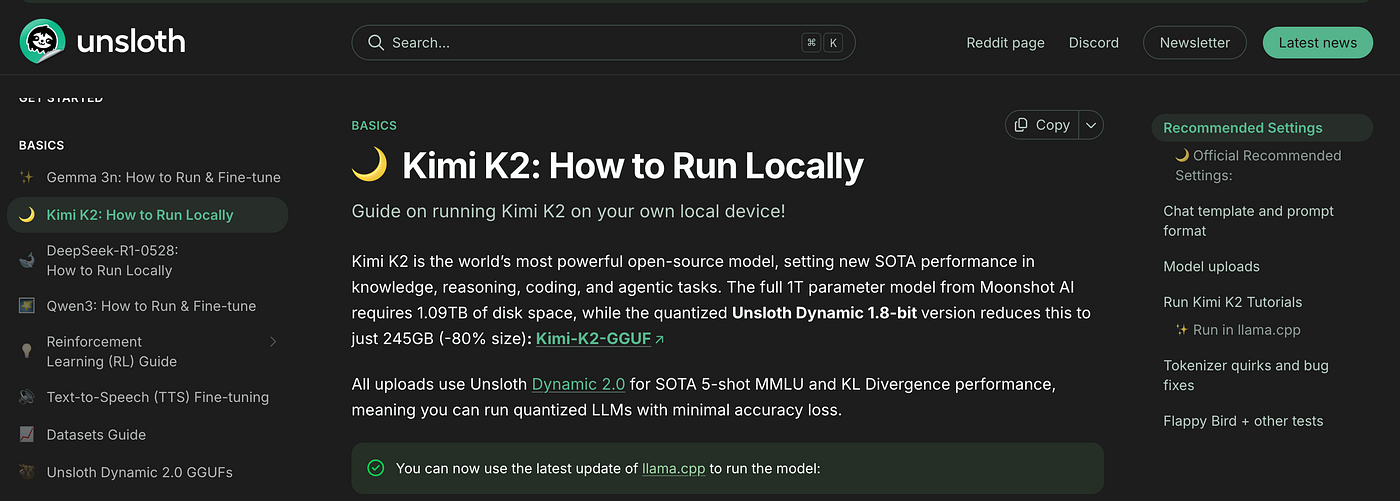
How to run Kimi K2 locally, published on Unsloth.ai.
Final Thoughts — From Power to Precision
The rise of Kimi K2 is more than just another benchmark-busting headline. It’s a testament to how fast the open-source LLM ecosystem is evolving. Moonshot AI’s release pushes the boundaries of what’s possible with agentic capabilities, and platforms like Unsloth.ai make these breakthroughs accessible. We’re not just downloading giant models anymore — we’re customizing, optimizing, and deploying them for real work.
In a world where LLMs are becoming foundational tools, the next frontier is clear: specialization.
General models get us 80% of the way there; fine-tuning gets us the rest.
And who knows — maybe tomorrow, your AI assistant will not only schedule your day, but also review your contract, write your code, and explain your blood test results, all before your second cup of coffee. Now that’s what I call progress.
메타데이터
- post_id
- 4f4fa6bebd03
- slug
- the-rise-of-kimi-k2-moonshot-ais-open-source-marvel-4f4fa6bebd03
- url
- https://medium.com/the-ai-bench/the-rise-of-kimi-k2-moonshot-ais-open-source-marvel-4f4fa6bebd03
- canonical_url
- https://medium.com/the-ai-bench/the-rise-of-kimi-k2-moonshot-ais-open-source-marvel-4f4fa6bebd03
- author_url
- https://medium.com/@ckhuang2527
- status
- ok
- fetched_at
- 2026-06-12 07:40:50