The Two Most Vulnerable Generations in the AI Era: Children and Seniors
In the midst of the roaring Artificial Intelligence (AI) revolution, the conversation usually revolves around tech jobs, efficiency, and…
The Two Most Vulnerable Generations in the AI Era: Children and Seniors
In the midst of the roaring Artificial Intelligence (AI) revolution, the conversation usually revolves around tech jobs, efficiency, and market growth. However, we rarely talk about the human cost. Today, two vastly different age groups find themselves in the exact same boat, standing as the most vulnerable targets of AI’s unintended consequences: developing children and seniors over the age of 50.
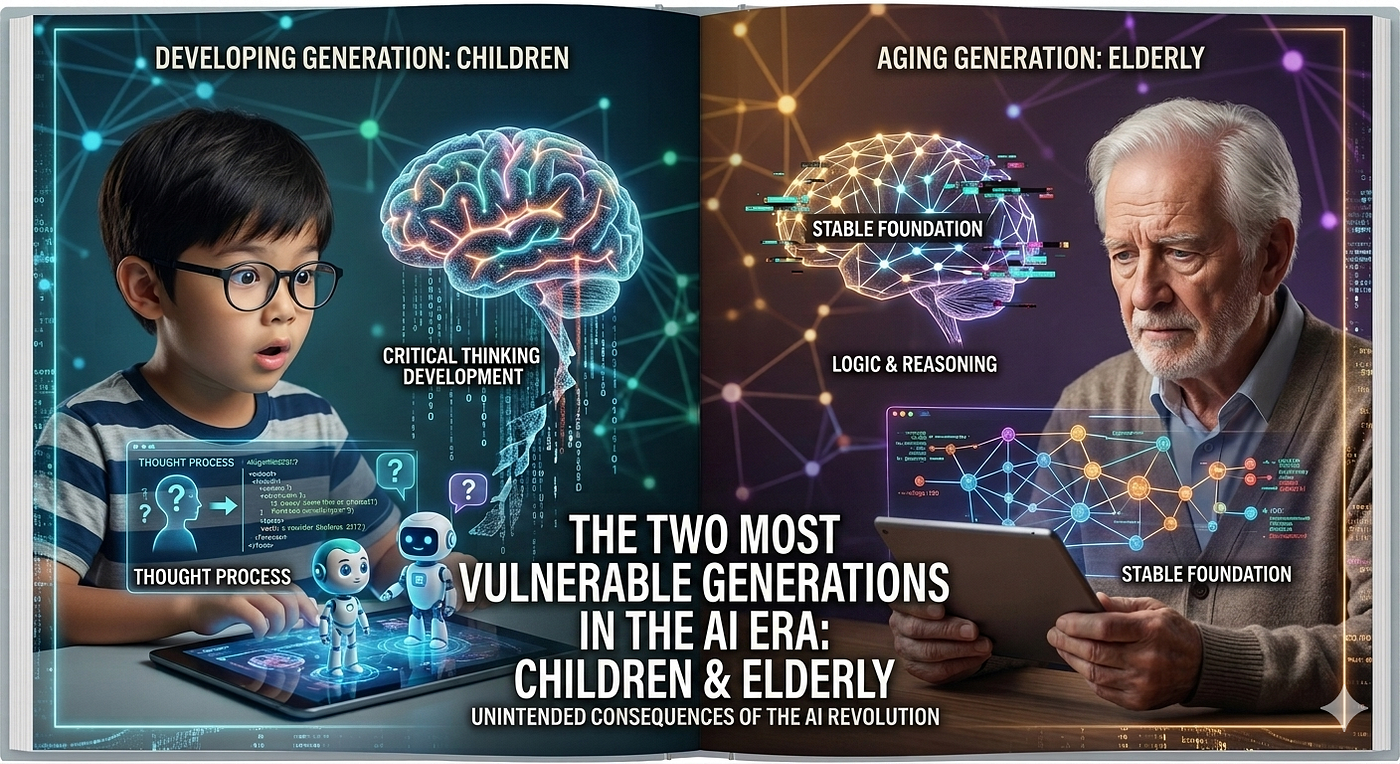
While one group is still building their understanding of the world, the other is struggling to navigate a completely rewritten digital reality. Here is why the AI era poses a profound risk to both generations.
Part 1: The Threat to Growing Children
As the first generation to grow up alongside AI, children face psychological and developmental risks that no previous generation has ever encountered.
- Stripping Away Critical Thinking and Independent Thought
In the past, curiosity forced children to read, experiment, or debate to find answers. This process of searching trained the brain to think critically.
- Instant Gratification: With AI tutors and chatbots, children can get instant answers for their homework without flexing a single mental muscle.
- The Risk: Children risk growing into intellectually passive individuals, losing problem-solving skills, and blindly accepting AI outputs without questioning their validity.
- The Erosion of Real Social Skills and Empathy
Humans are social creatures who learn empathy through face-to-face interaction, reading body language, and feeling real human emotions.
- The “Perfect” Virtual Friend: Many AI apps are now designed to act as companions, therapists, or virtual partners for teenagers. These AIs always agree, never get angry, and are constantly available.
- The Risk: Children may isolate themselves from the real world because human relationships feel too complex and exhausting. This triggers acute social anxiety when they are forced to interact with real people.
- Identity Crises Driven by Algorithmic Beauty Standards
AI-powered face filters on social media no longer just brighten photos; they completely reconstruct facial features to fit unrealistic beauty standards.
- Distorted Reality: Teenagers constantly see “perfected” AI versions of themselves on screen.
- The Risk: When they look in a real mirror, they experience deep dissatisfaction. This fuels body dysmorphic disorder, depression, and profound identity crises.
Part 2: The Threat to the Senior Generation (Ages 50+)
Interestingly, vulnerability to AI is not exclusive to the youth. On the other end of the age spectrum, seniors over 50 face a nearly identical psychological and social threat, particularly when it comes to consuming information.
- High Trust and Low Digital Literacy
The 50+ generation grew up in an era where mainstream media (TV, radio, newspapers) presented thoroughly verified facts. When they transitioned to the digital world, they brought the same mindset: “If there is a photo or a video of it, it must be real.”
- AI as a Defamation Factory
Generative AI is now incredibly skilled at creating realistic text, cloned voices, and deepfake videos. This manufactured content is frequently weaponized to defame public figures, disrupt elections, or spread highly provocative fake news.
- Prime Targets for Polarization and Scams
Because they tend to take AI-generated content at face value, seniors are the easiest group for political algorithms to radicalize. They are also prime targets for financial fraud — such as AI voice-cloning scams where fraudsters mimic a grandchild’s voice begging for emergency money.
The Irony: Two Generations in the Same Boat
The ultimate irony of the AI era is that children and their grandparents are facing the exact same adversary. Both are highly susceptible to manipulation, and both struggle to separate digital illusion from physical reality. One group lacks the life experience to judge the data, while the other lacks the technological skepticism to question the medium.
Conclusion: Becoming the Shield
We cannot stop the advancement of AI, but we can protect those we love. For our children, we must limit AI exposure and encourage real-world play. For our parents and seniors, we must patiently teach digital skepticism, reminding them that in the age of AI, seeing is no longer believing.
No matter how advanced AI becomes, it can never replicate the warmth of real human connection, genuine family discussions, and mutual protection.
메타데이터
- post_id
- 4f622ebeadc2
- slug
- the-two-most-vulnerable-generations-in-the-ai-era-children-and-seniors-4f622ebeadc2
- url
- https://medium.com/@jokonardi/the-two-most-vulnerable-generations-in-the-ai-era-children-and-seniors-4f622ebeadc2
- canonical_url
- https://medium.com/@jokonardi/the-two-most-vulnerable-generations-in-the-ai-era-children-and-seniors-4f622ebeadc2
- author_url
- https://medium.com/@jokonardi
- status
- ok
- fetched_at
- 2026-06-12 07:40:50



