Notable Lives: Harriet Beecher Stowe
The Woman Who Wrote with Her Heart’s Blood
Notable Lives: Harriet Beecher Stowe
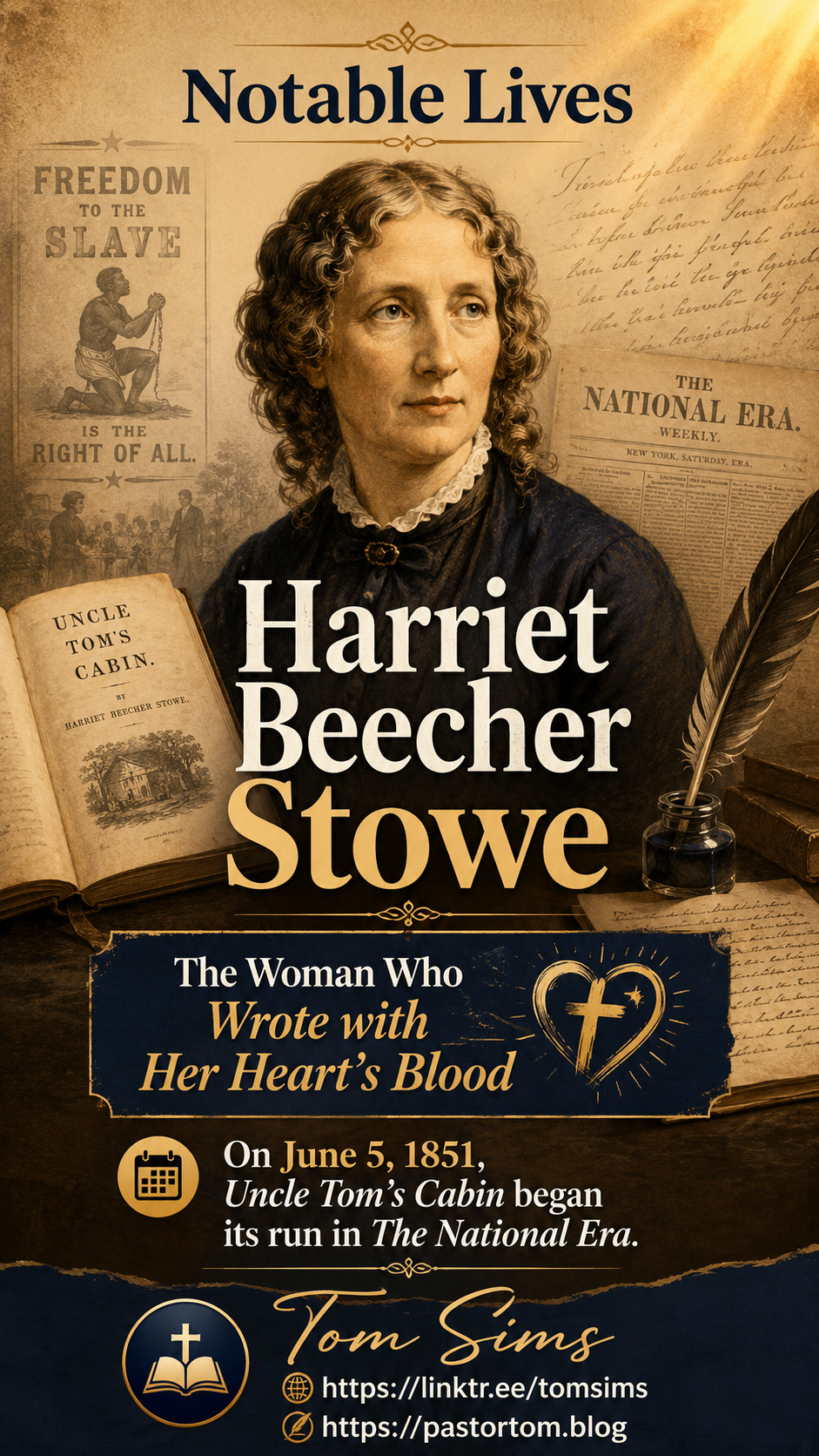
The Woman Who Wrote with Her Heart’s Blood
It is alleged that when President Abraham Lincoln met Harriet Beecher Stowe in 1862, he greeted her with the famous line:
“So you are the little woman who wrote the book that started this great war!”
It is a disputed story. One serious Lincoln journal calls the quotation “entirely apocryphal,” arising from Stowe family tradition without direct contemporary verification. Still, Stowe herself called the meeting funny, and the story has endured because it says something that feels true, even if the exact words may not be.
The truth is that Harriet Beecher Stowe, through writing and speaking, stirred a great deal of sentiment. She fanned the flames of moral outrage that would become part of the national outcry for the end of slavery.
On June 5, 1851, Stowe’s anti-slavery serial, Uncle Tom’s Cabin; or, Life Among the Lowly, began its run in The National Era, an abolitionist newspaper in Washington, D.C. It appeared in weekly installments from June 5, 1851, to April 1, 1852, before becoming a book in 1852.
She was not writing from nowhere.
[embed]
She was the daughter of scholar, theologian, and preacher Lyman Beecher; the sister of the Rev. Henry Ward Beecher; and the wife of biblical scholar and educator Calvin Ellis Stowe. She was surrounded by a family rooted in faith, learning, reform, and activism. They embraced and engaged many of the great causes of their time.
In her famous novel, Stowe sought to portray vividly the harsh conditions experienced by enslaved African Americans and to shine a bright light on the injustice of slavery. She did not write one book and disappear. In all, she wrote around thirty books and used both her writing and her speaking platforms to take courageous stands on the issues of her time.
Stowe said she had a vision of a dying enslaved man during a communion service, and that this vision helped inspire the story. She had also heard, directly and indirectly, from people who had suffered the horrors of slavery.
Actually, three things seem to have moved her deeply.
First, there was the vision she experienced and reported.
Second, there was grief. In 1849, her young son died in a cholera epidemic. Debra Michals notes that Stowe later said the loss of her child gave her a deeper empathy for enslaved mothers whose children were sold away from them.
Third, there was the Fugitive Slave Act of 1850. For the first time, many Northerners were legally compelled to assist in returning runaway enslaved people. Harriet was infuriated. Her conscience would not leave her alone.
She once remarked that she was not really the author of Uncle Tom’s Cabin:
“The Lord himself wrote it, and I was but the humblest of instruments in His hand.”
That may sound strange to the modern ear, but it tells us how she understood her vocation. She did not see the book merely as literary ambition. She saw it as witness.
On the day she completed Uncle Tom’s Cabin, March 2, 1852, she wrote to Horace Mann. In that letter, she said:
“To day I have taken my pen from the last chapter of ‘Uncle Tom’s Cabin’ & I think you will understand me when I say that I feel as if I had written some of it almost with my hearts blood.”
She called the book “a despairing appeal to civilized humanity.”
That is what makes Harriet Beecher Stowe’s life notable.
She saw something. She felt something. She suffered something. She listened to the suffering of others. Then she wrote.
And what she wrote made people think and feel. It entered homes. It entered churches. It entered public debate. It forced readers to consider what kind of country they were willing to inhabit and what kind of cruelty they were willing to tolerate.
The Lincoln quote may be disputed.
The impact is not.
Harriet Beecher Stowe lived a notable life because she used words as moral instruments. She placed imagination in the service of conscience. She joined faith to reform, grief to empathy, and storytelling to justice.
Hers was a notable life.
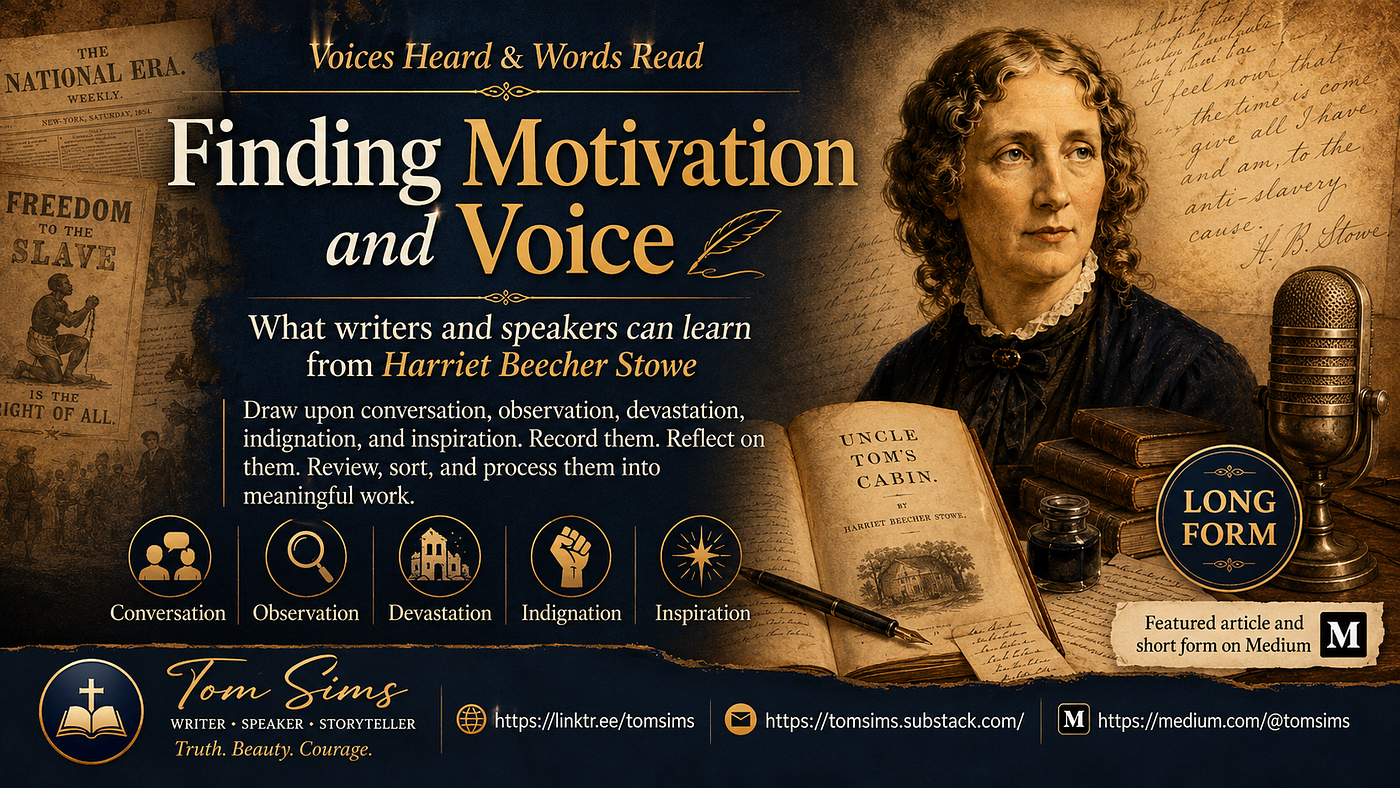
Where do writers and speakers find their motivation?
Harriet Beecher Stowe’s life suggests five sources: conversation, observation, devastation, indignation, and inspiration.
The challenge is not merely to experience them, but to record, reflect, review, sort, and process them into meaningful work.
Full reflection for writers and speakers on Voices Heard & Words Read.
메타데이터
- post_id
- 4f829099aedb
- slug
- notable-lives-harriet-beecher-stowe-4f829099aedb
- url
- https://medium.com/@tomsims/notable-lives-harriet-beecher-stowe-4f829099aedb
- canonical_url
- https://medium.com/@tomsims/notable-lives-harriet-beecher-stowe-4f829099aedb
- author_url
- https://medium.com/@tomsims
- status
- ok
- fetched_at
- 2026-06-16 19:09:56