Strengths Finder Glory
From the group We Love Categorization
Strengths Finder Glory
From the group We Love Categorization
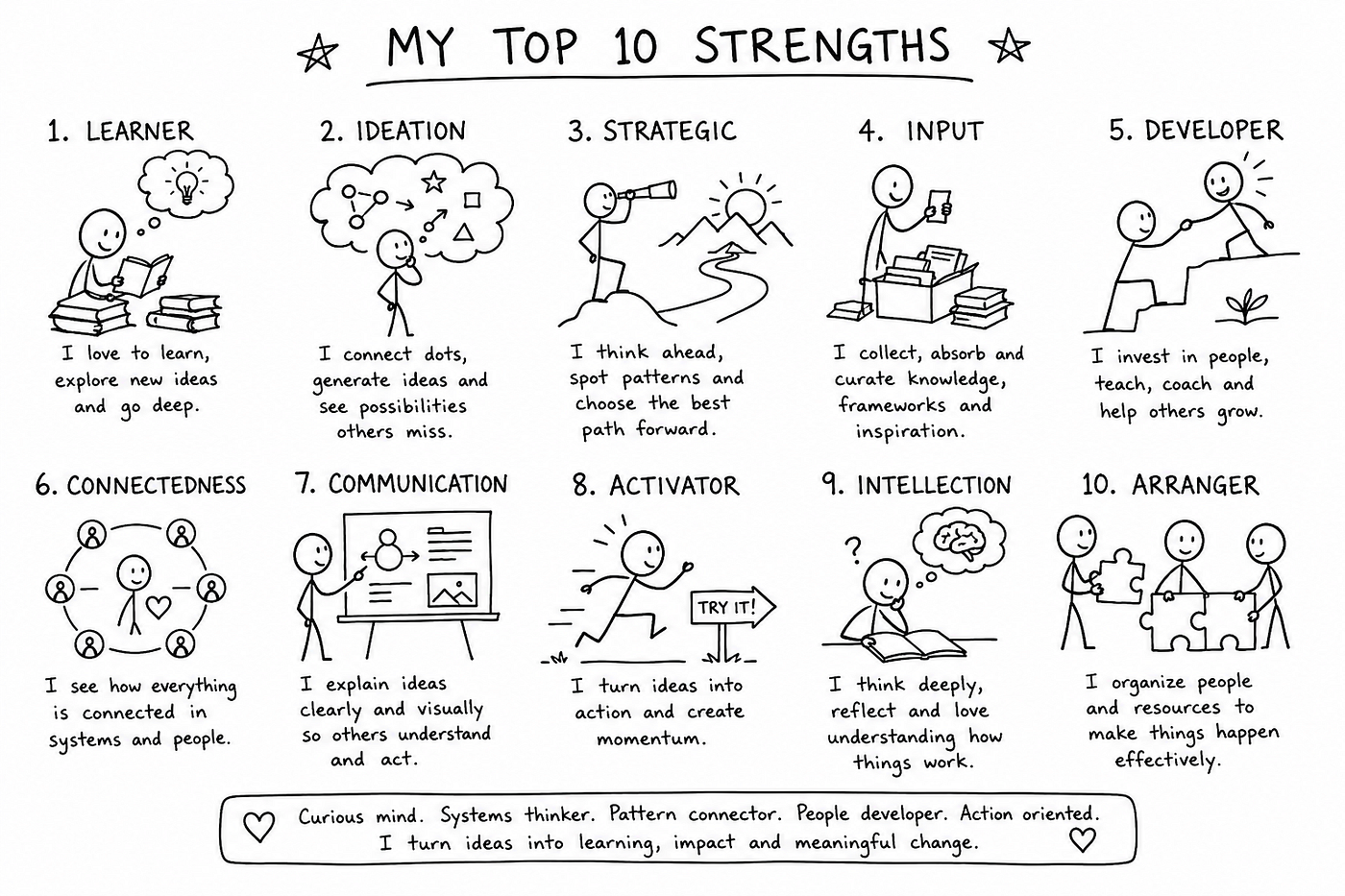
10 CliftonStrengths for learning, strategy, ideas, communication, teamwork, reflection, and coaching, image generated by ChatGPT 5.5
Many people find Gallup CliftonStrengths /1/ useful for reflection, team conversations, and coaching — but there are also several legitimate concerns raised by psychologists, organizational researchers, and practitioners.
Here are the main critiques that tend to come up:
1. Limited scientific validation compared to established personality models
CliftonStrengths is commercially successful and widely used, but it is not generally considered as scientifically established as models like:
- Big Five / OCEAN personality traits /2/
- HEXACO /3/
- also debated: MBTI as used by McK /4/
- Some industrial-organizational psychology assessments
- Flow state as in “to be in the zone” /5/
Critics argue that:
- The 34 “themes” are not always clearly distinct
- Peer-reviewed independent validation is more limited
- Some constructs overlap conceptually
This does not mean it is “fake,” but rather that it sits more in the applied coaching space than in rigorous psychometrics.
2. Risk of labeling people
A common concern is that people start treating themes as identity boxes:
- “I’m not strategic.”
- “I don’t have discipline.”
- “That’s not in my Top 5.”
This can unintentionally:
- reduce growth mindset,
- create self-limiting beliefs,
- or reinforce organizational silos.
Ironically, a tool intended to unlock potential can become deterministic if used poorly.
3. Over-focus on strengths can ignore critical weaknesses
The philosophy emphasizes:
invest in strengths rather than obsess over fixing weaknesses.
That can be valuable — but critics note that some weaknesses genuinely matter:
- ethical blind spots,
- communication failures,
- emotional regulation,
- inability to collaborate,
- missing technical competence.
In real systems, unmanaged weaknesses can become systemic constraints.
This critique is especially relevant in leadership and agile environments where team dynamics matter more than individual talent alone.
4. Commercial ecosystem incentives
Some criticism is directed less at the model itself and more at the ecosystem around it:
- certification programs,
- workshops,
- coaching packages,
- recurring assessments,
- proprietary terminology.
Organizations sometimes adopt it as a cultural identity system without critically evaluating whether it improves outcomes.
5. Context matters more than traits
A person’s “strength” can become a liability depending on context.
Examples:
- “Activator” may help experimentation but harm deep architectural thinking.
- “Harmony” may reduce conflict but suppress necessary tension.
- “Achiever” can drive delivery but also burnout.
This is similar to systems thinking and Scrum pattern thinking: a behavior is rarely universally good or bad; it depends on the surrounding environment and constraints.
6. Team composition misuse
Some organizations misuse CliftonStrengths for:
- hiring decisions,
- role gatekeeping,
- team “balancing” exercises,
- pseudo-scientific workforce engineering.
That becomes problematic because:
- strengths are not destiny,
- teams evolve,
- psychological safety matters more than personality sorting,
- diversity of experience often matters more than theme distributions.
7. Reliability over time
Some users notice that their results shift over years or across life phases which can be expected for a complex system where mere static categorization (as in my “top 10” forever) is rarely appropriate /6/.
That raises questions about:
- stability,
- situational influence,
- and whether the tool measures enduring traits vs. current self-perception.
To be fair, humans do evolve — but critics argue the system is often presented with more precision than warranted.
Where it does tend to work well
Even many skeptics acknowledge it can be useful when used as:
- a conversation starter,
- a coaching reflection tool,
- a non-deficit-oriented language,
- a way to appreciate diversity of contribution styles,
- a way to increase self-awareness.
Problems usually emerge when it is treated as:
- hard science,
- destiny,
- hiring criteria,
- or organizational truth.
A balanced way to think about it is:
CliftonStrengths is probably more useful as a shared reflective language than as a precise scientific measurement system.
That framing tends to avoid most of the failure modes.
Afterthought
Try Flow /5/ skill topic exercises for teams and reach out to the author if you’re interested in a dedicated article.
Many popular overviews of several approaches incl. Clifton can be found /7/. Feel inspired to try your own research and tests, what works well for your team(s).
Further Reading:
/1/ Clifton Strengths with a missing criticism chapter
/2/ Big Five / OCEAN / CANOE personality traits
/3/ HEXACO
/4/ MBTI
/5/ (Team) Flow by Mihaly_Csikszentmihalyi
/6/ Cynefin Decision Making Framework, by Dave Snowden
메타데이터
- post_id
- 4f8bc1727249
- slug
- strengths-finder-glory-4f8bc1727249
- url
- https://medium.com/elevate-tech/strengths-finder-glory-4f8bc1727249
- canonical_url
- https://medium.com/elevate-tech/strengths-finder-glory-4f8bc1727249
- author_url
- https://medium.com/@thoralfjklatt
- status
- ok
- fetched_at
- 2026-06-11 16:11:38