The Digital Gold Standard: How Washington and Silicon Valley Are Building the Next Global Financial…
The dollar’s next century will not be won by printing money. It will be won by whoever controls the collateral — and the code that moves…
The Digital Gold Standard: How Washington and Silicon Valley Are Building the Next Global Financial Empire
The dollar’s next century will not be won by printing money. It will be won by whoever controls the collateral — and the code that moves it.
The United States’ century-long dollar hegemony — built on printing money backed by nothing more than unlimited “government credit” as the world’s key reserve currency — has hit a structural wall.
The era of the so-called “bond credibility crisis” has arrived, as both allies and adversaries alike are reducing their purchases of U.S. Treasuries or avoiding them altogether.
This is precisely why the Trump administration and the Treasury Department are pushing, for the first time in history, to establish a federal-level Sovereign Wealth Fund (SWF). The age of credit is fading. A forced transition toward a “collateral-based system” — in which bonds and currencies are only respected when backed by tangible, visible assets — has begun.
This analysis dissects the institutional architecture of the digital standard the U.S. government is pursuing, examines Elon Musk’s X-Money project designed to disrupt traditional Wall Street, and provides a deep-dive into the governance structures and power dynamics of the Silicon Valley titans surrounding it.
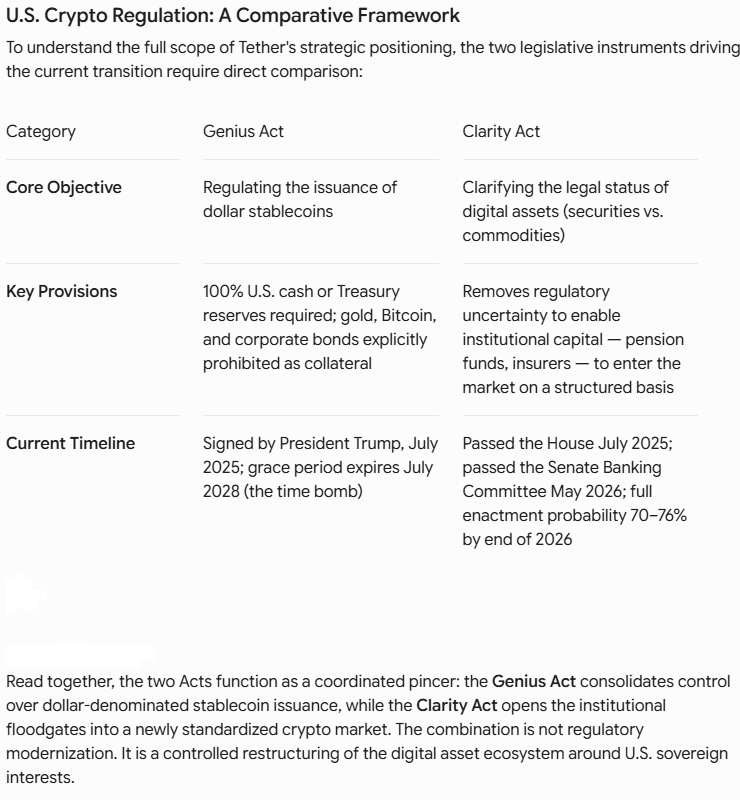
1. Unlocking the Institutional Framework: The Hidden Truth Behind the Genius Act and the Clarity Act
Even if the Treasury establishes a Sovereign Wealth Fund and contributes government-owned gold, state-owned real estate, and the 1 million Bitcoin seized by the Department of Justice into a Special Purpose Vehicle (SPC), a massive legal bypass was required to bring those assets into circulation in financial markets.
The two pivotal pieces of legislation that have cut through Washington’s political landscape are not simply crypto regulatory bills. They are sophisticated financial engineering blueprints designed to complete “America’s sovereign asset securitization scenario.”
1) The Clarity Act: Giving Wings to Heavy Physical Assets
The Digital Asset Market Clarity Act — which recently cleared the Senate Banking Committee and is approaching the final stage of enactment — functions as the bridge that forcibly connects Wall Street’s capital pipelines to the Sovereign Wealth Fund.
Traditional Wall Street banks are restricted by regulation to holding only Tier 1 High-Quality Liquid Assets (HQLA), which means that however valuable physical gold or large-scale state-owned real estate may be, they cannot easily be purchased under existing frameworks.
However, the Clarity Act contains a provision that the moment such physical assets are tokenized on-chain as Real World Assets (RWA), they are legally recognized as the highest-grade high-quality liquid assets. The hidden truth: Wall Street is handed a legal ticket to digitally dominate the world’s physical assets — oil, real estate, and more — and in exchange, it is compelled to absorb the large-scale “gold and Bitcoin RWA bonds” that the U.S. government intends to issue through the Sovereign Wealth Fund. A win-win arrangement engineered with surgical precision.
2) The Genius Act: Artificial Bifurcation and Manufactured Demand
The Genius Act (Payment Stablecoin Act) rigidly bifurcates the digital asset market into two distinct categories: “payment stablecoins” and “speculative/investment Bitcoin.” The law mandates that stablecoin issuers — Tether, Circle, and others — back 100% of their token issuance with cash and short-term U.S. Treasuries.
The hidden truth: regulators are going one step further, steering the definition of permissible reserves toward including “RWA bonds guaranteed by the U.S. government’s Sovereign Wealth Fund.” The result is that major issuers like Tether (USDT) and Circle (USDC), in order to ensure their own survival, become structurally obligated buyers of America’s digital collateral bonds — a captive demand mechanism for U.S. sovereign asset financing.
2. The Tech Empire Disruption: Elon Musk’s X-Money and the Silicon Valley Coalition
While the U.S. government constructs its vast collateral architecture, the private sector — led by Elon Musk’s Silicon Valley tech coalition — is mobilizing to dismantle the settlement and clearing toll cartel that traditional Wall Street institutions have monopolized for over a century.
Every time we swipe a card, a four-step process unfolds behind the scenes: authorization, verification, netting, and settlement. This process involves a two-day settlement delay (T+2) and extracts fees of up to 3% — Wall Street’s most reliably lucrative cash machine.
Musk’s X-Money (X.com) is preparing a disruptive innovation that integrates this entire chain through blockchain-based hybrid ledger technology, achieving instant settlement (T+0) and driving fees toward zero.
The critical dynamic to observe is the governance structure connecting Elon Musk with the other Silicon Valley titans — and the complex power dynamics among them. They are allied against the common adversary of Wall Street, while simultaneously engaged in fierce strategic competition for control of the future financial order.
TitanRole / StrategyPrimary WeaponElon Musk (X-Money)Head of Department of Government EfficiencyX-Money settlement infrastructurePeter Thiel (Palantir)Strategic treasury purchase bypassPYUSD stablecoin + Palantir surveillanceSam Altman (OpenAI & Microsoft)AI compute-based financial ledgerWorld Network ID (proof of personhood)Mark Zuckerberg (Meta)Learned from Libra’s failure; targeting niche payment corridorsMessenger-based simplified payment network
3. Peter Thiel’s Palantir and PYUSD: A Sophisticated Evasion Strategy
Musk’s longtime ally and rival, Peter Thiel, knows better than anyone the history of Mark Zuckerberg’s attempt to launch the digital currency “Libra” — and how it was torpedoed by Washington’s political establishment and the Wall Street cartel.
Dynamics: Rather than attempting a frontal assault, the Thiel camp made a calculated opening move: offering the Treasury Department the one thing it craves most — purchases of U.S. Treasuries. PayPal’s stablecoin, PYUSD, was structured with reserves composed strictly of U.S. Treasury securities, positioning it as a contribution to dollar hegemony rather than a challenge to it.
Outlook: Palantir’s surveillance technology — under Thiel’s direction — is highly likely to serve as the central intelligence brain of the “monetary stratification system” through which the U.S. Sovereign Wealth Fund tracks and blocks the on-chain provenance of domestically produced gold versus gold of Chinese or Russian origin. In relation to Musk’s X-Money, Palantir will maintain a peculiar symbiosis — simultaneously infrastructure provider and competitor.
4. Sam Altman’s World Network (Worldcoin)
The figure deserving the most careful attention in this landscape is OpenAI’s Sam Altman. The project he leads is emphatically not the “ghost Worldcoin” that circulates in popular discourse as an illegal pyramid scheme targeting ordinary people.
Altman’s project is a sophisticated blockchain-based proof-of-personhood system that verifies real human identity through iris-scanning devices (the Orb) and digital passports. It has officially rebranded as “World Network” — a global open-source AI security infrastructure that is expanding its scale and scope.
Dynamics: When money is defined at its most fundamental level as “a data ledger recording value and labor,” the most powerful weapon for controlling the next-generation ledger is artificial intelligence and computational power. Sam Altman, through World Network (formerly Worldcoin), is executing a preemptive process to establish global digital ID (proof of personhood) — backed by the enormous Azure cloud infrastructure of Microsoft.
Outlook: When Elon Musk’s X-Money attempts to absorb capital from traditional banks through an aggressive 6% annual interest rate and xAI (Grok)-driven asset allocation services — effectively inducing a bank run — the Altman-Microsoft alliance will counter with a combination of biometric identity data for the global population and massive AI financial analysis models. Musk’s ongoing legal and rhetorical offensive against OpenAI and Sam Altman is not unrelated to this underlying battle for dominance over the future financial and AI ledger.
5. Mark Zuckerberg’s Retreat and the Niche Strategy
Following the catastrophic failure of Libra, Zuckerberg’s Meta abandoned its ambitious vision of issuing an independent global currency. Instead, it compromised into a subordinate partnership structure — leveraging WhatsApp and Instagram infrastructure to simply “transmit” existing dollars or U.S.-regulated stablecoins.
In stark contrast to Musk’s frontal assault — which has gone as far as dismantling the regulatory personnel of the CFPB — Zuckerberg has pivoted to a low-profile strategy of targeting niche payment corridors while keeping his head firmly down.
Scenario Analysis 1: The “Government-Big Tech” Alliance and Global Monetary Stratification
Traditional Wall Street financial institutions will attempt to resist — pressuring Treasury yields, demanding Congressional hearings, and seeking to obstruct both Musk and the Trump administration. But the historical current will ultimately flow toward a grand bargain between the U.S. government (Treasury) and Silicon Valley’s Big Tech.
The logic is symmetrical: the government needs “money (collateral),” and Big Tech needs “legitimate authority (licenses).”
Projected Timeline for the Future Financial System:
PhaseEstimated TimeframeCore EventMarket ImpactPhase 1: Collateral ExpansionWithin 1–2 yearsFed gold reserve mark-to-market revaluation; Federal SWF legislation passedLiquidity supply without new Treasury issuance; institutional price floor established for gold and BitcoinPhase 2: Infrastructure IntegrationWithin 2–3 yearsClarity Act enacted; X-Money T+0 real-time settlement fully operationalBeginning of traditional card processor and small commercial bank collapse; explosive growth of RWA asset marketsPhase 3: New Standard EstablishedWithin 3–5 yearsMandatory inclusion of SWF RWA bonds in stablecoin and X-Money reservesPaper dollar fully evolved into “digital physically-collateralized dollar”; permanent entrenchment of dollar hegemony
Scenario Analysis 2: What Becomes of Ripple (XRP) in the Digital Standard Clash?
When the U.S. government’s digital collateral architecture and Silicon Valley Big Tech’s payment network dominance scenario materialize, Ripple (XRP) — long positioned as a cross-border payments powerhouse — faces not merely survival, but a defining strategic inflection point.
Having finally resolved years of SEC litigation risk and now receiving spot ETF inflows, Ripple’s trajectory compresses into two divergent scenarios.
Scenario A — Institutional Integration via RLUSD (Opportunity): Ripple has completed its integration with institutional finance through its own stablecoin, RLUSD, which fully satisfies the Genius Act’s 100% cash and Treasury collateral requirements. It is currently being connected to major Wall Street asset managers including BlackRock (BUIDL) as a tokenized fund settlement layer. If the XRP Ledger (XRPL) is selected as the primary tokenization and issuance infrastructure for RWA assets under the Clarity Act regime, Ripple can solidify its position as the institutional liquidity supply layer.
Scenario B — Pressure from X-Money and the Collateral Architecture (Risk): Conversely, the fundamental utility of XRP as a “volatility-based bridge asset” may narrow. If Musk’s X-Money absorbs private payment markets with zero fees and instant settlement (T+0), and U.S. government-guaranteed SWF RWA bonds become mandatory reserve assets for global stablecoins, the rationale for using volatile XRP as a bridge disappears. If institutions shift their settlement processes toward the stability of RLUSD, the Ripple network may grow while XRP token utility demand stagnates — a “decoupling” risk.
Ultimately, Ripple must reinvent itself not as a simple payment currency, but as a “neutral cross-region bridge for global RWA infrastructure and CBDC clusters” — only then can it withstand the indiscriminate payment network bombardment of the Silicon Valley tech empire and survive.

6. Conclusion: The “Dollar Black Hole” and Korea’s Survival Strategy
When this system reaches completion, global capital will be sucked into America’s digital collateral bonds and tech-integrated stablecoins — instruments that offer both maximum safety and the high interest rates (6% or more annually) that technology companies provide.
This powerful “liquidity straw effect” will trigger capital flight from emerging economies, potentially driving the Korean won-to-dollar exchange rate to extreme levels of 2,000 or even 3,000 won — a severe economic distortion.
Furthermore, the “monetary stratification” system — which tracks and blocks on-chain transactions involving assets of adversary nations (China, Russia) — will combine with Elon Musk’s Starlink and Tesla ecosystems to erect a massive “digital financial wall.”
The time remaining for South Korea’s financial authorities and corporations is not plentiful. Clinging to the existing won-denominated bond system — based solely on credit — risks having the nation’s assets absorbed wholesale at the moment the tech empire fully arrives.
Korea must urgently build an institutionalized on-chain RWA collateral architecture that bundles domestic real estate, social overhead capital (SOC), the Bank of Korea’s gold reserves, and digital assets into a single sovereign framework.
The Silicon Valley geniuses who shattered the monopoly tollbooth of Wall Street are now joining hands with the state to build a new global financial government.
The question is not whether this new order arrives. It is whether Korea will be among those who helped design it — or simply among those absorbed by it.
“The Silicon Valley geniuses who dismantled Wall Street’s century-old tollbooth are now signing contracts with the state. The new global financial government is being built on-chain — and nations that mistake this transition for regulation will wake up to find their assets already absorbed into someone else’s empire.”
메타데이터
- post_id
- 4f8fd68a76bb
- slug
- the-digital-gold-standard-how-washington-and-silicon-valley-are-building-the-next-global-financial-4f8fd68a76bb
- url
- https://medium.com/@annaadvicelab/the-digital-gold-standard-how-washington-and-silicon-valley-are-building-the-next-global-financial-4f8fd68a76bb
- canonical_url
- https://medium.com/@annaadvicelab/the-digital-gold-standard-how-washington-and-silicon-valley-are-building-the-next-global-financial-4f8fd68a76bb
- author_url
- https://medium.com/@annaadvicelab
- status
- ok
- fetched_at
- 2026-06-21 12:17:11