The Eisenhower Paradox & Why the GTD Projects List is Your Perfect Work Battle Plan
In an address in 1957, U.S. President and former World War II Supreme Allied Commander Dwight D. Eisenhower observed a paradox:
The Eisenhower Paradox & Why the GTD Projects List is Your Perfect Work Battle Plan
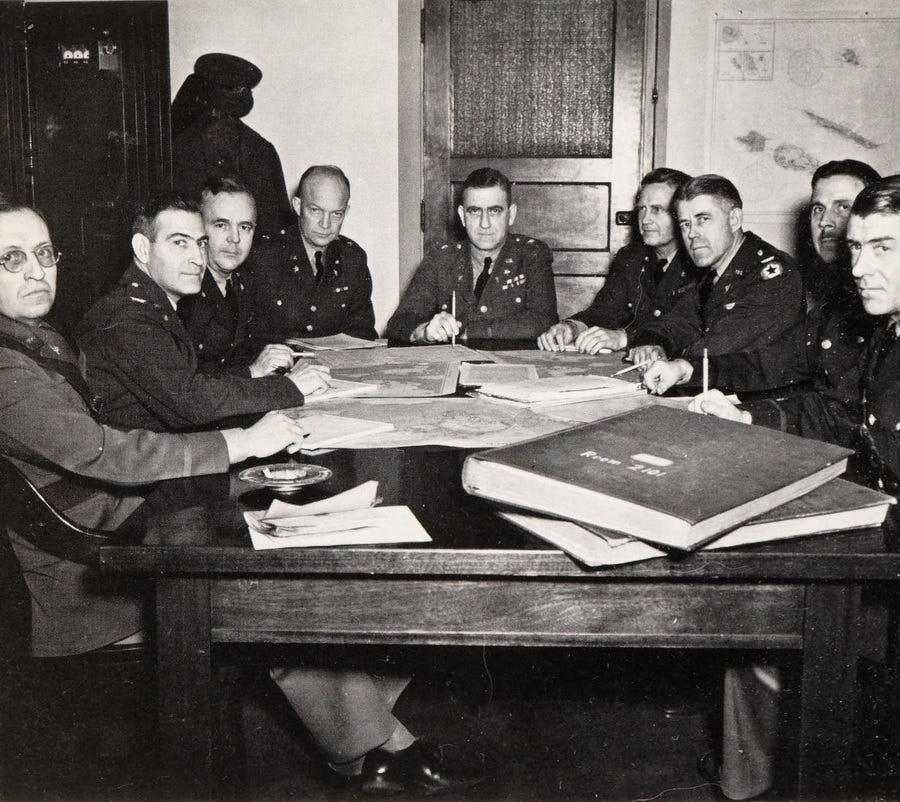
In an address in 1957, U.S. President and former World War II Supreme Allied Commander Dwight D. Eisenhower observed a paradox:
“Plans are worthless, but planning is everything.”
As a student of military history since childhood, Eisenhower would doubtless have studied the lessons of the rigid World War I plans: the Russian Mobilization Schedule XIX, the French Plan XVII, and the German Schlieffen Plan. Barbara Tuchman later critiqued these in her 1962 classic, The Guns of August: “Appalled upon the brink, the chiefs of state attempted to back away, but the pull of military schedules dragged them forward.” Page 80.
In contrast to rigid plans, non-planning isn’t an option either. Eisenhower would also have understood that without the “Rigid” Russian planning that led to Schedule XIX, the swift Russian offensive in East Prussia would not have succeeded in panicking the German high command and encouraging troop withdrawals from France. That withdrawal exposed German positions and led to the French victory at the Marne. Without France’s “Rigid” Plan XVII, the French would not have been able to mobilize their attack and defeat the exposed German flank, thereby saving Paris.
On the battlefield of our work lives, I have found, both as an executive and in my executive coaching practice, that we often struggle with the Eisenhower paradox. How much or how little planning is too rigid? Are we creating deadlines that stifle our creativity or become unrealistic when faced with reality? Caught between incoming volleys of emails, messages, and human and AI disruptions, we need to plan, even when reality intervenes and sets us off course. In this blog post, I will uncover the answers to the Eisenhower Paradox that underlie the flexible planning approach presented in David Allen’s classic Getting Things Done — The Art of Stress-Free Productivity (“GTD”). Specifically, I will present the concepts and explore the evidence-based psychological underpinnings of GTD’s deceptively simple yet remarkably effective project-inventory-and-next-action framework.
Rumination: Enemy and Ally
The enemy of our work-related productivity is what psychologists call Affective Rumination. It refers to intrusive, diffuse, repetitive thinking that triggers negative behaviors. Affective rumination is the fear of incomplete tasks that keeps us up at night, or the Sunday Scaries. Multiple studies show that continuous immersion in negative thinking significantly reduces efficiency by reducing our cognitive flexibility, concentration, and executive function. It makes us more likely to avoid our tasks than engage.
In contrast, Cognitive Rumination — the continuous, unemotional thinking aimed at finding solutions — is your productivity superpower. Sometimes called “Problem Solving Pondering,” Cognitive Rumination is the spark of inspiration that strikes us in the shower or the framing of a proposal that comes to us on a walk in the park.
The Psychological Impact of Planning
More than a century of psychological research shows that planning activities reduce affective rumination. One of the most cited psychological effects, the Zeigarnik effect — the tendency to remember incomplete tasks — and its cousin, the Ovsiankina effect — the desire to finish incomplete tasks — were identified by researchers in the 1920s at the University of Berlin. Who would have predicted that the work of these pioneering women would still be wrecking my weekends 100 years later?
More recent work shows that we are prone to this rumination. For example, in their 2011 work, Masicampo and Baumeister show that planning, rather than task completion, was sufficient to quiet rumination. “Committing to a specific plan may therefore not only facilitate attainment of a goal, but also free cognitive resources for other pursuits.” citation.
All plans are not created equal. Note in the quote above that the plan has to be “Specific.” In their research, Masicampo and Baumeister found that a vague plan like “deal with the Johnson project” is not going to quiet your mind. Rather, they found that a project requires “earnest” criteria, that is, the mind holds on to intentions until it trusts that implementation will occur.
Another researcher, Peter Gollwitzer, whom Masicampo and Baumeister cite, stresses that for a quiet mind you need two types of intentions: “Goal Intention,” a definition of the desired end state, and “Implementation Intention,” a pre-decided action tied to the Goal Intention.
GTD as Applied Cognitive Psychology
David Allen’s GTD methodology is a scientifically supported method (see, for example, Heylighen & Vidal) for quieting your mind. While the psychologists describe the state of reduced affective rumination as having “reduced cognitive load,” Allen more colorfully refers to it as achieving a “Mind like water.” In such a state, you are free of the other potential goals distracting your focus and are freed to create, because your projects and plans are defined and stored — collectively, he refers to this as a “Trusted system.”
Allen’s trusted system is both surprisingly simple and aligned with the cognitive science cited above. First, you get things out of your head: “minds are for having ideas, not holding ideas.” Ideas or intentions are classified as either Next Actions, single tasks, or Projects, goal intentions that require more than one Next Action to complete and are generally completed in one year or less. Each Project and Next Action is then stored in a place — analog or digital — that will be reviewed and updated at least weekly. Above Next Actions and Projects in his hierarchy are Areas of Focus, the different hats you wear that require ongoing maintenance (eg, parent, salesperson, people manager, etc.); Goals & Objectives, what you want to get done in the next 1–2 years; Vision, your longer term ideal scenario for the next 3–5 years; and Purpose & Principles, the “big picture” core values that guide your life.
The GTD Projects Inventory
The GTD projects inventory is a complete listing of all of your commitments that require more than one action to complete and will be completed within one year. Your Projects list functions as “a table of contents of everything currently on your plate… most people carry somewhere between 10 and 100.” [citation]
To count as “current,” every project must have at least one next action, waiting-for, or calendar item; if it doesn’t, it’s either dead or belongs on Someday/Maybe. Dependent future actions stay in the project plan, not on your Next Actions lists, until they’re actually actionable. The Weekly Review is where you verify each project still has a live next step. Multiple next actions per project are fine only if they’re parallel, not sequential. Finally, name projects by the outcome — what will be true when it’s done — with wording that motivates and clarifies direction. [citation]
No specific technology is required; you can limit it to a simple numbered list. Any format will do: a pen and paper, Google Doc, Apple Note, etc. The only rules are: name the project by its outcome, keep it current, and review it weekly.
More complete implementation steps can be found online in various sources. Here are some of my recommendations:
- David Allen’s Book, Getting Things Done — The Art of Stress-Free Productivity
- The David Allen Company website, YouTube Channel and Podcast
- GTD Focus, the exclusive partner for GTD individual coaching in the United States and Canada, including their outstanding YouTube Channel
- The also outstanding Podcast and YouTube Channels of Lars Rothschild Henriksen and Morten Røvik, of Vital Learning AS, franchisee of David Allen Company in Norway, Sweden, Denmark, Finland, Iceland and Estonia
- An oldy-but-goodie webinar conducted by David Allen for Zions Bank, found on YouTube
Conclusion
Eisenhower’s paradox: plans are worthless, but planning is everything. The rigid schedules of 1914 failed because they confused the plan with the planning. Once reality intervened, there was no mechanism to adapt. GTD succeeds precisely because it inverts that error. The Projects list is not a fixed schedule of attack; it is a living inventory of your commitments, each anchored by a specific, actionable next step and renegotiated every week as circumstances change.
The science tells us why this matters. Your mind will not release an open loop until it trusts that the loop has been captured, clarified as a goal intention paired with an implementation intention, and held in a system you actually review. Do that, and the affective rumination that hijacks your Sunday evenings gives way to the productive, problem-solving kind: the shower insight, the walk-in-the-park breakthrough. That is what “mind like water” really means — not the absence of commitments, but the confidence that every one of them is accounted for somewhere other than your head.
So start simply. Open a blank page and list every outcome you’re committed to finishing within the next year. Name each by what will be true when it’s done. Give each one a next action. Review the list weekly. The plan you write today will be obsolete within a month — and that’s fine. Like Eisenhower, you’ll find the worth was never in the plan itself, but in the thinking that keeps it alive.
For more information or to book a consultation, see:
or email: info@jpladv.com
메타데이터
- post_id
- 4f93eee98960
- slug
- the-eisenhower-paradox-how-the-gtd-projects-list-is-your-perfect-work-battle-plan-4f93eee98960
- url
- https://medium.com/@jplavine/the-eisenhower-paradox-how-the-gtd-projects-list-is-your-perfect-work-battle-plan-4f93eee98960
- canonical_url
- https://medium.com/@jplavine/the-eisenhower-paradox-how-the-gtd-projects-list-is-your-perfect-work-battle-plan-4f93eee98960
- author_url
- https://medium.com/@jplavine
- status
- ok
- fetched_at
- 2026-07-20 19:14:58