Rattlesnake Vaccine for Dogs: Clearing Up the Confusion
There are a lot of rattlesnakes in Colorado, especially in the parks that my dog frequents on a regular basis. So when we took her to the…
Rattlesnake Vaccine for Dogs: Clearing Up the Confusion
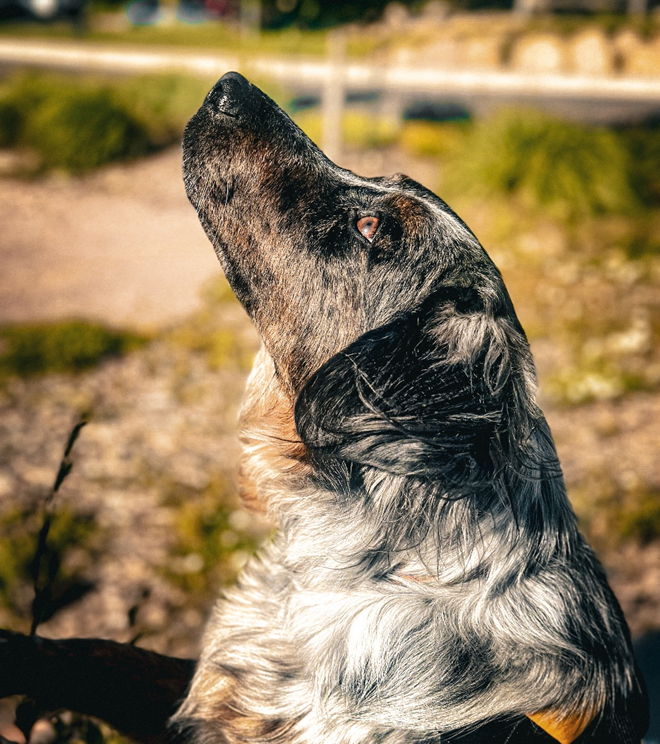
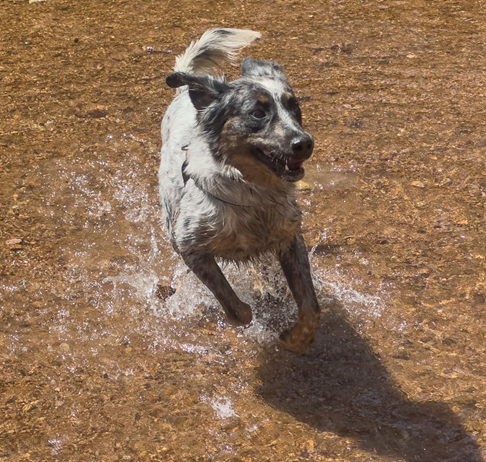
Partially vaccinated Sadie keeping her nose out of the grass where the rattlesnakes live.
There are a lot of rattlesnakes in Colorado, especially in the parks that my dog frequents on a regular basis. So when we took her to the vet last year we asked for the rattlesnake vaccine. This was a 2-injection series. She received the first dose, but when we went for the booster shot a few weeks later we were told that the vaccine was no longer available. Poor Sadie never got her booster. Fast forward to today… We just received a reminder that the dog is due her annual shots, including rattlesnake vaccine booster. So what is going on with the rattlesnake vaccine? I decided to take a look.
Rattlesnake bites
According to the ASPCA about 100,000 dogs and cats are bitten by venomous snakes each year, with rattlesnakes being the main culprit (other common offenders are coral snakes, water moccasins, and copperheads). Not surprisingly, bites most commonly occur on the face, muzzle, nose, or front paws. In other words, dogs get their nose into business they probably shouldn’t; humans are similar, with most bites being on the hands.
Most snakebites are not fatal to dogs, with estimates of fatality ranging from 1% to 30%. The risk of death is dependent upon the size of the snake and the victim. A small dog being bitten by a mature rattlesnake is much more likely to die than a large dog bitten by a young rattlesnake. In addition, some bites can be “dry”, meaning that no venom was actually transferred. However, these bites can still result in infection.
Treatment
Reactions to rattlesnake bites progress very quickly. Treatment requires administration of antivenom as soon as possible, before the venom causes too much tissue damage. Anitvenom is made up of antibodies that help to neutralize the venom in the blood. If treated promptly survival rates are as high as 95%. However, antibody products like antivenom are expensive to make, so treating a rattlesnake bite can cost $3,000–$10,000. With the high prevalence of bites and the high cost of treatment, a vaccine against rattlesnake bites, especially in the Southwest US, seems like a good idea.
The Rattlesnake Vaccine
Before we delve deeper into the history and science of the vaccine, let’s be up front about what it promises. It will not make your dog immune to rattlesnake bites. What it will do is help to prevent your dog’s immune system from having an extreme reaction, and buy time to get to an emergency vet who can administer antivenom. It will also help to reduce pain and swelling from the bite, as well as any long-term damage. From a purely financial point of view, it may also help to reduce the amount of antivenom needed, hence reducing the cost.
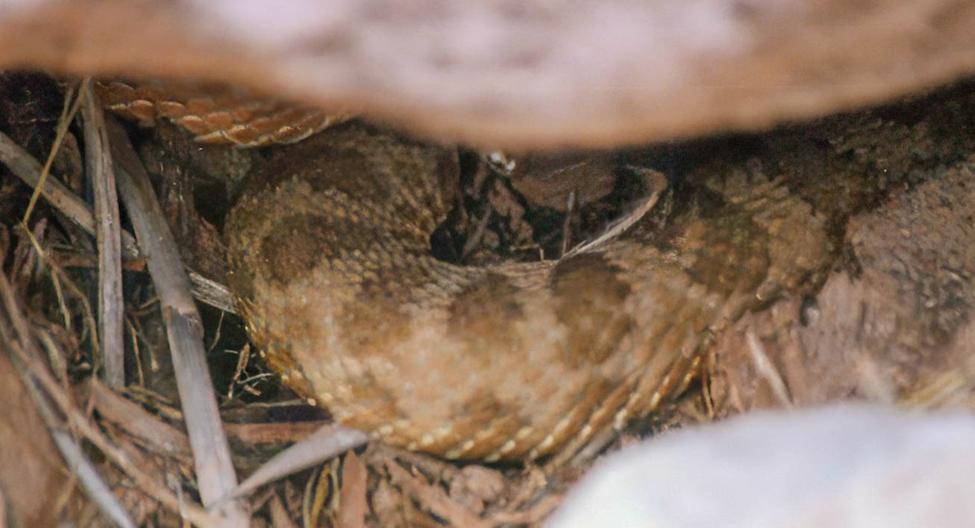
The vaccine contains Crotalus Atrox Toxoid an inactivated venom toxin from the Western Diamondback rattlesnake (Figure 1). As with all other vaccines it trains the immune system to produce antibodies against the venom. While it is designed to be effective against the more common Western Diamondback rattlesnake, it may also have activity against sidewinder rattlesnakes and timber rattlesnakes, and possibly copperheads. However, it is not effective against Mojave rattlesnake or coral snake bites.
Figure 1. Grand Canyon Rattlesnake. Unfortunately, I don’t have a photo of a Western Diamondback Rattlesnake. Fortunately, I have never actually seen one in the wild. This is the only rattlesnake picture I have, and I didn’t want to get too close for obvious reasons. The only other wild rattlesnake I have seen was 5 minutes after this one, and I nearly trod on it.
Why Is the Vaccine No Longer Available?
There is much confusion about the availability of the rattlesnake vaccine (that’s what prompted this article). Red Rock Biologics obtained a conditional license for manufacture and sale of the vaccine from USDA in 2003–2004 (vaccines for animals are regulated by USDA rather than FDA). In 2023 the rattlesnake vaccine fell afoul of a new USDA policy that ceased giving automatic renewals for conditional licenses. However, it wasn’t until Spring of 2025 that the vaccine became widely unavailable. What happened in the intervening 2 years is unclear. Many outlets attribute this to the suspension of the license, but it may just be that it took 2 years for supplies to run out. The Red Rock Biologics website is very minimal and does not address any of these issues, including whether or not the vaccine is even available.
The reason for non-renewal of the license is that after 20 years the manufacturer had not provided any evidence of efficacy or safety, something that is required to get formal and permanent approval. Conditional approval in this case is akin to FDA accelerated approval of drugs for rare diseases based on Phase 2 evidence, but with a requirement to conduct more studies. So let’s take a look at what evidence there actually is for this vaccine.
The Science Behind the Crotalus Atrox Toxoid Vaccine
Although not published the vaccine received its original conditional approval based on demonstration that it did in fact induce production of antibodies against the venom. An independent study of the vaccine in horses was published in 2013 (Gilliam, 2013). This study found that antibody production did occur, but was variable. An important detail of this paper is that the authors state that a key reason for conducting the study was because antibody titers in response to the commercially available product had not been published (the vaccine was approved for use in horses in 2010).
Published data on the efficacy of the rattlesnake vaccine are not positive. Two separate retrospective studies found that the vaccine provided no significant protection to dogs that had suffered rattlesnake bites (Leonard, 2014; Witsil, 2015). A study in mice did show that the vaccine improved survival and increased time to death compared to placebo (Cates, 2015); but this is why we don’t approve drugs based only on studies of lab mice.
There is also some question as to the safety of the vaccine. Anecdotal reports indicate that some dogs have a reaction to the vaccine. Furthermore, two case studies published in 2018 suggest that vaccination may have been the cause of anaphylactic shock in two dogs who had been bitten (Petras, 2018).
The usual way to assess the safety of a drug is to look at the label. In this case, that is not helpful; Figure 2 shows the relevant portion of the label. The corresponding section of the vaccine label for horses shows a reaction rate of 6%, mainly injection site reactions.
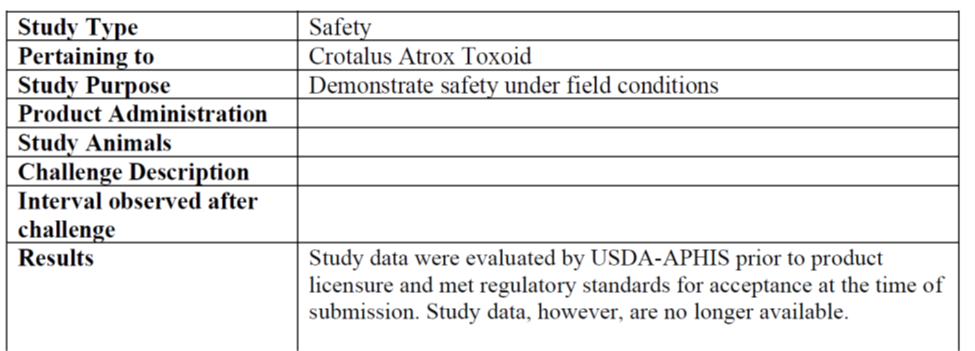
It has been reported that after losing their license the company submitted new data to USDA, but that this was rejected. It is impossible to assess this data as it has never been published. Indeed, Red Rocks Biologics does not appear to have ever published any data of any description on their vaccine.
In their defense, true efficacy and safety trials would be practically difficult to conduct. Such a study would be prohibitively large for a number of reasons. Firstly, a controlled study would be unethical, i.e. dogs (both vaccinated and unvaccinated) would have to be deliberately envenomated— whatever you think about animal experiments, no ethics board would approve subjecting multiple animals to that sort of suffering. That means hundreds of thousands of dogs would have to be enrolled just to yield a few hundred that got bitten. Add to that dog size, bite location, and the varying (unknown) potency of the actual bite and you can see that the number of confounding variables will make for a very large study. However, they have had 20+ years to figure out how to generate some data.
Conclusions
Perhaps the most surprising thing about this story is that this was not the result of RFK Jr’s FDA starting on their vaccine vendetta. In fact, veterinary vaccines are actually regulated by USDA, and the regulatory issues with the vaccine actually started during the Biden administration. While the reasons for not conducting a true efficacy and safety trial are understandable, this appears to be a matter of the manufacturer not following through on its scientific obligations following conditional approval. The lack of any publications in the peer-reviewed literature from Red Rock Biologics raises questions about their commitment to science.
The rattlesnake vaccine for dogs should in theory do what it claims to do. However, the very little data available indicates that at the same time that there may be safety issues, there is no evidence that it actually works in the real world.
When I started this article I was hoping I would unearth evidence that the vaccine was clearly effective and would be available again soon. Since that appears to not be the case, Sadie will have to keep her nose out of other people’s grass.
References:
Gilliam LL, Carmichael RC, Holbrook TC, et al. Clin Vaccine Immunol. 2013;20:732–737.
Leonard MJ, Bresee C, Cruikshank A. Vet Med (Aukl). 2014;5:153–158.
Witsil AJ, Wells RJ, Woods C, Rao S. Toxicon. 2015;105:19–26.
Cates CC, Valore EV, Couto MA, et al. Am J Vet Res. 2015;76:272–279.
메타데이터
- post_id
- 4f9557fc57dc
- slug
- rattlesnake-vaccine-for-dogs-clearing-up-the-confusion-4f9557fc57dc
- url
- https://medium.com/watts-the-science/rattlesnake-vaccine-for-dogs-clearing-up-the-confusion-4f9557fc57dc
- canonical_url
- https://medium.com/watts-the-science/rattlesnake-vaccine-for-dogs-clearing-up-the-confusion-4f9557fc57dc
- author_url
- https://medium.com/@james.street.phd
- status
- ok
- fetched_at
- 2026-06-14 11:28:49