Shanxi *Fahua* Ware: The Jeweled Architecture of Chinese Ceramics
In the vast landscape of Chinese ceramics, one category stands apart for its extraordinary texture and vibrant, jewel-like colors: **Shanxi…
Shanxi Fahua Ware: The Jeweled Architecture of Chinese Ceramics
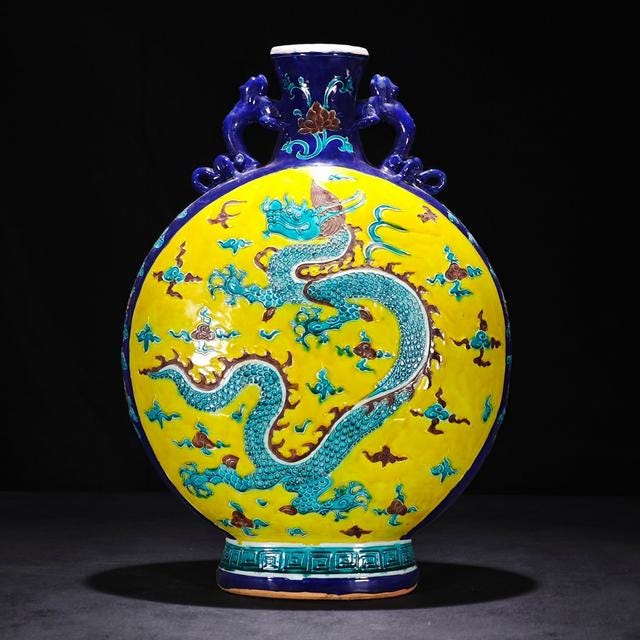
In the vast landscape of Chinese ceramics, one category stands apart for its extraordinary texture and vibrant, jewel-like colors: Shanxi Fahua Ware (山西珐华器, Shānxī Fǎhuáqì). Known in English as ”Fahua” or ”Fa-hua,” it is not a painted porcelain but a highly sculptural, low-fired pottery renowned for its raised, cloisonné-like outlines and striking translucent glazes. Primarily a product of the Ming Dynasty (1368–1644), Fahua ware served as a dramatic form of architectural and altar decoration, bringing the brilliance of colored enamels and the solemnity of Buddhist art into three-dimensional form.
Historical & Technical Context: A Northern Innovation
- Era: Flourished during the Ming Dynasty, with its roots potentially in the Yuan Dynasty.
- Location: Main kilns were located in Shanxi Province (notably around Taiyuan) and, to a lesser extent, in neighboring Shaanxi. Shanxi was a historical heartland of Buddhist temple architecture and wealthy merchant clans.
- Nature: Fahua was primarily architectural and ritual ware. Its forms were robust and iconic, designed for temples, altars, and elite homes, not for daily dining or imperial use like Jingdezhen porcelain.

The Defining Technique: The “Trailing Slip” Method
The unique appearance of Fahua is achieved through a technique reminiscent of cloisonné metalwork or cake icing, known as ”trailing slip” or ”paste-on-paste.”
- Creating the Outline: Artisans would use a tube or bag (similar to a pastry bag) to trail thick, white slip (liquid clay) onto the surface of the dried, unfired pottery body. This slip formed raised, linear barriers, outlining intricate designs of flowers, dragons, figures, or geometric patterns.
- Filling the Cells: Once the slip outlines dried, various colored glazes — predominantly turquoise blue, deep purple (aubergine), royal blue, yellow, and white — were carefully brushed into the compartments created by the raised lines. The raised slip acted as dams, preventing the glazes from bleeding into one another.
- Low-Temperature Firing: The ware was then fired at a relatively low temperature (around 800–1000°C). This produced an opaque, lead-based glaze with a soft, often slightly matte luster, rather than the hard, glassy finish of high-temperature porcelain.

Aesthetic & Artistic Character: Bold and Iconic
- Visual Impact: The effect is one of stunning boldness and clarity. The combination of sculptural lines, intense opaque colors, and metallic accents creates an object of immense decorative power.
- Color Palette: The iconic turquoise blue is its most recognizable feature, often paired with aubergine purple and accented with yellows and greens. These colors have distinct mineral bases: copper for turquoise/green, manganese for purple, and iron for yellow/brown.
- Metallic Accents: Many finer pieces feature additional gilding applied over the fired glaze, adding a final layer of opulence to highlight motifs like dragon scales or floral centers.
- Common Forms: Typical Fahua objects include:
- Altar Jars and Vases: For temple and home worship.
- Censer (Incense Burners): Often in archaic bronze shapes.
- Figures of Deities: Such as Guanyin or Luohan (Arhats).
- Roof Ridge Tiles and Architectural Ornaments: For decorating temples.

Cultural & Religious Significance
Fahua ware is deeply intertwined with Chinese folk religion and Buddhism. Its majestic and iconic style was perfectly suited for creating an aura of sanctity and awe in sacred spaces. The motifs — lotus flowers, Buddhist symbols, dragons, phoenixes — are all charged with religious and auspicious meaning. It represents the embodiment of temple art in ceramic form, making the divine tangible and radiant.
Jingdezhen’s Porcelain Imitation & Distinction
The style became so popular that the imperial kilns at Jingdezhen began producing their own version during the Ming and Qing dynasties. However, the Jingdezhen version was fundamentally different:
- Shanxi Fahua: Low-fired pottery (stoneware/ear thenware) with a soft body, raised slip outlines, and opaque, low-temperature lead glazes.
- Jingdezhen Fahua: High-fired porcelain with a white, hard body. The outlines were often created with raised threads of clay or even painted resist, and the colors were transparent, high-temperature glazes.
The Jingdezhen pieces are more refined and delicate, while the original Shanxi Fahua is more robust, sculptural, and visually potent.

Conclusion
Shanxi Fahua Ware occupies a unique and dazzling niche in ceramic history. It is not subtle but spectacular, prioritizing dramatic visual impact and tactile presence over painterly finesse. It stands as a testament to the ingenuity of northern folk kilns, applying textile and metalwork techniques to clay to serve faith and architecture. To encounter a piece of true Ming Fahua is to witness a fragment of a Ming Dynasty temple’s splendor — a jewel-like, three-dimensional painting in clay and glaze that continues to command reverence and awe centuries later.
메타데이터
- post_id
- 4fa4daad248d
- slug
- shanxi-fahua-ware-the-jeweled-architecture-of-chinese-ceramics-4fa4daad248d
- url
- https://medium.com/@owlchenweiliang219/shanxi-fahua-ware-the-jeweled-architecture-of-chinese-ceramics-4fa4daad248d
- canonical_url
- https://medium.com/@owlchenweiliang219/shanxi-fahua-ware-the-jeweled-architecture-of-chinese-ceramics-4fa4daad248d
- author_url
- https://medium.com/@owlchenweiliang219
- status
- ok
- fetched_at
- 2026-06-24 13:29:15






