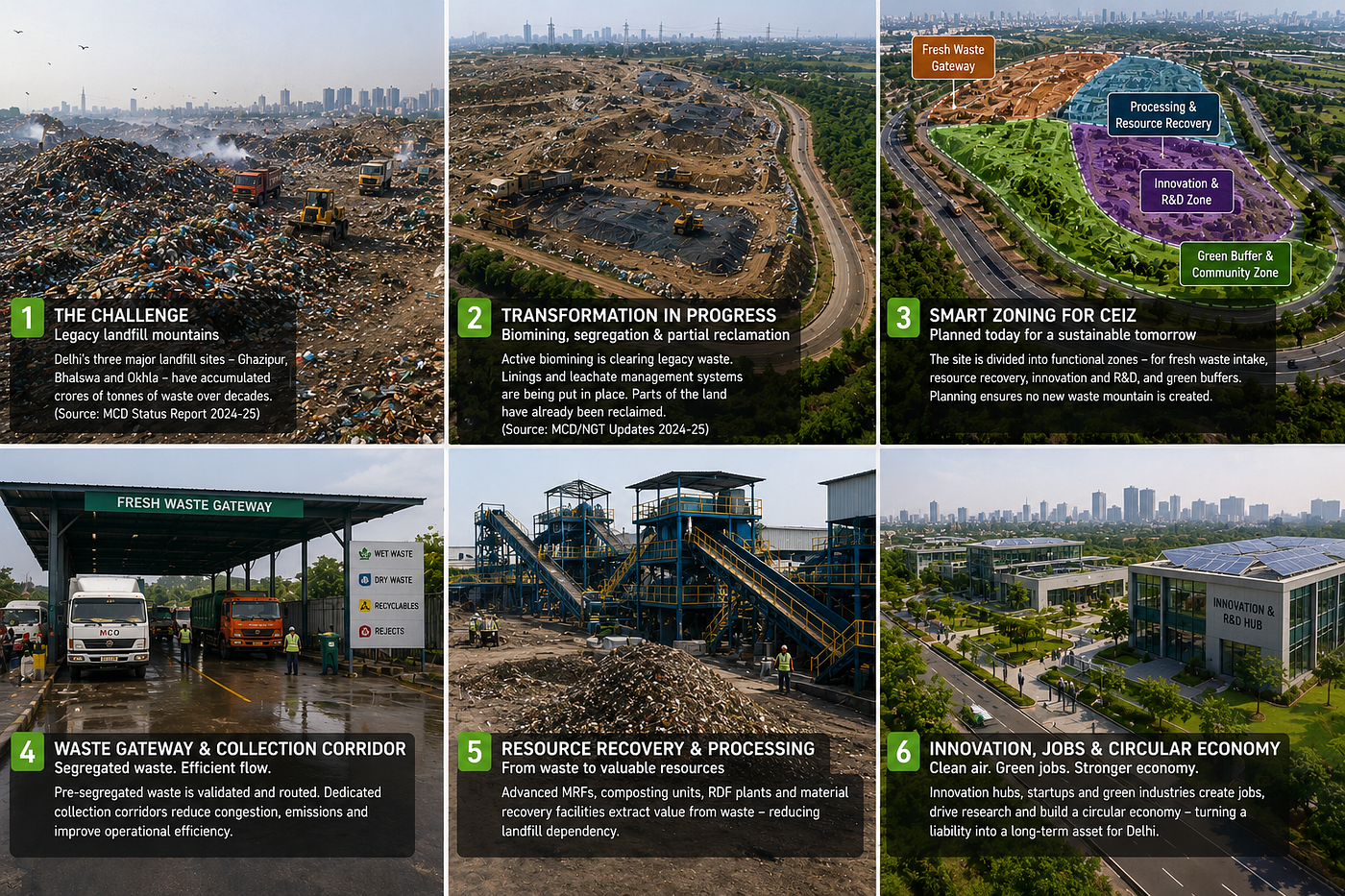
Waste Is Only Waste Until Innovation Finds Value In It
Because awareness starts movements, but economics sustains them.
Waste Is Only Waste Until Innovation Finds Value In It
Because awareness starts movements, but economics sustains them.

A suggestive policy Framework for Indian Government to look at for fostering economy
India may be one of the few countries in the world capable of transforming public behaviour at massive scale within days. We have stood in long queues during demonetisation, rapidly adopted digital payments, participated in nationwide cleanliness drives, adjusted to lockdown restrictions during COVID-19, and collectively responded whenever national missions emotionally connected with citizens. And yet, despite this extraordinary ability for mass mobilisation, India still struggles with one of the most basic civic challenges:- systematic waste management.
- Wet waste gets mixed with dry waste.
- Recyclable material quietly reaches landfills.
- Plastic enters rivers alongside religious offerings.
- Industrial scrap occupies valuable land for years.
- Government facilities accumulate unused machinery and obsolete equipment because disposal processes remain slow and risk-sensitive.
At first glance, waste appears to be only a sanitation problem. But perhaps the larger issue lies elsewhere.
Perhaps, India still largely sees waste as something to discard — rather than something to recover.
1. Waste is only waste until innovation finds value in it.
India’s Waste Problem is Also an Economic Opportunity. According to the Central Pollution Control Board (CPCB), India generates more than 1.7 lakh tonnes of solid waste every single day. India’s e-waste generation has also crossed 16 lakh tonnes annually and continues rising rapidly due to increasing consumption of:
- electronics,
- batteries,
- appliances,
- digital devices,
- packaging materials,
- textiles, and
- Construction products.
But hidden inside this growing waste stream is another reality: — “economic value”.
Plastic, metal scrap, batteries, construction debris, organic waste, textile fibres, industrial residue, fly ash, discarded electronics, and obsolete machinery are not merely waste streams. Many of them are future raw materials waiting for commercially viable recovery systems. In simple terms:
India may not only be generating waste. It may also be generating one of the world’s largest untapped circular economies.
2. Awareness Alone Cannot Sustain Systems
India has already launched several important initiatives in sanitation and environmental management. Programs such as:
- Swachh Bharat Mission,
- Namami Gange Programme,
- River-cleaning missions,
- Plastic waste rules,
- E-waste regulations,
- Battery waste management frameworks, and
- Biomedical waste regulations
have significantly improved awareness and public participation. And these efforts deserve recognition. Because
- Awareness matters.
- Behavioural change matters.
- Public participation matters.
But history repeatedly shows one important truth:
“systems become sustainable only when economics supports them”.
“Industries scale where commercial viability exists”.
“Innovation accelerates where investment becomes profitable”.
“Supply chains strengthen where recovery creates financial returns”.
India’s informal scrap ecosystem already proves this every single day.
Across cities and towns, thousands of kabadiwalas, recyclers, scrap dealers, aggregators, and repair workers recover value from paper, cardboard, metal, plastics, and electronic waste because there is economic incentive in doing so.
Which raises a larger National question:
“What happens when innovation makes a much larger portion of waste commercially valuable? “
Because the day waste begins behaving like economically recoverable raw material, the entire ecosystem changes. Suddenly:
- Segregation becomes profitable,
- Recycling attracts investment,
- Start-ups enter the ecosystem,
- Technology improves,
- recovery supply chains strengthen, and
- Public cleanliness stops being only a municipal responsibility.
3. India May Need a Circular Economy Ecosystem — Not Just Waste Collection Systems
Perhaps the next stage of India’s waste-management journey requires thinking beyond traditional municipal models. Instead of treating waste merely as sanitation, India could consider building dedicated integrated ecosystems focused on:
- waste recovery,
- recycling technologies,
- resource extraction,
- industrial scrap processing, and
- circular economy innovation.
One possible approach could be the creation of:
“ Circular Economy Innovation Zones (CEIZ) “
These could function somewhat like industrial clusters or SEZ-style ecosystems — but specifically designed for:
- recycling industries,
- waste-to-wealth technologies,
- start-up incubation,
- industrial recovery systems, and
- Most importantly, circular-economy R&D.
Because currently, India’s waste ecosystem operates in fragmentation.
Municipalities collect waste.
Industries generate waste.
Researchers work separately.
Start-ups experiment independently.
Informal workers operate outside institutional systems.
And recyclers often lack integrated infrastructure support.
What if all of them operated together within one collaborative ecosystem?
3.1 What Could Circular Economy Innovation Zones Include?
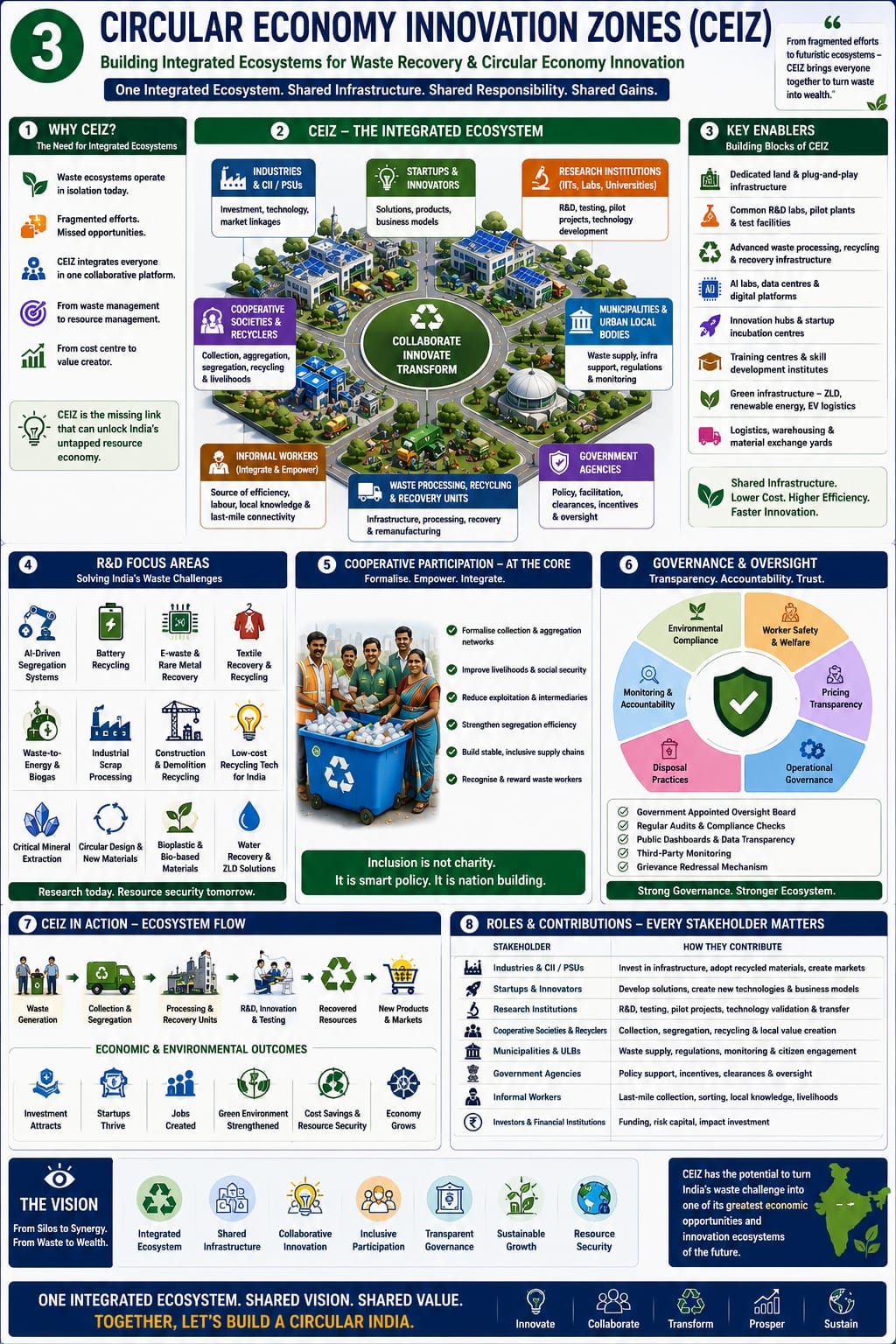
The Concept of Circular Economic Innovation Zone
Such ecosystems could potentially integrate:
- Industries,
- Start-ups,
- IITs and engineering institutions,
- research labs -using advanced technologies of AI,
- Municipalities,
- Recyclers,
- cooperative societies,
- Industrial Bodies — CII, PSUs,
- policy institutions, and
- informal waste workers
within a single coordinated framework.
These zones could evolve into:
- Recycling clusters,
- Innovation hubs,
- Pilot-scale testing centres,
- Start-up incubation parks,
- Waste-processing facilities, and
- Future circular-economy industrial corridors.
3.2 The Role of Research, Technology & Innovation
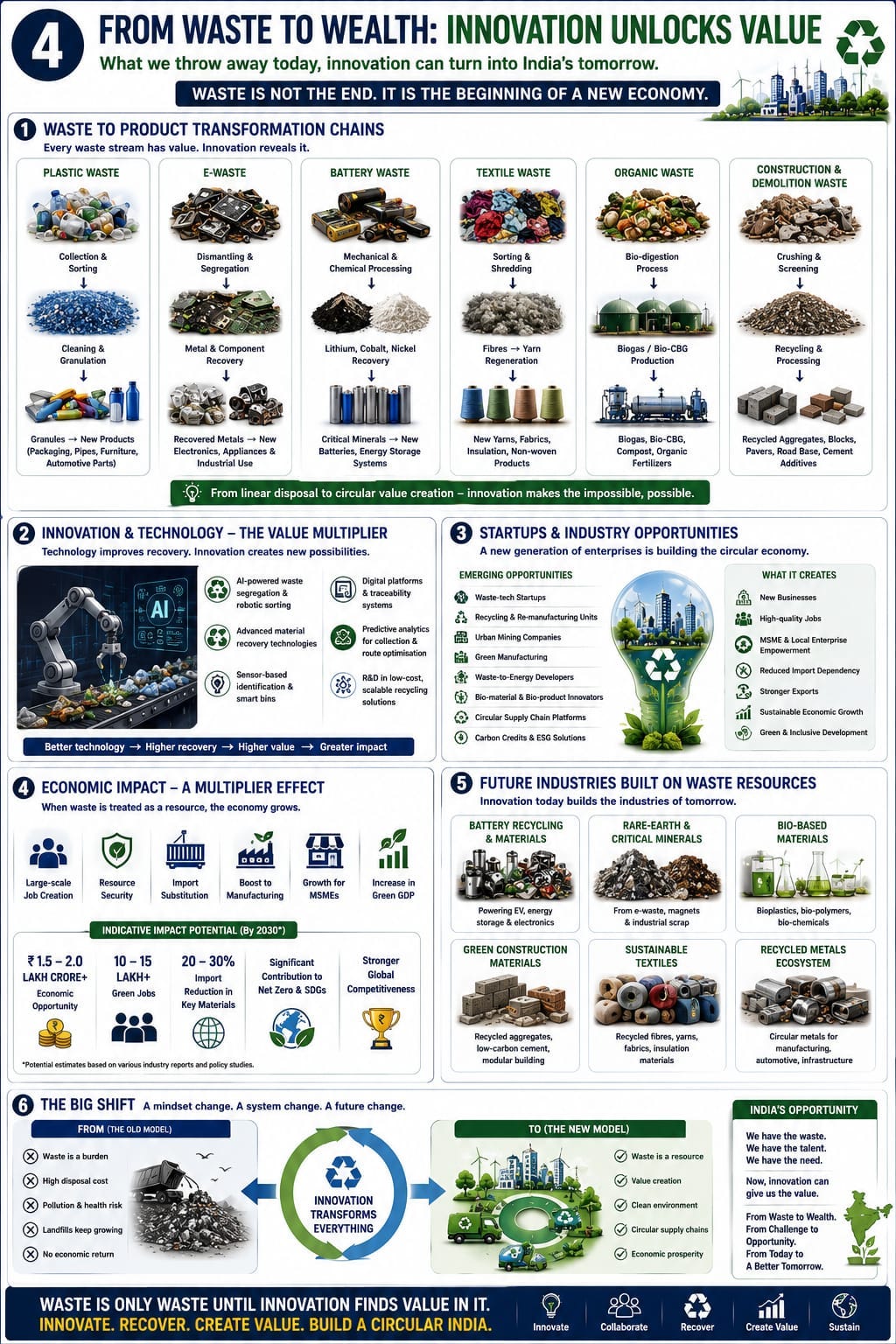
The Gamechanger — Research, Technology and Innovation
India’s waste challenge cannot be solved only through collection systems. It will require large-scale innovation. Research institutions and industries could collaborate on technologies such as:
- AI-driven waste segregation,
- Battery recycling systems
- Critical mineral recovery,
- Textile fibre recovery,
- Plastic re-processing,
- Industrial scrap optimisation,
- Low-cost recycling technologies,
- Waste-to-energy systems,
- Sewage recovery systems,
- Fly ash utilisation,
- Advanced material recovery.
- And Many more.
But for innovation ecosystems to mature, India may also need stronger exposure to global best practices.
“India Should Promote Global Learning & International Collaboration”
One important step could involve:
“Government-supported international exposure programs for researchers, engineers, start-ups, and policymakers”.
Selected researchers and innovators could be encouraged to visit:
- Advanced recycling plants,
- Waste-to-energy facilities,
- Circular-economy parks,
- Automated segregation systems,
- Advanced Battery recycling facilities, and
- Industrial recovery ecosystems
across countries already leading in circular economy technologies.
Such exposure could help India : —
adapt global best practices, reduce technology-development timelines, avoid repeated experimentation failures, and build Indian solutions suited to local realities.
“Innovation often accelerates when learning ecosystems remain globally connected.”
3.3 Industry Interaction Must Become Continuous — Not Occasional
Another major gap today is the lack of frequent collaboration platforms between:
- Policymakers,
- Industries,
- Start-ups,
- Researchers,
- Financiers, and
- Recyclers.
Perhaps India needs a dedicated national platform where industry leaders and innovators interact regularly on:
- Emerging waste technologies,
- Recycling economics,
- Investment challenges,
- Pilot projects,
- Technology gaps, and
- Policy bottlenecks.
Frequent interaction mechanisms could include:
Quarterly innovation forums,
Industry-research conferences,
Government-backed collaboration councils,
Start-up-industry matchmaking platforms, and
Sector-specific circular economy consortiums.
Because innovation ecosystems grow faster when ideas move continuously between laboratories, industries, and markets.
3.4 Waste Innovation Requires High-Priority Monitoring
Many waste-management projects fail not because of lack of ideas — but because execution gradually loses urgency. Circular economy projects often involve:
- Multiple departments,
- Environmental approvals,
- Municipalities,
- Industries,
- Logistics systems, and
- Funding agencies.
As a result, implementation slows down. Perhaps circular-economy projects require:
- Dedicated monitoring cells,
- Milestone-based reviews,
- Inter-ministerial coordination,
- Fast-track approvals, and
- High-priority implementation frameworks.
If India views circular economy as both environmental infrastructure and economic infrastructure, execution speed may improve significantly.
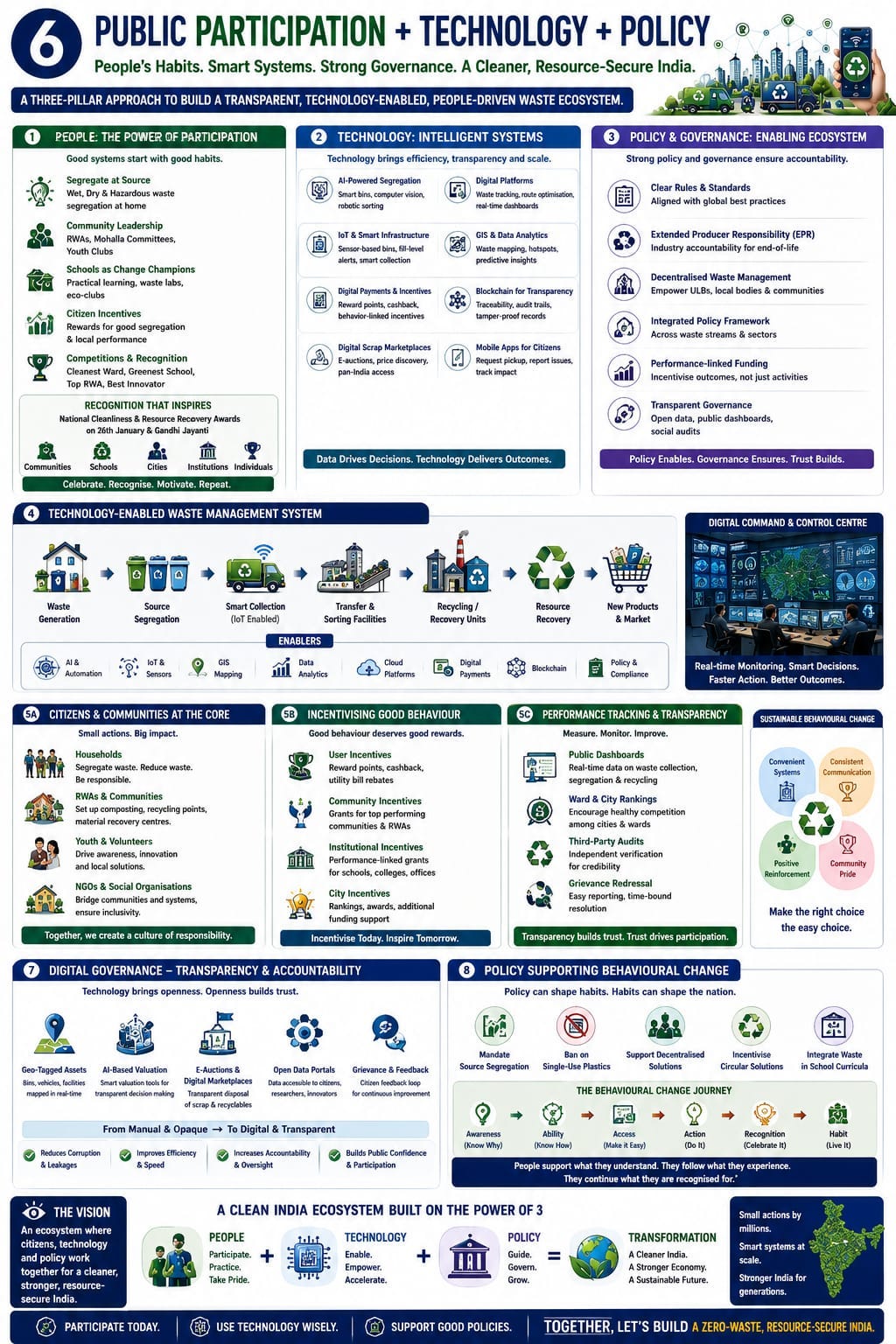
Idea of Policy when collaborated with Technology and led by public Participation
3.5 India Must Encourage Creative Talent in Waste Innovation
Some of the best waste-management ideas may not emerge only from large corporations or research labs. They may emerge from: — students, local innovators, start-ups, engineers, rural entrepreneurs, fabricators, and even informal workers.
Which is why India may need stronger systems to identify and encourage creative talent in circular economy innovation. Governments, industries, PSUs, and academic institutions could jointly promote:
- Innovation challenges,
- Reward-based idea competitions,
- School-level sustainability projects,
- Student innovation grants,
- Start-up fellowships, and
- Incubation support programs.
Because innovation ecosystems become stronger when participation becomes democratic.
“India Needs Government / Industry Backed Circular Economy Hackathons”
India has already demonstrated success with large-scale innovation missions in:
- Digital payments,
- Space technology,
- Renewable energy,
- Start-up ecosystems, and
- Semiconductor manufacturing.
Perhaps circular economy innovation also deserves similar national attention. Frequent government-backed hackathons and innovation programs could help identify:
Breakthrough recycling ideas,
Scalable segregation technologies,
Low-cost machinery solutions,
Rural waste-management systems,
Digital traceability platforms, and
Start-up-ready innovations.
These hackathons could involve:- IITs/NITs , Engineering colleges, Start-ups, PSUs, Municipal bodies, and Industry associations.
Winning ideas could receive:- funding support, pilot opportunities, incubation access, industry mentorship, and national-level recognition.
“Talent grows faster when ecosystems continuously discover and support it.”
3.6 India May Need a Dedicated National Circular Economy Institution
India created institutions like Software Technology Parks of India (STPI) to strengthen strategic technology ecosystems. Perhaps the country may now require a similar institutional framework dedicated specifically to circular economy development.
One possible model could be:
“Circular Economy Parks of India (CEPI) / Circular Economy Innovation Zones (CEIZ) “
or a similar national body focused on:
- Circular-economy infrastructure,
- Recycling technology ecosystems,
- Innovation parks,
- Start-up support,
- Industrial coordination,
- Research collaboration,
- Skill development, and
- Policy facilitation.
Such an institution could act as:
- Ecosystem coordinator,
- Technology enabler,
- Innovation facilitator,
- Funding catalyst, and
- National knowledge platform.
Over time, it could help India develop globally competitive leadership in waste-recovery technologies.
3.7 Formalising Informal Workers Through Cooperative Participation
India’s waste ecosystem already depends heavily on today’s informal sector : — Kabadi-walas, Scrap collectors, Aggregators, waste pickers, and local recyclers.
Yet most large policy systems barely integrate them formally. Instead of excluding them, India could strengthen them through:
- Cooperative structures,
- Digital integration,
- Skill development,
- Social security frameworks, and
- Institutional participation.
Formalisation could:- improve livelihoods, reduce exploitation, strengthen segregation networks, improve traceability, and increase recovery efficiency.
“A successful circular economy cannot ignore the people already sustaining it informally “.
3.8 Incentives Matter — Because Innovation Carries Risk
Waste-recovery R&D often involves:
- Expensive pilot projects,
- Imported machinery,
- Uncertain commercial outcomes,
- Repeated testing failures, and
- Long gestation periods.
As a result, industries may hesitate to invest aggressively despite long-term national benefits. One possible solution could involve:
“Performance-linked innovation incentives.”
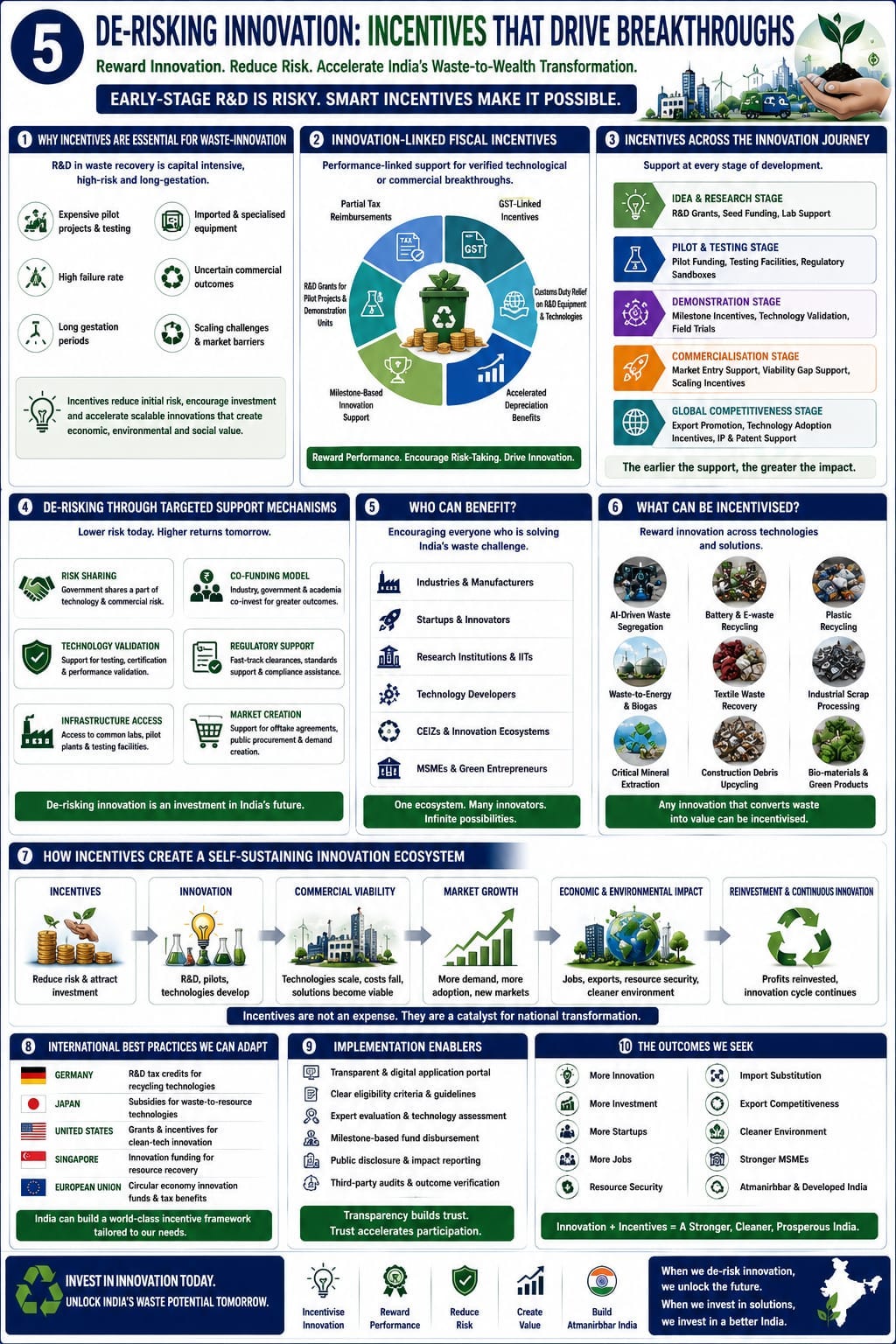
The idea of De-risking Innovation and R&D
Successful innovations achieving verified environmental or commercial outcomes could become eligible for:
- Tax reimbursements,
- GST-linked incentives,
- Customs-duty relief,
- Accelerated depreciation,
- Green financing support, or
- Milestone-based grants.
India has already used incentive-led models successfully in:
- Renewable energy,
- Electronics manufacturing,
- EV ecosystems,
- Digital payments, and
- Semiconductor policies.
Perhaps Circular economy innovation may now deserve similar strategic focus.
3.9 Public Participation Still Remains the Backbone
Even the world’s most advanced recycling systems struggle when waste segregation fails at the source.
No amount of technology, automation, or artificial intelligence can fully compensate for undisciplined disposal habits at the household level.
This means public participation remains the cornerstone of any successful waste management policy.
- Schools can play a transformative role by introducing practical waste segregation exercises and environmental stewardship programs from an early age.
- Residential societies can be encouraged to adopt decentralized recycling models and participate in healthy competitions based on waste reduction and recovery performance.
- Municipal bodies can further strengthen this ecosystem by rewarding communities that consistently demonstrate high levels of segregation and recycling.
Equally important is the way society perceives waste.
- Public awareness campaigns should gradually shift the narrative from “garbage disposal” to “resource recovery.” Language influences behaviour.
“Garbage” is often viewed as a burden to be discarded, whereas “resource recovery” highlights the economic and environmental value embedded within waste streams.
A key reform area is the
- Establishment of a Centralized Resource Recovery and Collection Network, drawing inspiration from successful international practices. Under such a system, citizens would be encouraged to voluntarily bring segregated recyclable materials — such as plastic bottles, metal cans, glass containers, electronic waste, and other recoverable materials — to designated collection centres.
To promote participation, governments and local bodies could
Implement a Deposit-Return and Incentive Mechanism, whereby citizens receive monetary compensation, digital reward points, tax rebates, utility bill credits, public recognition, or other benefits proportional to the quantity and quality of materials recovered. Modern technologies such as QR codes, digital wallets, and citizen reward platforms can make participation simple, transparent, and scalable.
Beyond financial incentives,
Public recognition can serve as a powerful motivator.
Individuals, schools, housing societies, businesses, and local communities demonstrating exceptional resource recovery efforts could be acknowledged through awards, sustainability rankings, certification programs, and public recognition initiatives. Such measures would help create a culture where responsible waste management becomes a matter of civic pride rather than regulatory compliance.
The long-term objective should be to transform waste from an environmental liability into an economic resource. When citizens are empowered, incentivized, and recognized for their contribution, waste management evolves from a government-led disposal activity into a nationwide resource recovery movement that generates environmental, social, and economic benefits for all stakeholders.
3.10 Government & PSU Scrap Systems Also Need Reform
Across railway yards, workshops, warehouses, industrial facilities, mines, and government campuses, enormous quantities of obsolete equipment and scrap remain unused for years.
To be fair,
“Disposal decisions inside public systems are complex.”
“Audit risks, valuation concerns, vigilance fears, transportation challenges, and legal complications often slow disposal processes.”
But idle scrap is not merely a cleanliness issue. It is also:
- Blocked land,
- Locked capital,
- Operational inefficiency,
- Safety risk, and
- Lost recovery opportunity.
A simple policy and procedural reform can significantly improve waste and scrap disposal outcomes. Along with providing clear guidelines that protect officials acting in good faith from undue audit, valuation, or vigilance concerns, institutions and officers who proactively identify, segregate, and dispose of scrap or unused assets should be formally recognised and incentivised.
Performance-linked recognition, annual awards, and measurable disposal targets can help shift the focus from risk avoidance to resource optimisation.
When positive outcomes are acknowledged and rewarded, organisations are more likely to take timely action, resulting in cleaner facilities, better asset utilisation, and enhanced resource recovery.
3.11 National Recognition Can Create Social Momentum
India has always valued public recognition. Perhaps, Circular economy champions should also receive national visibility and honour. Special recognition programs could felicitate:
- Innovators,
- Researchers,
- Start-ups,
- Municipalities,
- Recyclers,
- Cooperative societies,
- Schools,
- Industries, and
- Citizen groups
working exceptionally in waste recovery and sustainability.
Recognition ceremonies on national occasions such as:
- Gandhi Jayanti (2nd October),
- Republic Day (26th January),and
- Independence Day (15th August)
could help transform the circular economy into a matter of national pride.
Because Recognition inspires participation, and Participation multiplies impact.
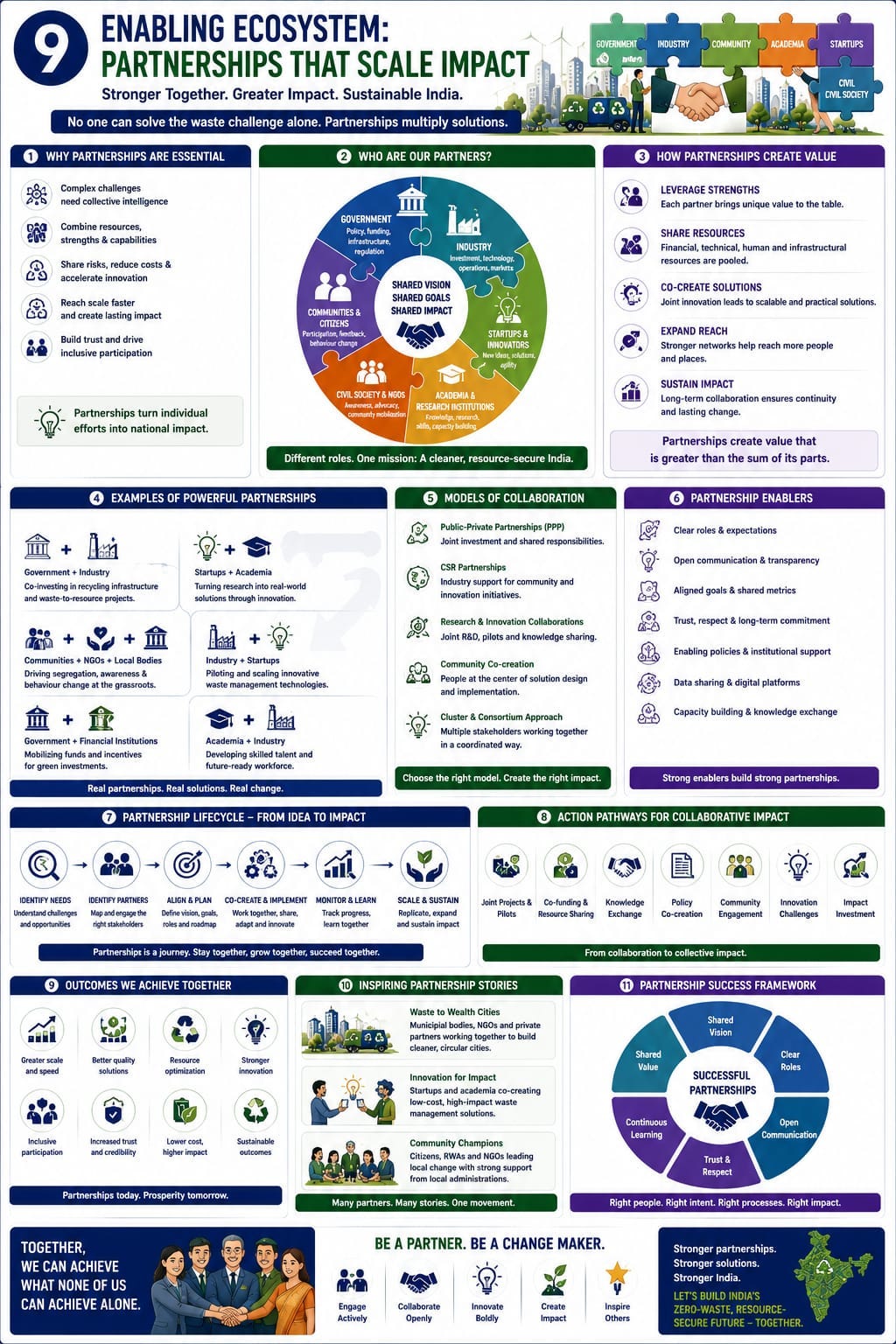
Ecosystem Enabler for Circular Economy
3.12 The Future of Waste Management Is Larger Than Cleanliness
Waste management is no longer only a sanitation issue. It is increasingly becoming:
An economic issue,
An innovation issue,
An environmental issue,
A climate issue,
A resource-security issue,
And perhaps even a strategic national-development issue.
India has already demonstrated that awareness can mobilise millions. The next challenge may simply be this:
Can India now build an innovation ecosystem where cleaning waste also creates economic value?
Because,
“ Awareness may start movements, but only economics can sustain them.”
And perhaps
“ The future of a cleaner India will depend on how quickly we stop seeing waste merely as something to throw away —
and start seeing it as something waiting to be transformed.”

메타데이터
- post_id
- 4fa830f82caa
- slug
- waste-is-only-waste-until-innovation-finds-value-in-it-4fa830f82caa
- url
- https://medium.com/@rohit.kr3531/waste-is-only-waste-until-innovation-finds-value-in-it-4fa830f82caa
- canonical_url
- https://medium.com/@rohit.kr3531/waste-is-only-waste-until-innovation-finds-value-in-it-4fa830f82caa
- author_url
- https://medium.com/@rohit.kr3531
- status
- ok
- fetched_at
- 2026-06-09 15:37:30