I Slept in the Outfield at the Field of Dreams — Nobody Planned It
A stranger named Ken owned the most famous baseball diamond in America. One night, he handed it to a tired man on a bicycle
ON THE ROAD
I Slept in the Outfield at the Field of Dreams — Nobody Planned It
A stranger named Ken owned the most famous baseball diamond in America. One night, he handed it to a tired man on a bicycle
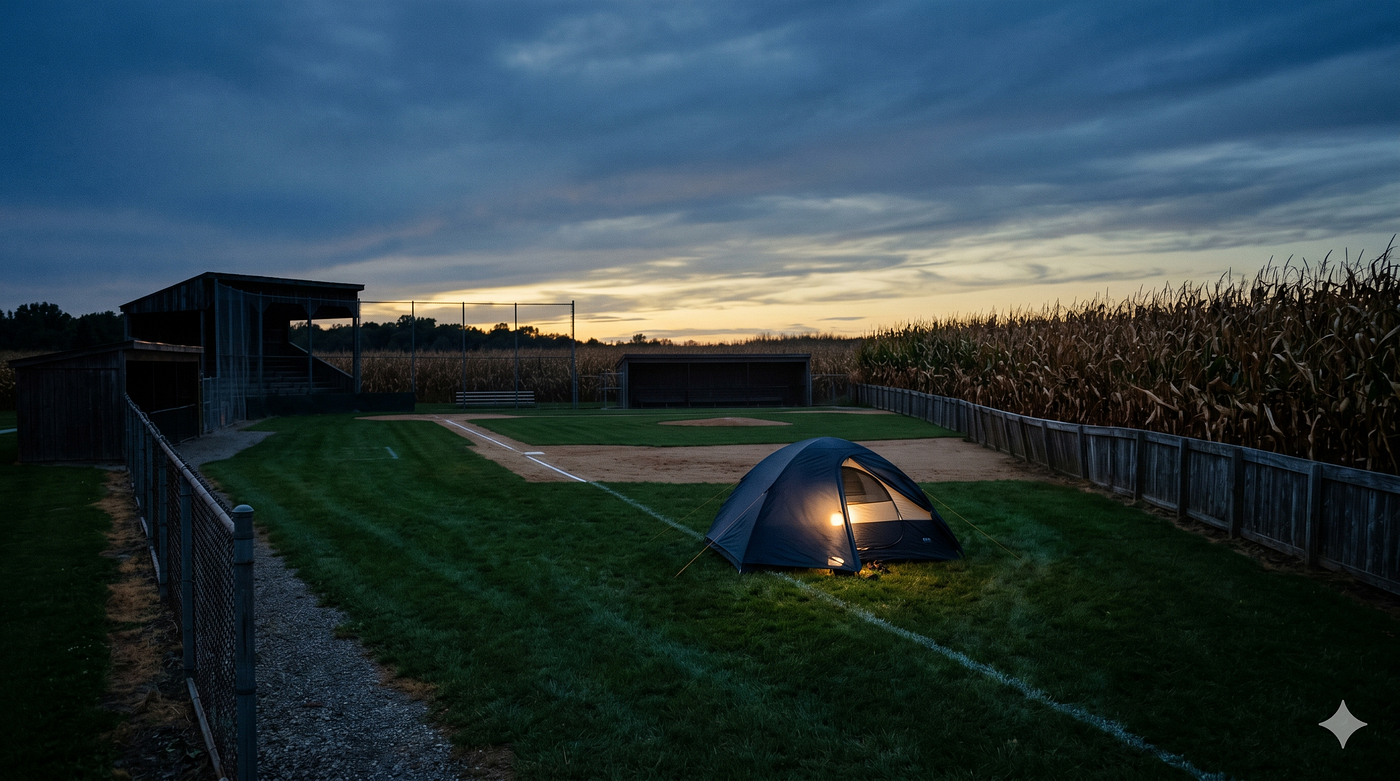
AI image created by author
There’s a kind of tired that sleep won’t touch. I had been carrying it for the better part of two years, the way a man carries a debt he can’t put a number on, and I had hauled it across half a country on a bicycle that knew me better than most people did. Then one September night in Iowa a stranger handed me a baseball field, and for a few hours the debt went quiet. That’s the heart of it. The rest is just how it came to pass.
I’d picked up a rule out on those long roads, the kind they don’t print in books. The good things come at you sideways. They don’t knock. They don’t keep appointments. They slide in from a blind corner wearing a stranger’s face and a stranger’s easy smile, and by the time you’ve worked out what they are, they’ve already changed the weather inside your chest. I learned it slow. I learned it the hard way, which is the only way the lesson ever sticks.
I’d been asked to speak at a civic club in a town called Dyersville. Strange business. A man who had backed out of his own driveway one gray morning with no plan and no place to be, and somewhere down the line folks decided they wanted to hear him talk. I’d made my peace with the oddness of it. You tell a story enough times and it stops being a wound you’re holding up for the room to look at. It turns into something you slide across the table, like a cup of coffee, like a thing the two of you somehow already knew.
Photo by Bill Stephan on Unsplash
So I talked. They listened the way decent people listen, leaning in a little, the room gone warm and close against the dark pressing on the windows. Then it broke up the way those rooms always break up. Chairs dragging. Hands finding hands. People folding back into their own lives like cards going back in the deck. I was gathering my things when a man came up slow and waited for the others to thin out. He had the patient face of somebody who’d done a lifetime of waiting and never once let it cost him his sleep.
He told me his name was Ken Larson.
Then he told me he owned the field.
I want to take this part slow, because the moment had weight and it earned the slowness. Picture it. A folding-chair room in a small Iowa town, the coffee gone to tar in the urn, and across from me a plain-spoken man who happened to own the most famous patch of grass in America. The diamond they cut out of a cornfield. The one where the ballplayers come walking out of the corn like the dead deciding to give it one more swing. The one where a grown man finally gets to throw the ball with his father and ask the question all the years never let him ask. Field of Dreams. That field. His field. And he stood there mentioning it like it was a back lot behind a feed store.
He asked if I’d like to sleep on it.
I said yes before the sentence had finished leaving his mouth. Some invitations you don’t chew over. You swallow them whole and find a way to say thank you later.
Photo by Kyle Cleveland on Unsplash
We drove out through the Iowa dark in his truck, the headlights carving a thin yellow road through a whole lot of nothing. Ken was easy company, the kind that doesn’t run you a tab. He didn’t put on a show of his kindness. He didn’t hang a price tag on it where a man could see the numbers. He just set the thing down in front of me and looked the other way, which is the only brand of giving that never leaves a bruise. He had heard my story back in that room. I think he understood I was tired in a place that miles can’t reach. He didn’t ask me to spread it out for him. He just drove, and the corn ran by black and endless on both sides, and neither of us felt the need to fill the quiet.
He stopped at the edge of the field and told me to put the tent up anywhere I pleased.
I stood there a minute and let my eyes do their work. The diamond pale and patient in the dark. The grass running off into nothing at all. And out past every bit of it the corn, tall and dry and whispering in the September wind, the stalks crowded shoulder to shoulder along the far edge of the outfield like a crowd that had been waiting a long time and had every intention of waiting longer.
I picked right field.
That’s the corner where the ballplayers vanish into the corn in the picture. I didn’t reason it out. I was beat, the dark was the kind that has no floor to it, and I wanted to be out there in the middle of the thing instead of up near the infield where a man feels watched by the dark. But I’ve turned it over plenty since. Of every square foot on that famous ground, I went and laid my head down in the one place where things go to disappear. Where a man walks into something tall and black and doesn’t come back out the same shape he walked in.
Maybe that’s too much freight to hang on a tent stake. Maybe a worn-down man just wanted to lie flat and quit thinking for a while. I couldn’t tell you which one is the truth. Both of them are true, and I gave up a long while back on making them pick.
Ken stuck around a few minutes. Made sure I had what I needed. We traded a little more talk about his life and the long road at my back. Then he went on up to the house and left me to the dark and the field and whatever the night had in store.
I got the tent up by feel and crawled in.
The corn came alive after that. I don’t have a cleaner way to say it. When the breeze moved through, the stalks dragged on each other in a sound that was dry and soft at once, a hush with a blade’s edge on it, like silk being pulled slow across a knife. Not loud. Not mean. Just there, steady as a pulse you forget you have. The corn talking to itself, or to anybody fool enough to lie still and listen. Under all that, the crickets kept up their small tin machinery. The whole orchestra of an Iowa night in September, tuning up for an audience of one tired man in a tent in right field.
Sure, I thought about the picture. You can’t lie on that grass under that wide black sky next to that corn and keep the picture out of your head. But somewhere in the dark it started to thin and fade, and the real place crowded it out the door. Not the version with the soft gold light and the music swelling up to tell a man how to feel. This one. The actual dark. The actual corn. The actual ground that stood here long before anybody aimed a camera at it and would still be standing long after the last reel had gone to dust.
I lay awake a good while before sleep came around to collect me. Not afraid. Just wide open to it. A man past the middle of his life, alone in a tent in the dead center of a continent, on a field that strangers cross the country just to stand on. No home waiting behind me. No notion where I’d lay my head the next night. And for the first time in longer than I cared to add up, that didn’t feel like a hole I was falling through. It felt like a door somebody had gone and left open on purpose.
Then I slept, and let the corn do the talking.
I’ll use a word now that I don’t spend often, because it gets cheap fast in careless hands. It was magical. Plain and true and not a bit of it planned. The not-planned part is the part I hold onto these days. Because here’s what the long road kept teaching me. The moments I built up in advance hardly ever paid out. The big famous overlooks. The sights I half killed my legs riding a hundred miles to stand in front of. They were fine. Some of them were less than fine. The real gifts came in off the blind side, the way Ken came in off the blind side, out of a folding-chair talk in a town I’d never heard of, in the shape of a quiet man who owned a field and knew the exact minute to open the gate.
I didn’t earn that night. I want that down on the record clean. I didn’t ride harder than the next man or deserve it any more than some other tired soul on some other dark road. It just came. A stranger heard a story and decided to be decent about it, and a famous field went still and held me until morning, and that was the whole transaction. You can’t book a thing like that in advance. You can only stay out where it might come looking for you.
Come morning, Ken’s family pulled me inside.
His wife had laid out a breakfast that meant business. Eggs and biscuits and bacon and pancakes and coffee that kept coming like it had nowhere finer to be. I sat at their table and ate every bit of it and felt what I’d felt at a hundred tables by then, the rare grace of people who feed a stranger before they make him explain himself. We talked. The kids watched me the way kids watch a man who’s blown in from someplace they can’t picture on a map. I answered what they asked. I drank the coffee. I let it be easy, which is a harder trick to pull than it sounds.
Then it was time to go. It is always time to go.
I loaded the bike and rolled out to the road. At the edge of the field I turned back for one last look.
The corn still stood out there keeping its own counsel. The diamond lay empty and perfect in the early light. And I’d swear I could see them out on the grass, not with my eyes, but the way you see things that belong to a place. The ballplayers drifting onto the field for morning practice, easy and unhurried, moving like men who had all the time the living never quite get their hands on.
Ken and his family stood up on the porch and waved me off down the road.
I faced the road again and kept going. A man on a bicycle always keeps going. It’s about the only thing he knows for certain how to do.
I think about right field more than I ever figured I would. About bedding down, without meaning to, in the one corner where things go to vanish. I’d walked out of a thirty-five year marriage and pedaled straight into a life I couldn’t yet make out in the dark. And I wonder, some nights, whether some buried part of me drove that stake on purpose. Whether the worn-out body understood something the planning mind hadn’t caught up to yet.
I still don’t know. I’ve made my peace with the not-knowing. Maybe that’s about the closest thing to wisdom a man like me ever gets handed.
Here’s the one thing I’ll stand behind. Stay out on the road long enough, keep telling the truth about where you’ve been, and every so often a stranger named Ken turns out to own the exact thing you need for a single night, and he hands it across and asks for nothing back. You won’t see it coming. That’s the whole point of it. If you could see it coming it wouldn’t be worth the having.
So you keep moving. You keep the tent rolled tight and ready by the back wheel. You leave a little room in the plan for the thing you never planned.
And some nights, if the dealer’s feeling kind, the corn talks you all the way down to sleep.
About the Author
Jerry Nelson is an American writer who backed out of a thirty-five year marriage in 2007 and went looking for whoever he was without it. He crossed the United States twice on a bicycle and once on foot, the first ride starting at fifty-four, which is either brave or foolish depending on the weather that day. He lives now in Buenos Aires with his Argentine wife, Alejandra. He ghostwrites memoirs for executives and for ordinary people carrying extraordinary stories, and he writes essays about grief, the road, and the long slow business of starting over. Find him on Medium at medium.com/@jandrewnelson2.
Follow Me
If this one got under your collar, follow me on Medium at medium.com/@jandrewnelson2. I write about the road, about starting over past fifty, and about the strangers who carry you when your own legs have quit. And if you’ve been meaning to set your own story down on paper before it gets away from you, I ghostwrite memoirs for a living. The first chapter is free, no strings, no catch. You can reach me at jandrewnelson2@gmail.com.
SEO & Content Metadata
Topic Tags
kindness | road | baseball | reinvention | gratitude
Search-Intent Keywords
-
sleeping on the field of dreams in iowa
-
kindness of strangers on a cross country bike trip
-
starting over after divorce at fifty
-
field of dreams dyersville visitor story
-
what biking across america taught me about life
About the Author
Jerry Nelson is an American writer who backed out of a thirty-five year marriage in 2007 and went looking for a self he recognized. He crossed the United States twice by bicycle and once on foot, the first ride starting at fifty-four. He now lives in Buenos Aires with his Argentine wife, Alejandra. He ghostwrites memoirs and autobiographies for executives and for ordinary people with extraordinary stories, and he writes personal essays about grief, the road, and starting over late. You can find more of his work on Medium at medium.com/@jandrewnelson2.
Follow Me
If this one landed, follow me on Medium at medium.com/@jandrewnelson2. I write about the road, starting over after fifty, and the strangers who carry you through it. And if you’ve got a story of your own that you’ve been meaning to put on paper, I ghostwrite memoirs for a living. The first chapter is free, no strings. Reach me at jandrewnelson2@gmail.com.
Topic Tags
kindness | travel | baseball | reinvention | gratitude
Search-Intent Keywords
-
sleeping at the field of dreams in iowa
-
kindness of strangers on a cross country trip
-
starting over after divorce in your fifties
-
field of dreams dyersville visitor story
-
what i learned biking across america alone
메타데이터
- post_id
- 4fb518b39929
- slug
- i-slept-in-the-outfield-at-the-field-of-dreams-nobody-planned-it-4fb518b39929
- url
- https://medium.com/readers-club/i-slept-in-the-outfield-at-the-field-of-dreams-nobody-planned-it-4fb518b39929
- canonical_url
- https://medium.com/readers-club/i-slept-in-the-outfield-at-the-field-of-dreams-nobody-planned-it-4fb518b39929
- author_url
- https://medium.com/@jandrewnelson2
- status
- ok
- fetched_at
- 2026-07-10 04:31:59