NVIDIA H200 at $2.16/hr:
The market for high-end AI compute has changed dramatically over the last year. A single frontier model deployment that once required…
NVIDIA H200 at $2.16/hr: Why Ocean Network Might Have the Most Affordable On-Demand H200 GPU Cloud in 2026

The market for high-end AI compute has changed dramatically over the last year. A single frontier model deployment that once required multi-node H100 clusters can now run on fewer, denser GPUs thanks to the arrival of NVIDIA’s H200 architecture. The problem is that most developers still cannot access these GPUs easily.
On hyperscalers like AWS or Azure, H200 access is often tied to enterprise contracts, reserved capacity, or multi-GPU minimums. In many cases, teams are forced into renting entire 8-GPU nodes even when their workload only needs a single accelerator.
That pricing model makes experimentation expensive.
This is where Ocean Network becomes interesting.
Through the Ocean Network marketplace and Ocean Orchestrator infrastructure, users can now rent NVIDIA H200 GPUs on-demand for around $2.16/hr using USDC payments, with no minimum GPU commitment, escrow-protected billing, and containerized job execution. The infrastructure is accessible directly through the Ocean Dashboard:
More importantly, the listing is not vague marketing copy. Ocean Network exposes the actual hardware configuration, runtime environment, benchmark verification status, and payment structure publicly.
For developers searching for the most affordable H200 GPU cloud, this changes the conversation from “who owns the biggest cluster” to “who provides usable AI compute without unnecessary overhead.”

Why the NVIDIA H200 Matters Right Now
The H200 is not just another incremental GPU refresh.
For AI workloads, memory bandwidth and VRAM capacity are becoming more important than raw marketing FLOPS numbers. This is especially true for long-context inference, retrieval-augmented generation (RAG), multimodal agents, and large open-source model deployment.
The NVIDIA H200 ships with:
- 141GB HBM3e VRAM
- Up to 4.8 TB/s memory bandwidth
- Significantly improved inference efficiency over H100 in long-context workloads
That extra VRAM matters more than many people realize.
A large portion of the current open-source AI ecosystem is moving toward larger context windows and heavier parameter counts. Models like LLaMA 4, DeepSeek, and newer reasoning-focused architectures quickly expose VRAM limitations on previous-generation GPUs.
A single H200 can serve LLaMA 4 70B in full precision. The same workload required two H100 nodes and 16 GPUs in many production configurations just a year ago.
That changes deployment economics entirely.
Instead of:
- tensor parallelism across multiple nodes,
- higher synchronization overhead,
- and significantly larger infrastructure bills,
developers can now consolidate workloads onto fewer GPUs.
NVIDIA’s own performance discussions around HBM3e memory improvements suggest that long-context inference throughput can improve substantially compared to H100-class deployments. In practical terms, this means:
- lower cost-per-token,
- reduced latency,
- and fewer GPUs required for equivalent workloads.
The issue is accessibility.
Most H200 inventory today remains concentrated among hyperscalers and enterprise infrastructure providers. Availability is inconsistent, waitlists are common, and many platforms still require users to reserve large multi-GPU clusters even for relatively small experiments.
That creates a strange bottleneck in the AI market:
the hardware exists, but practical access is limited.
Ocean Network’s marketplace approach is trying to solve exactly that problem.
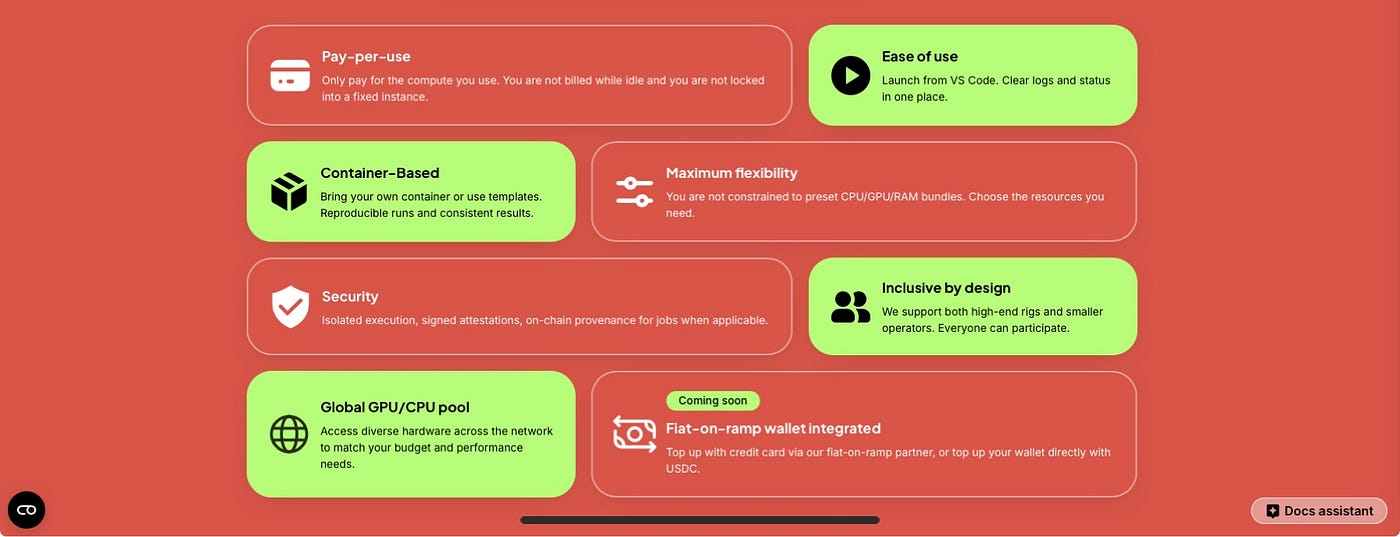
What Ocean Network’s H200 Infrastructure Actually Looks Like
One of the more interesting aspects of Ocean Network’s compute marketplace is transparency.
Many GPU providers advertise “enterprise AI infrastructure” without exposing the actual node details. Ocean Network does the opposite.
At the time of writing, one verified H200 deployment available through the Ocean Dashboard includes:
Verified Node Specifications
- Node Name: Example Node
- Region: East Asia (Kyoto, Japan)
- GPU: NVIDIA H200
- Available Units: 2
- CPU: Intel Xeon Platinum 8460Y+ (40 cores)
- RAM: 440GB
- Storage: 1000GB
- Runtime: Containerized jobs via Ocean Orchestrator
- Billing: 0.036 USDC/unit/min
- Approximate Cost: ~$2.16/hr per GPU
- Job Duration: 1 minute to 12 hours
- Payment System: Escrow-protected USDC settlement
- Node Version: Ocean Node v3.1.0
- Verification Status: Benchmark verified
- Historical Usage: 2.2K+ completed jobs
- Provider Revenue: ~$586 earned
Access:
https://dashboard.oncompute.ai
This matters because infrastructure buyers increasingly care about specifics rather than vague “AI-ready” labels.
For example:
440GB RAM combined with a 40-core Xeon processor gives enough CPU-side headroom for:
- preprocessing pipelines,
- embeddings generation,
- tokenizer-heavy workloads,
- data staging,
- and orchestration tasks running alongside GPU inference.
The 141GB HBM3e memory pool is equally important.
A large number of open-source deployments still struggle on:
- RTX 4090s,
- L40S nodes,
- or older A100 infrastructure,
simply because memory fragmentation and model size constraints force aggressive quantization or multi-GPU sharding.
The H200 reduces that operational complexity considerably.
And unlike enterprise cloud reservations, Ocean Network allows single-GPU access without requiring an 8-GPU commitment.
That difference alone dramatically lowers the barrier for smaller AI teams.
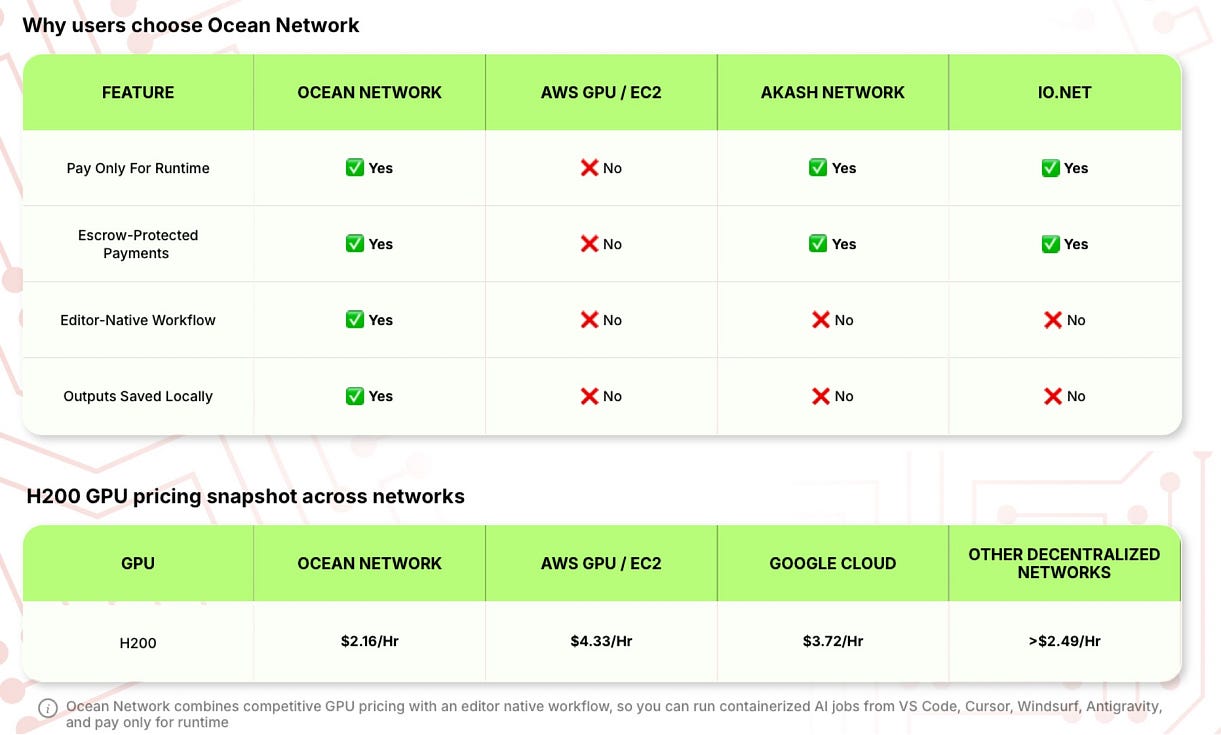
H200 Price Comparison: Ocean Network vs AWS, Azure, RunPod, Jarvislabs, and Spheron
Pricing observed May 2026. Rates may fluctuate depending on marketplace availability and regional inventory.
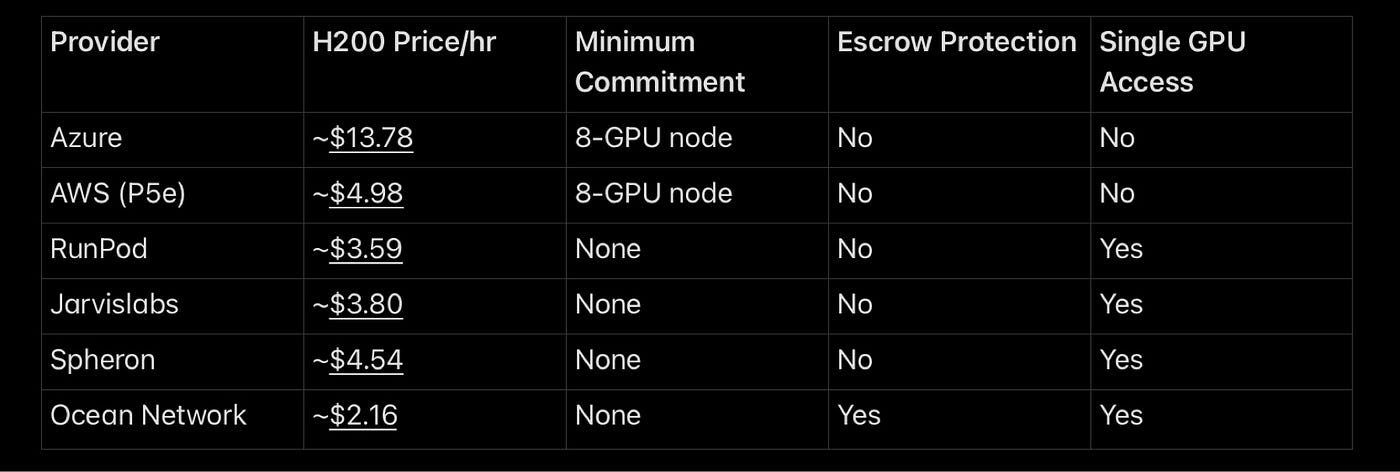
This is where Ocean Network becomes difficult to ignore.
The obvious differentiator is price. At around $2.16/hr, Ocean Network currently positions itself as one of the cheapest H200 GPU per hour options publicly accessible without enterprise procurement friction.
But the more important differentiator is structure.
AWS and Azure still operate around bundled infrastructure assumptions. Users often provision large clusters because the platforms are optimized for enterprise-scale deployments rather than targeted GPU access.
Ocean Network flips that model:
- single GPU,
- short-duration billing,
- containerized execution,
- escrow-secured settlement,
- and no long-term reservation requirements.
RunPod and Jarvislabs are closer philosophically because they already support flexible GPU rentals. However, Ocean Network adds two additional layers:
- decentralized provider participation,
- and escrow-protected payments.
That second feature is surprisingly important.
Most GPU clouds begin billing immediately when an instance starts, regardless of whether:
- the container crashes,
- dependencies fail,
- or the workload never finishes successfully.
Ocean Network’s escrow model changes that incentive structure.
You are not paying for idle uptime.
You are paying for completed compute execution.
That is a subtle but meaningful distinction
What You Can Actually Run on Ocean Network’s H200
The practical value of the H200 only becomes obvious when tied to real workloads.
LLM Inference
A single H200 can comfortably run large open-source models such as:
- LLaMA 4 70B,
- DeepSeek variants,
- and other long-context inference systems
without requiring aggressive tensor parallelism.
That simplifies deployment architecture considerably.
Instead of splitting workloads across multiple GPUs, developers can often deploy directly on one accelerator with lower synchronization overhead.
Fine-Tuning Workloads
The combination of:
- 141GB VRAM,
- 440GB RAM,
- and a 40-core Xeon CPU
creates a more balanced training environment than GPU-only marketing numbers suggest.
The CPU resources matter for:
- dataset streaming,
- preprocessing,
- tokenization,
- augmentation pipelines,
- and orchestration logic.
This becomes especially useful during LoRA fine-tuning and retrieval-heavy training pipelines.
Containerized ML Jobs
Ocean Orchestrator uses containerized job execution instead of requiring manual infrastructure management.
That means developers can:
- submit workloads from VS Code or Cursor,
- deploy isolated runtime environments,
- avoid SSH-heavy cluster administration,
- and package workloads reproducibly.
For smaller AI teams, that operational simplicity matters almost as much as raw GPU power.
Batch Jobs and Short Experiments
One underrated advantage of Ocean Network’s billing structure is the short runtime flexibility.
Because billing operates at minute-level granularity, users can:
- run quick evaluations,
- benchmark inference throughput,
- test embeddings pipelines,
- or execute short experiments
without paying for large hourly blocks.
That makes experimentation significantly cheaper.

How Ocean Network’s Escrow Payment System Works
Most cloud GPU billing systems assume trust upfront.
You start the instance.
The billing meter starts immediately.
Whether your workload succeeds or fails becomes your problem.
Ocean Network handles this differently.
Here’s the simplified workflow:
- A user submits a compute job through the Ocean Dashboard.
- The payment amount is locked in escrow using USDC.
- The workload runs on a verified H200 node.
- Ocean Orchestrator manages the containerized execution flow.
- Once the job completes successfully, funds are released automatically to the node provider.
If the workload fails before completion, the escrow structure helps reduce unnecessary payment exposure.
This is one of the more interesting architectural differences between Ocean Network and traditional GPU marketplaces.
On AWS, Azure, or most centralized GPU clouds:
you are paying for infrastructure uptime.
On Ocean Network:
the model is closer to paying for delivered compute execution.
That distinction creates a more developer-friendly pricing dynamic, especially for smaller teams experimenting with rapidly changing AI workflows.

FAQ: Ocean Network H200 Infrastructure
Does Ocean Network offer NVIDIA H200 GPUs?
Yes. Ocean Network offers verified NVIDIA H200 GPU nodes that can be rented on-demand through the Ocean Network Dashboard. These nodes are contributed by infrastructure providers across the network and are accessible without long-term contracts or enterprise cloud commitments. Users can launch H200-powered compute jobs for AI training, inference, fine-tuning, embeddings, and agent workloads directly from the dashboard while paying only for the compute time they actually use.
Dashboard:
https://dashboard.oncompute.ai
Can I run LLaMA 4 on Ocean Network’s H200?
Yes. NVIDIA H200 GPUs on Ocean Network are well-suited for running large open-source models such as Meta’s LLaMA 4 family. Each H200 node provides 141GB of HBM3e VRAM, enabling users to handle demanding inference workloads, larger context windows, and advanced fine-tuning configurations.
Through the Ocean Orchestrator workflow, developers can connect their IDE, launch containerized environments, and run AI workloads remotely without manually configuring GPU infrastructure.
How does Ocean Network’s escrow payment system work?
Ocean Network uses an escrow-secured payment mechanism designed to reduce trust assumptions between compute providers and users.
When a compute job is started, the payment amount is locked in escrow rather than transferred immediately. After the job completes successfully and the agreed compute resources are delivered, the funds are automatically released to the node provider in USDC.
This structure helps protect both parties by ensuring providers are compensated for valid work while users avoid paying upfront for incomplete or failed jobs.
Do I need to rent 8 GPUs minimum for H200 on Ocean Network?
No.
Unlike many traditional cloud GPU providers that encourage large multi-GPU cluster commitments, Ocean Network allows users to rent a single NVIDIA H200 GPU for a single workload with short-duration billing.
Jobs can typically be launched with as little as a one-minute minimum runtime depending on node availability. This makes the platform more accessible for:
- independent developers,
- researchers,
- startups,
- and small AI teams experimenting with targeted workloads.
Where are Ocean Network’s H200 nodes located?
One currently available verified H200 deployment on the Ocean Dashboard is located in Kyoto, Japan, serving the East Asia region.
Because Ocean Network operates as a decentralized compute marketplace, providers from multiple geographic regions can contribute infrastructure over time. This distributed model improves compute accessibility while allowing users to select deployments based on pricing, latency, compliance, or regional preferences.
What CPU, RAM, and storage come with Ocean Network’s H200 nodes?
A verified H200 node currently listed on Ocean Network includes:
- Intel Xeon Platinum 8460Y+ processor
- 40 CPU cores
- approximately 440GB RAM
- around 1TB storage
- 141GB HBM3e VRAM
This hardware configuration is designed to support demanding AI workloads that require both GPU acceleration and substantial CPU-side resources for preprocessing, orchestration, embeddings generation, and containerized execution.
Final Thoughts
The most interesting thing about Ocean Network is not just that it offers cheap H200 access.
It is that the platform changes the operational assumptions around AI compute.
Instead of:
- enterprise reservations,
-
- multi-GPU minimums,
-
- rigid infrastructure contracts,
-
- and billing tied purely to uptime,
Ocean Network moves toward:
- on-demand containerized execution,
-
- decentralized GPU supply,
-
- escrow-based settlement,
-
- and minute-level compute access.
For developers searching for the most affordable H200 GPU cloud in 2026, the current Ocean Network pricing of roughly $2.16/hr is difficult to ignore.
The H200 is no longer locked behind hyperscaler procurement processes and enterprise-only infrastructure models.
You can explore the available verified H200 nodes directly here:
https://dashboard.oncompute.ai
Additional Resources:
Suggested Sources
- NVIDIA H200 Technical Documentation
- Ocean Protocol Documentation
- ONCompute Dashboard
- AWS P5e GPU Pricing
- Azure ND-Series GPU Pricing
- RunPod GPU Marketplace
- Jarvislabs GPU Pricing
- Spheron Compute Marketplace

메타데이터
- post_id
- 4fb5fc2ec6b7
- slug
- nvidia-h200-at-2-16-hr-4fb5fc2ec6b7
- url
- https://medium.com/@camzyxworld/nvidia-h200-at-2-16-hr-4fb5fc2ec6b7
- canonical_url
- https://medium.com/@camzyxworld/nvidia-h200-at-2-16-hr-4fb5fc2ec6b7
- author_url
- https://medium.com/@camzyxworld
- status
- ok
- fetched_at
- 2026-06-09 15:37:30



