SUSE Storage(Longhorn) vs Red Hat ODF: Two Roads Through the Cloud-Native Landscape
SUSE’s Storage Backbone
SUSE Storage(Longhorn) vs Red Hat ODF: Two Roads Through the Cloud-Native Landscape

SUSE’s Storage Backbone
SUSE Storage, the tech once called Longhorn, is now the quiet heavyweight inside SUSE’s cloud-native stack. It doesn’t scream for attention like Rancher does, and it doesn’t have the edge buzz of K3s, but if you strip it out, the rest of the puzzle collapses.
The story SUSE tells is simple: this is the primary persistent block storage for their Kubernetes ecosystem. That means when a customer spins up stateful apps — a MySQL database, Kafka message queues, or machine learning pipelines that chew through training data — SUSE Storage is the thing keeping it all alive and consistent. It’s the storage layer that makes Kubernetes actually usable for production workloads, not just for stateless web apps.
And SUSE knows that’s its differentiator. In their broader portfolio pitch, they’ll talk Rancher Prime, NeuVector for security, Harvester for virtualization, but SUSE Storage is the foundational piece that lets them say, “Yes, we can run your business-critical workloads on Kubernetes.”
Rancher Integration That Feels Native
One reason SUSE Storage lands well with enterprises is how tightly it hooks into Rancher Prime. You don’t have to treat it like some bolt-on component that demands its own installer, console, and upgrade lifecycle. It’s there in the Rancher app catalog. You click once, it’s deployed.
From there, everything you’d expect — provisioning volumes, scaling clusters, monitoring health — runs through the same Rancher dashboard operators already live in daily. Kubernetes’ StorageClass automation takes care of the dynamic volume provisioning, and Rancher’s observability stack extends right into Longhorn metrics.
That matters because ops teams are already juggling enough consoles. SUSE’s bet is that “unified management” isn’t a buzzword but a real painkiller. And for once, the one-click marketing pitch isn’t overblown.
Longhorn’s Journey Into SUSE
SUSE didn’t invent this tech from scratch. Longhorn was born at Rancher Labs, built as an open-source distributed block storage system designed to run inside containers. Each volume in Longhorn has its own storage controller, replication happens synchronously across nodes, and the whole thing runs with microservices logic rather than legacy SAN or NAS models.
When SUSE acquired Rancher Labs in 2020, they weren’t just buying a Kubernetes management platform. They picked up the Longhorn project too. At the time, Longhorn was already in the CNCF as an incubating project (since 2019), with credibility as a community-driven tool. SUSE leaned into that. They rebranded it as SUSE Storage but kept the open-source foundation intact, making sure it remained vendor-neutral.
This move gave SUSE a strategic edge: they suddenly had a full-stack answer to Kubernetes persistence without having to lock customers into proprietary tech. Rancher + Longhorn became the open-source duo SUSE could bring into enterprises that were already wary of vendor lock-in.
Where It Fits in SUSE’s Bigger Play
If you zoom out, SUSE’s portfolio has four big pillars: Linux at the base, Rancher Prime as the Kubernetes control plane, edge computing powered by K3s and Harvester, and AI/ML capabilities layered on top. SUSE Storage is the quiet but necessary enabler across all of them.
Databases and enterprise apps demand persistent, resilient storage. AI workloads don’t run if your datasets vanish when pods restart. Edge deployments need lightweight storage that doesn’t assume a big datacenter backend. SUSE Storage checks each of those boxes by being distributed, container-native, and simple enough to scale down as well as up.
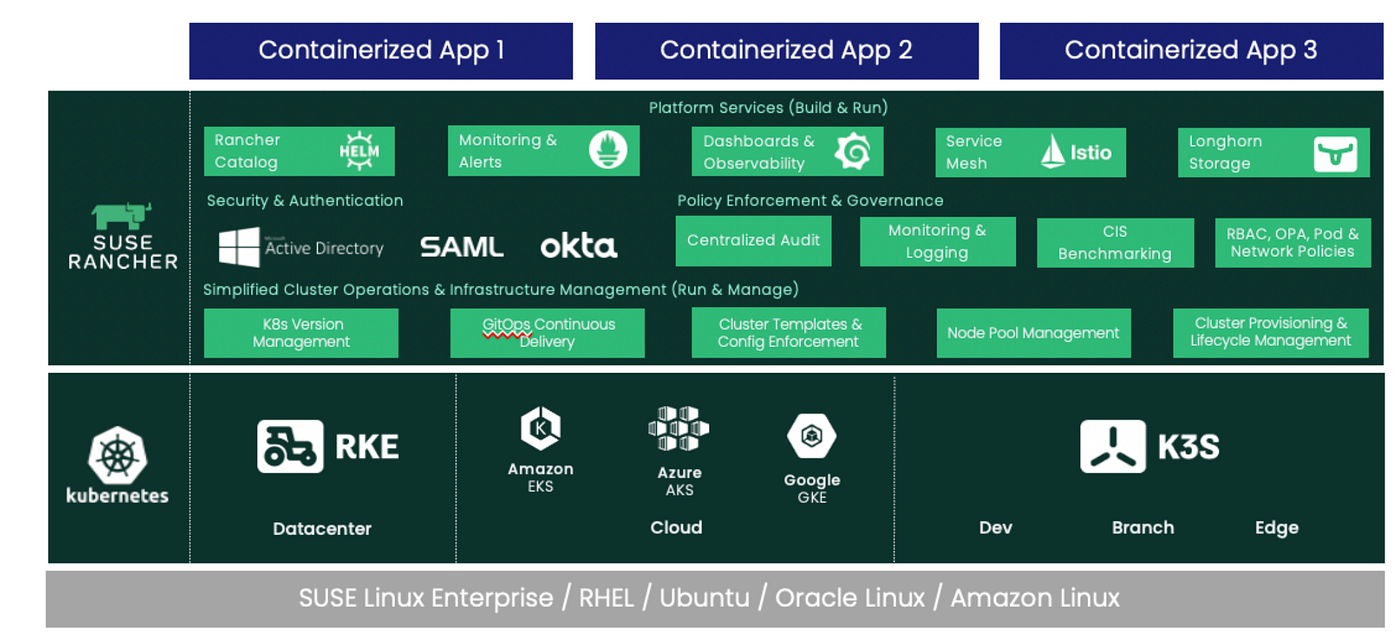
SUSE markets this modularity hard. Their story is that you can take just the pieces you want — Rancher on its own, Longhorn on its own — or run the full stack together. That modular, vendor-neutral vibe is part of how SUSE positions itself against Red Hat.
Red Hat’s Storage Answer: OpenShift Data Foundation
Now shift to Red Hat. Their equivalent to SUSE Storage is OpenShift Data Foundation (ODF), previously known as OpenShift Container Storage. Same broad goal: give Kubernetes a persistent storage layer. Different execution entirely.
Red Hat didn’t grab a lightweight container-born project like Longhorn. Instead, they leaned into a heavyweight: Ceph. Ceph has been around for years as one of the most respected open-source distributed storage systems. It handles block, file, and object storage in one system.
On top of Ceph, Red Hat uses Rook to orchestrate the storage services inside Kubernetes, and NooBaa to provide a multi-cloud object gateway. Together, these three form ODF.
So where SUSE focused Longhorn on distributed block storage, Red Hat went broad. ODF provides block, file, and object in one package.
Ceph’s Legacy and Red Hat’s Move
Ceph’s history is important here. It started as a research project, grew into a widely adopted distributed storage platform, and eventually became the backbone for many OpenStack deployments. Enterprises already trusted it at scale.
Red Hat saw that, acquired Inktank (the commercial company behind Ceph) back in 2014, and folded it into their portfolio. When containers and Kubernetes rose, Red Hat didn’t abandon Ceph. They adapted it. The result was ODF: Ceph running inside Kubernetes, orchestrated by Rook, extended by NooBaa.
That long heritage makes ODF feel enterprise-grade in ways Longhorn doesn’t try to. If you’re a bank or a telecom that already trusts Ceph for petabytes of storage, Red Hat’s ODF feels like a natural evolution.
Integration vs Modularity
Here’s the philosophical split. SUSE treats storage as a standalone product that integrates cleanly into Rancher but can also work anywhere. Red Hat treats storage as part of the OpenShift package. ODF isn’t sold separately; it’s a piece of OpenShift.
That means SUSE appeals to customers who want freedom. Maybe you’re already running clusters on AWS EKS, GKE, or AKS. Rancher plus SUSE Storage lets you bring those under management without forcing a rip-and-replace.
Red Hat appeals to customers who want certainty. You buy OpenShift, and you get a full enterprise Kubernetes platform with integrated storage, networking, developer services, and security. Everything’s tested and supported together.
Real-World Use Cases
Imagine a retailer running Kubernetes clusters in hundreds of edge locations — say, in-store systems or regional warehouses. They need something lightweight, resilient, and manageable at scale. SUSE’s K3s plus SUSE Storage (Longhorn) fits like a glove. You get the distributed persistence without the overhead of a traditional SAN, and Rancher gives you one place to see and control all those clusters.
Now flip it. Picture a financial services giant running in multiple datacenters with compliance-heavy workloads. They want enterprise certifications, built-in disaster recovery, and deep integration into their platform. Red Hat ODF, with its Ceph backbone and tight coupling to OpenShift, fits better. It’s less about modular flexibility and more about trusted, end-to-end integration.
Who Wins Where
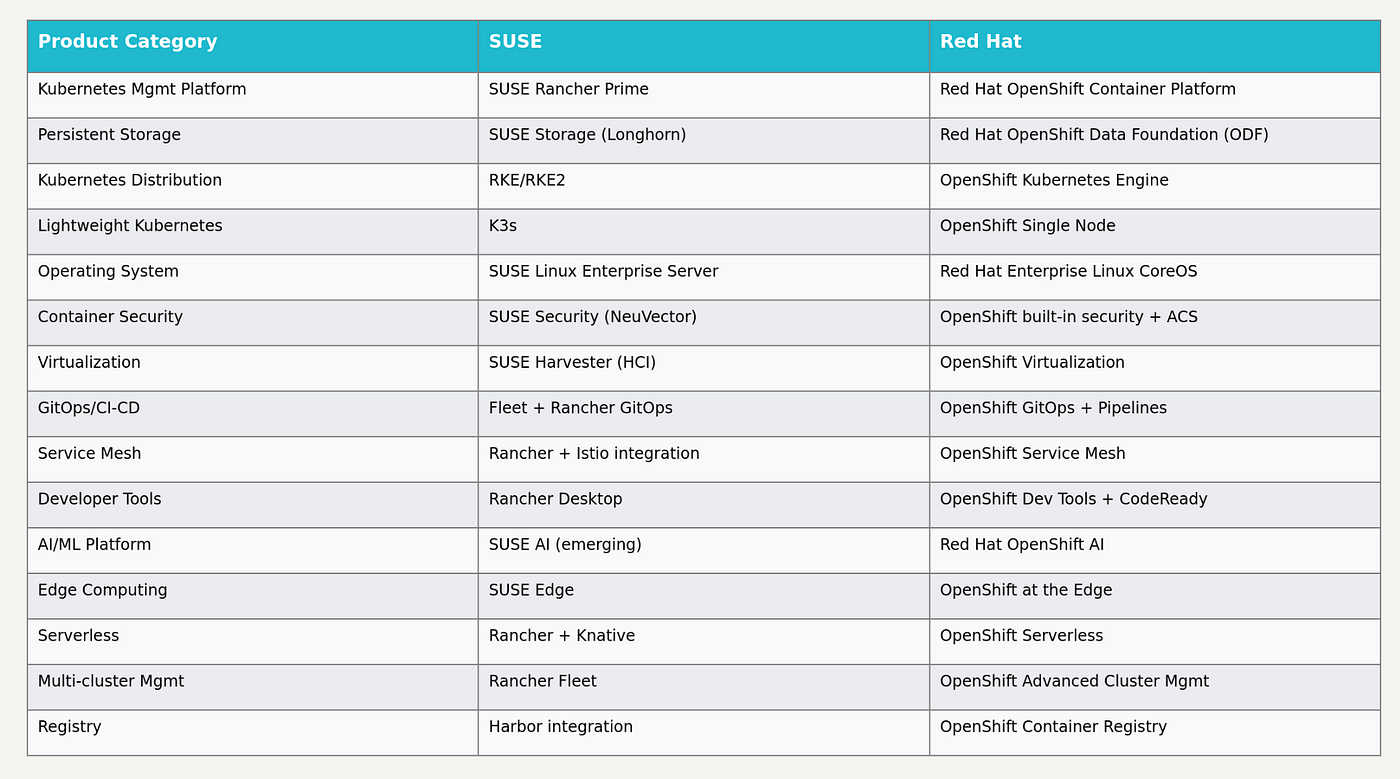
SUSE vs Red Hat Cloud-Native Portfolio Comparison
So, where does each land strongest?
SUSE wins in multi-cloud, multi-cluster environments where flexibility matters. They shine in edge scenarios and brownfield modernization projects where companies already have Kubernetes running in different places and want to unify management.
Red Hat wins in greenfield enterprise deployments, where the customer is choosing one platform to standardize everything. If you want one throat to choke and a platform backed by Red Hat certifications, ODF on OpenShift is hard to argue against.
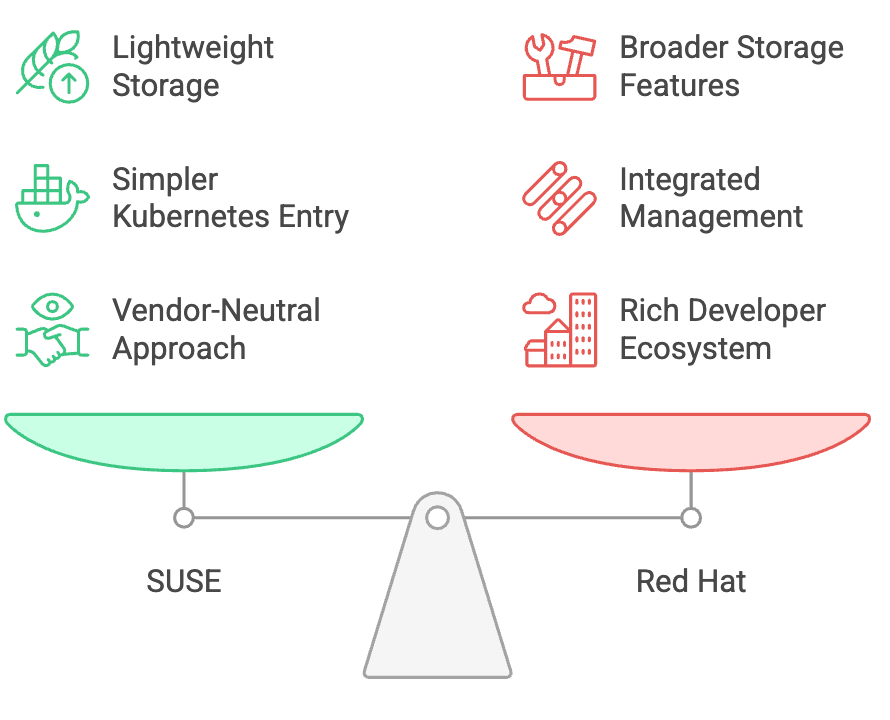
Competitive Edge Breakdown
SUSE’s strengths:
- Open-source, vendor-neutral approach.
- Lightweight, edge-ready storage.
- Works across any CNCF-certified Kubernetes distro.
- Easier entry point thanks to Longhorn’s simplicity.
Red Hat’s strengths:
- Broader storage features (block, file, object).
- Deep enterprise heritage via Ceph.
- Integrated management with OpenShift.
- Rich developer ecosystem built into the same platform.
Both companies ended up in Gartner’s 2025 Magic Quadrant for container management leaders. That’s basically the market acknowledging that both modular and integrated philosophies are valid — different roads, same destination.
메타데이터
- post_id
- 4fbcc3d8dfd9
- slug
- suse-storage-longhorn-vs-red-hat-odf-two-roads-through-the-cloud-native-landscape-4fbcc3d8dfd9
- url
- https://medium.com/@PlanB./suse-storage-longhorn-vs-red-hat-odf-two-roads-through-the-cloud-native-landscape-4fbcc3d8dfd9
- canonical_url
- https://medium.com/@PlanB./suse-storage-longhorn-vs-red-hat-odf-two-roads-through-the-cloud-native-landscape-4fbcc3d8dfd9
- author_url
- https://medium.com/@PlanB.
- status
- ok
- fetched_at
- 2026-06-24 11:06:28