What is Bertrand Russell’s Barber Doing?
Still pondering: To shave or not to shave, that is the question!
What is Bertrand Russell’s Barber Doing?
Still pondering: To shave or not to shave, that is the question!

To shave oneself or wait for the barber? Image created with Copilot
What’s behind several paradoxes like the one Bertrand Russell stumbled upon? We’ll show step by step what went wrong, with a lesson: Be more careful when doing logic and mathematics, go back to the roots, consider every step and its consequences. But first:
(1) What is a paradox?
According to Wikipedia,
A paradox is a logically self-contradictory statement or a statement that runs contrary to one’s expectation.
That’s a rather unfortunate definition, because it mixes two entirely different concepts. So let’s split it into two parts. Part 2, something contrary to our expectation, is a true paradox. It may or may not entail logical or mathematical difficulties, but it can usually be explained without problems. For example, the hydrostatic paradox in physics may be simply explained:

Different amounts of liquid, but the same pressure at the base. Source
Another paradox: How much space do you need to turn a needle around 180°? Answer: zero space! I’ve explained it here:
The first part of Wikipedia’s definition usually is called a (logical) contradiction or antinomy. Antinomies are really dangerous, because within a theory containing a logical inconsistency it is possible to derive any proposition — and the opposite is true too. Whenever an antinomy is detected, the theory crumbles into dust. And that’s the reason we have to be careful with this kind of paradoxes: They can (and did) destroy a lifetime’s work, as Russell’s barber-paradox with the work of German mathematician Gottlob Frege.
So let’s start with a simple problem, which shows us what’s usually going wrong with paradoxes.
(2) Ramanujan’s sum

A genius without concern for tradition. Photo of Ramanujan and blackboard source
Famous Indian mathematician Srinivasa Ramanujan “proved” the following equation:
1 + 2 + 3 + 4 + … = -1/12
Of course, that’s nonsense, and the proof consists of an incorrect application of a formula for an infinite series. In the formula, x has to be <1, which is not the case in the above equation. If you use a hammer to unscrew a bolt, you’ll get into trouble. For readers interested in Ramanujan’s magic trick, here is a good exposition.
Another example would be the insertion of a value v>c in the equations of special relativity. You will obtain imaginary space and mass, resulting in meaningless outcomes.
(3) Russell’s Barber

Will he shave us? Of course, as long as it’s not himself … Picture created with Copilot.
As you probably know, this paradox (actually an endless logical circle or circulus vitiosus) features a barber who shaves everyone who doesn’t shave himself. But then what of him? If he doesn’t shave himself, he shaves himself (according to the definition). But if he shaves himself, then (according to the definition) he doesn’t shave himself.
We’ll proceed very slowly. First, we have two sets: a barber, and the rest of the population:

Set A contains the barber, set B the rest of the population
Set A contains one member only, the barber. Set B may be divided into two mutually exclusive subsets:

B1 = people that do not shave themselves, B2 = people that do not need a barber
B1 consists of individuals who don’t shave themselves (and therefore have to wait for the barber, resulting in their skin not being as immaculately white anymore), while B2 comprises those who shave themselves, hopefully regularly.
Now we add the relation of set A (the barber) to set B1 (the people who don’t shave themselves):

Relation of set A (the barber) to subset B1
Next step: We move the only element of set A — the barber — to set B. There are two possibilities, and the relation of A to the inhabitants of set B1 remains:
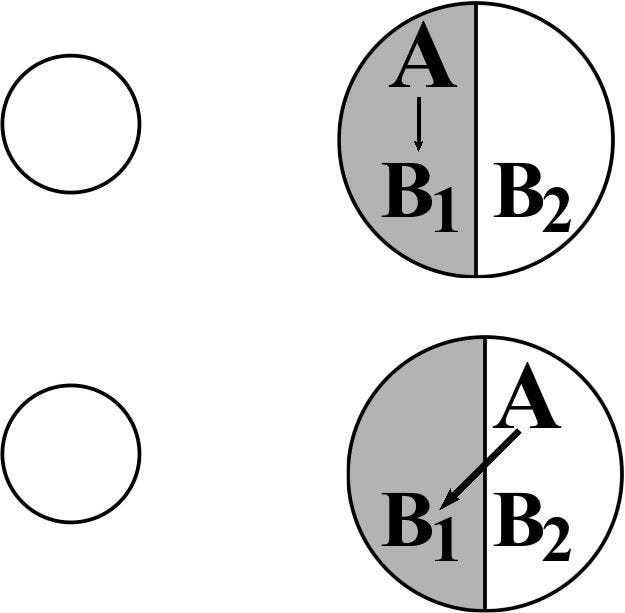
The only element of set A (the barber) is moved to B1 or B2
Everything is correct until now. That set A is empty now, doesn’t bother us; it’s just the empty set. In the next step, we change something important, and that’s the stumbling block of our proceeding: We define a new relation, now between A and himself, which throws us into difficulties:

A circular relation of A to himself, quite different from the previous relation
As you see, the situation now is quite different. The new relation is not the old one. Whether it results in something meaningful, we do not know beforehand. We do know now: It causes difficulties; therefore, this new relation should not be applied.
You see what went wrong? We pretended to handle one and the same relation, but actually, there are two, and they are different. Let’s call the first relation R1 and the second R2. We then notice that R1 is irreflexive (not applicable to itself) and asymmetric (working in one direction only), whereas R2 is reflexive and symmetric. They cannot be compared; the situation is new. With a new situation, you cannot expect the old results.
Note that the root of the problem is not self-reference, but sloppy thinking: two different relations are said to be the same. When working through the mathematical formulation of Russell’s paradox, don’t forget: “∈” is not the same as the “∈” a few symbols earlier or later!
(4) Cantor’s Real

It’s a long way to infinity. Collage by author. Background created with Copilot, photo of Cantor © Wikipedia
You are probably familiar with Georg Cantor’s diagonal argument, one of his methods to prove that there are more real numbers than integers. Here you find a short overview (with illustrations):
[embed]Are there infinite numbers? That depends on how you define “there are”.peterripota.medium.com
Cantor proceeded in there steps:
Step 1: He defines the set R as the set containing all reals.
Step 2: He assumes that this set is well-ordered, a prerequisite for enumerating its members, that is, mapping them to the integers (or to the natural numbers).
Step 3: He constructs a new element, using the elements of R.
Since, according to Cantor, this element wasn’t initially in R, steps 2 and 3 create a paradox. Therefore, the reals cannot be mapped one-to-one to the integers.
Let’s examine Cantor’s course of action. What catches one’s mental eye: Cantor uses three different methods of manipulating mathematical entities. First, he defines something, but this definition is rather vague. He doesn’t show what the set of “all” numbers looks like, how it was created, in which way we may envisage it. Besides, when he says: R contains all real numbers, then this set should, according to its definition, contain all real numbers. You cannot say: All humans are mortal, and after that: I’m human, I belong to that set, but I’m not mortal. At least you have to admit: I’m in a different set.
In step 2 he assumes a well-ordering, but doesn’t provide one. Mathematicians claim there is a well-ordering (a minimal element + a method for creating the next one), but do not provide it. If you really do it, as I tried here:
there is no possibility to create a new number outside of the algorithm. All the numbers are constructed according to a strict rule (here: enumerating all variations with repetition).
Finally, step 3, constructing, is very different from steps 1 (defining) and 2 (assuming). It seems that Cantor conducted a conjurer’s trick, blurring the difference of his methods, making the marveling reader believe three things are the same, although they are quite different.
However, there are really more reals than integers, because the reals may be seen as the number of subsets of the set of integers, that is, its number is the cardinal number of the power set. This number, 2^(aleph-zero), is really bigger than aleph-zero, as I showed graphically with a simple picture + explanation in my previously mentioned article.
(5) Gödel’s Proof

Kurt Gödel. Collage by author. Background created with the help of Copilot, photo of Gödel © Wikipedia
Austrian mathematician Kurt Gödel was a meticulous and thorough thinker. His proofs were well-founded, and Gödel never missed a step. Although he seemed to rely on self-reference, he did not. Here’s what Gödel accomplished, in five steps:
(1) He allocates a number to every mathematical symbol. For example, a → (is mapped to) 1, b → 2,… , ² → 27, + → 28, = → 29,
(2) Every mathematical term, like a²+b²=c², is mapped to a number, usually called a Gödel Number or GN, in such a way that from this single number all the numbers representing the symbols of the term may be extracted. The method uses the fundamental theorem of arithmetic: Every (integer) number is uniquely expressible by the product of powers of prime numbers.
The Pythagorean theorem from above would have the GN
2¹ × 3²⁷ × 5²⁸ × 7² × 11²⁷ × 13²⁹ × 17³ × 19²⁷
a rather large number for such a simple term. But that doesn’t matter.
(3) Not only terms, but propositions too may be represented by a GN. Even “S is true” or “S is provable” can be represented by a GN.
(4) Gödel constructs a sentence S that claims of itself not to be provable, by some ingenious (but complicated) calculations, after which the resulting GN is inserted into S.
(5) Since S is not provable, two possibilities arise:
-
S is provable, then it is not provable — a classic antinomy reminiscent of the liar’ paradox or Russell’s barber.
-
S is true. then it is not provable. This is a legitimate conclusion, an acceptable exit, the core of Gödel’s proof: There are sentences (propositions) that are true, but not provable within a certain axiom system.
(You may find a thorough treatise on Wikipedia or in the book “Gödel’s Proof “ by Ernest Nagel &James R. Newman.)
As you see, there is no circulus vitiosus, no endless logical circle. The reason for this “clean” reasoning: Gödel always constructed his mathematical entities; he did not rely on vague definitions, on “all” arguments, on cloudy conclusions about indefinite infinities.
(6) Einstein’s Twins

Who is younger than the other? Picture of Einstein created with Copilot
Special relativity is riddled with “paradoxes” that appear to be logical inconsistencies, rendering the theory useless if not resolved. Because, as I said, in a mathematical theory containing a logical contradiction like “0=0 AND 0=1” every assertion may be proven — and its opposite too.
Here are two of his paradoxes:
[embed]The Garden Fence Paradox Come on, let’s take a ride on the Einstein express!peterripota.medium.com
The solution usually lies outside of mathematics, although physicists disagree on which one is correct. For the twin’s paradox, I counted more than 100 “solutions,” which is rather depressing. And the search for the only valid one is still going on.
(7) What we learned
Do not believe what the books say! Start your own investigation, or as Immanuel Kant proclaimed:
Habe den Mut, dich deines eigenen Verstands zu bedienen.
(Have the courage to use your own reasoning faculties.)
메타데이터
- post_id
- 4fbfddcacfd5
- slug
- what-is-bertrand-russells-barber-doing-4fbfddcacfd5
- url
- https://sciencespectrumu.com/what-is-bertrand-russells-barber-doing-4fbfddcacfd5
- canonical_url
- https://sciencespectrumu.com/what-is-bertrand-russells-barber-doing-4fbfddcacfd5
- author_url
- https://medium.com/@peterripota
- status
- ok
- fetched_at
- 2026-07-22 21:10:48