NB-IoT vs LTE-M in 2026: The Definitive Decision Guide for Hardware Engineers
TL;DR: NB-IoT and LTE-M are both cellular LPWAN standards, but they’re built for different jobs. If your device sleeps for days and sends a…
NB-IoT vs LTE-M in 2026: The Definitive Decision Guide for Hardware Engineers
TL;DR: NB-IoT and LTE-M are both cellular LPWAN standards, but they’re built for different jobs. If your device sleeps for days and sends a few bytes, NB-IoT wins on cost and battery life. If you need real-time responsiveness, voice, or mobility, LTE-M is your call. Get the protocol wrong early and you’ll pay for it in every revision cycle.
What Is NB-IoT vs LTE-M?
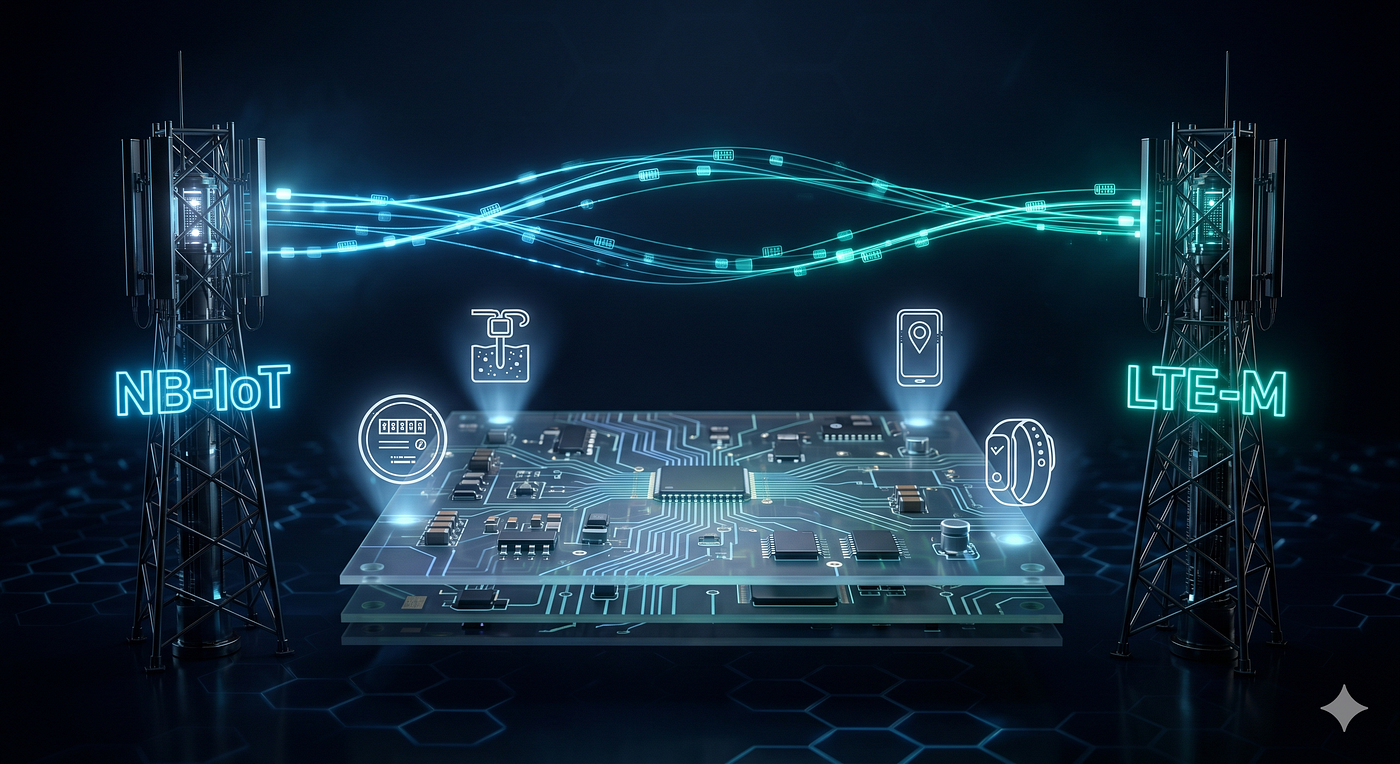
NB-IoT (Narrowband IoT) and LTE-M (Long-Term Evolution for Machines) are both 3GPP-standardized cellular protocols built for low-power, wide-area IoT deployments — but they sit at opposite ends of the performance-versus-efficiency tradeoff.
NB-IoT was designed to push signals through walls, across wide areas, and over years of battery life, at the cost of raw throughput and latency. LTE-M was designed to carry more data, faster, while still being dramatically more efficient than standard LTE.
They share a common heritage (both ride existing LTE infrastructure) but they solve different problems. Treating them as interchangeable is where most hardware teams go wrong.
Why It Matters for IoT Developers
The protocol you choose at architecture time doesn’t just affect radio specs — it shapes module cost, firmware complexity, antenna design, carrier support, and the ceiling on what your device can ever do.
In 2026, the stakes are higher than they were two years ago. Carrier consolidation has thinned out NB-IoT support in parts of North America, while LTE-M coverage has expanded into markets that used to be NB-IoT-only territory. Roaming support for NB-IoT has also improved, but it’s still patchier than LTE-M.
At the same time, modules have gotten cheaper on both sides. The price gap that used to make NB-IoT a clear cost winner has narrowed. That makes the real decision criteria more nuanced than ever — and more dependent on your specific application profile.
How It Works
Radio Access and Bandwidth
NB-IoT uses a 200 kHz channel, either in-band (carved out of an LTE carrier), guardband, or standalone. Its peak downlink rate is around 250 kbps — fast enough for a firmware update, slow for anything streaming.
LTE-M uses 1.08 MHz of bandwidth and can hit 1 Mbps in each direction. It also supports full-duplex and half-duplex modes, which matters when you’re designing around voice or continuous sensor streams.
The practical upshot: if your payload is under 1 KB and you’re transmitting a few times per hour, NB-IoT handles it cleanly. If you’re pushing firmware OTA to thousands of devices or need sub-second response loops, LTE-M is doing real work that NB-IoT physically can’t.
Power Consumption and PSM
Both protocols support Power Saving Mode (PSM) and extended Discontinuous Reception (eDRX) — the two mechanisms that let cellular IoT modules sleep for hours or days between transmissions.
NB-IoT eats less power in deep sleep, partly because its radio is simpler. A good NB-IoT design on a 3000 mAh cell can realistically hit 10-plus years of field life sending a daily update. LTE-M in PSM is also very efficient — you’re looking at multi-year deployments being routinely achievable — but the more capable radio costs slightly more idle current.
If your device charges or has a larger battery, this gap mostly disappears. For coin cell or small primary battery designs, it’s decisive.
Latency and Mobility
NB-IoT does not support handover between cell towers. If your device moves out of range of its registered cell, it has to re-register from scratch — which adds latency and burns power.
LTE-M supports handover, which means mobile assets can maintain a continuous connection while in motion. It also supports Voice over LTE (VoLTE), which opens up use cases like emergency call buttons and connected wearables that need push-to-talk.
If your device stays bolted to a wall, NB-IoT’s lack of mobility support is a non-issue. If it ever moves — a vehicle tracker, a shipping container, a field worker’s badge — LTE-M is the only rational choice.
Practical Use Cases
The clearest way to think about this: NB-IoT is for patient devices; LTE-M is for responsive ones.
- Smart metering and utility monitoring — Power, gas, and water meters transmit small packets infrequently and sit in underground vaults or behind thick walls. NB-IoT’s superior penetration and multi-year battery life make it the standard choice here.
- Asset tracking with mobility — Vehicles, shipping containers, or field equipment that cross cell boundaries need LTE-M’s handover support. Combined with PSM between movement events, you still get solid battery performance.
- Industrial sensor networks — Temperature, pressure, and vibration sensors on fixed equipment work well on either protocol, but if you need fast alerts (sub-second threshold triggers), LTE-M’s lower latency gives you that headroom.
- Consumer wearables and personal safety devices — Medical alert buttons, lone-worker devices, and pet trackers all benefit from LTE-M’s mobility support and, in some cases, VoLTE for emergency voice.
- Agricultural and environmental monitoring — Soil sensors, weather stations, and livestock tags that send data once per hour and live on small batteries for years are NB-IoT’s home turf.
Common Mistakes to Avoid
- Picking the protocol based on module price alone. The cheapest NB-IoT module costs you more downstream if your carrier doesn’t support it in your target region. Always validate coverage before committing to a BOM.
- Assuming PSM means the same thing on both protocols. The timers, re-registration behavior, and current profiles differ. Benchmark your specific module on your specific carrier before locking in a battery estimate.
- Ignoring roaming requirements. If your product ships globally, NB-IoT’s roaming ecosystem is still spottier than LTE-M. An LTE-M device with a global SIM is often simpler to deploy across regions.
- Designing for NB-IoT and then adding OTA later. Firmware update strategies need to account for NB-IoT’s throughput ceiling. A 500 KB firmware image that takes seconds over Wi-Fi can take minutes over NB-IoT — in the field, at scale, that matters.
- Treating carrier support as permanent. Carriers have switched off HSPA and will sunset LTE variants over time. Get your carrier’s published roadmap for both protocols before making a multi-year product commitment.
Frequently Asked Questions
Q: Can I use the same hardware module for both NB-IoT and LTE-M? A: Yes. Several multi-mode modules from Quectel, u-blox, and Sierra Wireless support both protocols on a single chip, letting you configure the radio at firmware level. This is worth the small cost premium if you’re targeting multiple regions or aren’t locked into one carrier.
Q: Which protocol has better global coverage in 2026? A: LTE-M has stronger coverage in North America and Australia. NB-IoT leads in Europe and much of Asia. For truly global products, a multi-mode module with a global SIM is more practical than betting on either protocol alone.
Q: Does NB-IoT work indoors and underground? A: Yes. NB-IoT’s Maximum Coupling Loss (MCL) of 164 dB makes it well suited for deep indoor and underground deployments like utility vaults and basement meters — roughly 20 dB better than standard LTE.
Q: Is LTE-M faster than NB-IoT for firmware updates? A: Yes, significantly. LTE-M’s peak 1 Mbps throughput makes OTA updates practical for larger firmware images. NB-IoT’s 250 kbps ceiling can make the same update take several times longer, which matters at fleet scale.
Q: Will NB-IoT and LTE-M still be relevant past 2030? A: Both are part of 3GPP Release 13 and beyond, and carriers have committed to supporting them well into the next decade. 5G RedCap overlaps in some use cases, but NB-IoT and LTE-M will remain the practical default for low-power cellular IoT for years.
Conclusion
The NB-IoT vs LTE-M decision isn’t hard once you’re honest about what your device actually does. If it’s stationary, power-constrained, and chatty only occasionally — go NB-IoT. If it moves, needs fast responses, or has to push real data — go LTE-M.
What makes this harder in 2026 is that the hardware gap has closed. Multi-mode modules are affordable and widely available. The real variable now is carrier strategy, regional coverage, and your own application’s future requirements. Design your protocol choice with a two-year roadmap in mind, not just the first production run.
Pick the wrong protocol and you’re not just re-spinning a board. You’re potentially re-qualifying a carrier contract, re-testing at scale, and explaining to your PM why a 10-year battery life estimate is now 4. Get this decision right early, and everything downstream gets easier.

Try the BLE Advertiser(GATT Simulator)
Working with BLE advertising while you nail down your cellular stack? The **BLE Advertiser(GATT Simulator)** handles the wireless automation side of your IoT prototyping workflow — so you can test BLE broadcasting behavior without building custom firmware from scratch.
MINI IoT gives hardware engineers and makers a fast way to automate BLE advertising with real-world triggers, letting you focus on protocol decisions like NB-IoT vs LTE-M without losing time on low-level radio config.
Key features:
- Schedule-based broadcasting — Set BLE advertising windows on a precise time schedule
- Location-based triggers (geofencing) — Start or stop advertising based on physical location
- Wi-Fi network conditions — Tie BLE behavior to network presence or absence
- Motion detection & battery/charging state control — Automate advertising based on device context
메타데이터
- post_id
- 4fd7a5c99d37
- slug
- nb-iot-vs-lte-m-in-2026-the-definitive-decision-guide-for-hardware-engineers-4fd7a5c99d37
- url
- https://medium.com/@miniiot/nb-iot-vs-lte-m-in-2026-the-definitive-decision-guide-for-hardware-engineers-4fd7a5c99d37
- canonical_url
- https://medium.com/@miniiot/nb-iot-vs-lte-m-in-2026-the-definitive-decision-guide-for-hardware-engineers-4fd7a5c99d37
- author_url
- https://medium.com/@miniiot
- status
- ok
- fetched_at
- 2026-06-25 12:15:08