Demographic Evolution of the Minecraft Player Base (2011–2026)
Owen R Thornton
Demographic Evolution of the Minecraft Player Base (2011–2026)
Owen R Thornton
University of North Carolina at Chapel Hill
Photo by Oberon Copeland @veryinformed.com on Unsplash
I was quite curious about Minecraft and its growth over time because, unlike many games that are created and eventually dissolve, Minecraft has seen a significant demographic evolution in its player base and long-term players.
*The reality of this evolution is reflected in the following statistics:
- The average age of a player is now 24 years old.
- 36% of the entire player base is over the age of 22.
- While the community was originally male-dominated, the gender gap is closing rapidly; it is currently quite close to a 50–50 split, at 54% male and 46% female.*
Minecraft is a unique game because it entered a massive digital ecosystem and has since sold over 300 million copies. It maintains 212 million active monthly players, which is extraordinary, making it the highest-selling game in history.
It is interesting that the game has lasted so long and served as a creative outlet for so many people over the years. One of the most notable trends is that the majority of people now play via mobile phones. Half of the global community accesses the game through the mobile app, which has driven massive growth in emerging markets like India and Brazil. This has pushed the community away from the US-centric and Eurocentric gaming demographic that Minecraft originally had.
While it began as a simple indie developer project, it has grown into something that users have grown up with, from childhood into adulthood. These queries and ideas prompted my research into the topic.
Below is the original article. I have summarized the majority of the content in layman’s terms, so enjoy the read.
Introduction
Within the economic and sociological frameworks of the interactive digital entertainment industry, the standard lifecycle of a commercial software product is characterized by a rapid acquisition phase immediately following launch, succeeded by an exponential decay in active users. Industry models dictate that a highly successful video game typically exhibits a maximum cultural and commercial shelf life of approximately twenty-four months.1 The sandbox application Minecraft, developed originally by Markus Persson in 2009 and officially launched to the retail market in November 2011, serves as an unprecedented statistical anomaly that defies this established decay model.1 Over the fifteen-year period spanning its official release to the first quarter of 2026, the software has transitioned from a niche, computationally lightweight independent project into a pervasive digital ecosystem, demonstrating compounding intergenerational growth and retention rates that have no contemporary equivalent in digital media.1
This descriptive statistical analysis provides an exhaustive evaluation of the Minecraft user base, tracing its demographic, geographic, and psychometric evolution from 2011 through early 2026. By synthesizing telemetry data, longitudinal sales distributions, regional market penetration analytics, and peer-reviewed behavioral research, this report constructs a highly nuanced profile of the active player base. The analysis moves beyond superficial aggregate counts to interrogate the underlying mechanisms of the software’s cross-generational appeal. It examines the precise age and gender stratifications that shape the community, the profound impact of hardware accessibility on regional growth, and the cognitive and neurobiological incentives that sustain active engagement among both developing adolescents and middle-aged adults.
Evolution of Demographic Data Collection Frameworks
To accurately interpret the demographic statistics of the Minecraft ecosystem, one must first analyze the structural evolution of the data collection methodologies employed over the software’s lifespan. The longitudinal mapping of this player base is complicated by the transition from informal, community-driven sampling in the early 2010s to the highly sophisticated, API-driven behavioral telemetry of the modern era.
During the software’s nascent retail phase (2011–2013), demographic profiles were largely constructed through self-selecting community polls rather than empirical telemetry. A widely cited October 2011 demographic survey distributed on the social media platform Reddit garnered 4,800 responses within a seven-hour window.4 While this early data suggested a user base that was overwhelmingly male, highly technical, and concentrated in the late teens and early twenties, subsequent sociological analyses identified extreme self-selection bias within the sampling methodology.4 The respondents were restricted to individuals who were not only early adopters of the personal computer (PC) alpha and beta builds but who were also highly motivated, English-speaking users actively engaging in external forum socialization.4 This methodology fundamentally obscured the silent, rapidly expanding demographic of young children interacting with early iterations of the software on tablet computers and smartphones, who lacked the capacity or inclination to participate in third-party online surveys.4
As the software transitioned under the corporate infrastructure of Microsoft following its $2.5 billion acquisition in 2014, the mechanisms for demographic tracking became rigorously empirical.1 The introduction of the “Bedrock Edition” and the subsequent rollout of “Unified Accounts” in late 2024 allowed for centralized tracking across previously siloed hardware ecosystems, including mobile devices, home consoles, and personal computers.3 Consequently, the modern descriptive statistics spanning 2018 to 2026 — derived from a combination of active server telemetry, unified account registrations, point-of-sale data, and expansive parental polling such as the 2018 Mavoa study — represent a highly accurate reflection of the global ecosystem.3 The contemporary dataset removes the vocal minority biases that skewed early sociological projections, revealing a substantially more diverse, cross-generational, and globally distributed user base than was previously theorized.
Longitudinal Expansion of the Active User Base
The trajectory of Minecraft’s active user base represents the most sustained volumetric expansion in the history of interactive media. Early sales and telemetry data from the game’s beta and launch windows indicate a highly engaged but comparatively modest user cohort. The beta iteration of the software achieved one million sales in less than thirty days, a figure that was considered exceptional for an independent title in 2010.2 By the end of 2011, the software had sold approximately 4 million units.7
The active player base scaled proportionately with these early commercial milestones. By the fourth quarter of 2011, the software supported 16.1 million active players, expanding to 26.2 million in the fourth quarter of 2012, 28.2 million in late 2013, and 29 million by the end of 2014.7
Table 1 delineates the annual evolution of the software’s Monthly Active Users (MAUs) and Peak Daily Active Users (DAUs) from the commencement of unified modern data tracking in 2016 through the current modeling in 2026.
Year
Average Monthly Active Users (MAU)
Peak Daily Active Users (DAU)
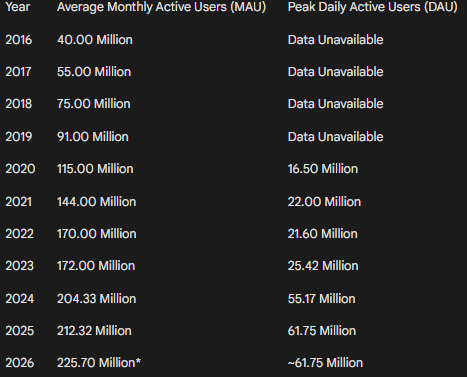
Note: 2026 MAU figures reflect the Q1/Q2 rolling average, representing a continued upward trajectory from the 212.32 million average recorded at the close of 2025. Current average daily active player counts hover steadily at 31.96 million.5
The most significant inflection point in the platform’s modern history occurred simultaneously with the onset of the global COVID-19 pandemic. The implementation of international quarantine measures forced a rapid digitalization of leisure and socialization, resulting in a 25% surge in active players.5 MAUs escalated from 91 million in 2019 to 115 million in 2020, followed by a sustained increase to 144 million in 2021.5 Crucially, unlike the majority of pandemic-induced digital surges that experienced severe market corrections and reverted to historical means post-quarantine, the Minecraft ecosystem retained its inflated user base. The platform effectively established a new baseline of engagement, continuing to scale to 204.33 million MAUs by 2024 and 212.32 million by 2025.5
The explosion in Peak DAUs between 2023 (25.42 million) and 2024 (55.17 million) suggests a fundamental shift in user behavioral patterns.9 Rather than treating the software as a casual, intermittent entertainment application, a massive cohort of players transitioned to utilizing the platform as a daily digital “third place” — a persistent social infrastructure decoupled from physical geography. By 2025, the average monthly playtime per user had risen to 11.2 hours, underscoring this transition from a traditional linear entertainment product to foundational digital infrastructure.3
Sales Trajectory and Commercial Distribution
The demographic expansion of the player base is inextricably linked to the software’s unprecedented retail distribution. In 2023, the software bypassed a historic commercial threshold, recording over 300 million total units sold across all platforms, formally establishing it as the single highest-selling video game in the history of the medium, outperforming legacy properties such as Grand Theft Auto V (205 million units) and Wii Sports (82.9 million units).5 As of early 2025, total sales surpassed 325 million copies.3
Table 2 outlines the year-over-year unit sales of the software, demonstrating the remarkable consistency of consumer acquisition over a decade.

Data aggregated from historical market reports and developer disclosures up to 2021. Between 2011 and 2021, the software sold an average of 22 million copies annually.7
This commercial dominance is further contextualized by the isolated distribution within the People’s Republic of China. Operated under a distinct licensing partnership with NetEase, the Minecraft Chinese Edition is distributed via a free-to-play economic model. This localized version of the software has been downloaded over 600 million times, with total registered users surpassing 700 million by September 2023.1 Consequently, when aggregating global retail sales and localized free-to-play distributions, the software has been installed on over one billion unique consumer devices.
Financially, this translates to immense recurring revenue. In 2024, the game generated $220 million in traditional software and microtransaction revenue, with the mobile iteration accounting for $115 million, or 52% of the aggregate total.5 The internal Minecraft Marketplace, a curated storefront for community-generated content, reported annualized earnings exceeding $560 million over a rolling twelve-month period leading into 2025.3 The subscription service, Minecraft Realms, which provides dedicated cloud-hosting for multiplayer environments, demonstrated a 17% year-over-year growth, maintaining 4.3 million active subscribers by March 2025.3
Age Demographics and the Intergenerational Shift
A pervasive cultural heuristic, frequently perpetuated by mainstream media analysis, posits that Minecraft functions primarily as a digital apparatus for children. While early childhood and adolescent demographics are undeniably critical to the platform’s user acquisition pipeline, empirical telemetry definitively refutes the notion that the player base is exclusively, or even predominantly, prepubescent. In 2026, the calculated average age of an active Minecraft player is 24 years old.1
This metric is the mathematical manifestation of the “aging up” phenomenon. A significant proportion of the user base that was introduced to the software during its period of peak cultural saturation between 2012 and 2015 — when they were navigating late childhood or early adolescence — has continued to actively engage with the platform into their twenties and early thirties.11 The game’s open-ended “sandbox” architecture allows the software to scale in mechanical complexity alongside the user’s cognitive, spatial, and technical maturation. An individual may initiate their interaction at age six by stacking rudimentary digital blocks on an iPad; a decade later, that same individual may utilize the PC architecture to program complex automated sorting machinery using the game’s internal “Redstone” logic circuits, or engineer expansive custom servers utilizing external coding languages.12
Table 3 details the precise age stratification of the active global Minecraft user base as of the most comprehensive datasets spanning 2025 and 2026.

Data aggregated from 2025/2026 demographic telemetry.1
Analyzing the Cohorts
The largest isolated demographic segment comprises individuals aged 15 to 21, representing 43% of the total user base.1 This cohort, firmly rooted within Generation Z, represents the first demographic to have been socialized entirely within an environment where Minecraft operated as a ubiquitous cultural fixture. Their engagement is heavily subsidized by the game’s multiplayer network infrastructure; behavioral telemetry indicates that 80% of children and adolescents interact with the game primarily through cooperative multiplayer modes, utilizing the software as a primary digital communication interface.5
The 22 to 30 age bracket accounts for 21% of the active user base.1 This group heavily features Millennial and early Generation Z players, constituting the foundational “legacy” community. This specific cohort is responsible for driving the vast majority of the game’s external meta-culture, including the development of sophisticated third-party modifications, long-form video essays on platforms such as YouTube, and live broadcasting. The symbiotic relationship between the software and external media platforms is staggering; in April 2025 alone, consumers watched over 37.4 million hours of Minecraft gameplay on Twitch, and the game generated over 2.1 billion views on YouTube in January 2025.3 These external media ecosystems are predominantly produced and consumed by the 15-to-30 age continuum.
Notably, adult users aged 30 to 65 comprise 15% of the total player population.1 While a fractional portion of this demographic engages in cooperative play with their offspring — polling suggests only 11% of parents routinely participate in the game with their children — a substantial sub-segment engages with the software entirely independently.14 To contextualize this adult participation, macroeconomic data indicates that the average video game player globally is 37 years old, and the average esports consumer is 32 years old.15 Roughly one-third of all global gamers fall between the ages of 35 and 55.15 Therefore, the 15% representation within Minecraft aligns tightly with broader shifts in adult digital leisure, where middle-aged consumers utilize relaxing, low-stakes creative environments for psychological decompression. A negligible 0.5% of the player base is 65 years or older, indicating that while the game spans multiple generations, it has yet to achieve meaningful market penetration among the senior citizen demographic.3
Gender Stratification and Trajectories Toward Parity
The longitudinal analysis of gender distribution within the Minecraft ecosystem reveals a gradual but definitive shift away from a male-dominated environment toward demographic parity, though severe disparities remain pronounced within early childhood acquisition pipelines.
Aggregate historical data models suggest that the lifetime global player base is composed of approximately 54% male users and 32% female users, with the remaining percentage historically representing unreported data or non-binary identifications.5 However, modern internal behavioral tracking for the 2024–2026 period indicates that the gender distribution has tightened significantly, with updated telemetry establishing a breakdown of 54% male and 46% female among active participants.10 This evolution heavily implies that the historical underrepresentation of female players was a byproduct of the generalized gaming culture of the early 2010s, rather than an inherent mechanical barrier within the software itself.
Early Childhood Gendering of Digital Play
To interpret the macro-level gender distribution, researchers must isolate the micro-level behaviors dictating early childhood adoption. A highly comprehensive 2018 sociological study conducted by researchers Mavoa and Carter analyzed the specific digital play habits of 753 children aged 3 to 12.6 The empirical results established Minecraft as the dominant digital entertainment title utilized by this age group, but it revealed a “marked early gendering” of the play experience.6
Within the broad 3-to-12 age bracket, 54% of male children actively played the game, compared to 32% of female children.7 This disparity compounded drastically when isolating the 6-to-8-year-old cohort; within this critical developmental window, 68% of young boys reported playing Minecraft, compared to a mere 29% of young girls.7 Sociological researchers attribute this early demographic divergence entirely to external cultural coding rather than software design. The game’s mechanics are gender-neutral, focusing on spatial geometry, resource management, and creativity. Advocacy groups such as “Let Toys Be Toys” suggest that the overarching societal narrative that digital interactive media is a “boy’s domain” heavily curtails early female adoption rates.18
However, as the user base progresses into the 15–21 and 22–30 age brackets, the gender gap substantially homogenizes. The collaborative architectural design, social networking utility, and community-management aspects of the multiplayer software appeal broadly across all gender identities.12 Furthermore, the increasing prominence of high-profile female content creators within the external YouTube and Twitch ecosystems has served to systematically normalize and validate female participation, accelerating the recent metrics that show the active female player base stabilizing near 46% globally.10
Hardware Stratification and Ecosystem Economics
A critical variable influencing both the age demographics and the geographic distribution of the player base is the hardware platform utilized for access. Unlike legacy software constrained to a single console ecosystem, Minecraft operates on a unified, cross-play infrastructure (marketed as the “Bedrock Edition”) across mobile devices, home consoles, and personal computers, alongside the highly modifiable “Java Edition” which remains restricted to PC users.
As of April 2025, the platform utilization distribution is established as follows:

Data derived from unified account telemetry as of Q2 2025.3
The Mobile Majority and the Tablet Pipeline
Mobile hardware represents the single largest operational access point for the global Minecraft community. Within this mobile ecosystem, consumers utilizing the Android operating system outnumber iOS users by a significant margin of 1.7 to 1.3 This mobile dominance executes two distinct demographic functions. Primarily, it facilitates deep market penetration in developing macroeconomic regions — such as India, Brazil, and Southeast Asia — where the acquisition of high-end personal computers and dedicated game consoles remains cost-prohibitive for the average consumer.3 Secondly, it serves as the foundational entry point for early childhood adoption in developed Western nations.
Survey analytics indicate that among children aged 3 to 8, over 70% experience the software exclusively via a tablet interface.7 As these children transition into the 9-to-12 age bracket, hardware usage splinters; approximately 50% remain tethered to tablet devices while the remaining 50% migrate to the more robust interface of a personal computer.7
From an economic perspective, the mobile sector is highly lucrative. In 2022, the mobile iteration, known historically as Minecraft Pocket Edition, generated $99 million in consumer spending.10 By 2024, mobile revenue escalated to $115 million, representing 52% of the game’s total traditional retail revenue for the year ($220 million).8 Early fiscal data for 2025 demonstrates a continuation of this trend, with the mobile application generating $69.37 million year-to-date by the mid-year mark.5
PC Enthusiasts and the Console Expansion
While the mobile sector caters heavily to youth demographics and emerging economies, the Personal Computer remains the domain of the older, highly dedicated enthusiast. The PC user base (32%) is responsible for generating the vast majority of the community’s third-party architectural development, including intricate software modding, custom server hosting, and high-level logic engineering.3 The historical Java Edition has sold nearly 80 million lifetime units exclusively on PC, while the unified Bedrock Edition has surpassed 220 million copies across all operating systems.3
Dedicated home consoles account for the remaining 22% of the active demographic.3 Historically, platforms such as the PlayStation 4 commanded significant legacy user bases, accounting for 93% of all active players within the PlayStation ecosystem.14 However, recent telemetry indicates that the Nintendo Switch is currently experiencing the most aggressive growth velocity in the console sector. Capitalizing on its hybrid mobile-console design, the Switch ecosystem observed a 14% year-over-year rise in daily active Minecraft players in 2025.3 The modern implementation of centralized “Unified Accounts” has fostered a highly fluid user base; cross-play usage among individuals who seamlessly alternate between PC, console, and mobile platforms increased by 16% in 2025, effectively blending these historically distinct hardware demographics into a single, cohesive network.3
Geographic Market Penetration and Emerging Economies
The geographic mapping of the Minecraft user base underscores its status as a ubiquitous global commodity. The software is actively played in over 130 independent nations, though its densest historical concentrations of daily usage have remained entrenched within North America and Western Europe.3 However, longitudinal data models from 2024 to 2026 illustrate explosive secondary growth vectors occurring throughout South America and South Asia, fundamentally altering the demographic center of gravity.
Table 4 details the percentage share of the active global player base distributed among leading national markets as of 2025 and 2026.
Percentage of Global Active Players

Data synthesized from 2025/2026 regional telemetry reports.3
Western Market Dominance and Infrastructural Support
The United States represents the undisputed epicenter of the core Minecraft player base, commanding 21.21% of all active users globally.5 This translates to approximately 35 million monthly active users operating within US borders.10 On any given day, telemetry indicates that between 500,000 and 800,000 users within the United States are logged into the software simultaneously.5 This regional dominance is subsidized by vast network infrastructural advantages; the United States hosts the highest concentration of active Minecraft multiplayer servers globally. Of the estimated 6,100 high-capacity servers tracked internationally, over 4,445 are physically hosted within the US (with specialized tracking often citing over 2,300 massive-scale community hubs), far outpacing the United Kingdom (approximately 1,212 servers) and Germany (625 servers).3
The Emerging Market Pivot
Despite the entrenched dominance of Western markets, an analysis of new user acquisition pipelines reveals a massive geographical pivot toward the Global South. In 2025, over 25% of all newly registered players originated from regions strictly outside of North America and Europe.3
Brazil currently commands 6.17% of the total global user base, maintaining a robust 23% year-over-year growth rate that resulted in 12.8 million MAUs as of March 2025.3 The most dramatic geographic expansion, however, is occurring on the Asian subcontinent. In the first quarter of 2025 alone, India contributed 8.2 million newly registered users to the ecosystem.3 This geometric growth is directly correlated with the proliferation of highly affordable Android-based smartphones and the rapid expansion of mobile broadband infrastructure across rural and semi-urban Indian demographics.
Furthermore, global aggregate statistics routinely exclude the highly isolated digital ecosystem of Minecraft China. Operated in a strict regulatory partnership with the publisher NetEase, the Chinese free-to-play edition of the software has amassed over 700 million registered users by late 2023.5 Within this heavily localized market, telemetry indicates over 68 million monthly active users.3 Consequently, while the United States holds the highest percentage of the globally interconnected player base, the localized Chinese iteration represents the largest single national concentration of Minecraft players on earth.
Psychometric Typologies and Player Behavior
The immense longevity and demographic breadth of the Minecraft user base cannot be fully comprehended through financial and geographic telemetry alone. To understand why a singular piece of software can retain an average of 212 million monthly users across a fifteen-year lifespan, analysts must examine the peer-reviewed psychological research detailing the behavioral and cognitive mechanisms of the player base. The platform functions not merely as an entertainment product, but as a highly plastic cognitive apparatus capable of accommodating wildly divergent psychometric profiles.
In a comprehensive 2024 psychological dissertation, researcher Bailey N. Brashears utilized the established Gaming Experience Questionnaire (GEQ) alongside the development of a novel psychometric instrument, the Minecraft Experience Scale (MES), to evaluate specific player behaviors.12 Following rigorous statistical modeling of self-reported gaming habits, Brashears successfully extracted five distinct latent typologies of Minecraft gameplay.
Table 5 outlines the five behavioral typologies that dictate player engagement within the virtual environment.
Psychometric Typology
Primary Engagement Modalities
Demographic Tendencies
Social Play
Interpersonal interaction, collaborative projects, live streaming.
Highly extraverted users; Heavily correlated with the 15–21 demographic.
Competence
Skill-based engagement, fast-paced combat, mechanical mastery.
Younger users seeking high-intensity mechanical feedback.
Redstone Engineering
Technical logic, automated machinery, systems engineering.
Older demographics; High cognitive demand and spatial logic.
Creativity
Expressive, novel, and aesthetic architectural building.
Broad demographic appeal; Utilized for psychological decompression.
Survival Gameplay
Resource management, environmental navigation, scarcity mechanics.
Broad demographic appeal; Appeals to users favoring structured progression.
Data extracted from Brashears (2024), “Learning in Minecraft: A New Paradigm for Psychological Research”.12
These five typologies operate as discrete vectors of psychological engagement, effectively allowing Minecraft to function as five entirely different software applications depending upon the specific cognitive and emotional needs of the end-user. Brashears determined that highly extraverted individuals are significantly more likely to engage with the software than introverted demographics, utilizing the platform primarily as a digital communication interface (Social Play) rather than a solitary game.12 Conversely, older users within the 22–30 and 30–65 brackets are heavily drawn to the complex, Turing-complete logic circuitry of Redstone Engineering and the low-stress environment of Creativity.12
When compared to highly competitive, high-velocity industry counterparts such as Call of Duty or League of Legends, the psychological profile of the Minecraft experience is universally categorized by its active users as inducing higher positive emotion, significantly lower physical tension, and drastically reduced negative affect (frustration).12
Furthermore, Brashears’ research demonstrated the presence of the “generation effect” within the virtual environment. In a controlled memory task utilizing arrays of virtual blocks (target blocks, unrelated foils, visually related lures, and functionally related lures), participants who actively interacted with the environment — physically placing and organizing structures — exhibited significantly enhanced memory retention for in-game items compared to participants who merely observed the gameplay.12 The research also indicated that highly competent players demonstrate advanced cognitive categorization; expert players differentiate virtual items based on functional, mechanical properties (e.g., categorizing blocks based on gravity mechanics or flammability) rather than superficial visual similarity, illustrating deep, higher-order cognitive processing.12
Neurobiological Impacts on the Middle-Aged Demographic
A prevalent statistical inquiry regarding Minecraft’s age demographics centers on the rationale behind the 15% of the player base — representing tens of millions of active users — who fall between the ages of 30 and 65.5 A landmark neurobiological study published in Frontiers in Sports and Active Living by Stark et al. (2021) provides a highly compelling scientific justification for this phenomenon.
The researchers hypothesized that engaging with immersive, spatially rich 3D video games provides a human equivalent to “environmental enrichment”.15 Within the context of established rodent neurobiology, placing subjects in highly complex, enriched environments naturally stimulates neurogenesis, synaptogenesis, and an increased density of dendrites within the hippocampus — the core brain structure responsible for memory encoding.15 To test this hypothesis in humans, the study targeted middle-aged adults between the ages of 40 and 49 who were explicitly classified as non-gamers, ensuring no pre-existing cognitive adaptations to digital environments.15
Participants were instructed to play Minecraft for approximately thirty minutes a day, five days a week, over a four-week intervention period.15 The experimental cohorts were divided into a no-contact control group, an active-control group (placed in a barren, featureless Minecraft world with no spatial landmarks), and an intervention group (instructed to actively explore complex biomes and engage in directed architectural building).15
To measure the neurological impact, participants were evaluated using the Mnemonic Similarity Task (MST), a highly rigorous cognitive assessment designed to tax pattern separation and specifically measure hippocampal function.15 The MST operates in two phases: an incidental encoding phase where subjects categorize 128 images of everyday objects, followed by an explicit surprise recognition test containing identical repetitions, completely novel foils, and highly similar “lure” items designed to trick the memory.15
The empirical results were profound. The study demonstrated a reliable, statistically significant improvement in memory performance (specifically the Lure Discrimination Index, or LDI, with a p-value < 0.05) strictly for the middle-aged adults within the active Minecraft exploration and directed building cohorts.15 The research concluded that the extreme cognitive demands of 3D spatial navigation, complex visual processing, resource planning, and critical thinking inherently required by the software actively stimulate neuroplasticity. Therefore, for the aging demographic, Minecraft operates as a highly effective form of functional cognitive rehabilitation and preventative maintenance against age-related hippocampal memory decline, offering a profound, neurobiological incentive for continued, long-term adult engagement.15
Institutional Demographics and Digital Game-Based Learning
The descriptive statistics surrounding the software must also account for its deep integration into formal educational institutions, a demographic vector entirely distinct from traditional commercial retail. Since the introduction of the specialized Minecraft: Education Edition in 2016, the software has successfully circumvented historical institutional bans on interactive media in classrooms, transitioning into a globally recognized pedagogical apparatus.8
As of early 2025, Minecraft: Education Edition accounts for nearly 15.2 million registered student accounts globally, active across 130 countries.3 Over 85,000 schools have officially integrated the software into their core curriculums, generating over 1.2 million new student users in the first quarter of 2025 alone.3 Within this structured environment, 80% of students utilize the platform’s logical mechanics and coding integrations to advance their education in computer science and basic programming.5
A 2025 systematic academic review conducted by Slattery et al. rigorously assessed the efficacy of Minecraft as a tool for Digital Game-Based Learning (DGBL). Evaluating twenty-nine independent, pre-post intervention studies involving children, adolescents, and young adults, the review confirmed that the game generates highly positive academic outcomes across multiple cognitive domains.23
Specifically, the empirical evidence demonstrates that the structured application of the software within a classroom environment significantly improves:
- Spatial Thinking and Geometry: Fostered by the manipulation of 3D architectural mechanics.22
- Mathematics and Science: Utilizing resource management and logical circuitry to model complex mathematical formulas and physics.22
- Language and Literacy: Improving reading comprehension, writing skills, and vocabulary retention through creative, interactive storytelling modules.22
- Social Cohesion: Enhancing emotional well-being and collaboration, particularly among student populations diagnosed with learning disabilities, by providing highly customizable, low-pressure virtual environments.22
The institutional adoption of the software artificially anchors its youth demographic baseline. Because millions of children are formally introduced to the software via compulsory public education systems globally, the game enjoys a user acquisition funnel that is entirely unparalleled by any commercial competitor. This institutional pipeline guarantees a constant, high-volume replenishment of the “Under 15” user base (currently sitting at 20.59%), effectively insulating the software from the generational attrition that destroys standard video game franchises.3
Synthesis and Structural Implications
The descriptive statistics and demographic evolution of the Minecraft user base spanning 2011 to 2026 illustrate the trajectory of a software product that has successfully transcended the boundaries of traditional interactive media to become foundational digital infrastructure. Retaining a rolling average of over 212 million monthly active users, generating daily engagement peaks exceeding 61 million simultaneous logins, and bypassing 350 million total commercial units sold, the platform operates at a scale that fundamentally alters consumer data models.3
The demographic profile reveals a remarkably balanced, cross-generational ecosystem. While anchored by a massive, continuously replenishing influx of early childhood and adolescent users — predominantly accessing the platform via mobile devices, which account for a 46% market share — the platform is financially and culturally sustained by a vast cohort of 15-to-30-year-olds who have aged directly alongside the software.3 The empirical reality that 36% of the active player base is over the age of 22, and that the global average player age remains mathematically locked at 24, permanently deconstructs the sociological misconception that the software is an exclusively juvenile application.5 Furthermore, the historical gender divide of the early 2010s is actively compressing, moving from a 54/32 male-to-female ratio toward near demographic parity (54/46) as the cultural stigma surrounding female participation in digital spatial environments continues to erode.5
The integration of peer-reviewed psychometric and neurobiological research highlights the underlying, mechanical drivers of this unprecedented retention. By offering distinct, highly malleable psychometric play typologies — ranging from high-stress survival combat to relaxing architectural expression — the software appeals simultaneously to highly divergent personality matrices.12 Crucially, its proven capacity to provide neurobiological “environmental enrichment,” actively improving hippocampal memory functions and pattern separation in middle-aged adults, offers a profound, peer-reviewed scientific justification for its sustained adult demographic.15
As the platform navigates through 2026, it is propelled by continuous volumetric expansion in emerging economies such as India and Brazil, the deployment of cloud-native beta architectures designed to bypass local hardware limitations, and deep pedagogical entrenchment via the Education Edition.3 The aggregated telemetry and behavioral data indicate no signs of macro-level user decay. Minecraft operates not merely as an interactive entertainment product, but as a multi-generational digital third-place, a validated cognitive rehabilitation tool, and a global educational standard, ensuring its demographic and commercial resilience for the foreseeable future.
Works cited
Previous references
References
- Chaudhry, Ahtshamullah; Cuthrell, Kimberly Morton; Thornton, Owen R (2023). Peptic ulcer disease; stomach and gastric ulcers, a concise review. Int Res J Gastroenterol Hepatol, 6(1), 30–39.
- Noor, MD Jawad; Thornton, Owen R (n.d.). and Kimberly Morton Cuthrell c.
- Roux, Gwendolyn; Hernández, Ariana; Thornton, Owen R; Manship, Emily; Nowlan, Alexandra C (2025). GluN2A-containing NMDA Receptors Treatment.
- Thornton, OR; Li, W; Cole, H; Cólon, I (2023). The Role of the Hippocampus in Borderline Personality Disorder: Structural and Functional Abnormalities. International Neuropsychiatric Disease Journal, 19(2), 28–38.
- Thornton, Owen (2023). Brain-derived neurotrophic factor (bdnf) in depression: a mini review of clinical and preclinical evidence. International Neuropsychiatric Disease Journal, 2023(3), 47–56.
- Thornton, Owen (2026). The Reflexive Scholar: A Meta-Analysis and Strategic Proposal for Personal Citation Intelligence Systems.
- Thornton, Owen R (2023). A Current Mini-Review on the Role of Neuroplasticity in the Treatment and Management of Borderline Personality Disorder.
- Thornton, Owen R (2023). An Overview of the Role of Neuroplasticity in the Pathophysiology and Treatment of Mental Illness: A Mini-Review.
- Thornton, Owen R (2023). Effective Ultramarathon Pacing Strategies on Road and Trail: A Narrative Review. Asian Journal of Advanced Research and Reports, 17(4), 1–11.
- Thornton, Owen R (2023). The Role of Neuroplasticity in the Pathophysiology and Treatment of Mental Illness: A Comprehensive Literature Review.
- Thornton, Owen R (2023). Varying Levels of Carbohydrate and Fat Diets for Ultramarathon Running: A Review on Performance and Health Outcomes. Asian J. Food Res. Nutri, 2(3), 1–11.
- Thornton, Owen R (2024). Literature Review: Recent Advances in Neuroscience. Medium.
- Thornton, Owen R (2025). A New Model for Academic Science Communication: Leveraging YouTube and TikTok to Enhance Public Engagement.
- Thornton, Owen R (2025). A Systematic Review and Meta-Analysis Quantifying the Dissociation of Pro-Cognitive and Motor Effects of Gs/Golf-Biased Dopamine D1 Receptor Agonism in Preclinical Models.
- Thornton, Owen R (2025). A Systematic Review and Meta-Analysis of Quantum Gravity at the Planck Scale.
- Thornton, Owen R (2025). Artificial Intelligence in Dentistry: A Systematic Review and Meta-Analysis of Techniques, Clinical Applications, and Performance Outcomes.
- Thornton, Owen R (2025). Biomechanical and Physiological Interactions of Footwear in Trail Running: A Systematic Review and Meta-Synthesis.
- Thornton, Owen R (2025). Borderline Personality Disorder: A Comprehensive Meta-Analytic Review of Epidemiology, Neurobiology, and Population Dynamics.
- Thornton, Owen R (2025). Closed Loop Simulation as a Human Created Replay of History.
- Thornton, Owen R (2025). Cognitive Offloading and Autonomous Agency: A Comprehensive Review of Self-Regulating Smartphone Architectures.
- Thornton, Owen R (2025). Emotional Intelligence as a Cornerstone of Success in Ultrarunning: A Synthesis of Meta-Analytic Evidence and Psychological Theory.
- Thornton, Owen R (2025). Heterogeneous Data Integration in Healthcare Big Data: A Comprehensive Systematic Review.
- Thornton, Owen R (2025). Machine Learning Approach to Predicting Protein Unfolding in Urea Solutions.
- Thornton, Owen R (2025). Medication-Related Osteonecrosis of the Jaw: A Comprehensive Review of Pathophysiology, Diagnosis, and Management Strategies.
- Thornton, Owen R (2025). On Polymathism in 2025.
- Thornton, Owen R (2025). Predicting Divorce and Separation from Social and Demographic in US Adults: A Linear Regression Model.
- Thornton, Owen R (2025). Quantum Gravity at the Planck Scale: Theory, Methods, and Emerging Observational Windows.
- Thornton, Owen R (2025). Relationship between running performance and bone mineral density.
- Thornton, Owen R (2025). Spatial Neglect: A Review.
- Thornton, Owen R (2025). The Compounding Mechanisms of Pre-Race Anxiety and Exercise on Gastroesophageal Reflux in Endurance Runners.
- Thornton, Owen R (2025). The Convergent Frontier: Artificial Intelligence in Treatment Planning for Neural Regeneration and Tissue Engineering in Oral and Maxillofacial Surgery.
- Thornton, Owen R (2025). The Erosion of Intelligibility: A Multi-Disciplinary Analysis of Linguistic Complexity and the Dilution of Meaning.
- Thornton, Owen R (2025). The Motivational Architecture of Success in Ultrarunning: A Systematic Review.
- Thornton, Owen R (2025). The Nourished Mind: A Meta-Analysis of Nutritional-Psychological Synergies in Ultrarunning Performance.
- Thornton, Owen R (2025). The Psychology of Competitive Exchange in Ultramarathon Running: A Framework for Managing Being Overtaken and Executing Effective Passes.
- Thornton, Owen R (2025). The Role of Brain-Derived Neurotrophic Factor in the Neurobiology of Borderline Personality Disorder: A Systematic Review and Meta-Analysis.
- Thornton, Owen R (2025). The Role of Physical Activity on Brain-Derived Neurotrophic Factors and Mental Health.
- Thornton, Owen R (2025). The Role of Physical Activity on Brain-Derived Neurotrophic Factors and Mental Health: A Systematic Review.
- Thornton, Owen R (2025). Trail Running as a Therapeutic Modality: A Meta-Analytic Review of its Efficacy in Anxiety Management and Resilience Building.
- Thornton, Owen R (2025). Ultrarunning as a Model for Neuroplasticity: A Review of Structural, Functional, and Neurobiological Adaptations.
- Thornton, Owen R (2025). What Education Could Be: The AI Method.
- Thornton, Owen R (2025). “Do Speedy-Shoes Make you Feel Speedier?” The Biopsychosocial Advantage: Deconstructing the Interplay of Biomechanics and Belief in Carbon-Plated Shoes for Ultrarunning.
- Thornton, Owen R (2026). “The Clutch Gene” and The Tethered Runner Paradox: A Multi-Disciplinary Meta-Analysis of Social Entrainment, Aerodynamic Drag, and Psychological Inhibition in Competitive Overtaking.
- Thornton, Owen R (2026). Beyond the Wall: A Comprehensive Meta-Analysis of Metacognitive Strategies, Executive Function, and Psychological Resilience in Ultrarunning Performance.
- Thornton, Owen R (2026). Determinants of Pain Perception and Patient Satisfaction in Dental Local Anesthesia: A Comprehensive Meta-Analysis of Verbal Cues, Mechanical Interventions, and the Expectancy Disconfirmation Model.
- Thornton, Owen R (2026). Metrics and Management in Modern Dental Medicine: A Comprehensive Meta-Analysis of Key Performance Indicators, Clinical Quality Measures, and the DSO Economic Model.
- Thornton, Owen R (2026). Pax Americana.
- Thornton, Owen R (2026). The Cognitive Architecture of Anorexia Nervosa and Associated Eating Disorders: A Meta-Analytic Review of Intelligence, Neuropsychology, and Genetic Correlations.
- Thornton, Owen R (2026). The Conceptualization and Operationalization of Shame: An Exhaustive Review of Variables, Methodologies, and Theoretical Frameworks.
- Thornton, Owen R (2026). The Debt-Financed Diet: A Critical Analysis of the Unjustified Exclusion of Financial Liability from United States Food Security Measurement.
- Thornton, Owen R (2026). The Financialization of Modern Dentistry: A Meta-Analysis of Equity Arbitrage, Valuation Hierarchies, and the Consolidation Lifecycle.
- Thornton, Owen R (2026). The Microbiota-Gut-Brain Axis as a Fundamental Regulator of Neuroplasticity: A Systematic Review and Meta-Analytic Synthesis.
- Thornton, Owen R (2026). The Unification of Oral and Systemic Health: A Comprehensive Meta-Analysis of Integrated Electronic Health Records in Dentistry.
- Thornton, Owen R (n.d.). Economic Disruption and Clinical Efficacy of Direct Patient Care and Dental Membership Models: A Comparative Meta-Analysis of Subscription-Based Healthcare versus Traditional Insurance Frameworks.
- Thornton, Owen R (n.d.). Sleep in Elite Ultrarunners: A Look into Athlete Health.
- Thornton, Owen R (n.d.). The Architecture of Adjudication: A Meta-Analysis of the Reasonable Person Standard Across Law, Philosophy, and Economics.
- Thornton, Owen R; Li, W (2024). Global trends and correlations in mental health disorders: A comprehensive analysis from 1990 to 2019. Int Neuropsychiatr Dis J, 21(2), 36–53.
- Thornton, Owen R; Li, Wenjun (2023). Advancements in AAV Therapy: A Bright Future for Cartilage Regeneration in Arthritis Treatment. Asian Journal of Orthopaedic Research, 6(1), 7–16.
- Thornton, Owen R; Li, Wenjun (2023). Advancements in Engineering for the Treatment of Joint Diseases. Asian Journal of Orthopaedic Research, 6(1), 1–6.
- Thornton, Owen R; Li, Wenjun (2023). Revolutionizing Arthritis Treatment: The Synergy of iPSCs and Extracellular Vesicles-based Acellular Therapies for Joint Tissue Repair. Revolutionizing Arthritis Treatment, 8(4), 33–38.
- Thornton, Owen R; Li, Wenjun (2025). Bulimia Nervosa Causing Unknown Threat to Oral Health: A Comprehensive Review. International Neuropsychiatric Disease Journal, 22(3), 166–174.
- Thornton, Owen R; Li, Wenjun (2025). The Psychology and Psychopathology of Ultrarunning: Mental Health and Psychiatric Insights into Extreme Endurance Athletes. International Neuropsychiatric Disease Journal, 22(1), 1–5.
- Thornton, Owen R; Li, Wenjun (n.d.). Global Trends and Correlations in Mental Health Disorders: A Comprehensive Analysis from 1990 to.
- Thornton, Owen R; Li, Wenjun; Cole, Hunter; Cólon, Isabella (2023). Borderline Personality Disorder and Neuroplasticity: A Review. International Neuropsychiatric Disease Journal, 19(1), 1–8.
- Thornton, Owen R; Li, Wenjun; Cole, Hunter; Cólon, Isabella (2023). The Role of the Hippocampus in Borderline Personality Disorder: Structural and Functional Abnormalities.
- Thornton, Owen R; Ly, Sophia; Colón, Isabella; Cole, Hunter; Li, Wenjun (2023). The psychological indicators of success in ultrarunning-A review of the current psychological predictors in ultrarunning.
- Thornton, Owen R; Tran, Cynthia; Li, Wenjun (2023). Effect of Chelating Agents on Cofactors of Catecholase Enzyme. South Asian Research Journal of Natural Products, 6(2), 58–63.
- Thornton, Owen R; Tran, Cynthia; Li, Wenjun (2023). Impact of Light Wavelengths on Photosynthetic Rates in Spinach. Asian J. Res. Bot, 9(2), 8–13.
- Minecraft User Statistics: How Many People Play Minecraft In 2026? — Matthew Woodward, accessed February 18, 2026, https://www.searchlogistics.com/learn/statistics/minecraft-user-statistics/
- 40+ Minecraft Statistics for 2025: Player Count & Revenue — Notta, accessed February 18, 2026, https://www.notta.ai/en/blog/minecraft-statistics
- Minecraft Statistics 2026: Player Counts, Revenue, Global Trends — SQ Magazine, accessed February 18, 2026, https://sqmagazine.co.uk/minecraft-statistics/
- The average minecraft player, 4800 responses in 7 hours. Enjoy …, accessed February 18, 2026, https://www.reddit.com/r/Minecraft/comments/lncf7/the_average_minecraft_player_4800_responses_in_7/
- How Many People Play Minecraft (2026 Player Count) — DemandSage, accessed February 18, 2026, https://www.demandsage.com/minecraft-statistics/
- Children and Minecraft: A survey of children’s digital play | Request PDF — ResearchGate, accessed February 18, 2026, https://www.researchgate.net/publication/321917200_Children_and_Minecraft_A_survey_of_children's_digital_play
- 40+ Little-Known Minecraft Statistics (2026): Sales, Revenue, Demographics, Player Stats, accessed February 18, 2026, https://headphonesaddict.com/minecraft-statistics/
- Minecraft Revenue and Usage Statistics (2026) — Business of Apps, accessed February 18, 2026, https://www.businessofapps.com/data/minecraft-statistics/
- Minecraft Statistics 2026: Shocking Player Boom — AFFiNCO, accessed February 18, 2026, https://affinco.com/minecraft-statistics/
- Minecraft User and Revenue Statistics (Updated 2025) — Host Havoc, accessed February 18, 2026, https://hosthavoc.com/blog/minecraft-statistics
- Age range for Minecraft? 2012–2015ish : r/generationology — Reddit, accessed February 18, 2026, https://www.reddit.com/r/generationology/comments/mstfww/age_range_for_minecraft_20122015ish/
- Learning in Minecraft: A New Paradigm for Psychological Research — Western University Open Repository, accessed February 18, 2026, https://uwo.scholaris.ca/bitstreams/ab3231f0-a67d-4238-9470-da8ffff34437/download
- Minecraft Live Player Count and Statistics — ActivePlayer, accessed February 18, 2026, https://activeplayer.io/minecraft/
- 15+ Mind-Boggling Minecraft Statistics for the Dedicated Gamer — Webtribunal, accessed February 18, 2026, https://webtribunal.net/blog/minecraft-statistics/
- Playing Minecraft Improves Hippocampal-Associated Memory for Details in Middle Aged Adults — Frontiers, accessed February 18, 2026, https://www.frontiersin.org/journals/sports-and-active-living/articles/10.3389/fspor.2021.685286/full
- Top Minecraft Statistics Every Player Should Know in 2026 — HostingSeekers, accessed February 18, 2026, https://www.hostingseekers.com/blog/latest-minecraft-statistics/
- How Many People Play Minecraft? Stats & Revenue [2026] — Udonis, accessed February 18, 2026, https://www.blog.udonis.co/mobile-marketing/mobile-games/how-many-people-play-minecraft
- Average age of Minecraft players — Reddit, accessed February 18, 2026, https://www.reddit.com/r/Minecraft/comments/1ex9jf3/average_age_of_minecraft_players/
- Bergen county blog, accessed February 18, 2026, https://www.bergenreview.com/bergen-county-blog.html
- (PDF) Playing Minecraft Improves Hippocampal-Associated Memory for Details in Middle Aged Adults — ResearchGate, accessed February 18, 2026, https://www.researchgate.net/publication/352994780_Playing_Minecraft_Improves_Hippocampal-Associated_Memory_for_Details_in_Middle_Aged_Adults
- Enriching hippocampal memory function in older adults through video games — bioRxiv, accessed February 18, 2026, https://www.biorxiv.org/content/10.1101/587006v1.full
- The Educational Benefits of Minecraft, accessed February 18, 2026, https://www.rom.on.ca/sites/default/files/2025-09/Minecraft_Educational_Benefits_Whitepaper.pdf
- Assessing the benefits of digital game‐based learning with Minecraft in children, adolescents and young adults, accessed February 18, 2026, https://doras.dcu.ie/30744/1/Review%20of%20Education%20-%202025%20-%20Slattery%20-%20Assessing%20the%20benefits%20of%20digital%20game%E2%80%90based%20learning%20with%20Minecraft%20in%20children%20.pdf
- Assessing the benefits of digital game‐based learning with Minecraft in children, adolescents and young adults: A broad systematic review — ResearchGate, accessed February 18, 2026, https://www.researchgate.net/publication/388557632_Assessing_the_benefits_of_digital_game-based_learning_with_Minecraft_in_children_adolescents_and_young_adults_A_broad_systematic_review
메타데이터
- post_id
- 4fdd140eec9c
- slug
- demographic-evolution-of-the-minecraft-player-base-2011-2026-4fdd140eec9c
- url
- https://medium.datadriveninvestor.com/demographic-evolution-of-the-minecraft-player-base-2011-2026-4fdd140eec9c
- canonical_url
- https://medium.datadriveninvestor.com/demographic-evolution-of-the-minecraft-player-base-2011-2026-4fdd140eec9c
- author_url
- https://medium.com/@othornt
- status
- ok
- fetched_at
- 2026-06-15 20:49:13