Hawaii Volcanoes NP: Sacred Cauldron
If you ever wanted to get close to an active volcano, here is your chance. This park contains two active volcanoes: Kilauea, one of the…
Hawaii Volcanoes NP: Sacred Cauldron
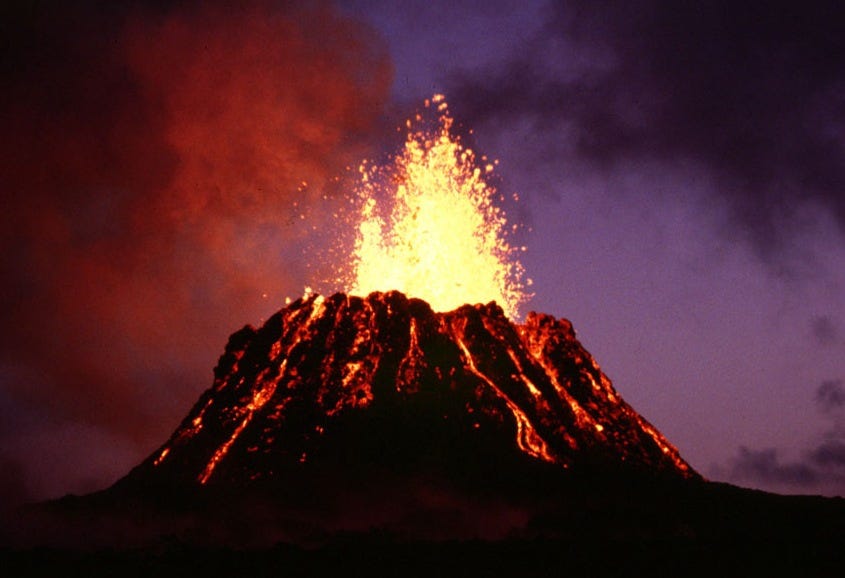
Pu’u O-o erupting, June 1983
If you ever wanted to get close to an active volcano, here is your chance. This park contains two active volcanoes: Kilauea, one of the world’s most active volcanoes, and Mauna Loa, the world’s largest shield volcano. The park provides scientists with insight into the development of the Hawaiian Islands and access for studies of volcanism. For visitors, it provides dramatic volcanic landscapes, glimpses of rare flora and fauna, and a view into traditional Hawaiian culture connected to the landscape.
Established as the nation’s tenth national park on August 1, 1916, it was originally called Hawaii National Park and included the Haleakala volcano on Maui; it was later split into this park and Haleakala National Park. In 1980, the park was designated as an International Biosphere Reserve, and a World Heritage Site in 1987. In 2012, the park was depicted on the 14th quarter of the America the Beautiful series.
In May 2018, the park was closed to the public in the Kīlauea volcano summit area, including the visitor center and park headquarters, due to explosions and a toxic ash cloud, as well as earthquakes and road damage. Portions of the park, including the visitor center, reopened to the public in September 2018. As of early 2025, most of the park is open; however, some road segments and trails, as well as the Jaggar Museum of the Hawaii Volcano Observatory, are still closed to visitors.
What to Know
Hawaii Volcanoes National Park can be accessed year-round. However, there are points of interest that are occasionally closed due to toxic fumes or volcanic smog. Check for current closures.
If you plan on staying in the park’s only in-the-park lodge, The Volcano House, reserve six months in advance. Rooms get snatched up fast. There are numerous options for lodging just outside the park in nearby communities.
Into camping? The park has two front-country campgrounds, and some camper cabins are available. You can even rent your equipment when you get there.
Geography
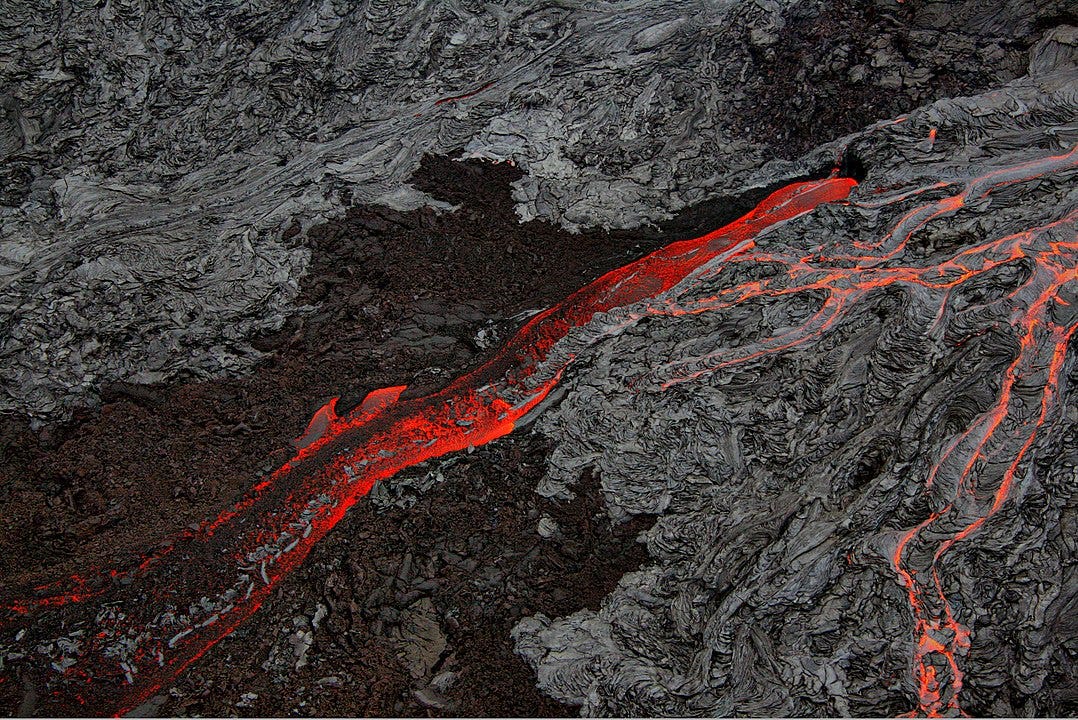
Pahoehoe and a’a lava flows
The park includes 553 square miles (354,461 acres), and around half was designated as the Hawaii Volcanoes Wilderness in 1978, providing solitude for hiking and camping. The park also encompasses diverse environments from sea level to the summit of the Earth’s most massive active volcano, Mauna Loa (13,679 feet; 19,999 cubic miles). st massive active volcano, Mauna Loa, at 13,679 feet (4,169 m). Climates range from lush tropical rain forests to the arid and barren Ka’u Desert.
The main entrance to the park is from the Hawaii Belt Road. The Chain of Craters Road leads to the coast, passing several craters from historic eruptions. The road continued to another park entrance near the town of Kalapana, but that portion is covered by a lava flow and is only available as an emergency evacuation route.
History
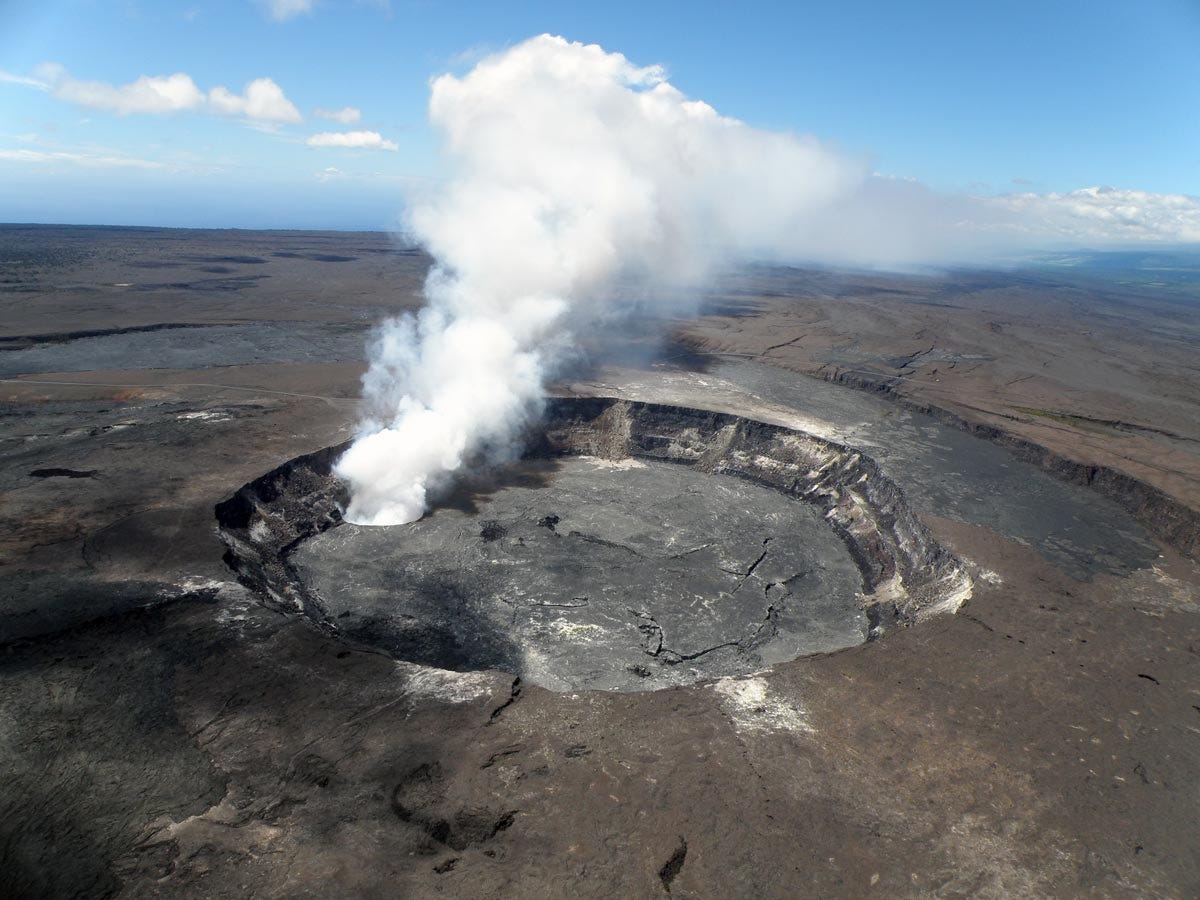
Halema’uma’u (September 2009)
In Hawaiian native culture, Kilauea and its Halema’uma’u caldera were seen as the home of the fire goddess Pele, and Hawaiians visited the crater to offer the goddess gifts. In 1790, a party of warriors, along with women and children who were in the area, were caught in an unusually violent eruption. Many were killed, and others left footprints that are still visible in the lava.
The first Western visitors, English missionary William Ellis and American Asa Thurston, came to Kilauea in 1823. Ellis wrote of his reaction to his first sight of the erupting volcano, “A spectacle, sublime and even appalling, presented itself before us. ‘We stopped and trembled.’ Astonishment and awe for some moments rendered us mute, and, like statues, we stood fixed to the spot, with our eyes riveted on the abyss below.”
The volcano became a tourist attraction in the 1840s, and local businessmen, including Benjamin Pitman and George Lycurgus, ran a series of hotels at the rim. Today, Volcano House is the only hotel and restaurant within the boundaries of the park.
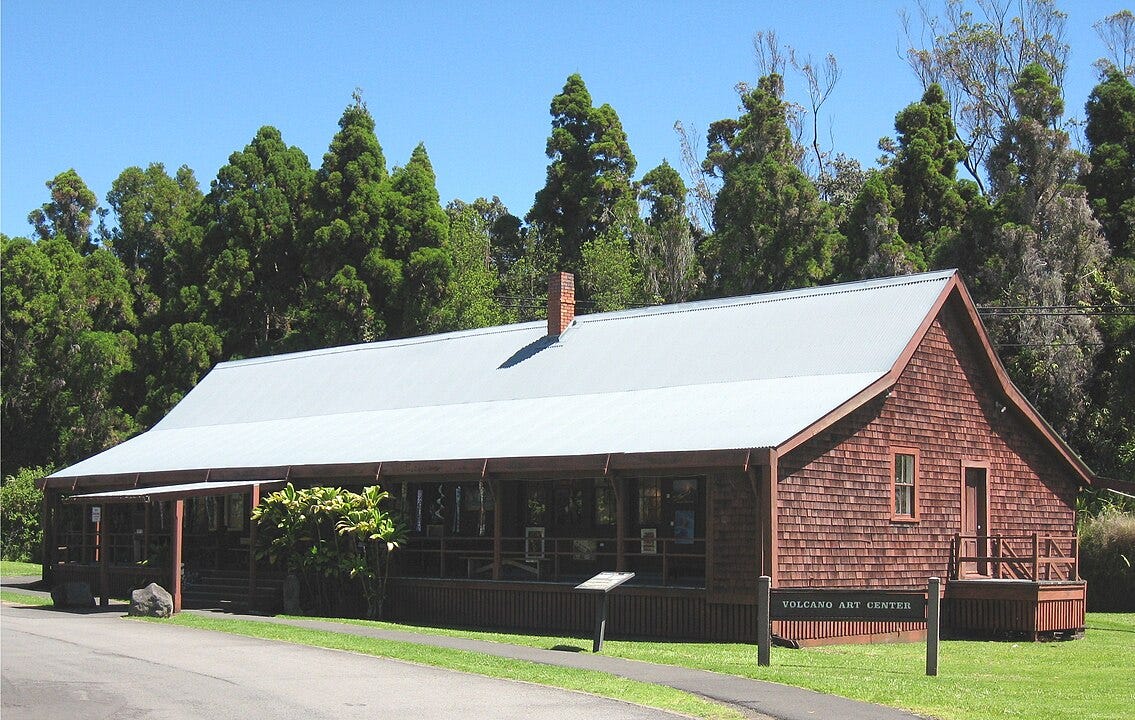
The Volcano Art Center was the Volcano House from 1877 to 1921
Establishment of a Park
Lorrin A. Thurston, grandson of Asa Thurston, was the driving force behind the creation of the park after investing in the hotel between 1891 and 1904. William R. Thurston first proposed the idea in 1903. Thurston, the owner of The Honolulu Advertiser, printed editorials favoring the park idea. In 1907, the territory of Hawaii paid for fifty members of Congress and their wives to visit Haleakala and Kilauea, including a dinner cooked over lava steam vents. In 1908, Thurston hosted the Secretary of the Interior, James Rudolph Garfield, and another Congressional delegation the following year. Governor Walter F. Frear proposed a draft bill in 1911 to create Kilauea National Park for $50,000 ($1.6 million today). Thurston and local landowner William Herbert Shipman proposed boundaries but ran into opposition from ranchers. Thurston printed endorsements from John Muir, Henry Cabot Lodge, and former President Theodore Roosevelt.
After several failed attempts, the legislation introduced by delegate (and former Hawaiian prince) Jonah Kuhio Kalaniana’ole finally got legislation passed, and on August 1, 1916, President Woodrow Wilson signed the bill creating Hawaii National Park as the tenth national park and the first in a territory. As stated in the foundation document:
The purpose of Hawai’i Volcanoes National Park is to protect, study, and provide access to Kīlauea and Mauna Loa, two of the world’s most active volcanoes, and perpetuate endemic Hawaiian ecosystems and the traditional Hawaiian culture connected to these landscapes.
Within a few weeks, the National Park Service was born, tasked with running the nation’s national parks. The park was officially renamed Hawaii Volcanoes National Park after being split from Haleakala National Park on September 22, 1961.
An easily accessible lava tube was named after the Thurston family.
The Painting of Pele
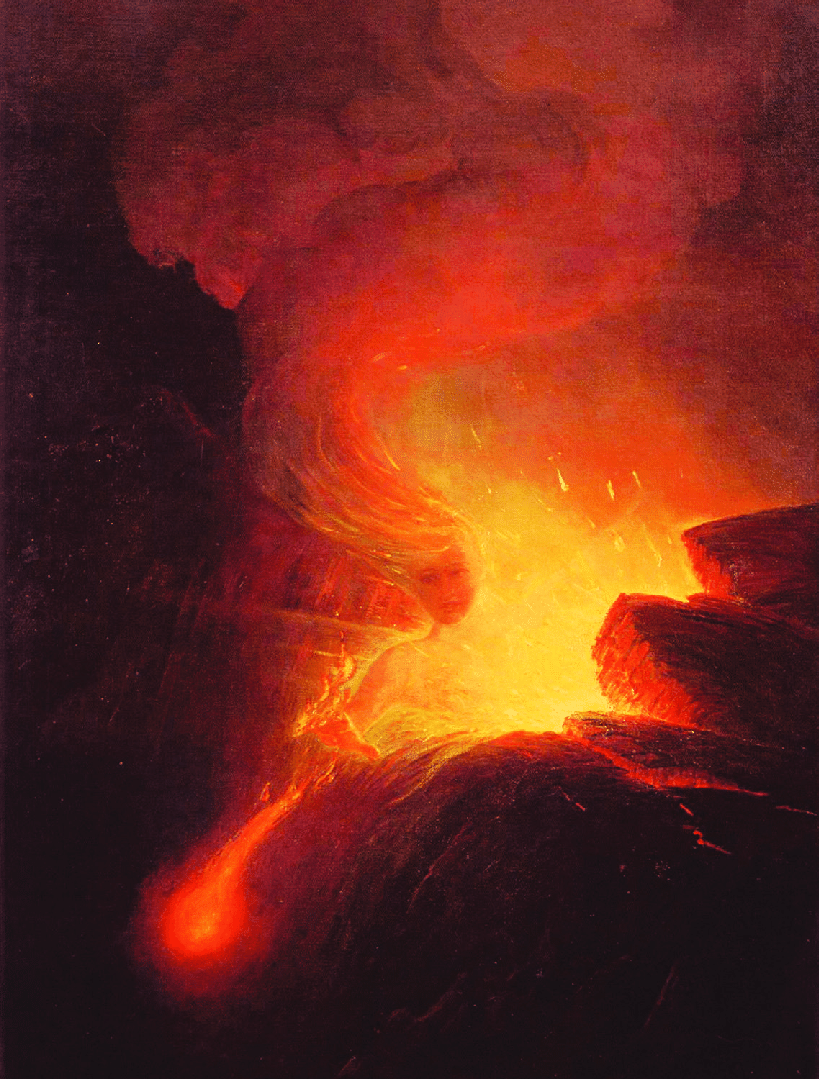
D. Howard Hitchcock’s painting of Pele
Around 1929, D. Howard Hitchcock created an oil painting of Pele, the Hawaiian goddess of fire, lightning, wind, and volcanoes. In 1966, his son Harvey donated the painting to the park where it was displayed in the visitor center from 1966 to 2005. The painting was criticized for portraying the Hawaiian goddess as a Caucasian. In 2003, the Volcano Art Center announced a competition for a “more modern and culturally authentic rendering” of the goddess. A panel of Native American elders selected a painting by Arthur Johnsen of Puna, Hawaii. In Johnsen’s painting, the goddess has distinctly Polynesian features. She is holding a digging stick (ʻōʻō) in her left hand and the egg that gave birth to her younger sister Hi’iaka, in her right hand. In 2005, the Hitchcock was replaced with Johnsen’s painting.
Expansion
In 2003, an additional 115,788 acres of the Kahuku Ranch were added to the park, the largest land acquisition in Hawaii’s history. Now named the Kahuku District, the park was enlarged by 56% with the newly acquired land.
Recent Events
On March 19, 2008, there was a small explosion in Halemaʻumaʻu, the first explosive event since 1924 and the first eruption in the Kīlauea caldera since September 1982. Debris from the explosion was scattered over 74 acres (30 ha). A small amount of ash was also reported at a nearby community. The explosion covered part of Crater Rim Drive and damaged Halemaʻumaʻu Overlook. The explosion did not release any lava, which suggests to scientists that it was driven by hydrothermal or gas sources.
This followed the opening of a major sulfur dioxide gas vent, greatly increasing levels emitted from Halemaʻumaʻu. The dangerous increase of sulfur dioxide gas prompted closures of Crater Rim Drive between the Jaggar Museum southeast to Chain of Craters Road, Crater Rim Trail from Kīlauea Military Camp southeast to Chain of Craters Road, and all trails leading to Halemaʻumaʻu, including those from Byron Ledge, ʻIliahi (Sandalwood) Trail, and Kaʻū Desert Trail.
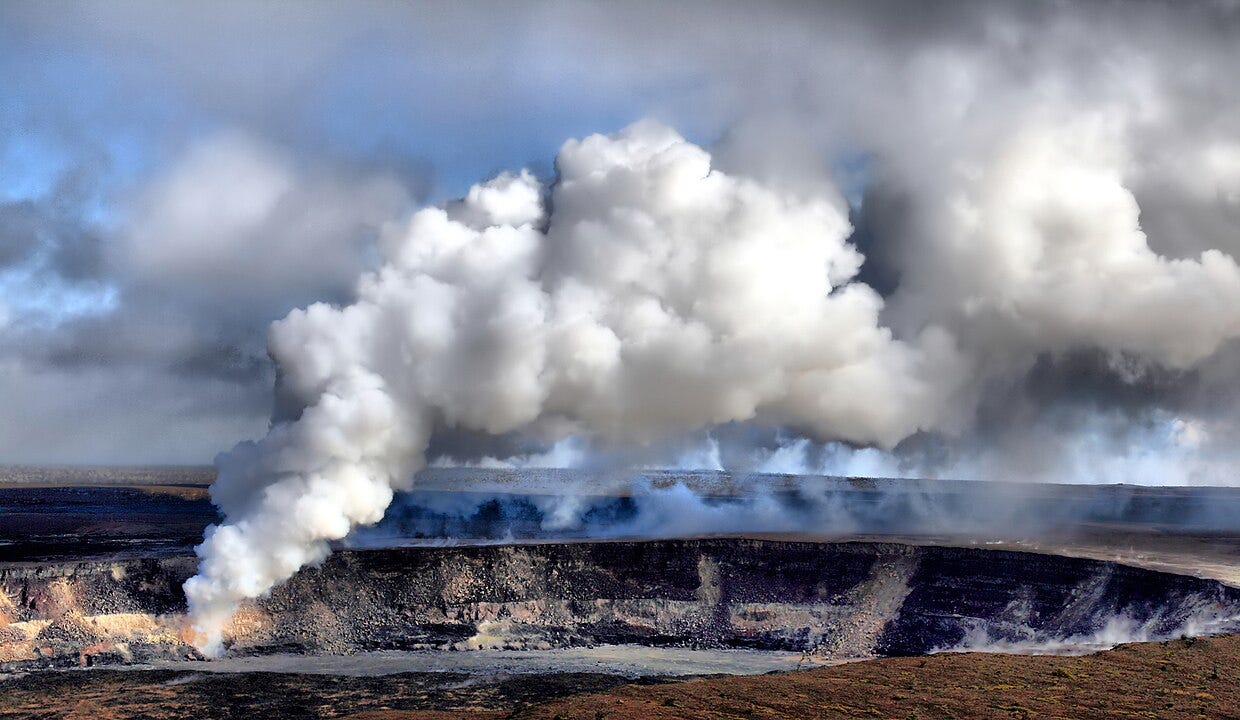
Sulfur dioxide emissions from the Halemaʻumaʻu event, April 2008
In mid-May 2018, the Kīlauea District of the park was closed due to explosive eruptions at Halemaʻumaʻu, though the Kahuku District remained open. The Kīlauea District, including the visitor center, reopened to the public on September 22, 2018.
As of now, most of the park is open, although some road segments, trails, and the Jaggar Museum of the Hawaii Volcano Observatory remain closed. The Thurston Lava Tube (Nāhuku) was reopened to the public on February 21, 2020. Several large rockfalls were cleared, and sensors were installed to monitor new cracks, along with improvements to water drainage and parking. The rockfalls and cracks had been caused by some of the 60,000 earthquakes recorded during the Kīlauea eruption. In 2022, the Mauna Loa volcano erupted after many years.
What to Do
Nahuku (Thurston) Lave Tube
One of the most fun things to do at the park is to walk through a giant lava tube. You enter this giant cave-like tunnel and experience an up-close look at an underground world created by a powerful volcano. You begin by walking through a verdant rainforest. As you do, listen for the calls of native birds. You’ll then enter the 500-year-old lava tube where once a 2000-degree (F) lava flowed. Its Hawaiian name, Nāhuku, means “the protuberances,” which may refer to the lava drippings that once hung from the ceiling. Unfortunately, those disappeared due to souvenir collectors after the tube was discovered in 1913. Entire ecosystems live in these fragile environments. So please be respectful and do not touch the walls or any hanging roots.
This short trail is perfect for all ages. It’s an easy 0.3-mile loop. Dim lights light the walkway (between 8 a.m. and 8 p.m.). It’s fun to bring your flashlight to get a closer look. Bring water, snacks, sturdy footwear, and rain gear. For your safety, do not walk along Crater Rim Drive. Be advised that parking is extremely limited and is likely to be full during peak hours (between 9 a.m. and 4 p.m.).
Kilauea Iki Crater
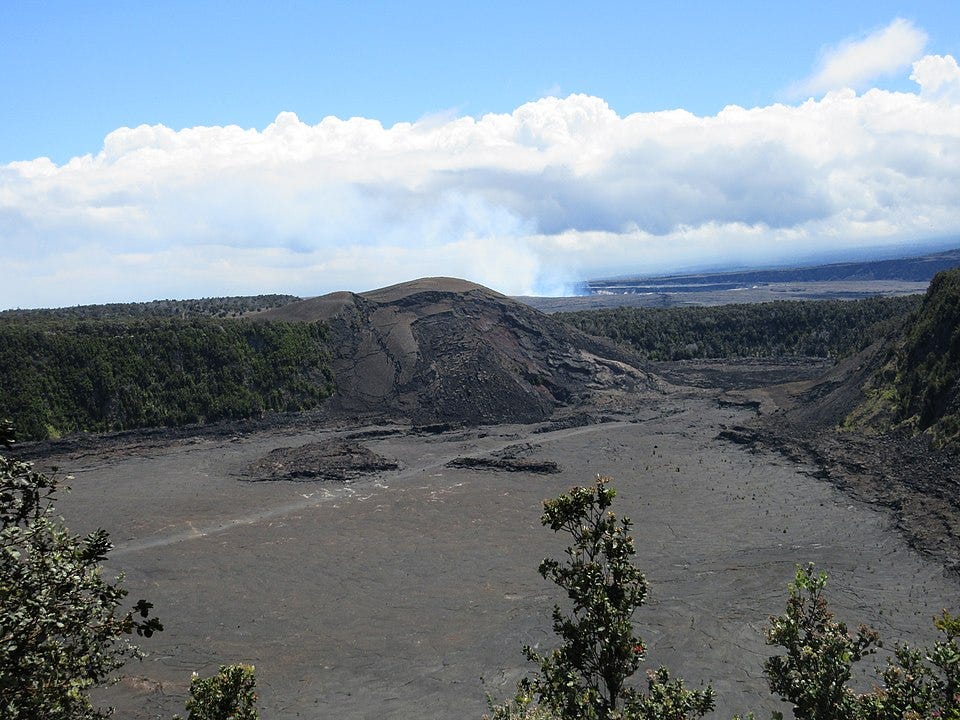
It’s not every day that you get to walk out on the crater of a volcano on a now hardened lake of lava. This pit crater is next to the main summit caldera of Kilauea. It is known for its eruption in 1959 that started on November 14 and ended on December 20, producing lava fountaining up to 1900 feet and a lava lake in the crater. Today, the surface of the lava lake has cooled, and it is now a popular hiking destination to view the aftermath of an eruption. Even after 50 years, parts of the surface are still warm to the touch. Rainwater seeps into the cracks and makes contact with the extremely hot rock below, and steam is emitted from various surface cracks. The steam and some rocks are hot enough to cause serious burns.
This hike is a four-mile loop that gains 400 feet in elevation. You’ll hike along the rim of the crater before descending to the hardened lava lake. Make sure to look for steam vents and cracks. Be sure to follow the ahu or stacked rocks and stay on course! Leaving the designated trail can be dangerous.
After you cross the crater, the trail will take you back up to the crater rim and through a beautiful forest to the parking area.
Wahinekapu (Steaming Bluff)
Here, you can surround yourself with a giant puff of steam as you walk along the edge of the Kilauea caldera. You can feel the breath of the volcano as hot water vapor billows from the earth. This short stroll is a fun way to experience the heat of a massive volcano. These steam vents are a result of rainwater seeping down through cracks in the earth and hitting rocks heated by magma deep underground. The rocks are so hot that they vaporize the water returning to the surface as steam. The ground underneath is so hot that trees can’t grow here. You can also enjoy the stunning views of the Kilauea caldera.
Chain of the Craters Road
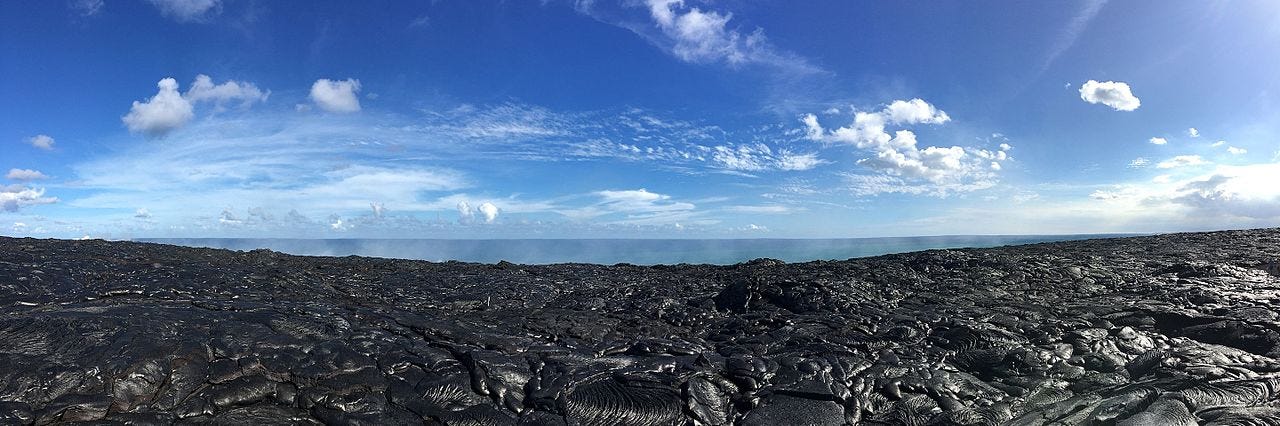
Panoramic view of the lava at the end of the road
This scenic 19-mile road takes you down to the sea and has an elevation change of 3700 feet. From here, you can see the island is growing due to the lava flow. There are no services such as shops, food, or gas stations along the road, except a refreshment kiosk and public toilets at the bottom end of the road, near the Holei Sea Arch. So plan accordingly. Also, keep in mind that due to the elevation change, the weather here can be drastically different than it is at the park’s entrance station.
In Conclusion
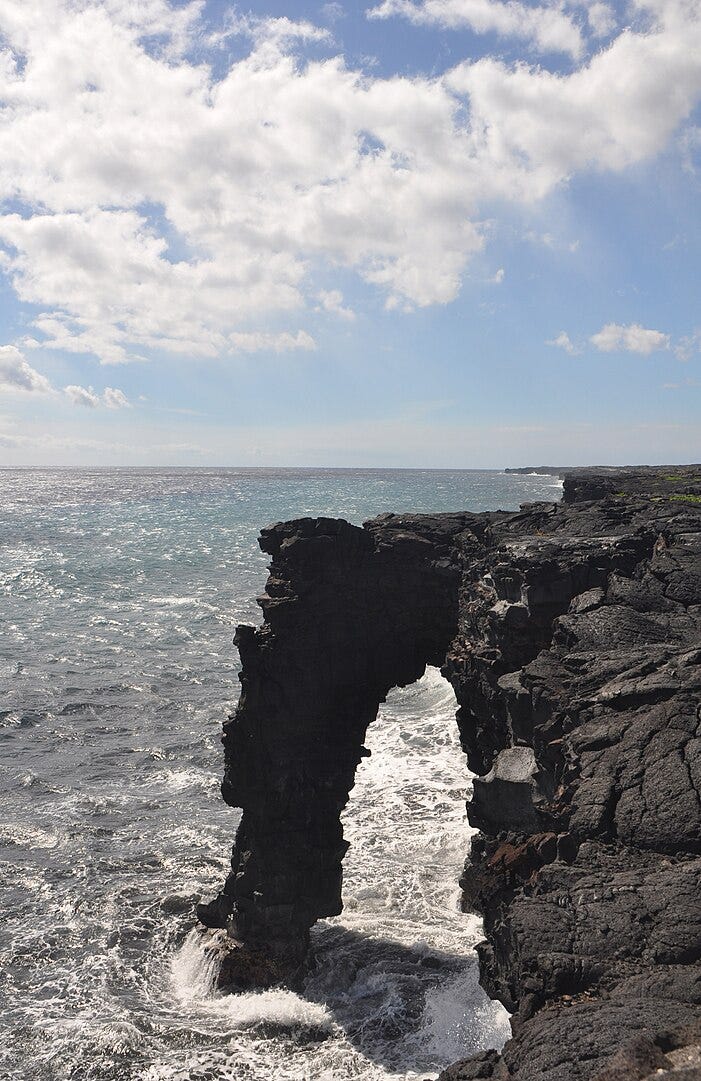
Holei Sea Arch
The opportunity to get up close to an active volcano doesn’t happen every day. Hawaii Volcanoes gives you such a chance. Observing these powerful forces of nature will take your breath away. Not to mention the sheer beauty of these islands, which are rightly seen as paradise on earth. It’s well worth the journey.
메타데이터
- post_id
- 4fe2ef787f2f
- slug
- hawaii-volcanoes-np-sacred-cauldron-4fe2ef787f2f
- url
- https://medium.com/@swgorham/hawaii-volcanoes-np-sacred-cauldron-4fe2ef787f2f
- canonical_url
- https://medium.com/@swgorham/hawaii-volcanoes-np-sacred-cauldron-4fe2ef787f2f
- author_url
- https://medium.com/@swgorham
- status
- ok
- fetched_at
- 2026-07-20 17:10:53