The Peninsula That’s Breaking Putin’s Empire
Blackouts, burned-out fuel convoys, and a “Highway of Death” are turning the Kremlin’s greatest trophy into its biggest liability
The Peninsula That’s Breaking Putin’s Empire
Blackouts, burned-out fuel convoys, and a “Highway of Death” are turning the Kremlin’s greatest trophy into its biggest liability

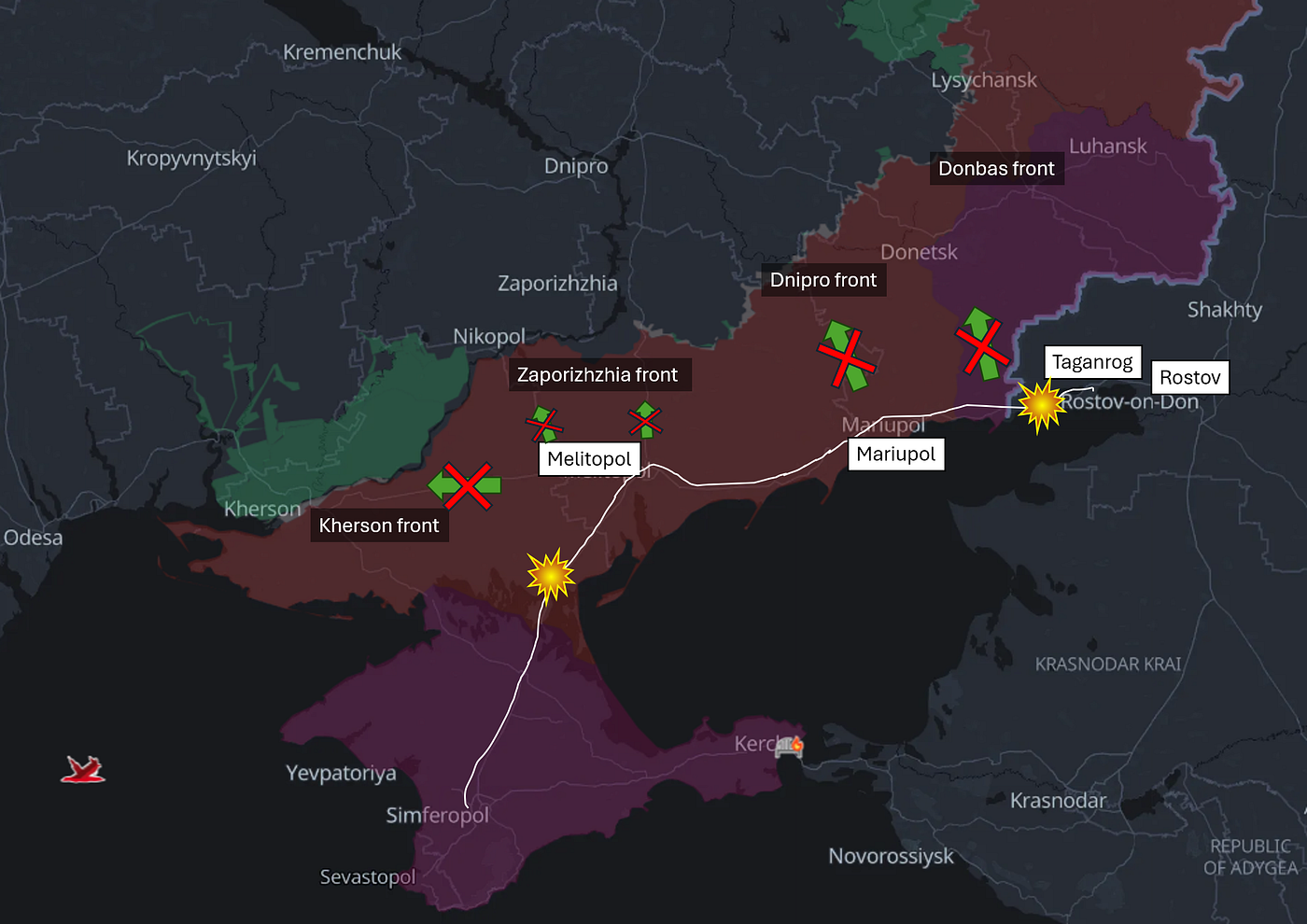
screenshot by author
The lights went out across an entire peninsula this week, and almost nobody in the West noticed.
Not a storm.
Not a grid failure.
A deliberate, months-long campaign that has left 2.5 million people in the dark, rationed on fuel, and cut off from the empire that annexed them.
Crimea — the crown jewel Vladimir Putin seized in 2014 and has spent a decade mythologizing as proof of Russia’s restored greatness — is quietly falling apart.
This matters far beyond Ukraine’s borders.
Crimea has functioned since 2014 as the single most potent symbol of Putin’s rule: the moment he redrew a European border by force and got away with it.
If that symbol cracks, it doesn’t just dent morale in Sevastopol. It reshapes how every autocrat watching — from Beijing to Tehran — calculates the cost of conquest.
From Trophy to Target
For a decade, Crimea was untouchable in Russian propaganda — a sun-drenched resort peninsula, its Black Sea Fleet a permanent reminder of restored imperial reach.
That image is now colliding with reality.
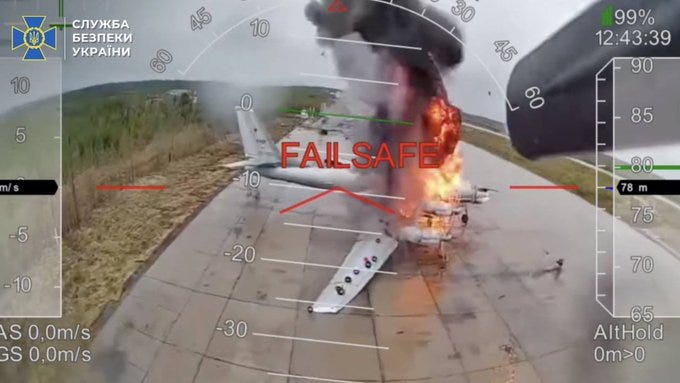
Since early 2026, Ukraine has run a sustained bombing campaign against Crimea using a new generation of cheap, long-range attack drones — models capable of covering nearly 200 miles and carrying warheads heavy enough to cripple fuel depots and power substations.
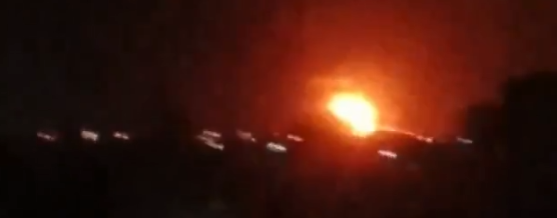
In just the first days of July, Ukrainian forces reportedly struck 38 separate energy facilities in Crimea and occupied Donbas, and a single night of attacks in early July knocked the entire peninsula off the power grid — the largest blackout of the war.
The tactical logic is simple but devastating: instead of attempting a costly frontal assault to retake the peninsula, Kyiv is trying to make it unlivable and unusable as a military asset.
Ukraine’s defense officials have openly described the goal as turning Crimea “into an island” — severing its bridges, rail lines, ferries, and coastal highways until it functions as a besieged outpost rather than a thriving Russian province.
The Highway of Death
The most visible sign of Russia’s unraveling grip isn’t in Crimea itself — it’s on the road leading to it.
The main supply route connecting the Russian hub of Rostov-on-Don to Crimea and occupied southern Ukraine has become littered with the wreckage of tanker trucks and military transports, so consistently hit by drones that soldiers on both sides now call it the “Highway of Death.”
Ukrainian strikes have disabled Crimea’s northern bridges, choked coastal shipping lanes, and repeatedly damaged the Kerch Bridge — the 12-mile crossing Putin personally opened in 2018 as a monument to annexation.
That leaves the bridge as nearly the only functioning link to the mainland, and even it now sees mile-long backups of vehicles waiting hours for inspection, with nearly twice as many cars trying to leave the peninsula as enter it.
The consequences are cascading into the battlefield itself.
Fuel and ammunition meant for Russian positions in Zaporizhzhia and Kherson have been destroyed before ever reaching the front, forcing some troops to haul supplies on foot for the final stretch.
Analysts tracking the war note that Ukraine’s disruption of logistics contributed to what several assessments call Russia’s worst month for territorial gains in years — a striking reversal for a military that has spent 2026 grinding forward elsewhere.
Life Under Siege
For ordinary residents, the war has stopped being a distant headline and become a daily hardship.
Sevastopol, Crimea’s largest city, has endured repeated blackouts as its main power substation has been hit multiple times.
Fuel sales to civilians have been suspended outright in parts of the peninsula, with only emergency and government vehicles exempted.
Summer camps have been canceled, streetlights switched off, outdoor events banned, and public transport schedules gutted. Russian-installed authorities have formally declared a state of emergency — an admission, however reluctant, that the situation is no longer under control.
Kremlin officials, naturally, are not calling this a crisis.
Spokesman Dmitry Peskov has framed it as “intensive” work to manage the fallout of what he calls Kyiv’s “barbaric actions,” while Putin himself continues to insist publicly that Russian forces are “advancing on all fronts.”
But the gap between that rhetoric and the reality on the ground — blackout maps, fuel lines, and burned convoys — is becoming difficult to paper over, even for a state that controls its own media narrative.
Why the World Should Watch
This isn’t only a story about drones and substations.
It’s a test of whether territorial conquest can still be sustained in an era of cheap, precise, mass-producible weapons.
Crimea was supposed to be Russia’s permanent, unassailable prize — heavily fortified, symbolically sacred, strategically vital as home to the Black Sea Fleet.
If a smaller neighbor can render that prize dysfunctional without retaking it in a traditional military sense, the lesson will echo well beyond the Black Sea.
Every government weighing whether to seize contested territory by force will be recalculating the price of holding it afterward.
Peace talks between Russia and Ukraine remain stalled, and Crimea’s status is widely seen as the single hardest issue standing between the two sides.
That makes the peninsula’s unraveling more than a battlefield curiosity — it’s arguably the clearest pressure point Kyiv has found to force Moscow back to the table.
Whether it’s enough to actually end the war is still an open question. But for the first time in over a decade, Putin’s signature conquest looks less like an unshakable trophy and more like a liability he cannot fully control.
메타데이터
- post_id
- 4ffacd641311
- slug
- the-peninsula-thats-breaking-putin-s-empire-4ffacd641311
- url
- https://medium.com/@neelam.jadon93/the-peninsula-thats-breaking-putin-s-empire-4ffacd641311
- canonical_url
- https://medium.com/@neelam.jadon93/the-peninsula-thats-breaking-putin-s-empire-4ffacd641311
- author_url
- https://medium.com/@neelam.jadon93
- status
- ok
- fetched_at
- 2026-07-08 17:17:42