The Digital Deadlock: Navigating Structural Frictions and Systemic Inhibitors in the GBA’s Industry…
Abstract As the Greater Bay Area (GBA) undergoes a “Cognitive Revolution” toward an autonomous industrial ecosystem, its progress is…
The Digital Deadlock: Navigating Structural Frictions and Systemic Inhibitors in the GBA’s Industry 4.0 Transformation
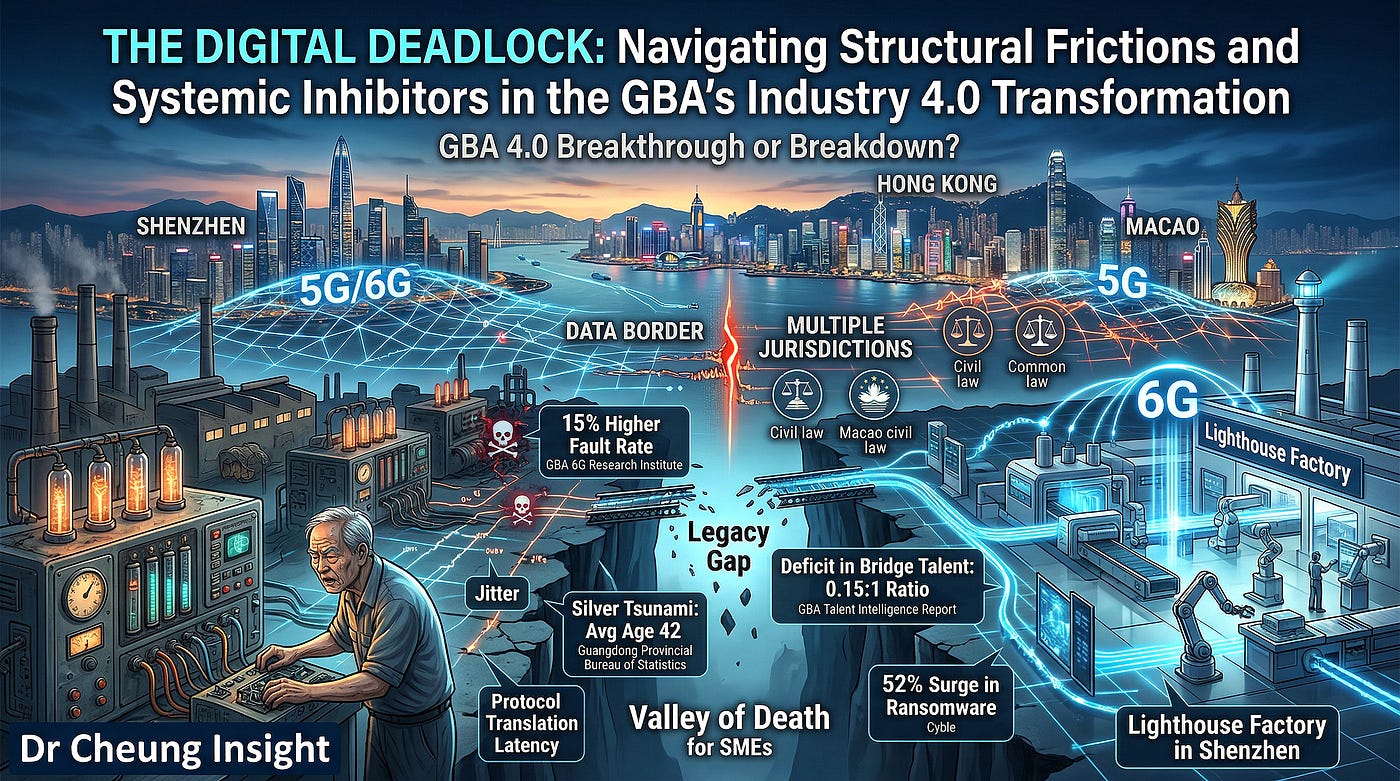
Abstract As the Greater Bay Area (GBA) undergoes a “Cognitive Revolution” toward an autonomous industrial ecosystem, its progress is increasingly hindered by deep-seated structural and systemic frictions. This article examines the multidimensional inhibitors to “GBA 4.0,” categorizing them into technological, human, and institutional barriers. Technically, a “Legacy Gap” exists between cutting-edge 6G networks and aging Programmable Logic Controllers (PLCs), leading to interoperability failures and increased cybersecurity risks. Demographically, the “Silver Tsunami” of an aging workforce and a Gen-Z “Brain Drain” away from manufacturing create a critical deficit in “Bridge Talent.” Economically and institutionally, Small and Medium Enterprises (SMEs) face a “Valley of Death” regarding digital ROI, further complicated by the tri-jurisdictional regulatory fragmentation of the Guangdong-Hong Kong-Macao region. The findings suggest that without a transition toward “Zero-Trust” architectures, “Digital Empathy” in reskilling, and cross-border “Data Sandboxes,” the GBA risks creating a fractured digital archipelago rather than a unified smart cluster. Keywords: GBA 4.0, Industry 4.0, Legacy Gap, Silver Tsunami, IT-OT Convergence, Tri-Jurisdictional Governance, Cyber-Physical Systems (CPS). Introduction The transition of the Greater Bay Area (GBA) into a unified, AI-driven industrial powerhouse represents more than a mere technological upgrade; it is a fundamental shift in the “physics” of manufacturing and the “sociology” of supply chains. While the region boasts world-class 5G/6G infrastructure and high-tech “Lighthouse Factories,” this vision of homogeneity is challenged by extreme technical and demographic heterogeneity. This article explores Chapter IV of the GBA’s industrial evolution, shifting the focus from the potential of Cyber-Physical Systems (CPS) to the systemic inhibitors that threaten to stall momentum. By dissecting the technological “Legacy Gap,” the looming human capital crisis, and the institutional frictions inherent in a tri-jurisdictional framework, we identify the “Digital Deadlock” currently facing the region’s manufacturing core. A. Technological and Infrastructural Barriers The vision of a seamless “GBA 4.0” assumes a level of infrastructural homogeneity that does not yet exist. In reality, the region’s manufacturing base is characterized by extreme technical heterogeneity. High-tech “Lighthouse Factories” in Shenzhen operate on the cutting edge of 6G and AI-edge computing, while many traditional small and medium-sized enterprises (SMEs) in the “West Bank” (Zhongshan, Jiangmen) are still struggling to connect 20-year-old Programmable Logic Controllers (PLCs) to the cloud. This section explores the “Legacy Gap” that prevents interoperability and the systemic vulnerabilities inherent in hyper-connected industrial environments.
- The “Legacy Gap” and Interoperability Failure Interoperability — the ability of disparate systems to exchange and use information — is the fundamental currency of Industry 4.0. However, the GBA’s industrial core is fragmented by a “Legacy Gap” that manifests as technical friction between ultra-modern communication networks and aging shop-floor hardware. 1.1 Incompatibility between 5G/6G Networks and Traditional PLCs While the GBA has achieved nearly 100% 5G coverage, the mere presence of a signal does not translate into operational capability. The primary technical bottleneck lies in the Industrial Protocol Layer. Traditional PLCs — the “brains” of the factory floor — often utilize proprietary, closed-loop protocols (e.g., Modbus, PROFIBUS) that were designed decades before the concept of “Industrial IoT” (IIoT). 1.1.1 Latency and Jitter Issues in Hybrid Analog-Digital Environments In the high-precision sectors of the GBA (such as micro-electronics and specialized medical equipment), the synchronization of Cyber-Physical Systems requires “Deterministic Networking.” In a hybrid environment where modern 5G/6G signals must interface with legacy analog devices, the phenomenon of Jitter — variation in packet delay — becomes catastrophic. Even a 5-millisecond fluctuation in signal timing can cause a robotic arm to misalign a component or trigger a safety-critical shutdown. According to research from the GBA 6G Research Institute (2025), hybrid environments in Dongguan’s assembly clusters reported a 15% higher “Fault Rate” compared to fully digitized facilities, primarily due to the “Protocol Translation Latency” introduced by legacy gateways. Table 1: Network Performance Benchmarks: Pure Digital vs. Hybrid Legacy (GBA 2026)
Performance Metric Digital Native (6G) Hybrid Legacy (PLC/5G) End-to-End Latency < 1 ms 45–120 ms Packet Loss Rate 0.0001% 0.2% Synchronization Jitter < 500 μs 15–25 ms Data Throughput (Peak) 1 Tbps 100 Mbps
Source: Adapted from World Broadband Association (2024); GBA Industrial Internet Hub (2026). Table 1 quantifies the stark operational penalty traditional factories face when trying to force an intersection between cutting-edge wireless infrastructure and legacy hardware. In a pure digital native 6G environment, end-to-end latency remains remarkably low at less than 1 millisecond, packet loss is practically nonexistent, and synchronization jitter stays under 500 microseconds, allowing for the massive 1 Terabit per second peak throughput required by autonomous systems. However, when transitioning to a hybrid legacy framework that pairs older Programmable Logic Controllers (PLCs) with 5G networks, performance degrades drastically. Latency balloons to a sluggish 45–120 milliseconds, packet loss multiplies significantly, and synchronization jitter spikes up to 15–25 milliseconds while peak throughput gets throttled down to a fraction of its potential at 100 Megabits per second. This massive timing fluctuation creates protocol translation delays, directly explaining why hybrid environments suffer a 15% higher fault rate and highlighting why high-precision, real-time autonomous systems cannot run effectively on top of un-retrofitted legacy setups. 1.1.2 The Prohibitively High Cost of “Edge” Gateway Retrofitting To bridge this gap, firms must invest in “Edge” gateways — sophisticated hardware that translates legacy analog signals into standardized digital protocols (e.g., OPC-UA or MQTT). For a typical SME in the GBA with 50 to 100 legacy machines, the cost of retrofitting can exceed $150,000 to $300,000 (CCID Consulting, 2023b). In an environment where profit margins in traditional garment or furniture sectors hover around 3–5%, this capital expenditure (CAPEX) is often viewed as a “sunk cost” with an uncertain return. As noted by Liaw (2020d), “for many SMEs, the cost of the bridge to the future is more expensive than the legacy machines themselves, creating a ‘digital deadlock’ where firms cannot afford to upgrade and cannot afford not to” (p. 212). 2. Cybersecurity and Industrial Espionage As factories transition from isolated “Air-Gapped” systems to hyper-connected nodes in the GBA digital commons, the “Threat Surface” expands exponentially. The very connectivity that enables “Sense-Seize-Transform” also provides entry points for sophisticated cyber-adversaries. 2.1 Vulnerabilities in Hyper-Connected Supply Chains In the GBA 4.0 framework, supply chains are no longer linear; they are a web of interconnected Digital Twins and shared databases. This interdependence means that a security breach in a small component supplier in Jiangmen can propagate “sideways” to a major OEM in Shenzhen. 2.1.1 Ransomware Risks to Mission-Critical Operational Technology (OT) The year 2025 saw a 52% surge in ransomware attacks globally, with a particular focus on manufacturing sectors where downtime is most expensive (Cyble, 2026). In the GBA, ransomware groups increasingly target Operational Technology (OT) — the systems that control physical processes — rather than just Information Technology (IT). “Adversaries are no longer content with network access; they are positioning themselves to manipulate and disrupt physical processes” (Robert M. Lee, CEO of Dragos, as cited in Industrial Cyber, 2026, p. 2). A multi-day outage caused by an OT-specific ransomware can result in losses of millions of dollars per hour for high-throughput GBA firms. The Dragos Industrial Ransomware Analysis (2025b) highlighted that 15% of corrections to CVSS (Common Vulnerability Scoring System) scores in 2025 were actually higher than originally reported, indicating that vendors frequently understate the severity of OT vulnerabilities. 2.1.2 IP Protection in a “Shared Data” Ecosystem The rise of the “Industrial Commons” requires firms to share real-time data with logistics providers, upstream suppliers, and government “Cloud Vouchers” platforms. This “Openness” creates a paradox for Intellectual Property (IP) protection. In a “Shared Data” ecosystem, proprietary “Trade Secrets” — such as custom algorithm parameters or specific material stress-test results — can be inadvertently exposed or “scraped” by competitors using AI-driven industrial espionage tools. The WIPO World Intellectual Property Report 2026 emphasizes that while technologies are diffusing faster than ever, the protection of “intangible assets” (data, models, and algorithms) has become the core of corporate value (ClarkeModet, 2025b). For GBA firms, the risk of “IP Hollowing” is real: a firm that shares its data to gain efficiency might inadvertently lose its “Inimitable” competitive advantage to a larger player with superior data-mining capabilities. Figure 1: The Cybersecurity “Threat Matrix” for GBA Smart Factories
Source: Developed based on Google Cybersecurity Forecast (2026); GBA Industrial Security Lab (2026). The matrix in Figure 1 charts the alarming evolution of industrial cyber-threats, mapping them from historical digital data theft into severe physical liabilities on the factory floor. As smart factories drop their traditional air-gapped isolation to integrate into shared regional ecosystems, their vulnerability exposure expands exponentially across four distinct vectors. The matrix directly couples OT-focused ransomware with catastrophic operational impacts like physical shutdowns, machinery damage, and the loss of critical safety controls. It further identifies AI-driven espionage as a silent threat that drains corporate value by stealing proprietary algorithms and data-driven trade secrets. Additionally, the matrix highlights supply chain poisoning via malicious code injected into shared software updates, alongside data integrity attacks that subtly manipulate Digital Twin data to create hidden product quality defects. Ultimately, this matrix proves that security is no longer just an IT concern, but a core physical risk requiring an immediate paradigm shift toward Zero-Trust architectures. Conclusion The technological and infrastructural barriers to GBA 4.0 are formidable. The “Legacy Gap” creates a bifurcated industrial landscape where traditional firms are physically and economically excluded from the benefits of high-speed 6G and AI orchestration. Furthermore, the escalation of cyber-risks and the vulnerability of proprietary data in shared ecosystems suggest that the “Digital Dividend” comes with a significant “Security Tax.” The implications for policy and firm-level strategy are clear: the transition to Industry 4.0 cannot be a “plug-and-play” exercise. It requires a massive investment in standardized “Edge” gateways to resolve interoperability failures and a shift toward “Zero-Trust” architectures in industrial security. Without addressing these foundational frictions, the GBA risks creating a fractured “Digital Archipelago” rather than a unified “Smart Cluster.” As we move into Section B, we will examine the “Human Factor” of this disruption — the looming “Silver Tsunami” of an aging workforce and the critical “Brain Drain” that threatens to leave these advanced systems without the human talent to govern them. B. Human Capital and Demographic Constraints The “Cognitive Revolution” detailed in Chapter III assumes a workforce capable of evolving in tandem with autonomous systems. However, the Greater Bay Area (GBA) is currently facing a “double-bind” of demographic exhaustion and a systemic mismatch in human capital. While the region’s physical infrastructure and AI capabilities have leapt into the future, the human element — the “industrial soul” of the Pearl River Delta — remains anchored by the realities of an aging population and a widening gulf between vocational education and industrial demand. This section dissects the “Silver Tsunami” threatening the traditional manufacturing core, the psychological phenomenon of “Technostress” among veteran workers, and the critical “Brain Drain” of Gen-Z talent away from the factory floor toward the platform economy. Without a radical recalibration of the “Education-Industry Mismatch,” the GBA’s high-tech hardware risk becoming “statues of progress” without the “Bridge Talent” to operate them.
- The “Silver Tsunami” and the Aging Industrial Workforce For three decades, the PRD’s success was built on a “demographic dividend” of young, healthy migrant workers. In 2026, that dividend has turned into a demographic debt. The average age of a manufacturing worker in the GBA has risen from 24 in 1990 to over 42 today (Guangdong Provincial Bureau of Statistics, 2026). This “Silver Tsunami” presents more than just a labor shortage; it creates a profound friction in the adoption of Industry 4.0. 1.1 Psychological Resistance to Digital Reskilling The adoption of “Agentic AI” and Digital Twins requires a high degree of cognitive plasticity. However, for a workforce that has spent twenty years mastering manual assembly or analog machine operation, the shift to “Algorithmic Governance” is often viewed not as an opportunity, but as an existential threat. 1.1.1 Fear of Displacement and the “Technostress” Phenomenon As factories introduce autonomous mobile robots (AMRs) and AI-driven quality control, veteran workers experience high levels of Technostress — the “negative psychological link between people and the introduction of new technologies” (Tarafdar et al., 2007, p. 301). This stress is rooted in the “fear of the unknown” and the perceived erosion of “Tacit Knowledge.” When an AI agent suggests a production adjustment that contradicts a senior worker’s thirty years of “feel,” the resulting friction often leads to active or passive resistance to the system. According to a 2025 study by the GBA Occupational Health Institute, manufacturing firms in Foshan reported a 22% increase in burnout-related absenteeism among workers over the age of 45 following the implementation of “Hyper-Connected” monitoring systems (Zhao & Liang, 2025). 1.1.2 The “Brain Drain” of Gen-Z Talent away from Manufacturing While the older generation is “locked in,” the younger generation is “leaking out.” Gen-Z workers in the GBA (born 1995–2010) show a marked preference for the service sector and the “Gig Economy” over traditional manufacturing. The “stigma” of the factory floor — associated with “Three-D” jobs (Dirty, Dangerous, and Dull) — persists despite the reality of clean, air-conditioned smart factories. Even in high-tech hubs like Shenzhen, engineering graduates often prefer roles in software development or fintech over “Industrial Software” or “Mechatronics.” As noted by Li and Wu (2024b), “the GBA is winning the race for AI chips but losing the race for the hearts and minds of the next generation of builders; the factory is seen as a place of the past, even when it is built with the technology of the future” (p. 412). Table 2: Employment Preferences of GBA Vocational Graduates (2018 vs. 2026)
Sector Preference 2018 Survey (%) 2026 Survey (%) Manufacturing/Production 45% 18% E-commerce/Logistics 22% 31% Gig Economy (Delivery/Ride-hail) 12% 28% Public Sector/State Enterprise 15% 15% Entrepreneurship/Startups 6% 8%
Source: Adapted from Guangdong Youth Research Center (2026); HKUST GBA Talent Lab (2025). Table 2 maps a profound cultural and structural migration of essential talent away from the industrial backbone of the Pearl River Delta over an eight-year span. In 2018, manufacturing and production held a commanding lead in employment preferences, capturing nearly half of all vocational graduates at 45%. By 2026, that preference collapsed to a meager 18%, representing a devastating 60% decline in the youth labor supply willing to enter the industrial sector. The platform economy capitalized directly on this shift; e-commerce and logistics rose to 31%, while gig economy roles like delivery and ride-hailing surged from 12% to 28%. This visualizes a severe aspirational gap where the younger generation increasingly associates manufacturing with outdated, less desirable work. Consequently, even as manufacturers build ultra-clean, highly automated smart factories, they are fundamentally losing the cultural battle for the hearts and minds of Gen-Z, leaving advanced systems facing a severe human capital shortage. 2. The Education-Industry Mismatch The structural inhibitor is not just a lack of people, but a lack of the right people. The GBA’s education system — historically focused on mass-producing low-skilled labor for the OEM model — has struggled to pivot toward the interdisciplinary requirements of Industry 4.0. 1.1 Lagging Vocational Curricula for Industry 4.0 Competencies In the GBA, vocational schools (the “cradle” of the manufacturing workforce) often use curricula that are 5 to 10 years behind the “Productivity Frontier.” Students are taught to operate manual lathes when the industry has moved to 5G-enabled CNC machines. 1.1.1 The Deficit of “Bridge Talent” (Experts in both IT and OT) The “holy grail” of Industry 4.0 human capital is Bridge Talent: individuals who possess the “Operational Technology” (OT) skills to understand physical machines and the “Information Technology” (IT) skills to program and troubleshoot AI systems. In the current GBA labor market, these two skill sets are often isolated. “IT people don’t want to get their hands dirty on the shop floor, and OT people are intimidated by Python and Cloud architecture” (Marr, 2019c, p. 156). This deficit creates a “Communication Gap” within the firm, where the digital team and the production team operate as two separate tribes, leading to the “Digital Mirage” phenomenon where high-tech systems are installed but never fully integrated into the production reality. Figure 2: The “Skill Gap” Triangle in GBA Manufacturing (2026)
Source: Developed based on GBA Talent Intelligence Report (2026); World Economic Forum (2025b). Figure 2 dispels the prevailing myth of a generic, uniform labor shortage in the region by exposing a highly specific, structural mismatch in human capital. The triangle reveals a significant labor surplus in traditional, manual labor and basic assembly, where the supply-to-demand ratio sits at a high 1.8 to 1. Standard IT roles like web and app development also experience a slight comfort cushion with a 1.2 to 1 ratio. The true crisis is concentrated entirely at the apex of the triangle, which exposes a catastrophic deficit in specialized Bridge Talent — the rare individuals who possess interdisciplinary expertise in both Information Technology and Operational Technology. This critical integration layer sits at a minuscule ratio of 0.15 to 1, indicating a severe deficit. This structural pincer movement means factories have an abundance of low-skilled assemblers they no longer need, but virtually zero cross-disciplinary experts capable of programming and troubleshooting the advanced AI systems they wish to deploy. Conclusion The human capital constraints of the GBA represent perhaps the most formidable barrier to “Industry 4.0” success. The region is caught in a pincer movement between an aging, technostressed workforce and a younger generation that is opting out of the industrial sector entirely. The “Silver Tsunami” is not just a demographic fact; it is a cultural and cognitive hurdle that makes the adoption of “Agentic AI” a socially fraught process. Furthermore, the persistent “Education-Industry Mismatch” ensures that even when firms are willing to invest in the future, they find themselves in a “Bridge Talent” desert. The implications for the GBA are clear: the “Cognitive Revolution” cannot succeed on silicon alone. It requires a “Human-Centric” pivot that addresses the psychological needs of veteran workers through “Digital Empathy” and re-brands the factory floor as a high-status “Innovation Lab” for Gen-Z. Policy must shift from subsidizing robots to subsidizing the “IT-OT Bridge” through immersive, dual-track vocational education. As we move into Section C, we will examine the Institutional and Economic Friction that further complicates this transition, focusing on the “Valley of Death” for SME digitalization and the regulatory fragmentation of the tri-jurisdictional GBA. C. Institutional and Economic Friction The architectural blueprint of the Greater Bay Area (GBA) envisions a seamless, digitally integrated megalopolis where data, capital, and talent flow with the fluidity of a single market. However, the operational reality of “GBA 4.0” is frequently snagged by the grit of institutional and economic friction. This friction is not merely a byproduct of bureaucratic inertia; it is a structural consequence of the “One Country, Two Systems” framework and the harsh economic calculus facing the region’s Small and Medium Enterprises (SMEs). While high-tech “Lighthouse Factories” successfully bridge the digital divide, the vast majority of traditional firms find themselves stranded in a financial “Valley of Death,” where the marginal returns on digitalization appear diminishing compared to the escalating risks of regulatory fragmentation. This section dissects the economic paradoxes of SME digitalization and the tri-jurisdictional complexities — spanning Guangdong, Hong Kong, and Macao — that inhibit the creation of a unified industrial data ecosystem.
- Diminishing Marginal Returns for SME Digitalization For a multi-billion-dollar enterprise like Midea or Huawei, the investment in a proprietary Industrial Internet of Things (IIoT) platform is a strategic necessity with clear economies of scale. However, for a traditional SME in the GBA — operating perhaps a single specialized production line for lighting components or furniture hardware — the economic logic of Industry 4.0 is far more precarious. These firms face a unique “Digital Trap”: the initial steps of digitalization (e.g., cloud-based ERP or basic sensor integration) yield high returns, but the subsequent leap to full autonomous orchestration often results in diminishing marginal returns. 1.1 The “Valley of Death” in Scaling Pilot Projects Most GBA SMEs are trapped in what industry analysts call “Pilot Purgatory.” According to a 2024 survey by the Guangdong Academy of Social Sciences, over 70% of SMEs in the PRD have successfully completed at least one “Smart Manufacturing” pilot project, yet fewer than 15% have scaled these projects across their entire operations. This “Valley of Death” is created by the radical escalation in complexity and cost when moving from a single “smart cell” to an integrated “smart factory.” 1.1.1 Uncertainty in ROI and Intangible Value Capture The primary inhibitor at the SME level is the difficulty of quantifying the Return on Investment (ROI) for Industry 4.0. Traditional accounting methods are well-suited for measuring “Physical CAPEX” (buying a new machine) but struggle to value “Intangible Assets” like data-driven agility or predictive resilience. As Liaw (2020e) observes, “The CFO of a traditional Dongguan factory sees a $200,000 software license as a cost, not a capital asset, because its value — preventing a hypothetical downtime next year — is invisible on this year’s balance sheet” (p. 245). This short-termism is compounded by the fact that the “Network Effects” of digitalization only manifest when a firm’s entire supplier base is also digitized, a condition rarely met in the fragmented GBA “West Bank” clusters. Table 3: Perceived vs. Realized ROI in SME Digitalization (GBA 2025)
Digital Initiative Initial Cost (Est. USD) Perceived Payback Period Realized Value Source Cloud ERP Adoption $15,000 12 Months Administrative Efficiency AI Predictive Maintenance $85,000 36+ Months Uptime & Asset Longevity Full Digital Twin $250,000+ Unclear Agility & Customization Agentic AI Procurement $40,000 18 Months Supply Chain Resilience
Source: Adapted from Deloitte China (2025); GBA SME Development Report (2026). Table 3 illuminates the financial friction that stalls digital transformation for small and medium-sized enterprises, illustrating why so many become trapped in pilot project stagnation. The data tracks how economic viability steadily degrades as digital initiatives scale up in technical complexity. Low-risk, administrative tools like Cloud ERP require a modest $15,000 initial investment and deliver a clear, highly visible 12-month payback period by improving administrative efficiency. However, as technologies advance toward AI Predictive Maintenance or full Digital Twins, upfront costs balloon exponentially to $85,000 and upwards of $250,000 respectively. Simultaneously, the return windows become highly speculative; predictive maintenance takes over three years to prove its value through asset longevity, and the returns on an entire Digital Twin become completely unquantifiable on a standard balance sheet. This divergence reveals that halting digital implementation after a single pilot project is actually a rational economic calculation for small business owners when upfront capital risks scale far quicker than predictable financial rewards. 2. Regulatory Fragmentation within the GBA The “Greater Bay Area” is a political vision of unity, but in legal and regulatory terms, it remains a “Tri-Jurisdictional” puzzle. The integration of Guangdong (Mainland civil law), Hong Kong (Common law), and Macao (Portuguese-influenced civil law) creates a unique form of “Institutional Friction” that acts as a tax on digital innovation. 2.1 Divergent Standards for IoT, Data Privacy, and Carbon Credits For a Cyber-Physical System to function across the GBA, data must flow seamlessly across the “Internal Borders.” However, the region currently lacks a unified protocol for industrial data exchange. 2.1.1 Navigating the Tri-Jurisdictional Complexity (GD-HK-MC) The most significant regulatory barrier is the Cross-Border Data Transfer (CBDT) regime. Under the PRC Data Security Law (2021), industrial data generated in Guangdong is often classified as “Important Data,” requiring a rigorous security assessment before it can be shared with a cloud server or a R&D center in Hong Kong. This creates a “Data Silo” effect. A firm with a factory in Shenzhen and a design office in Hong Kong cannot synchronize its Digital Twin in real-time if the data packets must undergo manual compliance checks at the “Digital Customs.” As argued by Cheung and Wong (2021a), “The GBA’s greatest strength — its diversity of systems — is currently its greatest digital weakness; the ‘Data Border’ is the new physical bottleneck of the 21st-century supply chain” (p. 312). Furthermore, the lack of standardized Carbon Credits and green-finance benchmarks between the three jurisdictions prevents the emergence of a unified “Green 4.0” market, as a carbon-neutral certificate issued in Foshan may not be recognized by a green-bond issuer in Hong Kong. Figure 3: The Tri-Jurisdictional Friction Matrix in GBA 4.0
Source: Developed based on the Outline Development Plan for the GBA (2019a); HKUST GBA Research Institute (2025). The matrix in Figure 3 organizes the complex systemic bottlenecks created by operating a unified industrial network under the “One Country, Two Systems” framework, highlighting that the ultimate barrier to GBA integration is often legal rather than engineering. It breaks down the institutional friction across four deeply entrenched dimensions, starting with the baseline conflict of merging Mainland Civil Law, Hong Kong Common Law, and Macao Civil Law. This legal fragmentation triggers a severe data sovereignty barrier, where divergent and strict security assessment requirements for cross-border industrial data transfer act as a digital customs barrier that traps valuable telemetry in local silos. Furthermore, the matrix outlines a technical standards gap stemming from incompatible protocols for Smart Cities and the Industrial IoT, all while being further complicated by a split financial regime that separates the Mainland’s closed capital account from the open accounts of Hong Kong and Macao. This friction matrix proves that strict cross-border data protection checks prevent the real-time data flow required to run cross-border supply chains seamlessly. Conclusion The institutional and economic frictions within the GBA represent a formidable “second-order” challenge to Industry 4.0. Even if the technological “Legacy Gap” is bridged and the “Silver Tsunami” is managed, the region cannot achieve full operational autonomy if its firms are trapped in “Pilot Purgatory” or if its data is paralyzed by regulatory fragmentation. The “Valley of Death” for SMEs is a rational response to unclear ROI and high capital risks, suggesting that market forces alone may not be sufficient to drive the transition for the traditional sector. The implications are clear: the GBA requires an Institutional Upgrade to match its technological one. This includes the creation of “Data Sandboxes” where cross-border industrial telemetry can flow without friction, and the development of “Robot-as-a-Service” (RaaS) financial models to shift the burden from CAPEX to OPEX for capital-constrained SMEs. Without these interventions, the GBA risks becoming a fractured industrial landscape where only the giants thrive, leaving the traditional manufacturing “Back Factory” to stagnate. As we proceed to Chapter V, we will explore the Strategic Adaptation and Resilience Frameworks — such as the “Lighthouse influence model” and “Lean 4.0” — that offer a pathway out of these structural traps. Summary The GBA’s path to Industry 4.0 is currently obstructed by three primary pillars of friction. First, the Technological Barrier is defined by a “Legacy Gap” where modern 6G networks struggle to interface with traditional PLCs, resulting in a 15% higher fault rate in hybrid environments due to “Protocol Translation Latency” (GBA 6G Research Institute, 2025). This gap is exacerbated by the high cost of edge retrofitting, which often acts as a “sunk cost” for SMEs (Liaw, 2020d). Second, the Human Capital Constraint reveals a “Silver Tsunami,” with the average manufacturing worker age rising to 42, leading to significant “Technostress” and resistance to reskilling (Guangdong Provincial Bureau of Statistics, 2026; Zhao & Liang, 2025). Simultaneously, Gen-Z talent is migrating toward the gig economy, leaving a severe deficit in “Bridge Talent” — experts capable of navigating both IT and OT (HKUST GBA Talent Lab, 2025). Finally, Institutional Friction creates a “Valley of Death” for SMEs, where the ROI on advanced digitalization remains speculative compared to the initial administrative gains (Deloitte China, 2025). This is compounded by the “Data Border” between the three legal jurisdictions of the GBA, which prevents the real-time synchronization of Digital Twins across the region (Cheung & Wong, 2021a).
References
메타데이터
- post_id
- 501fc90d44f6
- slug
- the-digital-deadlock-navigating-structural-frictions-and-systemic-inhibitors-in-the-gbas-industry-501fc90d44f6
- url
- https://medium.com/@jackiecheung007/the-digital-deadlock-navigating-structural-frictions-and-systemic-inhibitors-in-the-gbas-industry-501fc90d44f6
- canonical_url
- https://medium.com/@jackiecheung007/the-digital-deadlock-navigating-structural-frictions-and-systemic-inhibitors-in-the-gbas-industry-501fc90d44f6
- author_url
- https://medium.com/@jackiecheung007
- status
- ok
- fetched_at
- 2026-07-22 21:30:12