Curious Minds: Who is Holding Your Rope?A 70-foot abyss. No Technology. Pure Trust
Quick Listen If you’d rather listen than read, here’s the podcast episode that covers the key points. Tune in! 🎧 Spotify | Apple Podcasts…
Curious Minds: Who is Holding Your Rope?A 70-foot abyss. No Technology. Pure Trust
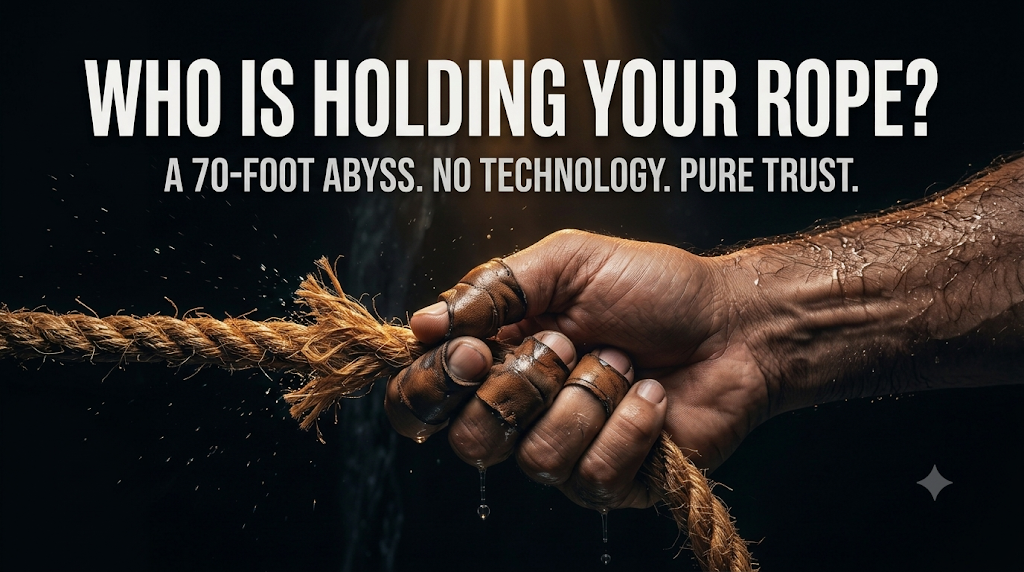
Created by Nano Banana Pro
Quick Listen If you’d rather listen than read, here’s the podcast episode that covers the key points. Tune in! 🎧 Spotify | Apple Podcasts | Amazon Music | YouTube
[embed]Listen on Spotify
Imagine you are seventy feet underwater. It is pitch black. Your lungs are screaming for air, and your heart is pounding against your ribs. You have no oxygen tank, and you have no dive watch. Your only lifeline to the sun is a single, rough coir rope, held by a man sitting in a small wooden boat directly above you. If he gets distracted, or if his hands slip, you do not go home tonight.
For thousands of years along the coasts of India, this was not a nightmare, it was a Tuesday.
Welcome to the ancient art of Tamil pearl diving, known historically as Muthu Kulithal. Today, we are diving deep into how our ancestors survived the harshest conditions on Earth without a single microchip. You will discover why the most advanced tool you will ever have in your life is not a piece of software, but a person.
🌊 The Physics of the Abyss
Before cultured pearls were born in modern laboratories, the Gulf of Mannar produced the finest natural pearls in the world. The Indian pearl oyster, Pinctada fucata, was a highly sought-after global currency. Generations of families relied on this harvest to trade and survive.
But they did not conquer the ocean with loud machinery or heavy dredgers. Instead, they utilized an incredibly intuitive grasp of fluid dynamics.
When you look at the ocean, the wind creates tiny, chaotic ripples on the surface called capillary waves. These ripples scatter sunlight, creating a blinding glare. To combat this, divers utilized a brilliant hack: before diving, a diver would take a mouthful of sesame or coconut oil and spit it directly onto the surface of the water. The oil changed the water’s surface tension, flattening the micro-ripples and stopping the sunlight from scattering. It turned the choppy ocean into a temporary, crystal-clear window to the depths.
They engineered visibility out of thin air. To reach the bottom fast and save their breath, they hacked gravity. Strapped to a harness, the diver held onto a heavy sinking stone often weighing around fifteen kilograms. When the diver let go of the boat, the stone plummeted, pulling them instantly to the seabed.
The Manduck: Your Human Lifeline
The greatest technology these divers possessed wasn’t the oil that cleared their vision, the thick leather wrapped around their fingers to protect against razor-sharp oyster shells, or the wooden clips pinching their noses to equalize the crushing deep-water pressure. It was the Manduck.
The Manduck was the helper who stayed up on the boat, acting as the anchor. In these tight-knit coastal communities, the helper holding the rope was often deeply embedded in the diver’s family network, a brother-in-law or a cousin. When you are holding someone’s life in your hands, blood and shared history matter infinitely more than daily wages. You needed someone up there who cared about the family’s legacy, not just the pearls.
Seventy feet down, gathering oysters in the dark, the diver and the Manduck could not see each other. They communicated entirely through the tension of a second, life-saving rope tied around the diver’s waist.
Imagine those calloused fingers gently wrapped around the wet line, reading it like braille. A slack feeling meant the diver was sweeping horizontally across the ocean floor. A gentle tug meant give me some slack. But three rapid, sharp, frantic pulls? That meant my lungs are burning, pull me up to the sun, now.
🦈 Shark Charmers and the Science of Belief
And what about the monsters in the dark? When foreign travelers witnessed this harvest, they were baffled.
In 1292, the Venetian traveler Marco Polo visited the coast and was astonished by the divers and the “Shark Charmers” standing on the boats. He wrote in his travelogues that divers paid one-twentieth of their catch to these charmers, who supposedly cast spells to bind the mouths of the sharks during the day. Later, in the 14th century, the Moroccan explorer Ibn Battuta visited and vividly described the raw mechanics of the dive, observing men plunging into the water with tortoise-shell masks.
To Marco Polo, the shark charmers were dark magic. But through a modern psychological lens, this tradition provided profound psychological safety. It acted as an incredible placebo effect. If a diver truly believed they were magically protected from predators, their heart rate remained low. They didn’t panic, thereby conserving precious oxygen. It was bio-endurance hacked through cultural belief.
🌅 The Return to the Lifeline
As the demand for pearls grew globally in the 20th century, modern industrial greed pushed the oyster beds toward ecological extinction, leading the Indian government to officially ban natural pearl diving in the Gulf of Mannar in 1961. The boats stopped sailing.
Yet, the lesson of the rope remains wide awake. As we move further into an era where AI writes our emails and algorithms manage our schedules, the premium on genuine human trust is skyrocketing. We are beginning to realize that the most successful teams and families are prioritizing collaborative psychological safety over brute-force efficiency.
🫵 Who is Holding Your Rope?
The families and organizations that thrive in the future will not be the ones with the most expensive algorithms. They will be the people who know how to read the subtle vibrations on the rope when their partner is struggling in the dark.
We all need someone who knows what our three frantic pulls feel like. If you want to build a foundation of wealth, creativity, or love, you need a Manduck, someone to monitor the environment so you can take the plunge into the deep, risky work of innovation.
So, I leave you with a question: Who is holding your rope?
Next time you feel like you are drowning in the pressure of modern life, don’t look for an app to save you. Look for your Manduck. Hand them the rope. And then… take a deep breath, and dive.
Just make sure they aren’t checking their smartphone when you give those three frantic pulls :P
🗣️ Join the Conversation
Do you have a Manduck in your life, a mentor, partner, or friend who provides you with unconditional psychological safety? How do you maintain that trust? Share your thoughts in the comments below!
Disclaimer: This article is for educational and historical purposes only, based on verified historical accounts. Regarding health, safety, or diving in extreme environments, always consult a qualified professional.
✅ Sources
- Biodiversity Heritage Library — Report of the Government of Madras on the Indian Pearl Fisheries in the Gulf of Mannar (1905). https://www.biodiversitylibrary.org/
- Open Library — Report of the Government of Madras on the Indian Pearl Fisheries in the Gulf of Mannar. https://openlibrary.org/
- Indian Journal of Fisheries (ICAR) — Survey of the Pearl Banks, Gulf of Mannar, 1955. https://epubs.icar.org.in/
- Project Gutenberg — The Travels of Marco Polo. https://www.gutenberg.org/ebooks/10636
- Encyclopaedia Britannica — Oil on troubled waters (Surface Tension). https://www.britannica.com/science/surface-tension
메타데이터
- post_id
- 50387aeea2b9
- slug
- curious-minds-who-is-holding-your-rope-a-70-foot-abyss-no-technology-pure-trust-50387aeea2b9
- url
- https://medium.com/the-geopolitical-economist/curious-minds-who-is-holding-your-rope-a-70-foot-abyss-no-technology-pure-trust-50387aeea2b9
- canonical_url
- https://medium.com/the-geopolitical-economist/curious-minds-who-is-holding-your-rope-a-70-foot-abyss-no-technology-pure-trust-50387aeea2b9
- author_url
- https://medium.com/@balajeev7
- status
- ok
- fetched_at
- 2026-07-13 06:23:13