“This Can Be Anything You Want.”
How an Emerging Media Master’s taught me that curiosity is a skill, and that good design can change lives.
“This Can Be Anything You Want.”
How an Emerging Media Master’s taught me that curiosity is a skill, and that good design can change lives.
Intro
When I was fifteen, I ran a streetwear resale business on Chinese social media. I didn’t have a business plan or a marketing degree; I just knew which brands my classmates wanted, posted photos on the right platforms, and built enough trust that people kept coming back. I made enough to stop asking my parents for allowances, which felt like freedom.
I didn’t realize at the time that I was already learning the fundamentals of what I’d eventually study in graduate school: understanding your audience, earning trust through consistency, and recognizing that trends aren’t random — they’re tied to identity, belonging, and the platforms people use to connect.
It would take me a decade and a few unexpected detours to make that connection.
Before EM
I came to the U.S. to study art at the Savannah College of Art and Design, then transferred to the University of Georgia, where I earned my B.A. in Communication Studies. After graduating, I worked as a legal assistant at a family law firm — a job that had nothing to do with design or media on the surface but taught me more than I expected. Research. Attention to detail. Understanding interpersonal dynamics under pressure. Those skills followed me into everything I’ve done since.
But after a year of legal work, I knew something was missing. I’d always been drawn to the intersection of visual communication and technology, and I wanted to build things, not just analyze them. When I found the Emerging Media program at UGA’s New Media Institute, it felt like exactly the right next step.

My favorite classroom at the NMI
The First Spark
I’ll never forget the moment in my first few EM classes when the project brief essentially said: “This can be anything you want.”
I remember staring at that and thinking — anything I want?
Coming from a structured undergraduate experience and a legal job where every document followed a template, the openness was almost disorienting. But it quickly became the thing I loved most about the program. That freedom wasn’t just permission to be creative — it was an invitation to be curious. To ask, what if I tried this? and actually build it.
The early coding courses were intimidating. Before I understood any of the logic, HTML, CSS, and JavaScript felt like three separate languages that didn’t want to talk to each other. But once I understood how they worked together — how structure, style, and behavior combine to create something a person can actually interact with, I was hooked. I felt like I could create anything. I’d stay up until 4 a.m. in my app development class, obsessing over one small function, determined to make it work. Not because I had to, but because I wanted to see it come to life.

NMIX 6030: Native App Development
Learning to Design for People, Not Assumptions
The technical skills opened doors, but the real shift happened in how I learned to think.
UX and CX design fundamentally changed my approach to creative work. I came in thinking design was about making things look good. I left understanding that design is about making things feel right — and that feeling right means the user shouldn’t have to think. They should know exactly what they’re looking at, exactly where to go, and exactly what to do next. That clarity doesn’t come from intuition alone. It comes from testing and empathy.
I learned to approach digital experiences with fewer assumptions and more questions. Instead of designing what I thought was right and hoping it worked, I learned to build, test, observe, and iterate. That cycle — build, test, learn, refine — became second nature, and it’s something I now carry into every project.
Beyond the Screen
Not everything I gained from EM happened inside a design tool.
One of the most impactful courses for me was Emerging Media Industries. It wasn’t about building a product — it was about building yourself as a professional. I overhauled my portfolio, learned how to introduce myself when networking, and rewrote my resume with intention. More importantly, it taught me that reaching out to people wasn’t as scary as I thought. I started taking LinkedIn seriously. I cold-messaged connections. I met mentors who genuinely wanted to help. And those soft skills — the ones that felt so far removed from UX or development — ended up being the reason I landed a summer internship at the start of my second year.
That internship led to a broader shift in how I saw my career. I realized that the skills I was building in EM weren’t limited to one title or one industry. UX research, visual design, empathy-driven thinking — these aren’t just design skills. They’re communication skills. They’re leadership skills. They’re the foundation for understanding any audience, in any context.
The Capstone: Designing for What Matters
All of this came together in my capstone project: a full website redesign for the Murray County Humane Society, a small, volunteer-run, no-kill animal rescue in rural Georgia that receives no government funding.
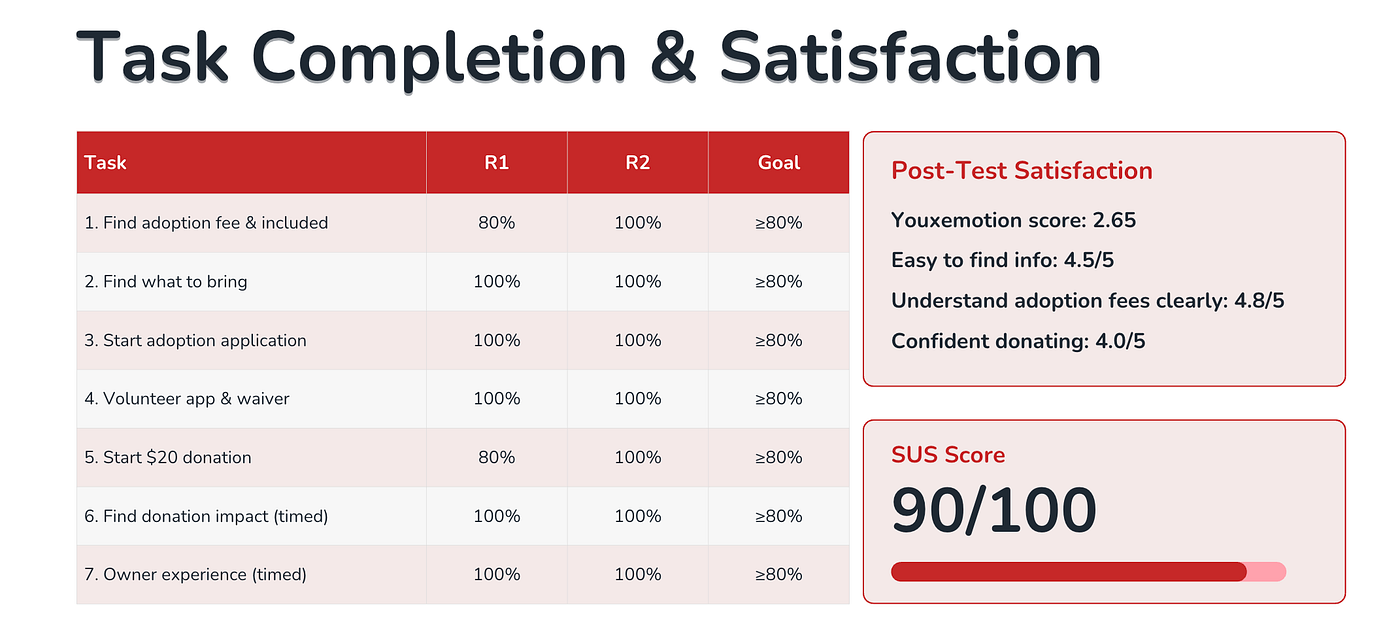
Working on MCHS was the first time my work felt like it had real stakes beyond a grade. This wasn’t a hypothetical user or a class exercise — this was an organization where every dollar donated goes directly to keeping animals fed, sheltered, and alive. When my UX research revealed that 6 out of 10 test participants left the donation page without finding where their money would go, that wasn’t just a usability finding. For a rescue that survives entirely on community support, that gap could mean a missed meal or a missed vet visit for an animal who’s already been through enough.
The fix took less than an hour — a clear sentence explaining what the donations fund, placed above the donation form. In Round 2 of testing, every single participant completed every single task. That experience crystallized something I’d been learning all along: good design isn’t about flashy features. It’s about clarity, empathy, and trust. And sometimes, the smallest changes carry the most weight.
UXRR Data
The Hardest Part
I won’t pretend the journey was smooth. Balancing a full-time, on-site job with graduate coursework pushed me harder than anything I’ve done. I’d come home after a full day of work and sit down to design, code, or write — and the pressure I put on myself to do every assignment at the highest level meant the hours stretched late. I’ve spent an hour staring at a finished design just to tweak a font size. I’ve stayed up until 4 a.m. chasing a single function in an app development project because I refused to let it beat me.
There were moments where I questioned whether I could keep it up. But I kept showing up, and every late night built something I couldn’t see in the moment — not just a project, but discipline, persistence, and proof that I could do hard things on my own terms.
Where I Am Now
Today, I work as a Marketing Specialist at an InsureTech startup in midtown Atlanta, where everything I learned in EM shapes how I approach my role. UX research taught me to test before I assume. CX design taught me that empathy is the core of understanding any end user — whether they’re adopting a pet or buying insurance. And the design thinking process I practiced across three semesters of capstone work gave me a framework for solving problems that extends far beyond a screen.
I didn’t enter this program knowing exactly where I’d end up. I came in as someone who’d studied art, communication, and law — a combination that didn’t always make sense on paper. But EM showed me that those experiences weren’t scattered. They were layers. And the program gave me the skills and the confidence to bring them together.

Our office view
What I’m Taking With Me
If I had to distill what I gained from earning an Emerging Media Master’s into one idea, it would be this: curiosity is a skill, and it can be practiced.
EM didn’t just teach me how to code, design, research, or present. It taught me that we live in an era where you can build almost anything — and that the real barrier isn’t technical knowledge. It’s whether you’re willing to stay curious, stay uncomfortable, and keep asking what if?
When I was fifteen, selling streetwear on Chinese social media, I didn’t know the word “UX.” But I was already doing the work — understanding my audience, building trust, and iterating based on what I observed. EM gave me the language, the tools, and the framework to turn that instinct into a career.
And the best part? I’m just getting started.
메타데이터
- post_id
- 5039c742f3f2
- slug
- this-can-be-anything-you-want-5039c742f3f2
- url
- https://medium.com/@tx60233/this-can-be-anything-you-want-5039c742f3f2
- canonical_url
- https://medium.com/@tx60233/this-can-be-anything-you-want-5039c742f3f2
- author_url
- https://medium.com/@tx60233
- status
- ok
- fetched_at
- 2026-07-08 10:09:58