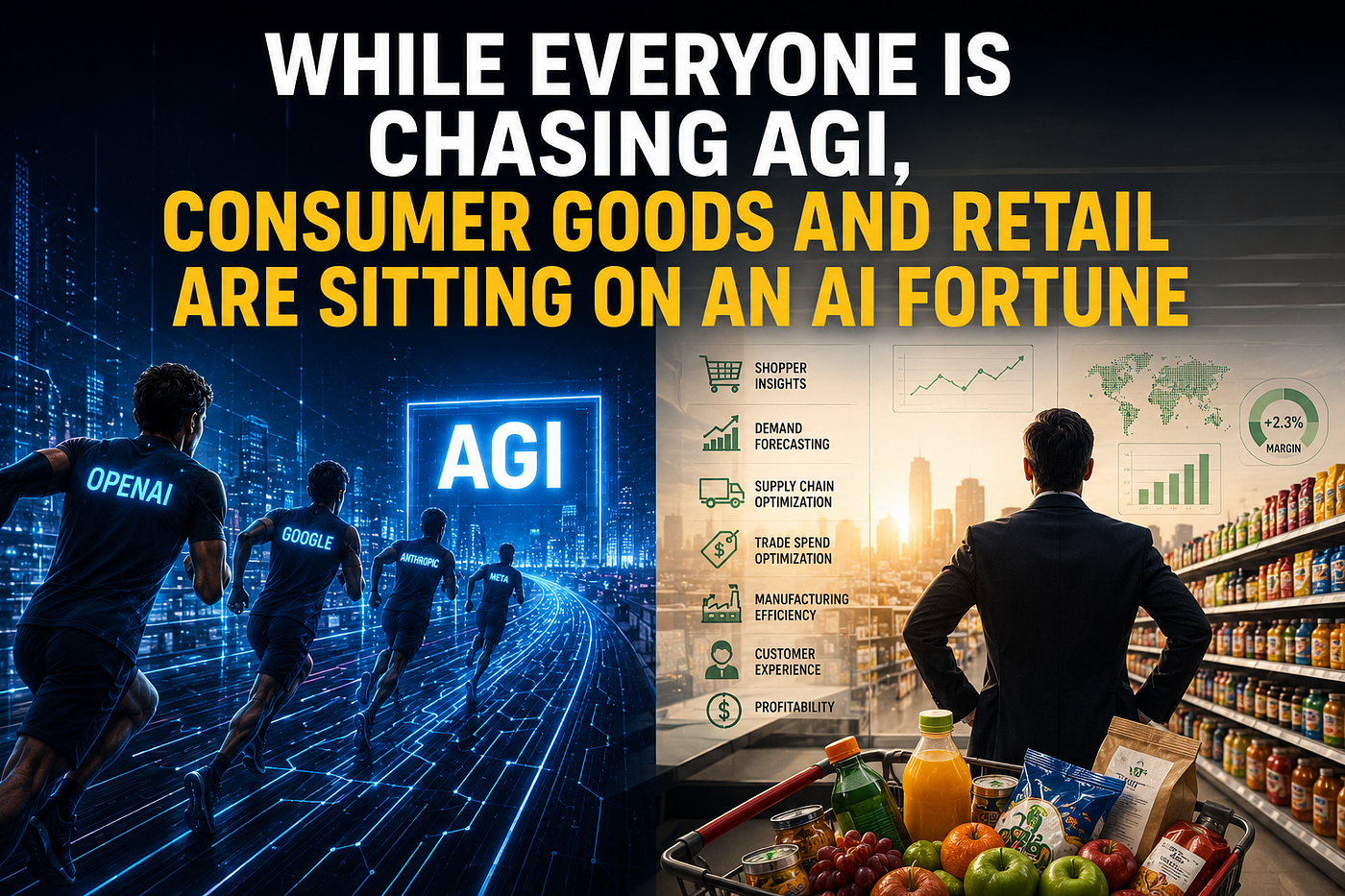
While Everyone Is Chasing AGI, Consumer Goods and Retail Are Sitting on an AI Fortune
The future winners won’t necessarily own the smartest models. They’ll be the companies that best apply inexpensive, widely available AI to…
While Everyone Is Chasing AGI, Consumer Goods and Retail Are Sitting on an AI Fortune
The future winners won’t necessarily own the smartest models. They’ll be the companies that best apply inexpensive, widely available AI to some of the world’s largest data ecosystems.
Artificial intelligence has always had a glamour problem. The conversation tends to orbit around the industries with the most futuristic use cases: drug discovery, cybersecurity, autonomous defense systems, surgical robots, and frontier scientific research. These are the categories where the most advanced models, the newest chips, and the most powerful computing infrastructure matter enormously. In those fields, the frontier really is the business. AI is already being applied to drug development, cybersecurity, and robotic surgery in ways that require advanced modeling, real-time decision support, and specialized technical capabilities.1 If a pharmaceutical company can shorten discovery cycles, if a cybersecurity firm can detect novel attacks faster, or if a surgical robotics company can improve precision in the operating room, then constant upgrades to the most advanced models and compute platforms are not optional. They are strategic necessities.
Consumer packaged goods and retail are different.
That does not mean they are less attractive to AI. In fact, the opposite may be true. CPG and retail may become among the fastest adopters of practical AI precisely because they do not need to wait for the next great frontier model to begin capturing value. McKinsey estimates that generative AI could unlock between $240 billion and $390 billion in economic value for retailers, equal to a potential industry-wide margin increase of 1.2 to 1.9 percentage points.2 These industries can do a great deal with the models, tools, and platforms that are already widely available, increasingly affordable, and relatively easy to implement. For many of the most valuable use cases in CPG and retail, the breakthrough is not inventing artificial general intelligence. The breakthrough is finally making existing data usable at scale.
Artificial intelligence and machine learning were once associated primarily with companies like Netflix, Facebook, Amazon, and Google. That made sense. Technology companies had a natural advantage because their products were already digital. Their daily business was data. They did not have to buy raw materials, manufacture physical goods, ship pallets, stock shelves, negotiate with retailers, manage deductions, or forecast demand across thousands of locations. Their path to AI was shorter because their businesses already lived inside the machine.
At first glance, CPG and retail looked like likely laggards. These were physical industries with factories, warehouses, trucks, stores, brokers, distributors, sales teams, planograms, slotting fees, promotion calendars, procurement processes, and trade-spend negotiations. But that view misses something important. CPG and retail have a long history of adopting technologies when those technologies support the business’s real competitive moat: scale of operations.
These industries were early and aggressive users of barcodes, scanners, logistics systems, enterprise planning, loyalty data, category management, and advanced analytics. The first commercial barcode scan occurred on June 26, 1974, when a pack of Wrigley’s gum was scanned at a Marsh supermarket in Ohio.3 From that moment forward, the industry began generating a river of data. Over time, that river became an ocean. Manufacturing data, logistics data, scanner data, loyalty-card data, ecommerce data, social media comments, online reviews, trade-promotion records, invoice deductions, retailer portals, distributor feeds, procurement systems, and warehouse sensors now combine to create some of the largest underexploited data environments in the private sector.
The problem is no longer whether these companies have enough data. The problem is that they have too much data moving too quickly for traditional organizations to use effectively.
Many CPG and retail companies have invested heavily in data lakes, enterprise systems, and consumer information platforms. They have stored enormous streams of internal and external data. But storage is not intelligence. In many cases, the data exists, but it has not yet become actionable. Daily scanner data arrives at an overwhelming scale. Online posts, product reviews, complaints, search terms, retailer comments, ratings, promotion results, and social signals pile up faster than human teams can interpret them. Factories and warehouses produce sensor-dense data streams that can reveal breakdowns, bottlenecks, quality drift, labor inefficiencies, and missed scheduling opportunities, but much of that information remains trapped in dashboards, logs, and exception reports.
AI changes the equation. It can ingest these large data flows, identify patterns, summarize anomalies, recommend action, and increasingly execute routine decisions. That makes AI unusually well-suited to the CPG and retail environment. These industries are data-rich, process-heavy, cost-sensitive, and scale-driven. In other words, they are exactly the kind of industries where small improvements can produce very large financial outcomes. McKinsey has identified more than 140 digital and AI use cases across the CPG value chain. At the same time, Google Cloud and NVIDIA both describe retail AI use cases across personalization, product discovery, inventory, operations, supply chain, associates, warehouses, and logistics.4
The Frontier Model Divide
One of the mistakes executives make is assuming that all AI adoption depends on the latest and most expensive technology. That is not true. Some industries absolutely require frontier models. Drug discovery, cyber defense, advanced robotics, and scientific computing may require the latest architectures and most advanced chips because the problems they solve are novel, high-stakes, and technically complex.5
CPG and retail have plenty of complex problems, but many of them are not frontier-model problems. They are workflow, pattern recognition, prediction, automation, and decision support problems. Invoice processing does not need a moonshot model. Deduction management does not need the same infrastructure as protein folding. Distribution scheduling, customer-service triage, product-description generation, procurement analysis, trade-spend optimization, shelf analytics, and online-review synthesis can often be handled with commercially available models that are inexpensive to run and increasingly simple to integrate. Major cloud and AI infrastructure providers already market retail AI capabilities for product discovery, customer service, inventory, logistics, store operations, and employee productivity.6
This is a critical distinction. The fact that CPG and retail do not always need the most advanced models lowers the barrier to adoption. A company does not need to build a research lab to automate invoice reconciliation. It does not need a billion-dollar compute budget to summarize consumer reviews by retailer, region, pack size, and complaint type. It does not need a breakthrough in machine reasoning to identify recurring deductions, late shipments, promotion mismatches, or warehouse bottlenecks. In many cases, the tools already exist. The opportunity is implementation.
That is why AI adoption in CPG and retail may move faster than many expect. The business case is not abstract. It is hiding in budgets, claims, chargebacks, empty shelves, stale forecasts, promotion waste, slow insights, and underused data.
Big Data Finally Becomes Usable
Retail and consumer goods companies have been dealing with “big data” long before the term became fashionable. Scanner data, loyalty programs, syndicated retail data, household panels, ecommerce clicks, and supply-chain feeds have long created large and valuable information assets. But the industry has often struggled to turn these assets into speed.
The scale is overwhelming. A national brand may sell hundreds or thousands of SKUs across dozens of retailers, thousands of stores, and multiple channels. A retailer may process millions of transactions, searches, reviews, returns, price changes, and inventory movements every day. A manufacturer may be receiving data from plants, warehouses, carriers, brokers, retailers, distributors, and consumers all at once.
Historically, much of this data has been useful only after it has been cleaned, structured, analyzed, and presented by specialists. That process can be slow. By the time a report arrives, the promotion has ended, the trend has moved, the shelf has changed, the competitor has reacted, or the consumer has shifted.
AI can compress that cycle. It can help companies move closer to the speed of the data itself. Instead of storing consumer complaints for quarterly review, AI can summarize them daily. Instead of waiting for a category review to discover a competitive threat, AI can flag unusual movement in search, social conversation, scanner velocity, pricing, reviews, and promotional response. Instead of allowing deductions to sit unresolved for weeks or months, AI can match invoices, shipping records, contracts, and retailer claims to recommend resolution.
This matters because the criticism often aimed at large CPG and retail companies, that they are slow, bureaucratic, and buried in process, may become an advantage if AI is deployed correctly. Process-heavy companies create enormous amounts of structured and semi-structured data. Bureaucratic companies create trails. Scale-driven companies create patterns. AI is built to detect patterns and act across repetitive processes.
The very thing that once slowed these companies down may now become the raw material for speed.
AI Aligns with the Existing Moat
Historically, CPG and retail have not always been investors in cutting-edge technology for its own sake. That is because technology, by itself, was rarely the primary moat. The moat was scale: scale in manufacturing, procurement, distribution, shelf presence, trade relationships, brand spending, category expertise, and operational execution.
AI is different because it does not sit outside that moat. It deepens it.
If a company’s advantage is distribution scale, AI can improve routing, load planning, warehouse scheduling, labor deployment, inventory positioning, and delivery reliability. If the advantage is brand and marketing scale, AI can improve creative testing, audience segmentation, personalization, promotion planning, search relevance, and campaign learning. If the advantage is manufacturing scale, AI can improve quality control, maintenance, yield, safety, and throughput. If the advantage is retailer relationships, AI can improve category insights, joint business planning, forecast accuracy, and promotion effectiveness. If the advantage is procurement scale, AI can improve supplier risk monitoring, contract analysis, should-cost modeling, and buying decisions. Current retail and CPG AI use-case libraries from major providers already map AI across these exact areas: customer experience, inventory, supply chain, store operations, associates, logistics, and enterprise productivity.7
In short, AI does not replace the core logic of CPG and retail. It enhances it.
This is why the industries are so attractive for AI deployment. AI does not have to create a brand-new business model to generate value. It can be integrated into the existing business model and improve the areas where the most money already moves.
Marketing and Trade Spend
One of the largest budget lines in consumer products, outside of cost of goods sold, is the combined spending on marketing, promotion, and trade. For decades, companies have poured enormous sums into advertising, shopper marketing, coupons, retailer programs, price promotions, displays, endcaps, slotting, and trade allowances. The challenge has always been knowing what really worked.
AI is already well-suited to this problem. Marketing has been one of the leading areas of AI adoption within the enterprise because data is abundant, feedback loops are relatively fast, and the need for personalization is obvious. CPG and retail companies can use AI to generate and test creative variations, personalize messages, optimize media spending, predict promotion lift, analyze retailer-specific performance, and identify which consumer segments are responding to which claims, packs, prices, and benefits. McKinsey has highlighted marketing and customer interactions as major areas of value from generative AI in retail, and its CPG research found broad adoption of AI across business functions among consumer-goods leaders.8
Trade spend may be an even bigger opportunity. Promotion calendars, retailer agreements, scanner data, inventory levels, shipments, deductions, and display compliance all contain signals that AI can use to improve decision-making. A small improvement in trade-spend effectiveness can create enormous value because the dollars involved are so large. AI can help answer the questions that have frustrated sales and finance teams for years: Did the promotion truly drive incremental sales? Was the display executed? Did the discount subsidize purchases that would have happened anyway? Did the retailer’s deduction match the actual agreement? Which promotions should be repeated, redesigned, or killed?
The result is not just better marketing. It is a more intelligent commercial system.
Invoice Processing, Deductions, and Back-Office Friction
Some of the most attractive AI opportunities in CPG and retail will not look glamorous. They will live in the back office.
Invoice processing, deduction management, billing, claims, procurement, shipping documentation, order management, and contract compliance are filled with repetitive work, mismatched records, exceptions, and manual review. For decades, companies have dealt with payments for shipped products that do not match invoices. They have managed retailer deductions, short payments, missing paperwork, disputed promotions, freight claims, and compliance penalties through armies of analysts and shared-service teams.
AI can interpret documents, compare records, identify discrepancies, recommend resolutions, and automate large portions of these workflows. It can read invoices, purchase orders, bills of lading, promotion agreements, proof-of-delivery documents, emails, and retailer portals. It can classify claims, detect recurring problems, and route exceptions to the right person. It can also learn which deductions are worth fighting and which are not.
This is where inexpensive, readily available AI can have an outsized impact. These are not use cases that require the most advanced frontier models. They require good data access, workflow integration, governance, and a willingness to redesign processes. The savings can be immediate and measurable.
Manufacturing, Warehousing, and Distribution
Factories and warehouses are becoming sensor-dense environments. Cameras, RFID, robotics, temperature monitors, production systems, warehouse management software, transportation systems, and IoT devices generate continuous data streams. Yet many companies still operate with gaps between manufacturing, warehousing, forecasting, customer service, and sales.
AI can connect these signals.
In food processing and manufacturing, AI can support visual inspection, calibration, predictive maintenance, yield optimization, contamination detection, and automated issue identification. In warehousing, AI can improve labor scheduling, shipping, and receiving dock management, slotting, replenishment, route planning, and exception handling. In distribution, it can use multiple data sources to improve delivery timing, reduce empty miles, anticipate disruptions, and optimize inventory placement. NVIDIA describes retail and CPG AI use cases across operations, supply chain, logistics, warehouse workflows, personalization, and associate productivity.9
These use cases are compelling because they occur inside scaled systems. A tiny improvement in forecast precision, warehouse throughput, spoilage reduction, truck utilization, or manufacturing yield can cascade across the enterprise. In a low-margin, high-volume business, small percentages matter.
Shopper Experience and Product Discovery
The shopper experience is another area where AI can create immediate value. Online shopping has created endless digital shelves, but endless choice can become its own problem. Consumers often do not know how to find what they want, especially when they search by need state rather than by brand name. They may want the lowest-priced gluten-free, sugar-free, vegan salad dressing in the store. They may want a lunchbox snack with no peanuts, less sugar, and a flavor their child will actually eat. They may want a cleaning product that is safe for pets, available today, and on promotion.
Traditional search often struggles with these requests. AI-powered search and shopping assistants can understand intent, attributes, substitutions, dietary restrictions, price sensitivity, inventory availability, and location. Voice AI can make the experience even more natural. A shopper should be able to ask, “What aisle is the mayo on?” or “Which pasta sauce has the least sugar and is on sale today?” and get a useful answer. Google Cloud identifies AI-powered product discovery, personalization, inventory, logistics, and shopping experience improvements as major retail AI applications.10
This is not just convenience. It is a conversion. Better discovery reduces friction. Better guidance helps shoppers buy with confidence. Better personalization helps retailers and brands connect products to actual consumer needs.
Forecasting and Demand Sensing
Forecasting has always been one of the most important and difficult problems in CPG and retail. Traditional predictive models are useful, but they often struggle with volatility, promotions, weather, local events, supply disruptions, social trends, and sudden changes in consumer behavior. AI can improve forecasting by ingesting more signals and updating more frequently.
Even tiny improvements can matter. A small increase in forecast accuracy can reduce spoilage, out-of-stocks, excess inventory, markdowns, and lost sales. Demand sensing can help companies detect shifts earlier: a flavor gaining traction on TikTok, a competitor’s product breaking through, a new diet trend accelerating, or a regional weather pattern changing consumption. Retail AI use-case research and industry materials consistently identify demand forecasting, inventory optimization, supply-chain efficiency, and customer experience as core AI applications.11
The real opportunity is to connect forecasting to action. AI should not merely predict demand. It should help adjust manufacturing schedules, inventory positions, replenishment plans, pricing decisions, and promotion timing. The companies that win will not simply have better dashboards. They will have faster operating loops.
Trend Detection, Innovation, and M&A
One of the most underappreciated opportunities for AI in CPG and retail is external sensing. Consumer trend data now exists everywhere: online reviews, creator content, search terms, social posts, retailer ratings, recipe sites, restaurant menus, ingredient chatter, community forums, competitor launches, and emerging brand velocity. The challenge is volume.
Humans cannot read it all. AI can.
Companies can use AI to identify weak signals, competitive threats, white-space opportunities, product innovation ideas, and possible acquisition targets. A large CPG company should be able to detect when a small insurgent brand is gaining traction before it shows up in traditional market-share reports. A retailer should be able to see when shoppers are asking for attributes not yet well served by the assortment. A brand should be able to understand which complaints are isolated noise and which represent a real product or positioning problem.
This may become one of the most strategic uses of AI in the sector. The future of innovation will not be driven only by annual planning cycles and focus groups. It will be driven by the ability to interpret the living marketplace in near real time.
Speed to Implement and Speed to Value
In 2018, one of the strongest arguments for AI in CPG and retail was the speed of implementation. That argument is even stronger now. AI tools have become more modular, more accessible, and easier to integrate. Proofs of concept can be built quickly. Many use cases can be piloted inside a single workflow, region, brand, plant, warehouse, or retailer relationship before scaling across the company.
That matters because these industries are under pressure. Top-line growth has been slow in many categories. Costs remain under scrutiny. Consumers are more fragmented. Retailers are more demanding. Supply chains are more volatile. Private label is stronger. Emerging brands can scale quickly through e-commerce and social media. CFOs want measurable ROI, not science projects.
AI fits this environment when it is tied to specific business outcomes: reduce deductions, improve forecast accuracy, increase conversion, lower spoilage, improve promotion ROI, reduce customer service costs, accelerate innovation, improve on-shelf availability, or optimize procurement. The winning projects will not be the ones with the most impressive demos. They will be the ones that attack large, recurring, measurable sources of value.
Why Adoption May Be Faster Than Expected
The case for rapid AI adoption in CPG and retail comes down to a simple combination:
The industries have enormous data assets.
The data is underexploited.
The processes are repetitive and scaled.
The budgets are large.
The margins benefit from small improvements.
The available AI tools are already good enough for many use cases.
And the value can be measured.
That is a rare combination.
The industries that require the most advanced models will keep racing at the frontier. CPG and retail do not need to win that race to win with AI. Their opportunity is different. They can take widely available models and point them at the operational heart of the business: scanner data, marketing, trade spend, invoicing, deductions, procurement, shipping, forecasting, factories, warehouses, consumer feedback, and product discovery.
For years, many consumer and retail companies have been accused of moving slowly. But the next advantage may belong to the companies that use AI to move at the speed of their own data flows. The winners will be those who stop treating data as something to store and start treating it as something to act on.
The initial impact of AI on CPG and retail will likely be felt in several areas:
Shopper Experience: AI-driven search, voice assistants, and personalized recommendations can help shoppers find products by need, attribute, price, dietary restriction, availability, and occasion.
Food Processing and Manufacturing: AI can support visual inspection, calibration, predictive maintenance, yield improvement, and automated issue identification.
Warehousing and Distribution: AI can optimize labor, shipping docks, slotting, routing, replenishment, and exception management.
Invoice Reconciliation and Deduction Management: AI can interpret, analyze, match, and resolve invoice deductions and payment discrepancies with far less manual effort.
Forecasting and Demand Sensing: AI can improve forecast precision by incorporating scanner data, promotions, weather, social trends, inventory levels, and external signals.
Marketing and Trade Spend: AI can improve promotion planning, creative testing, personalization, retail media effectiveness, and trade-spend accountability.
Procurement and Supplier Management: AI can analyze contracts, supplier performance, pricing shifts, risk signals, and purchasing opportunities.
Consumer Trend Intelligence: AI can analyze reviews, search behavior, social conversations, competitor movements, and emerging brand data to identify threats, innovation opportunities, and potential acquisitions.
The strategic question for leaders is not whether AI is coming. It is where AI can connect to the largest pools of value already within the business. If the supply chain is disconnected from warehousing, if forecasting is detached from manufacturing, if consumer insight is separated from innovation, if deductions are trapped in manual workflows, or if trade spend cannot be tied to real outcomes, AI can have a transformational impact.
The irony is that CPG and retail may not need the most futuristic AI to produce some of the most meaningful business results. They need practical AI aimed at the places where scale, data, and friction already exist. That is why these industries are not laggards waiting for the future. They are sitting on one of the richest AI opportunities in the economy.
Best of all, almost everything described here can be deployed on commonly available, relatively low-cost AI technology and models. Open and commercially available model families from providers such as Meta and Mistral are already accessible to enterprises and developers. In contrast, smaller open models and optimized deployment frameworks have made task-specific AI far less dependent on the most expensive frontier systems.12 CPG and retail do not need to invent the next model to capture the next wave of value. They need to connect the existing models to the data, workflows, and operating scale they already own.
Endnotes
- Panna Sharma et al., “Artificial Intelligence in Drug Development,” Nature Medicine 31 (2025); Niveen O. Jaffal, Mohammed Alkhanafseh, and David Mohaisen, “Large Language Models in Cybersecurity: Applications, Vulnerabilities, and Defense Techniques,” arXiv, July 2025; D. Diana et al., “AI-Powered Robotic Surgery: Transforming Surgical Decisions,” Journal of Robotic Surgery 19 (2025).
- McKinsey & Company, “Generative AI in Retail: LLM to ROI,” January 9, 2024.
- GS1, “GS1 50th Anniversary,” accessed June 22, 2026.
- McKinsey & Company, “Fortune or Fiction? The Real Value of a Digital and AI Transformation in CPG,” October 2024; Google Cloud, “AI for Retail: 12 Use Cases with How-Tos,” accessed June 22, 2026; NVIDIA, “Retail Industry Solutions Powered by AI,” accessed June 22, 2026.
- Sharma et al., “Artificial Intelligence in Drug Development”; Jaffal, Alkhanafseh, and Mohaisen, “Large Language Models in Cybersecurity”; Diana et al., “AI-Powered Robotic Surgery.”
- Google Cloud, “AI for Retail”; NVIDIA, “Retail Industry Solutions Powered by AI.”
- Google Cloud, “AI for Retail”; NVIDIA, “Retail Industry Solutions Powered by AI”; McKinsey & Company, “Fortune or Fiction?”
- McKinsey & Company, “Generative AI in Retail”; McKinsey & Company, “Fortune or Fiction?”
- NVIDIA, “Retail Industry Solutions Powered by AI.”
- Google Cloud, “AI for Retail.”
- Google Cloud, “AI for Retail”; NVIDIA, “Retail Industry Solutions Powered by AI”; McKinsey & Company, “Generative AI in Retail.”
- Meta, “The Official Meta Llama 3 GitHub Site,” accessed June 22, 2026; Mistral AI, “Introducing Mistral 3,” December 2025; Yannis Bendi-Ouis, Dan Dutartre, and Xavier Hinaut, “Deploying Open-Source Large Language Models: A Performance Analysis,” arXiv, September 2024; Peiyuan Zhang et al., “TinyLlama: An Open-Source Small Language Model,” arXiv, January 2024.
메타데이터
- post_id
- 503b094b1f29
- slug
- while-everyone-is-chasing-agi-consumer-goods-and-retail-are-sitting-on-an-ai-fortune-503b094b1f29
- url
- https://medium.com/design-bootcamp/while-everyone-is-chasing-agi-consumer-goods-and-retail-are-sitting-on-an-ai-fortune-503b094b1f29
- canonical_url
- https://medium.com/design-bootcamp/while-everyone-is-chasing-agi-consumer-goods-and-retail-are-sitting-on-an-ai-fortune-503b094b1f29
- author_url
- https://medium.com/@mikebruening
- status
- ok
- fetched_at
- 2026-06-23 17:05:31