Hong Kong’s Future: Between Integration and Distinctiveness
Hong Kong stands at a pivotal moment in its history. As economic integration with mainland China accelerates and the Greater Bay Area (GBA)…
Hong Kong’s Future: Between Integration and Distinctiveness
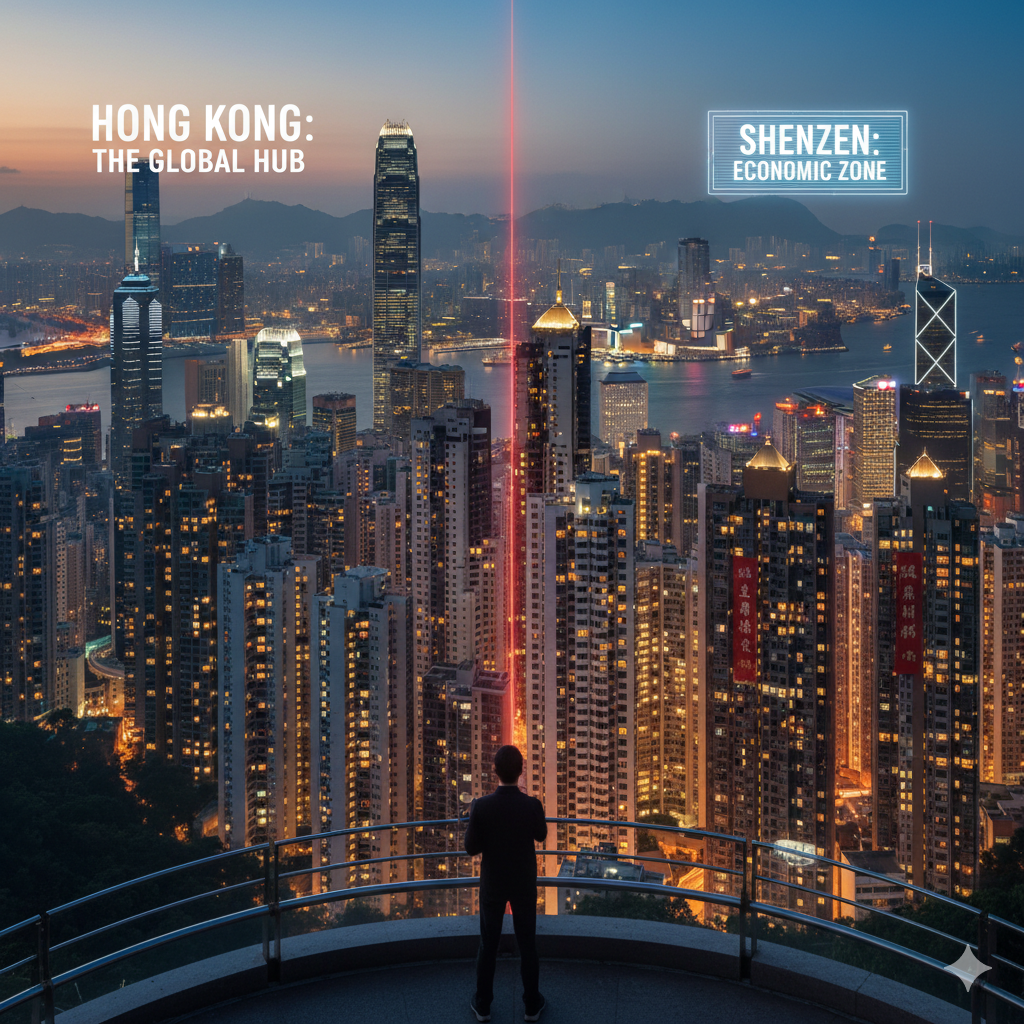
Hong Kong stands at a pivotal moment in its history. As economic integration with mainland China accelerates and the Greater Bay Area (GBA) deepens cross-border connectivity, Hong Kong’s long-term trajectory is being reassessed by residents, economists, and policymakers alike. Some believe Hong Kong will gradually lose the uniqueness that once defined it; others argue that the city still possesses enduring advantages. A balanced analysis reveals that both optimism and pessimism have legitimate foundations, and Hong Kong’s future will likely be shaped by the tension between these competing forces.
I. The Case for Pessimism: Structural Convergence Driven by Economic Arbitrage
A. Mainland China’s Cost Advantages Are Too Large to Ignore
One of the strongest reasons for predicting a gradual “mainlandization” of Hong Kong lies in persistent factor-price differentials.
- Labor costs in Shenzhen, Dongguan, and Guangzhou remain substantially lower than in Hong Kong.
- Land and commercial rents in major GBA cities are dramatically cheaper.
- Services such as dental care, health checkups, massages, dining, haircuts, and shopping cost a fraction of Hong Kong prices.
This creates a powerful economic force: arbitrage.
Policies may shift, but arbitrage is relentless. When two regions sit side by side with radically different cost structures, integration happens naturally. Much as New Yorkers cross the Hudson for cheaper services, Hongkongers are increasingly going north for daily necessities. This behavioral shift undermines local small businesses, squeezes the middle class, and erodes traditional livelihoods in the city.
B. Daily-Life Convergence Is Already Underway
The change is not theoretical — it is visible:
- Shoppers cross the border to buy groceries and medicine.
- Households use Shenzhen clinics for routine care.
- Entertainment and leisure spending flows into China.
- Restaurants and retail stores in Hong Kong face shrinking margins.
These patterns signal a deep structural reshaping of Hong Kong’s domestic economy. Even if Hong Kong retains certain high-end roles, the everyday fabric of life is trending toward cross-border integration.
C. The Mainland Has Caught Up — or Surpassed — Hong Kong in Key Areas
The old frontier — where Hong Kong was “developed” and the mainland was “catching up” — has collapsed. (a) Shenzhen’s GDP per capita rivals Hong Kong’s. (b) Infrastructure is often superior.
(c ) Innovation ecosystems in the mainland have surged ahead.
When economic parity increases, convergence becomes more plausible, not less. Hong Kong no longer dominates China economically; it must now coexist with a mainland that is more dynamic, wealthier, and more technologically advanced than ever before.
II. The Case for Optimism: Enduring Anchors of Distinctiveness
Despite powerful forces of convergence, several structural features continue to give Hong Kong an enduring advantage.
A. Hong Kong’s Commercial Legal System Remains a Pillar of Strength
Your classmate’s point about Hong Kong’s legal system is not without merit. Even after recent political changes, commercial law in Hong Kong remains:
- professional
- reliable
- internationally respected
- aligned with common-law traditions
- competitive for arbitration and cross-border dispute resolution
Multinational corporations still trust Hong Kong’s courts for contract enforcement, financial regulation, and commercial disputes. Mainland companies continue to choose Hong Kong for IPOs and international financing precisely because of its legal architecture.
In short:
The commercial and financial dimensions of the legal system remain intact, and this sustains Hong Kong’s role as a global financial hub.
B. Financial and Professional Sectors Will Not Easily Relocate
Finance is not footloose in the way restaurants, retail, or manufacturing are. It requires:
- human capital
- stable regulation
- trusted institutions
- common-law predictability
- global networks
These are difficult for mainland cities — however advanced — to fully replicate in the short term. As long as Hong Kong retains its financial markets, professional services, and international profile, it will remain distinct in function even if daily life becomes more integrated.
C. Hong Kong Still Serves as a Global Interface
For all its challenges, Hong Kong remains:
- bilingual
- outward-facing
- globally networked
- familiar to international professionals
- a convenient base for multinational entry into the Chinese market
This “interface function” remains valuable to both China and the world. Beijing continues to use Hong Kong as a controlled experiment for internationalization (e.g., RMB convertibility, offshore RMB markets), something mainland cities cannot yet fully substitute.
III. Weighing the Forces: A Net Assessment
Both sides of the argument hold weight. A fair assessment of Hong Kong’s future requires recognizing how these forces interact.
A. Distinctiveness Will Likely Persist at the Top — in Finance, Law, and High-End Sectors
The city is still valuable to China as:
- an international financial center
- an offshore RMB hub
- a platform for global business
- a region that operates under common law
These high-level functions are shielded from economic arbitrage because they rely on institutions, not low prices.
B. Convergence Will Accelerate from the Bottom — in Lifestyle, Costs, and Daily Consumption
At the level of:
- shopping
- services
- entertainment
- healthcare
- small businesses
- neighborhood economics
Hong Kong is already being reshaped by Shenzhen’s gravitational pull. Price arbitrage will continue to siphon consumer spending northward. Over time, this will alter the city’s economic structure and perhaps its cultural distinctiveness as well.
C. The Result Will Not Be Full Assimilation — but Asymmetric Integration
The most realistic future lies between your prediction and your classmate’s optimism:
- Hong Kong will remain a global city at the top, preserving its financial, legal, and professional advantages.
- But in daily life, retail, services, and local culture, it will increasingly resemble its mainland neighbors, driven by unavoidable cost dynamics and regional integration.
This is less “Hong Kong becoming China” and more “Hong Kong and Shenzhen becoming a single economic ecosystem with differentiated roles.”
Conclusion: A Dual Future
Hong Kong’s trajectory cannot be understood through a purely optimistic or pessimistic lens. It is a story of dual forces shaping one city:
- Top-level distinctiveness sustained by institutions, legal frameworks, and international finance.
- Bottom-level convergence driven by economic arbitrage, cross-border consumption, and demographic shifts.
Hong Kong will not lose its identity overnight — nor will it remain unchanged. Its future lies in navigating this delicate balance, preserving what must endure while adapting to a region whose economic center of gravity has already shifted.
메타데이터
- post_id
- 5072f0b892e6
- slug
- hong-kongs-future-between-integration-and-distinctiveness-5072f0b892e6
- url
- https://medium.com/@kleong54/hong-kongs-future-between-integration-and-distinctiveness-5072f0b892e6
- canonical_url
- https://medium.com/@kleong54/hong-kongs-future-between-integration-and-distinctiveness-5072f0b892e6
- author_url
- https://medium.com/@kleong54
- status
- ok
- fetched_at
- 2026-07-27 01:10:15