Four Roads to Superhuman AI. The Receipt Is Real, the Runaway Is Not.
An AI just sped up the very code used to train its own successor. Here are the four engineering roads from human-level to superhuman…
Four Roads to Superhuman AI. The Receipt Is Real, the Runaway Is Not.
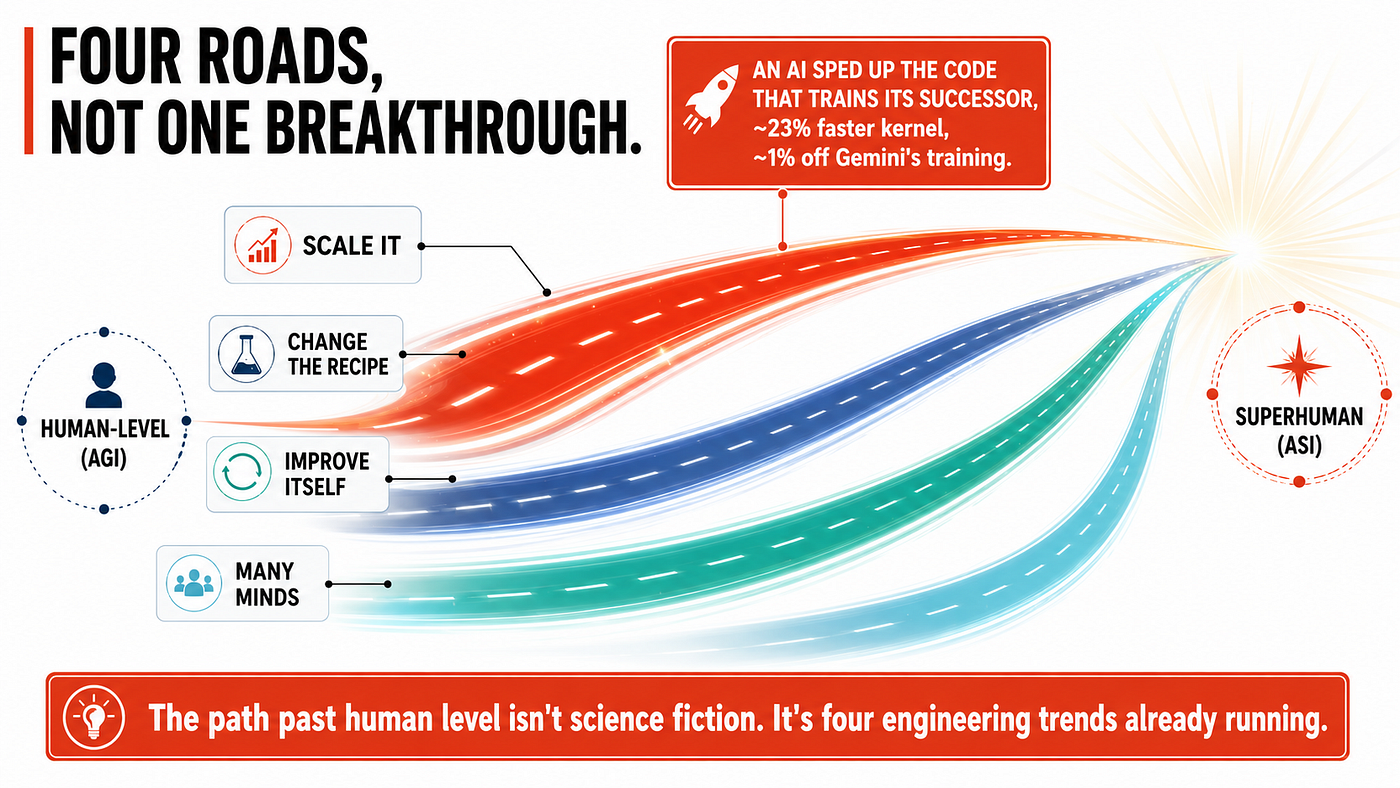
An AI just sped up the very code used to train its own successor. Here are the four engineering roads from human-level to superhuman, already running in parallel, and how to tell a real receipt from a science-fiction singularity.
In May 2025, a Google DeepMind system called AlphaEvolve did something quietly recursive. It rewrote a piece of low-level code, a matrix-multiplication “kernel” that is one of the arithmetic workhorses inside Gemini, Google’s flagship AI, and made it about 23% faster. That single change trimmed roughly 1% off the time it takes to train Gemini itself.
Read that slowly. An AI found a way to make the training of its own successor a little quicker. Not a metaphor, not a forecast. A logged commit.
It is a small number sitting on a road that, followed far enough, leads somewhere strange.
Here is the question the June 2026 DeepMind report “From AGI to ASI” actually answers, and the take I want you to leave with. Once you have AGI, an AI with the general competence of a median human, how do you get to superintelligence, a system that out-thinks entire expert organizations at nearly everything? The report’s answer is refreshingly unmysterious. There is no single magic mechanism, no genius spark. There are four roads, all already under construction, and none excludes the others.
And across all four, the honest verdict is the same, and it is the line to carry: the receipt is real, the runaway is not. The mechanisms are genuinely working. The science-fiction singularity is not here, and confusing the two is how smart people get this wrong in both directions.
What you’ll walk away able to do:
- Classify any “AI is accelerating” claim by which of four roads it rides: scale, new recipe, self-improvement, or many minds.
- Read a parameter count correctly, knowing why a 671-billion-parameter model can run at small-clinic cost.
- Separate a real receipt from a runaway, using the one distinction (exponential vs hyperbolic) that defuses most singularity talk.
- Watch the slope that actually matters, a measured doubling time, instead of waiting for a vertical line on a calendar.
Road one: make it bigger, but smarter
The first road is the one everyone knows, scaling: more compute, more data, more parameters (the adjustable internal numbers a model learns). Day 3 covered its economics, effective compute growing about 10x a year. But if you stop at “bigger,” you will misread the road, because bigger got clever.
Take DeepSeek-V3, a 2024 to 2025 model with 671 billion parameters. Naively, running it should cost a fortune per word. It does not, thanks to a design called Mixture-of-Experts. Picture a hospital with hundreds of specialists on staff but a triage nurse who, for each patient, wakes only the two or three doctors who actually matter. DeepSeek-V3 holds 671 billion parameters but activates only about 37 billion for any given chunk of text, roughly one-eighteenth of the model. You get the knowledge of the whole staff at the running cost of a small clinic.
So here is the first reading habit. When you see a giant parameter count, ask two numbers, not one: total, and active. Total is the knowledge. Active is the bill. A model that separates them is not doing brute scaling. It is scaling with a brain, and that gap is why “too expensive to run” keeps turning out to be wrong.

Road two: change the recipe
The second road is not more of the same engine, but a different one, and the most consequential example arrived in the last year. If you only track scaling, you will miss it entirely.
The old bargain was simple: spend enormous compute training a model, then answers come out cheap and instant. Models like OpenAI’s o1 and o3, and DeepSeek-R1, broke that bargain. They think before answering, generating long internal chains of reasoning and checking their own work, and the longer they think, the better they do on hard problems. That opened a genuinely new axis of scaling, one you pay for at the moment of use rather than during training.
So update your mental model of cost. You can now buy intelligence by the minute. When a system is struggling on a hard problem, “let it think longer” is a real lever, not a figure of speech, and it is a different lever than “train a bigger model.” Knowing which axis you are on changes what you reach for next.
Two newer shifts are further from proven, and here the discipline matters. Mamba, a state-space architecture, processes long sequences in linear time instead of the steeply rising cost of today’s transformers, a possible escape from a structural bottleneck. And world-model systems like Genie and Sora generate video that looks, frame to frame, as if it obeys physics. Keep the honest caveat the report keeps: whether these have learned real physics, actual cause and effect, or a dazzling statistical mimicry of it, is genuinely contested. A model that renders a bouncing ball beautifully has not necessarily discovered gravity.

Road three: the machine that improves itself
Now the dramatic one, and the place where you most need a clear head, because the hype gradient here is steep.
In 1965, the mathematician I.J. Good wrote a sentence that has haunted the field ever since. An ultraintelligent machine could design even better machines, which would design better ones still, and so “the first ultraintelligent machine is the last invention that man need ever make.” This is the famous intelligence explosion, recursive self-improvement, the road that turns a steady climb into something potentially vertical. For sixty years it was a thought experiment. Now there is a receipt.
It is the AlphaEvolve commit from the top of this piece, and it did not stop at one kernel. AlphaEvolve’s scheduler has run inside Borg, the software that manages Google’s worldwide datacenters, for over a year, continuously clawing back about 0.7% of Google’s entire global compute, a perpetual rebate paid in capacity that an AI discovered and keeps collecting. More striking still, it found a way to multiply two 4-by-4 matrices using 48 scalar multiplications, beating the 49 that Volker Strassen’s celebrated 1969 algorithm had held as the mark for 56 years. A machine improved a piece of mathematics that humans had not bettered in over half a century.
Here is where you must not get swept up. AlphaEvolve improves narrow components, a kernel here, a scheduler there, an algorithm in a well-defined search space. It does not rewrite its own general reasoning end to end. Good’s loop, smarter system builds smarter system builds smarter system, is at most weakly and partially visible today. It is an early, fragile loop, not a confirmed explosion. The receipt is real. The runaway is not.

And here is the single distinction that defuses most singularity arguments. A true intelligence explosion has a specific mathematical signature: hyperbolic growth, infinite growth in finite time, a curve going vertical on a particular date. That is not the same as exponential growth, which is merely a steady doubling time. METR, a research group, tracks a “task horizon,” the length of task, in human time, that an AI can finish with 50% reliability, and it has been doubling on the order of every few months. A doubling time is the fingerprint of exponential growth, which is fast and serious and still not a singularity. Exponential is a doubling time. Hyperbolic is a date. Do not confuse them.
And real systems rarely go hyperbolic, because they hit frictions. Every exponential anyone has watched in nature, a bacterial colony, an epidemic, a technology spreading, eventually bends into an S-curve: fast rise, a shoulder, a plateau. The report says plainly that recursive self-improvement “may fizzle out relatively quickly.” Whether this curve keeps climbing or bends depends entirely on the obstacles, which is tomorrow’s subject.

Road four: not one mind, but many
The fourth road is the one we forget, because it does not fit the lone-genius picture, and it may be the most important.
Superintelligence might not arrive as a single colossal model. It might emerge from multi-agent collectives, swarms of AGI-level systems coordinating, dividing labor, trading, checking each other, forming what the report frankly calls AI corporations or agent economies. Recall the digital-mind advantages from Day 2: a copy is free, instances can be spawned and halted at will, and they share experience at bandwidths no human team could approach.
So widen what you watch. A thousand competent agents that coordinate well can outwork a single brilliant one, and researchers are already hunting for multi-agent scaling laws to describe how group intelligence grows with numbers. The reading habit: when you assess where AI is, do not only track the size of the biggest single model. Track the swarm. Intelligence, on this road, is something a population has, not just an individual.
Now put the four roads together, because that is the report’s quietly unsettling point and the most common mistake in reading it. None of these roads has to be a highway. The usual move is to evaluate each one alone, judge it promising but not proven, and conclude that nothing much is happening. That is the error. The roads compound. Four merely decent footpaths, walked in parallel, can still carry you a very long way from where we started, and a real takeoff would likely travel several at once.

The honest counterweight
Stack the caveats in one place, because a frame this clean earns scrutiny. The self-improvement loop is narrow and fragile, not the general runaway. The world models may be mimicry, not physics. The recursive curve may fizzle into an S-curve, and the report itself refuses to say whether the explosion is coming. And as with the rest of this series, the report is days old and not yet stress-tested.
None of that makes the four roads fake. The receipts are logged commits and measured doublings, not vibes. It makes them roads, with real distances and real obstacles, rather than a guaranteed highway to a fixed destination. The skeptic’s job is not to deny the roads. It is to ask which one bends first, and why.

The verdict
Here is where I land. The popular debate keeps waiting for the one breakthrough, the genius model, the vertical line. That is the wrong thing to watch. What is actually happening is mundane and harder to dismiss: four ordinary engineering roads, all under construction at once, each with logged receipts, none of which needs to be a highway for the combination to carry us a long way. The unsettling part is not any single road. It is that you can travel four decent footpaths in parallel.
And the discipline that keeps you honest in both directions is one sentence. The receipt is real, so do not wave the progress away as hype. The runaway is not, so do not buy the singularity date on a slide. Watch the slope, the measured doubling time, not the vertical line on a calendar.

The part that should change how you read the next headline
So stop waiting for the one road to become a highway. The path past human level is not science fiction and not a single magic spark. It is four engineering trends already running in parallel, including an AI that sped up the code used to train its own successor.
Every one of those roads runs toward something: walls, frictions, hard limits. The data we might run out of, the energy bill, the chance that ideas simply get harder to find. Are those speed bumps or dead ends? That is tomorrow.
The receipt is real. The runaway is not. Learn to tell them apart, and the next AI headline will read very differently.
Check out my book AI Agents In Action, 2nd Edition book by downloading your copy here. Sponsored by Anaconda Inc.
메타데이터
- post_id
- 5075c2b855c6
- slug
- four-roads-to-superhuman-ai-the-receipt-is-real-the-runaway-is-not-5075c2b855c6
- url
- https://medium.com/@Micheal-Lanham/four-roads-to-superhuman-ai-the-receipt-is-real-the-runaway-is-not-5075c2b855c6
- canonical_url
- https://medium.com/@Micheal-Lanham/four-roads-to-superhuman-ai-the-receipt-is-real-the-runaway-is-not-5075c2b855c6
- author_url
- https://medium.com/@Micheal-Lanham
- status
- ok
- fetched_at
- 2026-06-26 12:24:55