How AI Improves Batch Manufacturing Efficiency in Pharmaceutical Plants
Pharmaceutical manufacturing is built on precision. Every batch produced must meet strict quality standards, comply with regulatory…
How AI Improves Batch Manufacturing Efficiency in Pharmaceutical Plants
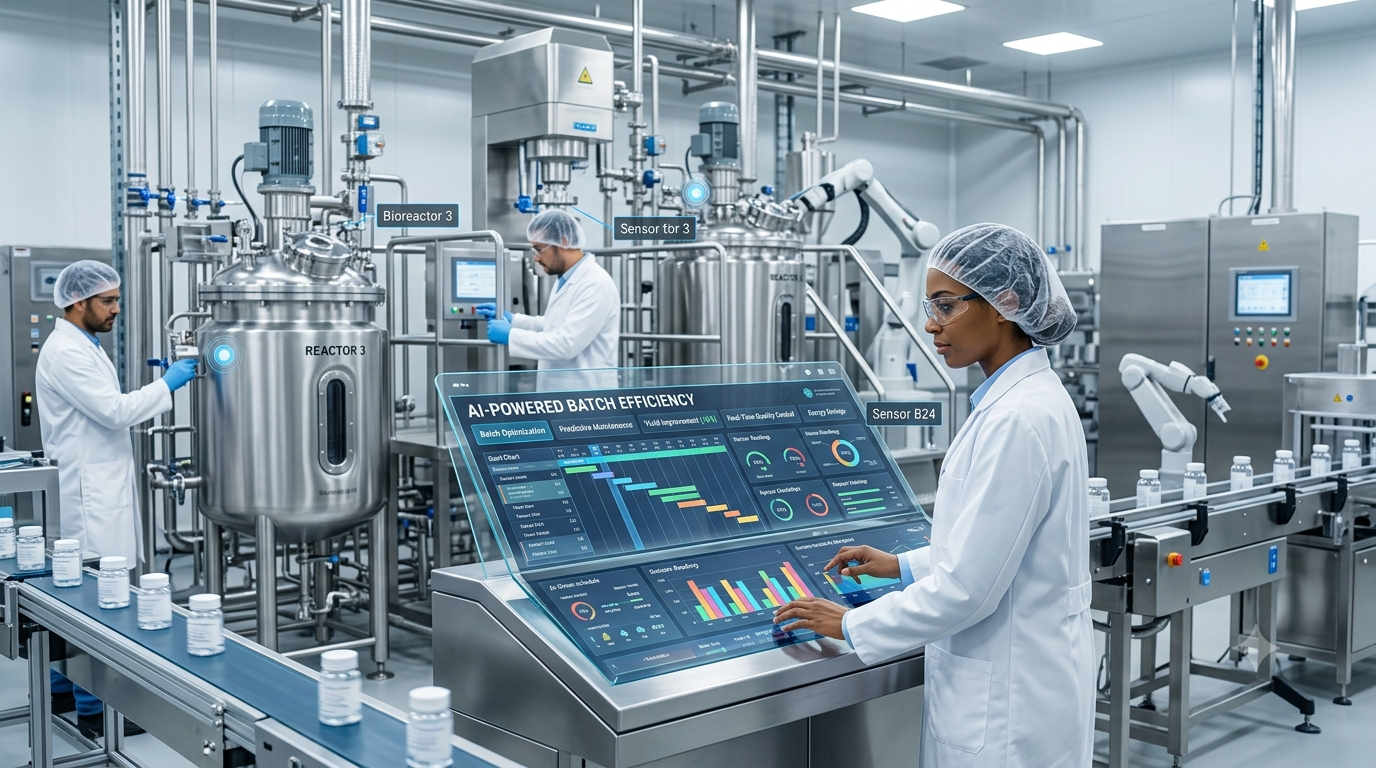
Pharmaceutical manufacturing is built on precision. Every batch produced must meet strict quality standards, comply with regulatory requirements, and be manufactured within tightly controlled parameters. Even a small deviation can lead to production delays, product recalls, compliance issues, or significant financial losses.
As pharmaceutical companies scale operations, maintaining this level of consistency becomes increasingly challenging. Production teams must manage thousands of process variables, monitor equipment performance, maintain detailed documentation, ensure batch traceability, and respond quickly to unexpected deviations — all while keeping production schedules on track.
Traditional manufacturing systems have helped automate many of these activities, but they are primarily designed to execute predefined processes rather than analyze data or predict outcomes. As a result, manufacturers often identify production issues only after they have already affected a batch.
This is where **Artificial Intelligence in Pharma Manufacturing** is changing the landscape.
Instead of simply automating repetitive tasks, AI enables pharmaceutical manufacturers to analyze historical and real-time production data, identify patterns that humans might overlook, predict potential issues before they occur, and support faster operational decision-making. From optimizing batch execution and reducing downtime to improving quality assurance and minimizing waste, AI is becoming a critical component of modern pharmaceutical manufacturing.
For manufacturers pursuing operational excellence and digital transformation, AI is no longer a future initiative — it is becoming a strategic advantage.
Why Batch Manufacturing Efficiency Matters More Than Ever
Every pharmaceutical batch represents a significant investment in raw materials, equipment, workforce, regulatory compliance, and production time. When batches are delayed, rejected, or require rework, the impact extends far beyond production costs.
Manufacturers may experience supply chain disruptions, delayed product launches, inventory shortages, increased compliance risks, and reduced customer confidence.
As global demand grows and regulatory expectations become more stringent, improving batch manufacturing efficiency has become a business priority rather than simply an operational objective.
Increasing Production Complexity Requires Smarter Decision-Making
Today’s pharmaceutical facilities produce multiple products across different production lines while managing complex manufacturing processes, varying formulations, and evolving regulatory requirements.
Operators monitor hundreds of production parameters throughout every batch, including temperature, humidity, pressure, mixing speed, process timing, equipment status, and environmental conditions.
Although Manufacturing Execution Systems (MES) collect large amounts of operational data, manually interpreting this information in real time remains extremely difficult.
Production supervisors often rely on experience and historical knowledge to make decisions. While valuable, this approach can delay problem identification and increase the likelihood of process deviations.
By implementing Artificial Intelligence in Pharma Manufacturing, manufacturers gain the ability to continuously analyze production data, identify abnormal trends, and recommend corrective actions before quality or productivity is affected.
Manual Monitoring Limits Operational Performance
Traditional batch monitoring depends heavily on manual observation, paper-based procedures, spreadsheets, or isolated dashboards.
Operators frequently spend valuable time reviewing production logs, comparing process parameters, and investigating deviations after they occur.
This reactive approach creates several operational challenges:
- Delayed identification of equipment issues
- Increased batch review time
- Higher probability of human error
- Longer investigation cycles
- Reduced production throughput
Artificial Intelligence transforms this process by continuously monitoring production conditions in real time.
Instead of waiting for operators to recognize problems manually, AI algorithms detect unusual process behavior immediately and generate actionable alerts.
This allows production teams to intervene earlier, reducing disruptions while maintaining product quality.
How Artificial Intelligence Optimizes Batch Manufacturing
Artificial Intelligence provides value throughout the entire batch lifecycle — not only during production but also before, during, and after manufacturing activities.
By combining machine learning, predictive analytics, and real-time data processing, AI helps pharmaceutical companies produce more consistent batches while reducing operational risks.
Predicting Process Deviations Before They Affect Production
One of the biggest advantages of Artificial Intelligence in Pharma Manufacturing is its predictive capability.
Instead of reacting to deviations after they occur, AI continuously compares current production data with historical batch performance.
If process variables begin moving outside expected patterns, the system identifies the anomaly before it becomes a critical quality issue.
For example, AI may detect subtle changes in equipment vibration, mixing consistency, temperature fluctuations, or production timing that indicate a potential deviation.
Rather than waiting for laboratory testing or operator intervention, production teams receive early warnings that allow corrective action before the batch is compromised.
This proactive approach significantly reduces rejected batches, investigation time, and production interruptions.
Improving Batch Consistency Through Continuous Learning
Maintaining batch-to-batch consistency is essential for pharmaceutical quality.
Even when Standard Operating Procedures are followed carefully, small process variations can accumulate over time.
Artificial Intelligence continuously learns from previous manufacturing cycles.
It analyzes successful batches alongside historical deviations, identifying which operating conditions consistently produce the best results.
Over time, AI becomes increasingly effective at recognizing optimal production parameters.
Manufacturers can use these insights to standardize production processes, reduce variability, and improve first-pass yield.
The result is more reliable production with fewer unexpected quality events.
Supporting Faster Decisions on the Shop Floor
Pharmaceutical manufacturing environments generate enormous volumes of operational data every minute.
Without AI, much of this information remains underutilized because production teams simply cannot analyze everything in real time.
Artificial Intelligence converts complex manufacturing data into practical recommendations.
Instead of presenting operators with thousands of data points, AI highlights only the information requiring immediate attention.
Production supervisors receive clear insights such as:
- Equipment operating outside normal conditions
- Production steps approaching predefined risk thresholds
- Process variables affecting batch quality
- Recommended corrective actions based on historical outcomes
This decision to support operators respond faster while reducing unnecessary production interruptions.
Instead of relying solely on experience, teams make data-driven decisions supported by intelligent analytics.
Where AI Delivers the Greatest Efficiency Gains in Batch Manufacturing
The value of Artificial Intelligence in Pharma Manufacturing extends beyond monitoring production parameters. AI creates measurable improvements across equipment performance, quality management, production planning, and resource utilization. These improvements not only increase batch efficiency but also help pharmaceutical manufacturers reduce costs while maintaining compliance with stringent regulatory requirements.
Organizations that integrate AI into their manufacturing operations often discover that the technology becomes a decision-support system for every stage of the production lifecycle.
Predictive Maintenance Reduces Unplanned Downtime
Equipment reliability directly influences batch manufacturing efficiency.
Unexpected machine failures during production can delay entire manufacturing schedules, increase maintenance costs, and compromise batch quality. Traditional preventive maintenance follows fixed schedules, meaning equipment may be serviced too early or after performance has already begun to decline.
Artificial Intelligence changes this approach through predictive maintenance.
By continuously analyzing machine data such as vibration, motor performance, temperature, pressure, runtime, and historical maintenance records, AI can identify patterns that indicate potential equipment failure long before it occurs.
Maintenance teams receive early notifications, allowing repairs to be scheduled during planned production windows rather than emergency shutdowns.
The benefits include:
- Higher equipment availability
- Reduced production interruptions
- Lower maintenance costs
- Longer equipment lifespan
- More consistent batch execution
For pharmaceutical manufacturers operating under strict production timelines, minimizing downtime directly improves manufacturing efficiency and customer delivery performance.
AI-Driven Quality Assurance and Deviation Management
Quality remains the highest priority in pharmaceutical manufacturing.
Traditional quality processes often identify issues after production has progressed or once laboratory testing is complete. Investigating deviations then requires reviewing large amounts of production data, batch records, and equipment logs.
Artificial Intelligence accelerates this process significantly.
AI continuously compares live production data with historical quality trends and predefined process limits. When unusual patterns emerge, the system alerts production teams immediately, enabling corrective action before the deviation affects product quality.
AI can also support deviation investigations by identifying similar historical events and highlighting likely root causes.
Instead of manually reviewing thousands of process records, quality teams receive intelligent recommendations based on previous production outcomes.
This leads to:
- Faster deviation investigations
- Improved first-pass yield
- Reduced batch rejection
- Shorter CAPA cycles
- Stronger compliance documentation
By reducing quality-related disruptions, Artificial Intelligence in Pharma Manufacturing helps manufacturers maintain consistent production while meeting regulatory expectations.
Optimizing Resource Utilization and Production Scheduling
Efficient batch manufacturing depends on more than equipment performance.
Raw materials, production personnel, utilities, manufacturing capacity, and production schedules must all work together efficiently.
Artificial Intelligence helps manufacturers optimize these interconnected resources.
AI analyzes historical production performance, equipment availability, workforce schedules, and material inventory to recommend more efficient production plans.
Instead of relying solely on manual planning, production managers can make scheduling decisions supported by predictive analytics.
For example, AI may recommend:
- Adjusting production sequences to reduce equipment changeovers
- Scheduling maintenance during low-demand periods
- Prioritizing high-value production batches
- Optimizing raw material consumption
- Improving workforce allocation across production lines
These improvements reduce idle time while increasing overall manufacturing productivity.
Building an AI-Ready Pharmaceutical Manufacturing Environment
Successfully implementing Artificial Intelligence in Pharma Manufacturing requires more than purchasing AI software.
The effectiveness of AI depends heavily on the quality of manufacturing data, system integration, and organizational readiness.
Manufacturers should establish a strong digital foundation before expecting AI to deliver meaningful operational improvements.
Connected Manufacturing Data Is the Foundation of AI Success
Artificial Intelligence performs best when it has access to complete, accurate, and standardized manufacturing data.
Unfortunately, many pharmaceutical facilities still operate with disconnected systems where information is distributed across MES platforms, ERP systems, laboratory software, maintenance applications, spreadsheets, and paper-based SOPs.
When data remains fragmented, AI models receive incomplete information, limiting prediction accuracy and reducing business value.
Creating connected manufacturing environments allows AI to analyze production data holistically rather than in isolated segments.
Integrated data provides greater visibility into relationships between equipment performance, production quality, process variables, maintenance activities, and compliance documentation.
This connected ecosystem enables AI to generate more reliable recommendations while supporting better operational decisions.
Integrating AI with MES, SOPs, and Manufacturing Systems
Artificial Intelligence should complement existing manufacturing systems rather than replace them.
Modern pharmaceutical manufacturers achieve the greatest results when AI works alongside Manufacturing Execution Systems (MES), digital Standard Operating Procedures (SOPs), Quality Management Systems (QMS), Enterprise Resource Planning (ERP), and equipment monitoring platforms.
For example:
- AI can analyze MES production data to identify process optimization opportunities.
- Digital SOPs provide operational knowledge that AI can reference when recommending corrective actions.
- ERP integration allows AI to consider inventory availability during production planning.
- Quality systems supply historical deviation information that strengthens predictive analytics.
This connected architecture creates intelligent manufacturing environments where operational decisions are based on comprehensive business information rather than isolated datasets.
Choosing the Right AI Platform for Long-Term Scalability
Artificial Intelligence initiatives should support long-term business growth rather than solve only short-term operational challenges.
Pharmaceutical manufacturers should evaluate AI platforms based on several important factors:
- Scalability across multiple manufacturing sites
- Compatibility with existing manufacturing systems
- Regulatory compliance support
- Secure data management
- Real-time analytics capabilities
- Integration flexibility
- User-friendly dashboards for production teams
Selecting an experienced technology partner is equally important.
A partner with expertise in pharmaceutical manufacturing understands GMP requirements, manufacturing workflows, validation processes, and regulatory expectations while designing AI solutions that fit existing operations.
This approach reduces implementation risk and accelerates measurable business value.
Conclusion
As pharmaceutical manufacturing becomes increasingly data-driven, improving batch efficiency requires more than traditional automation.
Artificial Intelligence in Pharma Manufacturing enables organizations to predict equipment failures, detect process deviations early, optimize production schedules, improve quality assurance, and support faster operational decision-making.
Rather than replacing manufacturing expertise, AI enhances it by transforming vast amounts of production data into practical insights that improve every stage of batch manufacturing.
Organizations that establish connected manufacturing systems today will be better positioned to improve operational efficiency, maintain regulatory compliance, reduce production costs, and scale future digital transformation initiatives.
The future of pharmaceutical manufacturing belongs to companies that combine intelligent technology with standardized, data-driven manufacturing processes.
Transform Batch Manufacturing with Yuktra’s AI-Powered Solutions
Improving batch efficiency requires more than isolated automation — it requires intelligent manufacturing powered by connected data.
**Yuktra helps pharmaceutical manufacturers leverage Artificial Intelligence in Pharma Manufacturing** by integrating AI with MES, digital SOPs, production workflows, and quality systems to deliver real-time operational intelligence. Our platform enables predictive maintenance, intelligent deviation detection, production optimization, and smarter decision-making across the manufacturing lifecycle.
메타데이터
- post_id
- 50866dca1fd9
- slug
- how-ai-improves-batch-manufacturing-efficiency-in-pharmaceutical-plants-50866dca1fd9
- url
- https://medium.com/@sofia01miller/how-ai-improves-batch-manufacturing-efficiency-in-pharmaceutical-plants-50866dca1fd9
- canonical_url
- https://medium.com/@sofia01miller/how-ai-improves-batch-manufacturing-efficiency-in-pharmaceutical-plants-50866dca1fd9
- author_url
- https://medium.com/@sofia01miller
- status
- ok
- fetched_at
- 2026-07-31 02:07:08