now playing — pokèmon firered
played on nintendo switch 2
now playing — pokèmon firered
played on nintendo switch 2
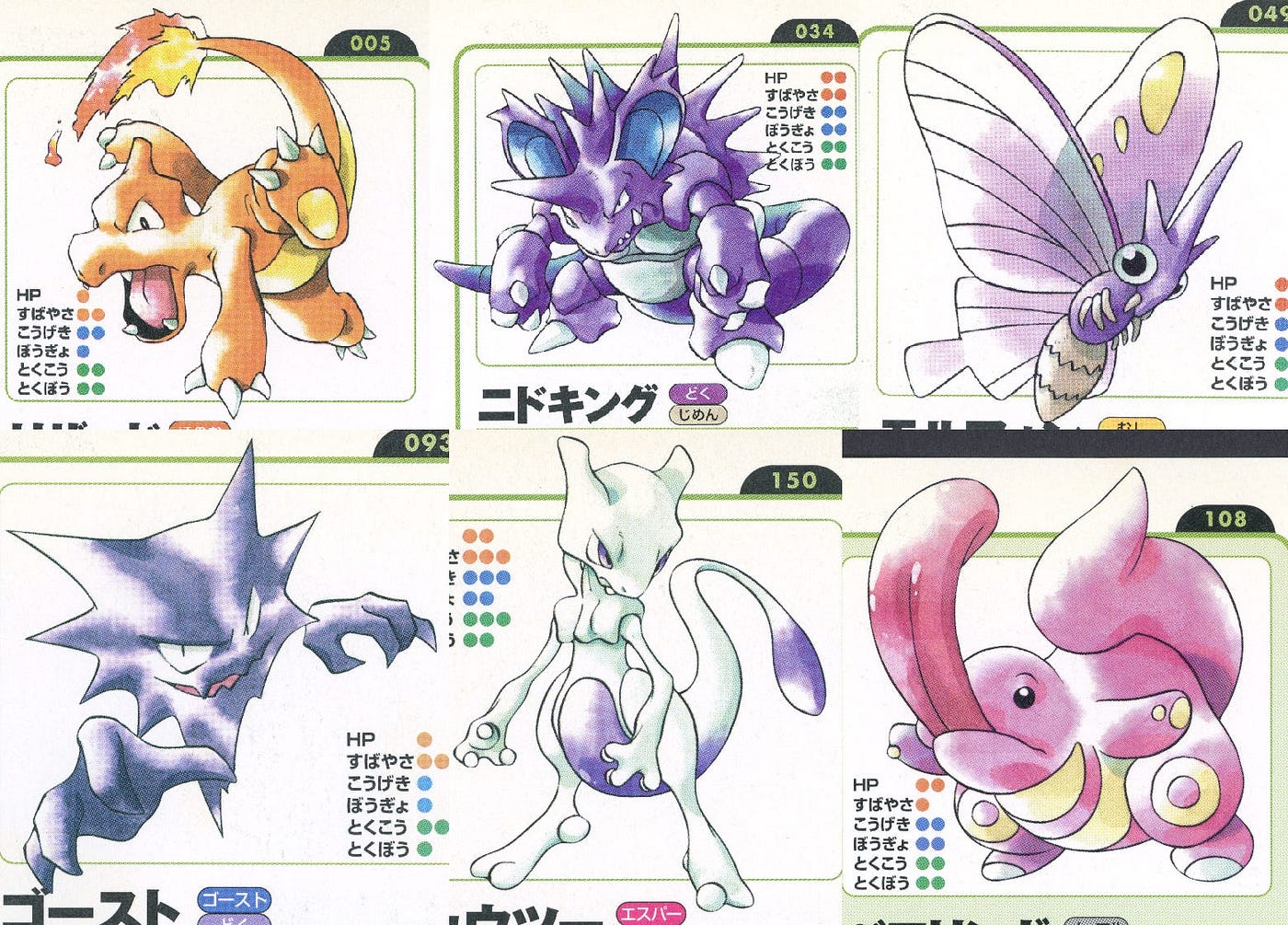
Pokèmon enjoys a level of ubiquity and recognition amongst the 30–40 year old Millennial demographic that simply has no peer. Ask anyone this age who their favorite Pokèmon is and they will have an answer for you locked and loaded.
Nintendo has recently re-released the FireRed/LeafGreen editions to celebrate the franchise turning 30, and I thought I’d do a quick play-through and try to re-evaluate it after so many years.
Between the original R/B/Y releases, and these 2003 remakes, I’ve probably played first-gen Pokèmon like ten times over the years, so these are games I’m deeply familiar with. I’m always sucked in by the variety, the excellent world-building and design, and always play with some self imposed rules to keep things more interesting.
- I always throw my starter away, as I think it makes for a game with more interesting team composition.
- No legendarys — again, it just makes for a more interesting playthrough if you don’t have a slot taken by such a strong no-brainer choice.

my winning team
The qualities of these games are too many to count ; the creature designs, the music, the world and level design, the smart decision to have two versions of the game with different pokemon to incentivize trading, it’s all just a cohesive and beautifully constructed package.
That said, I do have a few criticisms when playing these games from a modern perspective.
- Psychic-type pokemon are extremely strong. I initially tried completing the game without one, but the Bruno/Agatha of the Elite Four ground me down into submission, so I backed out into the main world, went and got a Mr Mime, leveled it up, and came back and just totally wiped out the elite four within an hour or so. They also don’t have much in the way of a weakness, because Dark type didn’t exist yet, and all the ghost-type in Gen 1 are also poison-type, so they end up being weak to psychic anyway. This type imbalance is well understood, and they rectified it quickly.
- Gym Leaders & The Elite Four shouldn’t be able to use items. I think these are okay for battles with wild Pokemon, but being able to use this stuff in boss fights just makes things feel slightly cheap. It should just be you, your pokemon, and your strategy…items shouldn’t be allowed, especially seeing as that the strongest enemy trainers seem to have infinite access to these items. Bosses have an annoying habit of always using these items once their pokemon are at <10% health, which leads to you having to utilize a meta-strategy of trying to damage the enemy, but not SO much that they end up using a full-restore to negate everything you’ve done so far.
- I think that HM5-Flash is a little too far off the beaten path, and it’s quite easy to miss. This isn’t as much of a problem in FireRed as it was in the original 1998 release, but not having flash makes the rock tunnel a pretty frustrating ordeal. It’s location requires backtracking through a cave that is off of the critical path, and is easily missed.
- The Gym Leaders don’t progress linearly in difficulty — ideally any game should get harder as it goes on, but some of the later game bosses are just ridiculously easy because they only utilize one-type that has tons of weaknesses…Blaine in particular, the fire-type gym-leader, is hysterically easy. You need a pokemon that knows Surf, one of the strongest water type moves in the game to even get to Blaine, so when you get there you already have a guaranteed win. Most of the challenge of this game is at the very beginning with Brock/Misty, and at the very end with the Elite Four.
- The Elite Four is a major step up in difficulty, and at that point you are essentially out of strong trainers to battle against and level up — the only way to overcome this is to abuse the “VS Trainer” item, which lets you re-battle previously defeated trainers, which is a good idea but still not an ideal solution.
Outside of these minor issues, it’s a phenomenally strong RPG, and one that is worthy of the total Pokèmania that succeeded it.
The primary pull here after all these years is still the creature designs. The Ken Sugimori designs from the first two generations have a mass appeal that I think have never been surpassed. Take a look at Digimon released at a similar time, and they just lack a cohesiveness — The evolution from one form to the next has little rhyme or reason, and it makes it hard to form a cohesive world in your head.
Meanwhile in Pokemon-land, we see how these creatures fit into the daily lives of the population of the Kanto region — We see Machokes assisting in construction, we see that Voltorbs populate a Power Plant. There are things like the Safari Zone, and a zoo in Fuschia City, there is a training gym for fighting type pokemon in Saffron City — it’s a great example of how to properly build your world. None of this stuff is necessasry or critical to get through the game, but it’s all there to enhance the atmosphere and the feeling of being in this place. One particularly quirky moment is in Celadon City where you find the offices of “Game Freak”, the developer who makes the Pokemon games, and you meet the team who has created the game — it’s a funny meta moment that
Another thing that I like about this game is how some of the best Pokemon are hidden behind tricky mechanics or situations — the primary example is that Magikarp is a totally worthless Pokemon by itself, but once you level it up to 20 via swap-battling, it becomes Gyrados, which is probably the strongest non-legendary in the game. What an amazing idea. The other one that comes to mind is how Abra is basically similarly useless until level 16 where it evolves into Kadabra, and later Alakazam via trade…and now you have the strongest psychic type in the game.
FireRed is a nice looking game, but I would say largely that is from the creature designs, and their aforementioned universal appeal. It looks roughly equivalent to a late-era SNES game like Chrono Trigger in it’s sprite work. The music is the standout of the technical presentation here — So many of these themes and songs have become totally iconic over the years.
Something that I think doesn’t get quite enough recognition about these games are the world-design in terms of the map layout. There are so many little touches and smart decisions that end up making the world feel so much grander and more epic than it really is. Imagine if there were no impediments or obstacles in your way, you could probably walk from Pallet to Lavender Town in like five minutes…but the world doesn’t feel like that, especially when you play it as a child — it has this massive grand scale to it.
There are smart decisions that really contribute to this feeling — right off the bat in the beginning of the game when you go through Viridian City, you find that the final Gym of the game is located there, but is closed off to you. “Oh I’m going to be coming back here later, cool!”. The Indigo Plateau is also right there at the start, teasing you about the end-game less than a half hour into the start of your experience.
Another smart one is how the towns in the second half of the game are organized — They are like spokes on a wheel, surrounding Saffron City. The catch is that Saffron is locked off to you until around Gym 5/6, so you can’t cut through the city directly. You’ll have to go under it via these tunnels that connect all the outer wards. As a child I was unaware that they were all connected in this way, and were so close together.
To get from Celadon to Fuschia you need to take a long bike-ride down a hill…to get from Fuschia to Cinnabar Island you need surf…it’s a good way of keeping the exploration fresh between all these places and making them feel somewhat unique from each other. It also serves as another way of making you diversify your party lineup, because most Pokemon can’t learn more than one or two of the traversal based moves like Strength/Surf/Cut, to help you get around. Eventually you do get the ability to fast-travel via Fly, but I find this to be largely unhelpful and unnecessary if you know the shortcuts placed throughout the world.
Pokemon is now, and forever will be a phenomenally strong RPG that inspires strong feelings of love from both casual and hardcore players. These are the best versions of the Kanto adventures, and for $20 on the eShop it’s hard not to recommend if you haven’t already played them elsewhere.
메타데이터
- post_id
- 509e1fcf0928
- slug
- now-playing-pokèmon-firered-509e1fcf0928
- url
- https://medium.com/@sam.strajack/now-playing-pok%C3%A8mon-firered-509e1fcf0928
- canonical_url
- https://medium.com/@sam.strajack/now-playing-pok%C3%A8mon-firered-509e1fcf0928
- author_url
- https://medium.com/@sam.strajack
- status
- ok
- fetched_at
- 2026-06-09 15:37:30