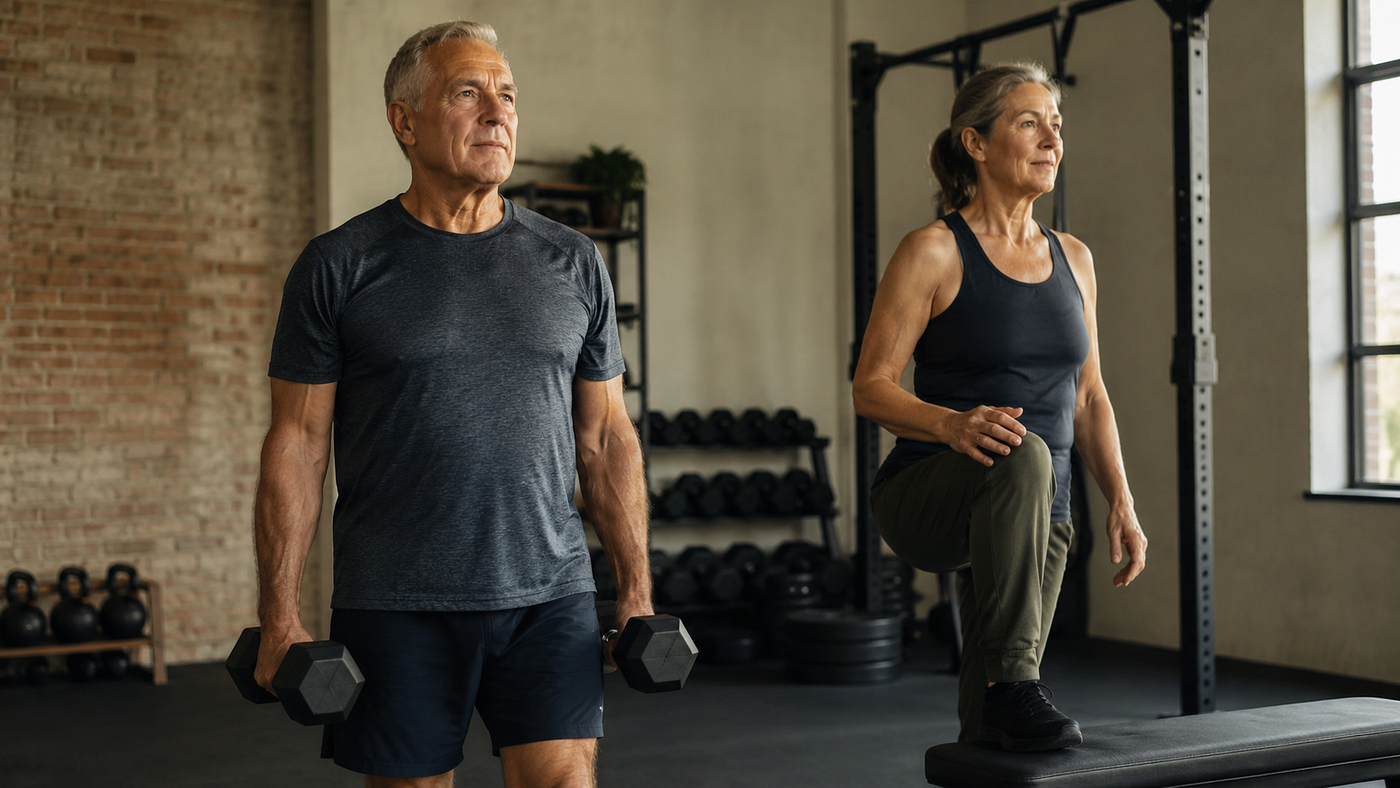
The 5 Best Bodyweight Exercises for People Over 60 (And What to Do If Your Body Says No)
Strength doesn’t need a barbell to be real.
Fitness Over 60
The 5 Best Bodyweight Exercises for People Over 60 (And What to Do If Your Body Says No)
Strength doesn’t need a barbell to be real.
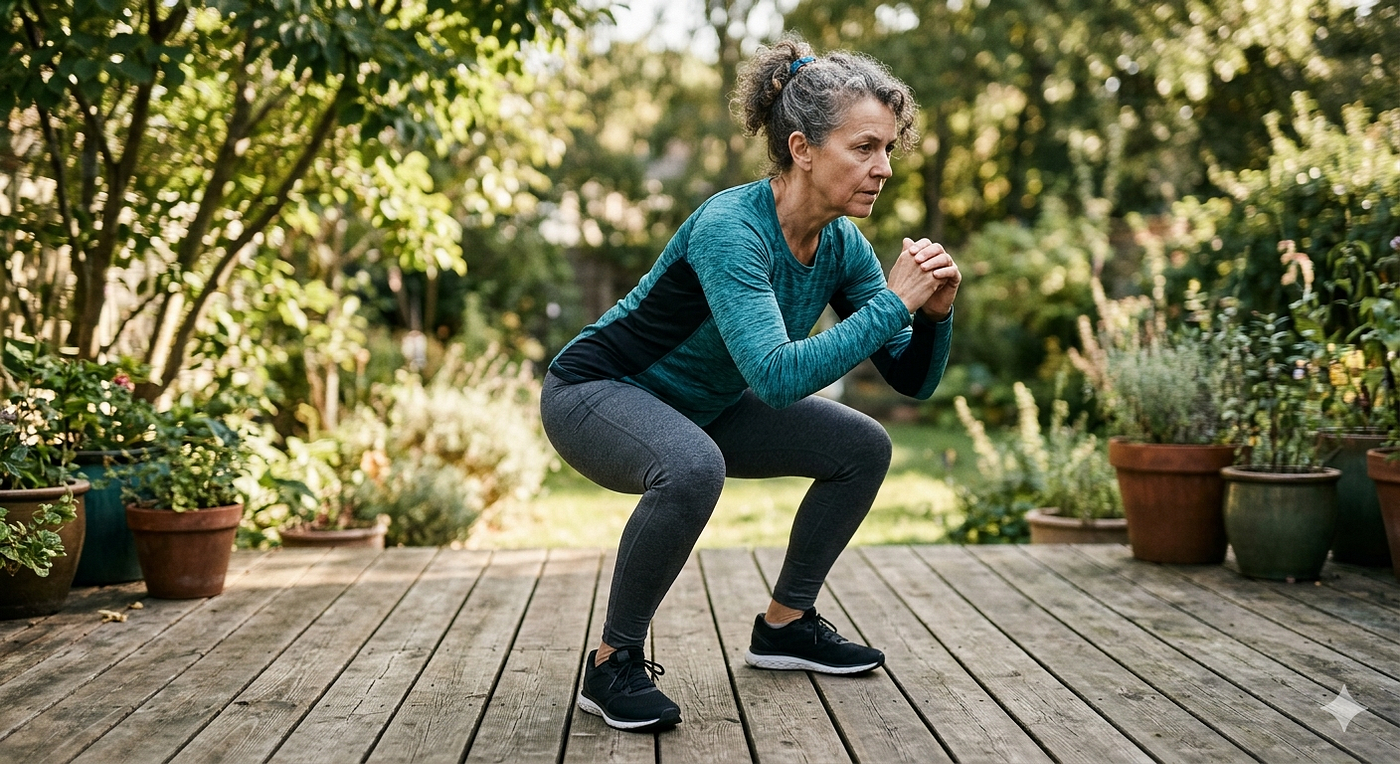
This image was created using AI image generation tools and does not depict a real individual.
You don’t need a rack full of iron to stay strong after 60. You need your own bodyweight, a little floor space, and the willingness to keep showing up. That’s it. I say this as someone who trains around psoriatic arthritis and still lifts several times a week, because the alternative, deconditioned, stiff, and dependent on other people to open jars, is not a retirement plan I’m interested in.
Bodyweight training gets dismissed as beginner stuff, which is one of the dumber fitness myths still circulating. Done right, it builds real functional strength, the kind that keeps you climbing stairs at 75, getting up off the floor without grabbing the furniture, and carrying groceries without wincing. The five exercises below are not a beginner circuit. They are the foundation of a capable body, at any age.
The Squat
What it works: Quadriceps, hamstrings, glutes, hip flexors, core, and every supporting muscle that keeps you upright when your balance gets tested.
Why it matters: The ability to squat is directly tied to independence. If you can lower yourself into a chair and stand back up without using your arms, you have functional lower body strength. If you can’t, you’re in the early stages of a problem that compounds fast. Falls are the leading cause of injury-related death in adults over 65. Strong legs and hip stability are your best insurance policy.
How to do it: Stand with feet shoulder-width apart, toes turned out slightly. Keep your chest up, spine neutral. Sit back and down, as if lowering onto a chair behind you. Go as deep as your mobility allows without your heels coming up or your torso folding forward. Drive through your heels to stand. Keep your knees tracking over your toes throughout. Start with 3 sets of 10 and build from there.
If you can’t do a full squat yet: Chair-assisted squats. Lower yourself onto a chair slowly, barely touching the seat, then stand back up. This takes the depth variable off the table while still training the movement pattern. A box squat to a higher surface works the same way.
The Push-Up
What it works: Chest, shoulders, triceps, and core. Also trains the serratus anterior, which stabilizes your shoulder blades and matters more than most people realize.
Why it matters: Upper body pressing strength declines fast if you stop demanding it. Beyond aesthetics, it directly affects your ability to push yourself up from the floor, brace yourself in a fall, and perform basic daily tasks without fatigue. Shoulder stability also protects the rotator cuff, which becomes increasingly injury-prone with age if the surrounding musculature goes soft.
How to do it: Start in a high plank position, hands slightly wider than shoulder-width, body forming a straight line from head to heels. Lower yourself until your chest is an inch from the floor, elbows flaring out at roughly 45 degrees from your torso, not straight out to the sides. Press back up. Don’t let your hips sag or your lower back arch. Every rep should look the same as the first one. When they stop looking the same, stop the set.
If you can’t do a floor push-up yet: Incline push-ups against a wall or sturdy elevated surface. Lower the angle gradually as you get stronger. A push-up from the knees is an option, but prioritize incline push-ups first because they train the full body alignment.
The Hip Hinge (Bodyweight Romanian Deadlift)
What it works: Hamstrings, glutes, lower back extensors, and the entire posterior chain.
Why it matters: The hip hinge is the movement pattern behind nearly everything you do when you bend forward to pick something up. Most people over 60 have forgotten how to hinge at the hip and compensate by rounding their lower back instead, which is exactly how disc injuries happen. Learning and owning this pattern is protective. A strong posterior chain also counteracts the forward-rounding posture that becomes common with age.
How to do it: Stand with feet hip-width apart, soft bend in the knees. Push your hips back while hinging forward at the waist, letting your hands travel down the front of your legs. Keep your back flat, chest up, and weight balanced through your whole foot. Go until you feel a stretch in your hamstrings, then drive your hips forward to stand back up. Squeeze your glutes at the top. The movement is all hips, not lower back. Think “push hips back” on the way down and “push hips forward” on the way up.
If you can’t hinge without rounding your back: Wall hip hinge. Stand about a foot from a wall, hinge back until your glutes touch it, then return to standing. It teaches the movement with built-in feedback and limits range of motion until mobility improves.
The Plank
What it works: The entire anterior core, including the rectus abdominis, transverse abdominis, obliques, and hip flexors. Also loads the shoulders, chest, and upper back isometrically.
Why it matters: Core stability is not about six-pack aesthetics. It is about spine protection and force transfer. Every time you lift, carry, twist, or reach, your core is the bridge between your upper and lower body. Weakness there means stress lands somewhere it shouldn’t, usually your lower back. For people with arthritis or any spinal history, a stable, well-trained core is non-negotiable.
How to do it: Start in a forearm plank, elbows directly under shoulders, forearms parallel. Body forms a straight line from shoulders to heels. Brace your abs like you’re about to take a punch. Squeeze your glutes. Hold for 20 to 30 seconds to start, and build over time. Do not chase duration at the expense of form. A shaky, sagging 60-second plank is less useful than a tight, controlled 20-second one.
If a full plank is too much: Plank from the knees. Keep the same body alignment and bracing. Or try a dead bug, lying on your back with arms extended toward the ceiling and knees at 90 degrees, then slowly lower alternating arm-and-leg combinations while pressing your lower back into the floor. It trains the same stability system with less load.
The Reverse Lunge
What it works: Quadriceps, glutes, hamstrings, hip stabilizers, and the single-leg balance system that keeps you from going down on an uneven sidewalk.
Why it matters: Unilateral training, meaning working one leg at a time, is essential after 60 because it exposes and corrects the strength imbalances that bilateral exercises (squats, leg presses) paper over. It also demands balance and coordination, which are skills you keep only by practicing them. The reverse lunge is specifically easier on the knees than a forward lunge because the loading mechanics are gentler, which makes it the right starting point for most people.
How to do it: Stand tall, hands on hips or extended for balance. Step one foot back and lower the back knee toward the floor, stopping just before it touches. Keep your front shin vertical, your torso upright, and your front knee tracking over your toes. Press through your front heel to return to standing. Alternate legs each rep. Start with 3 sets of 8 per side.
If balance is an issue: Hold the back of a sturdy chair for support with one hand while you lunge. Or perform a split squat, same position but both feet stay planted, which removes the stepping variable entirely. Build toward the unsupported version as balance and confidence improve.
A Word on Training Around Pain
These five exercises work. They also have to work for your specific body. If you have arthritis, previous surgeries, or joint issues, that is not a reason to stop, but it is a reason to pay attention. Modify range of motion before you modify frequency. Move slowly through any exercise the first time you try it and notice where it talks back. Pain that sharpens, catches, or radiates is a signal, not a challenge to push through. Discomfort from muscular effort is different from joint pain. You learn to tell them apart with experience.
Training in your 60s is not a race. Nobody is handing out medals for fastest comeback or most reps. The goal is to still be doing this at 75, and 80, and beyond. Consistency beats intensity every time at this stage of the game. Get the movement patterns right, build them into your week, and let the strength follow.
If this helped you, follow The Proud Boomer on Medium for more no-nonsense health and fitness content written for people who’ve actually been around long enough to know the difference between good advice and marketing copy. And if you’re building a training routine around real-world limitations, drop a comment. I read them all.
Stay strong. Stay skeptical. — John Harris, The Proud Boomer
메타데이터
- post_id
- 50a6d5224724
- slug
- the-5-best-bodyweight-exercises-for-people-over-60-and-what-to-do-if-your-body-says-no-50a6d5224724
- url
- https://medium.com/@theProudBoomer/the-5-best-bodyweight-exercises-for-people-over-60-and-what-to-do-if-your-body-says-no-50a6d5224724
- canonical_url
- https://medium.com/@theProudBoomer/the-5-best-bodyweight-exercises-for-people-over-60-and-what-to-do-if-your-body-says-no-50a6d5224724
- author_url
- https://medium.com/@theProudBoomer
- status
- ok
- fetched_at
- 2026-07-19 10:33:50