Exploring Hakka through the lens of a Chinese family takeaway
Language can evolve in unexpected ways — sometimes encoding ancestral knowledge we didn’t know we have within us
Exploring Hakka through the lens of a Chinese family takeaway: a story of migration, food and transmission
Language can evolve in unexpected ways — sometimes encoding ancestral knowledge we didn’t know we have within us
Photo by Steve Long on Unsplash
My parents are from Hong Kong, immigrating to the UK over half a century ago in the search of a better life.
On International Mother Language Day, I reflect on our family’s linguistic journey, tracing our meandering global path as Hakka ‘guest people’.
My dad arrived first along with one of the major post-Second World War waves of migration from the Commonwealth. Years later, when meeting my mum, she spoke to him in the lingua franca of Hong Kong: Cantonese.
Having been schooled in Hakka and having to ‘catch up’ on Cantonese when leaving the family village, my dad insisted that as Hakka people (tee-gah nyin (自己人) — our own people) they should converse in their shared first language of rural Hong Kong. He’s immovable. (Literally. Spends most days in his armchair now).
To my ear, Hakka has volume (‘are your parents arguing?’ ‘No, that’s just how they speak’), immediacy and directness – and a cadence that seems quite universal among its speakers: dramatic at times, while also stoic. It’s often directive and emphatic, sometimes critical and cutting too.
In common with all Chinese dialects, Hakka is tonal — apparently the standard number of tones in Hakka is six (in contrast to four plus a neutral tone in Mandarin, and 6–9 in Cantonese, depending on how you count them). The tones give Chinese its sing-song like qualities, melodic or sometimes harsh, depending on the context and speaker, of course.
While Hakka is one dialect, with between 30–50 million speakers – estimates vary – there are many variants that are not quite intelligible to others. It’s a national language of Taiwan, for example, though I can’t understand their form of Hakka (though my mum is able to).
It is spoken across Southern China and by the Chinese diaspora across Southeast Asia, and a significant number of Chinese populations in the UK, Europe, and the Americas. In fact, I recently met a Hakka-speaking young woman from Suriname during a boat trip in Amsterdam. It was surreal and wonderful to discover we spoke the same kind of Hakka as her dad was from Shenzhen, China.
Hakka is more often than not, the language spoken at home – and the language of the elders – with the younger generation using dominant and official languages like Cantonese, Mandarin and English.
Hakka literally means ‘guest people’ or ‘guest families.’ Over the course of around 1,500 years, Hakka migrated from the northern plains in search of our own land.
After generations of hostility, clashes, conflict and displacement, Hakka communities eventually settled in southern China, including the New Territories of Hong Kong, where my ancestors are from. We are classed as indigenous to Hong Kong, yet, Cantonese are known as ‘Bunti nyin’ — local people. It’s an inverse logic that the guests are the indigenous population and the locals are the more recent arrivals.
There is a rich history of Hakka heritage and folklore — we’re known for being wily, resilient and scrappy, and even ruthless as Hakka main protagonists in political manoeuvrings, historical rebellions, uprisings and revolutions. (Maybe I should more accurately describe us as antagonists).
Hakka women had unbound feet — so-called beauty standards were far too impractical for the needs of rural family life and working the land. Practical pragmatism over pressure. Apparently, during the Taiping Rebellion, General Zeng referred to Hakka women as ‘big foot hillbilly witches’ — which I’d take as a massive compliment: maybe one for my epitaph.
Even though education is revered in Hakka culture for its power to uplift and confer status – and with some of its own literary traditions – for most communities, Hakka was primarily an oral language. With low literacy levels until the 20th century, Hakka language and expressions formed through the daily rhythm of rural life – functional, literal and practical.
While Hakka can be written, its written form takes it out of the vernacular to the formal – grammatically closer to Mandarin than Cantonese. There were some attempts to romanise the language by Christian missionaries but I don’t believe that gained broader usage.
While Chinese lacks the rich descriptive vocab of English in general, it uses playful and interesting ways to evoke feelings and descriptions.
A simple example: in Mandarin, to express a sense of excess or intensity, you would say ‘tai…le!’ So for example, to say ‘that’s too hot’: ‘tai re le!’ That’s too expensive: ‘tai gui le!’ In contrast, in Hakka you would say ‘sit fun nyet!’ (十分热) which translates to something like ‘ten parts too hot!’ They use the ‘ten parts’ construction in Mandarin too to denote a sense of excess — ten parts is to convey 100% — but it is not used in every day speech in the same way, I don’t think.
I can think of one Hakka way of speaking that seems quite idiosyncratic, or at least used in a way that I don’t think is rendered in the same way in Cantonese or Mandarin. There must be a linguistic term for it – AI reckons it’s called ‘reduplication’ – but I will refer to it as onomatopoeic intensifier words.
As a softer, descriptive way to express something in Hakka, you can often take the adjective and add an intensifier word, repeated twice. (I’ve compiled a list with examples further below to illustrate how this works).
Growing up in a Chinese takeaway in a northern English town, our family operated in a very particular cultural and linguistic bubble: interacting with customers and people we met while out and about in English, and among ourselves in Hakka — yet English seeped in through the back door.
In my very early years, being close to my mum I spoke Hakka only. I remember starting school and being a little linguistically confused, saying ‘mah-gai?’ (What?) if I didn’t understand something and then catching myself.
As my older siblings brought home increasingly sophisticated English, that soon began to replace the Hakka which did not serve a purpose in our growing world beyond the takeaway. It didn’t give us the ability to express ourselves in the lives we were living at school and among playmates in the terraced Victorian streets behind us.
With our parents’ time spent toiling in the kitchen, serving our customers, and working around the clock every day, family conversation during our formative years was limited to more functional communication. Their one day off each week was spent buying supplies, doing the accounts, making a vast pot of curry paste (my dad’s job, stirring the thick golden base with what looked like a wooden oar), and cutting cardboard boxes into small rectangles to line the carrier bags to serve as a sturdy base for the food containers (mum’s task, conducted with annoyance and at speed with a bread knife).
Around the table, as a rabble we would be loud, somewhat chaotic and laugh a lot. We did impressions of Margaret Thatcher (we had no idea about politics but we knew she was someone people around us poked fun at) and chatted inanely about other things we’d seen and heard on TV.
The Hakka passed down all these generations fragmented and mixed in to create the odd bit of colour in otherwise English sentences. Our Hakka language attrition was not our parents’ fault of course: our set up was what we did as a unit to operate and survive — like the ‘guest families’ that came before us. They lacked options and support, largely isolated in this world we inhabited. They assumed proximity would ensure continuity of the language, yet the loud industrial extractor fan in the kitchen broke the transmission.
Over the years, the Hakka was displaced. We wanted to assimilate, not stand out.
My siblings and I wanted to be the same as everyone else around us. We were among the only Chinese and in fact non-white people in our town. Difference highlighted vulnerabilities, not pride. No one around us spoke Cantonese so that didn’t even enter our world, except from the occasional Chinese video, recordings of Hong Kong TV series passed over from our uncle (who we saw at Christmas). So we didn’t feel the lack of Hakka or Cantonese fluency as something ‘lost’.
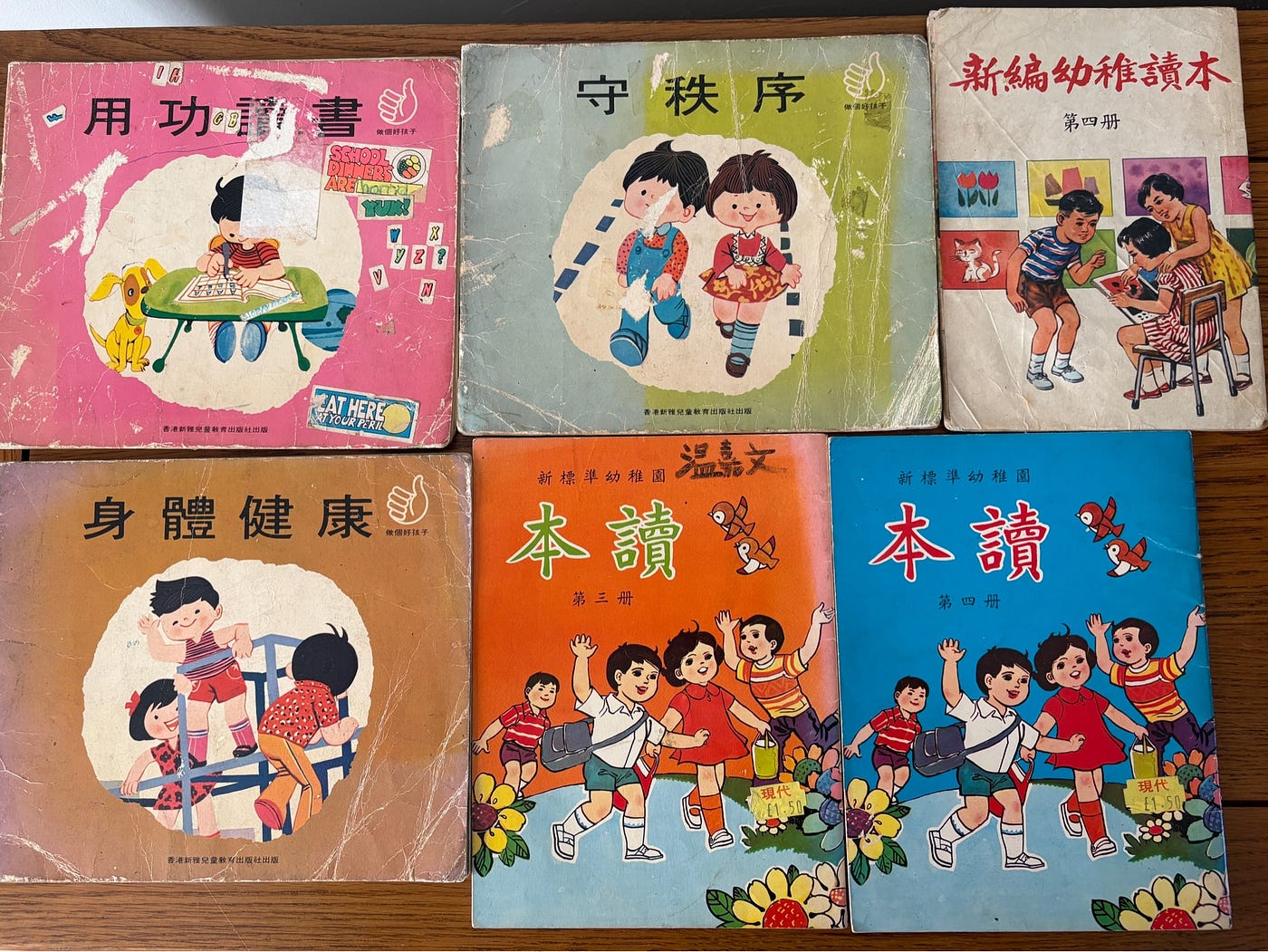
Vintage Cantonese children’s reading books unearthed at my parents’ house, purchased in the 1980s from Manchester Chinatown. Mum tried to make us recite the short passages out loud while she prepared food for the takeaway — in HK, she had been a kindergarten teacher. Sadly, we made limited progress. Image: author’s own.
Code switching — my parents speaking in Hakka and my siblings and me in English peppered with a few Hakka words — baffled and amused everyone around us.
As a family we recognised this was unusual, but my parents conceded it was just the trade off they had made. They also viewed it at the time as wilful cultural rejection by their children, and yes there was certainly resistance, but they do recognise now it was largely circumstances. Language has to be actively preserved and passed on through proximity and use with shared meaning.
I recently thought about some of the words and phrases spoken at Hakka at home, and I thought about this specific linguistic feature where an adjective is followed by a duplicated word to denote its weight.
I was never taught these Hakka words, I just recall them — they were transmitted to me, just as they have always done in the oral tradition.
I called my mum to verify these and she agreed I got them right. She laughed a lot. She said they are just words that we use every day so they’re not funny, but hearing me say them to her out of nowhere was amusing. It’s interesting how I remember the domestic phrases but can’t always formulate full sentences with proper syntax and grammar.
As there is no standard romanisation, I’ve typed them as an approximation based on how I hear them, together with what I think is the correct Chinese character for the adjective (but not the ‘reduplication’ as I don’t have any authority for that, and my parents aren’t sure of their written form either).
What strikes me is how sensory, unsubtle and literal they are, and how they all link to every day life and preoccupations of village life — around food and the home mostly and the condition of things.
They provide a window to every day life of the generations past. Mum asked me how I know and recall these phrases, I said thinking about it I remember her using them a lot, but not so much dad. She agreed that it’s a middle-aged/elderly woman vocab, the people taking care of every day domestic life. They often express dissatisfaction, which says something about the hardship of life. This was not the vocab of those with abundance.
Incidentally, as an adult I decided I wanted to fill in some linguistic gaps and I studied Mandarin. I learned to read and write to a reasonable level, and it retrospectively illuminated Hakka syntax and vocab.
For example, I knew the word for something in Hakka sounds like ‘dun-see’ — in Mandarin it’s ‘dongxi’ which means East-West. What a concept — I visualise an orange sun rising in the east and setting in the west and somewhere in that arc is something. With my limited knowledge of Cantonese, I know they don’t use this word — they say something like ‘yeh’, like ‘do you want to eat [yeh]?’
Hakka expressions of a certain form: adding colour and sound to domestic and rural life
Light, temperature and colour
暗 Am mar-mar: dark (night is closing in, lack of visibility)
暗 Am sau-sau: dark (really dark)
暗 Am dung-dung: dark (totally dark, no visibility)
So many ways to express diminishing light – this likely expresses the urgency around finishing various agrarian tasks before dark.
光 Gong wah-wah: bright (like the sun)
冷 Lang wai-wai: cold
熱 Sau lut-lut: hot (temperature hot, like food or liquid)
暖 Liong wut-wut: warm (cozy, toasty)
烏 Wuu diat-diat: black, the colour of a crow (or blackened, covered in dirt)
白 Pat kat-kat: white (pale, like pasty and ill)
白 Pat sut-sut: white (clean and bright)
青 Chiang gang-gang: green (deep green, like deep water or an unripe fruit)
黃 Wong kiang-kiang: yellow (like a paper wall calendar yellowed in the sun or a white shirt yellowed through wear)
Taste and food
飽 Bau bit-bit: full (of food)
鹹 Ham lang-lang: salty (overly)
甜 Tiam ye-ye: sweet (overly)
苦 Fuu diu-diu: bitter (overly)
Interestingly, this pattern does not apply to ‘spicy’ — Hong Kong Hakka cuisine did not traditionally use chilli — salt was used to preserve meats for example. If you’d eaten something too hot, you might say ‘lat dow-see’ which translates into something like ‘spicy to death’ or ‘so spicy I’ll die!’
State and condition
舊 Kiu met-met: old (aged, old and past its usefulness)
爛 Lan bo-bo: broken (beyond repair, decrepit)
滑 Wat tut-tut: smooth (positive, like polished)
㾫 Hai siap-siap: Rough (to the touch)
燥 Zau mat-mat: dry (dehydrated, dry as a bone)
濕 Sip tap-tap (sodden/saturated)
濕 Sip tan-tan: wet (wet through)
硬 Ngan kang-kang: hard (solid)
軟 Nyong dang-dang: soft (overly cooked)
空 Kung liao-liao: Empty, spartan, hollow (like an unfurnished room, or a shell with nothing inside)
Appearance
高 Gao ten-ten: Tall (lanky)
矮 Ai dut-dut: Short (squat)
肥 Fui tan-tan: fatty (derogatory, like a large body or fatty meat)
肥 Fui dut-dut: chubby (can be cute, like a baby or animal)
瘦 Siu mang-mang: Skinny (scrawny)
What strikes me is the lack of pure joy — there’s no sugarcoating the hardship of life.
It’s often dissatisfied and descriptive on a functional basis. That said, some of those expressions are quite funny — there’s a deadpan comic quality to the bluntness of them.
The exception in terms of emotional register is the more evocative ‘kung liao-liao’ — someone’s home described as kung liao-liao would denote something sad and austere, suggesting a house full of things is a state to strive to.
These were people navigating centuries of invasion, famine and displacement — already pushed to the margins before the Opium Wars, the Taiping Rebellion and Japanese occupation compounded the misery.
My parents told me about Hakka hill songs in some communities of the generations before them — but among their generation with educational and work opportunities opening up, this practice did not endure. But, it turns out that no one sang these in either my mum’s or dad’s village, even when they were very young. It transpires we are the least joyful or expressive Hakka in all of society, it seems. That’s some accolade.
A number of years ago I visited relatives in Hong Kong and I chatted to them in Hakka to the best of my ability. I unwittingly became the family comedian as apparently I used the vocab of my grandmother — of the generation past!
Their Hakka had evolved with the influence of Cantonese and moving out to towns and the city with professionalised jobs, while mine had stayed true to its original form from village life. Examples: ‘hau hip’ for the weather being ‘humid’ and my favourite subject being ‘lat su’ — history. I corrected them as they used a Cantonese approximation — they found that hilarious, especially as I had only visited Hong Kong a couple of times in my life at that point (my first visit being at aged 17). So the extractor fan hadn’t broken down all cultural transmission after all.
Hakka in many communities is fading, as Cantonese and Mandarin dominate.
As the light goes down on the old ways and linguistic practices — it’s turning ‘am mar-mar’ — we can’t lose this window to the world of the past — one that I got a sideways glimpse into from my home in England.
Are you a Hong Kong Hakka speaker? Please let me know if there are others I should add to this list!
메타데이터
- post_id
- 50aba6aa59bf
- slug
- exploring-hakka-through-the-lens-of-a-chinese-family-takeaway-a-story-of-migration-food-and-50aba6aa59bf
- url
- https://medium.com/@kamanparkinson/exploring-hakka-through-the-lens-of-a-chinese-family-takeaway-a-story-of-migration-food-and-50aba6aa59bf
- canonical_url
- https://medium.com/@kamanparkinson/exploring-hakka-through-the-lens-of-a-chinese-family-takeaway-a-story-of-migration-food-and-50aba6aa59bf
- author_url
- https://medium.com/@kamanparkinson
- status
- ok
- fetched_at
- 2026-07-17 07:29:34




