JESUS IS CUTE, BUT JEHOVAH’S A BRUTE ~PART 5
Tradition quenches the Spirit — God’s and Humanity’s.
HOLY HORMONES BIBLE STUDY. IF YOUR BOOK ISN’T A BUZZ, IT’S NOT THE BIBLE.
JESUS IS CUTE, BUT JEHOVAH’S A BRUTE ~PART 5
Tradition quenches the Spirit — God’s and Humanity’s.

Public Domain: Movie advertisement published on line.
Press HERE if you want a free read.
Preamble: This is a re-issue of a post from days of yore [one of my first]. It had been withdrawn several years ago because it had attracted exactly zero with the ring rubbed out interest after a number of years. But Faithful Writers buddy, I.M. Koen published something along the same lines just a little while ago and is, at this very moment, publishing more along those same lines again. This could mean one of two things. (1) There are two of us on the Lunatic Fringe. [It has been lonely out here.] or (2) The time has come for this Revelation. I detect the vibes that there are enough spiritual war wounds in the Faithful Writers Livery to resonate to I.M.’s meaning.
I’ve changed the conclusion a bit because I’ve been taught things since then. However, I haven’t changed the rest of the post because that would burst the bubble. So there are comments about other posts that don’t link to anything, so don’t wait for the other shoe to drop. The whole series has been culled.
It is long (even for one of my posts), so perhaps you’ll read it — perhaps not. But be warned. You’d better have a cup of tea, an aspirin, and a couch for a good lie down, at hand for when you’ve finished.
Firstly, the Conclusion.
Because it is a long post, I’ll present the conclusion up front. But you will have to read the core so that you understand it. So sad, but don’t expect emoji theology from this end.
So why were we created?
The conclusion of the matter: WE WERE CREATED TO BE LOVERS!
The grammar of the famous “God is Love” text is along the lines that the Father is the existing essence of Divine Love. He exists in/as that Divine Love, which is something that we will not understand this side of the grave. Anything that is not Divine Love cannot exist within that same sphere.
But there is already an Eternal Love Affair
Though not in the smutty ways of the kosmos (that part of Humanity which hates God, i.e., all of it), where the whole circle of earthly goods, endowments, riches, advantages, pleasures, etc, which, although hollow and frail and fleeting, stir desire and seduce away from God.
That is what Satan would have us see. But it is this.
“This is my beloved son,” spoken by the Father about Jesus, is mentioned four times in the Gospels and once in 2 Peter 1:17.
Also, it is written in John 14:31 || But that the world may know that I love the Father, and as the Father gave Me commandment, so I do.
And in John 15:9 || As the Father loved Me, I also have loved you; abide in My love.
That should settle the issue.
But God makes it clear that He does not trust Humanity because of the Fall.
(If you haven’t noticed it, go back and read the Bible.)
So how does He bring corrupted Humanity into His Presence? He uses the only Human He trusts — His Son. He places those who so choose in Christ.
When the texts for the Eternal Love Affair are blended, they result in this astounding relationship.
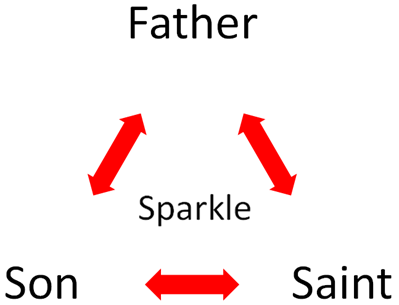
Holy Hormones! Surely this talk about Romance is blasphemy! God is Love, isn’t He?
If your pastor has not taught this to you, teach your pastor because he has been missing out, too.
Brace yourself! This is more of a teaching blog than an entertaining one. It may not be an easy read because there is more here than a normal, well-adjusted person would normally want to know, but it will be worth it. It is the detail that makes me a boring person that brings the Bible alive for me.
This post is longer than my usual because it may be introducing a new concept to some people, so it needs more explanation.
[NOTE: Important words analysed below are identified with Hebrew/Greek transliterations into English and Strong’s Numbers so that whoever wants to can check them out — it is strongly recommended that you do. I use the Blue Letter Bible.]
This is a five-part series.
Part 5 will examine the evidence provided in the Scriptures to give a different perspective as to the type of relationship Christ desires with His Church.
Part 1 demonstrated, using simple Hebrew spelling and etymology, that, at the Burning Bush, Moses was speaking to the God of the Old and New Testaments, Who is one and the same person.
Part 2 used the Jehovah’s Witnesses’ Bible to confirm that the OT Yehovah and NT Yeshua/Jesus are one and the same person.
Part 3 used the Scriptures from both Testaments to show that the tasks completed by Yehovah, Christ, and the Holy Spirit confirmed that the OT Yehovah and NT Yeshua/Jesus are one and the same person.
Part 4 examines why NT Saints have such a low regard for the loving kindness and mercy of the OT Yehovah and presents a remedy for anyone interested enough to take it up.
Christianity from a different perspective.
We hear a lot about the various forms of Love, which is of utmost importance. What is missing between Christ and His Bride in the (small ‘c’)church is the Romance.
I have a friend whose Mother Tongue is Hebrew, so he hears the words unspoken in the Language, which is very ‘earthy.’ He said, “When HaShem says, ‘Seek my face,’ think hormones.”
Imagine two young lovers seeking each other in a crowd. Their eyes are darting about, their hearts are pounding, their temples throbbing, and their mouths are dry. Then, at first glimpse, their heart leaps — they are alive. That is the eagerness that God responds to when He promises, “You will seek me and find me when you seek me with all your heart,” and He does not lie. This is what your Saviour wants from you — PRIMITIVE PASSIONATE RELATIONSHIP — as is written in the Song of Songs, which will be mentioned later.
It also works the other way. Any parent knows the cry of their own child. When you call to your Heavenly Father, He can pick you out of a cacophony of screeches around you.
[There is another post, “Where does the Lord’s Joy come from? He explains it in the grammar,” which mentions The Joy of Shamar. It is there for you to read, so it won’t be covered here.]
Before we start, let’s get in the mood for romance.
(If you are on the bus or busy, do something else until you get a quiet place and enough time.)
Spend a few minutes doing these things and relax; these are the best bits.
Firstly: Invoke this link, relax, close your eyes, and soak it up.
Secondly: Let it sink into the depths of your soul so that, by the Blood that Christ eagerly shed for you, you WILL NEVER be more Righteous, more Secure, more Redeemed, more Holy, more Chased, more Cherished, more Loved, than you are at this very moment.
Thirdly, the Bible repeatedly presents goodness as a core quality of our Lord, and I want to share just 23 of those occasions. These 22 verses point you to the goodness of our God and what it means for our lives. Open this link to an online Bible App, and paste these verses in, all at once. Then soak up the flavour of the message that the Lord is a good God.
Exodus 34:6, Psalm 145:9, 1 Chronicles 16:34, Ezra 3:11, Psalm 25:8, Psalm 23:6, Psalm 27:13, Psalm 145:5–7, Psalm 34:8, Psalm 100:4–5, Psalm 107:8–9, Psalm 103:13–14, Psalm 143:10, Psalm 92:15, Psalm 119:68, Nehemiah 9:20, Psalm 69:16, Nahum 1:7, Psalm 31:19–20, Mark 10:18, James 1:17, Matthew 7:11
Now you are in the mood.
God reveals the mystery through Apostle Paul in Ephesians 5:31–32, where it is written, “For this reason a man shall leave his father and mother and be joined to his wife, and the two shall become one flesh.” This is a great mystery (G3466 — mystērion), but I speak concerning Christ and the church.’
G3466 — mystērion, in this context, does not mean that it can’t be known. It means something that God has not previously revealed but now, in His Wisdom, has chosen to make known. He has already called Israel His wife in the OT, but she chased after foreign gods. The Gentiles should have been drawn into the Commonwealth by the obvious relationship between Yehovah and Israel, but Israel did not obey the Torah. The Church includes all Humanity.
[AN ASIDE: “Chased after” is a sanitised translation. As mentioned, Hebrew is an earthy language, and the closer translation is, “Whored after.” If you are offended, don’t shoot the messenger. Track it down in the OT Hebrew. The trouble with today’s (small ‘c’)church is that it is more sanitised than sanctified. Try this https://medium.com/the-faithful-writer/passover-stories-blood-and-ugliness-from-a-different-perspective-c2e950c45685]
A posture for prayer.
Prayer is the most Holy Action humans can do. In a teaching on the subject I read a very long time ago, there were some descriptions of the posture to take up. Two I remember are:-
- A subservient posture to the omnipotent, omniscient, omnipresent Being.
- Bending forward as if to kiss.
Someone got the point.
Primitive Passion
The story so far is that God is good in Christ; in Christ, you will never be in a better position with God than you are now. He hears you. He wants a primitive, passionate relationship.
Sophisticated folk tend to be offended when called “primitive.” But it is interesting to compare the two words.
Sophisticated: “make impure by admixture,” from Medieval Latin sophisticatus, past participle of sophisticare. From about 1600 as “corrupt, delude by sophistry;” from 1796 as “deprive of simplicity.” A Sophist is a person who reasons with apparently clever, but false, arguments. Penetrate false argument with the Sword of the Spirit — the Bible.
Primitive: late 14th century, primitif, “of an original cause; of a thing from which something is derived; not secondary but primary”, from Latin primitivus “first or earliest of its kind.” Meaning “of or belonging to the first age” is from the early 15th century, especially in a Christian sense of “adhering to the qualities of the early Church.”
Passionate: Suffering (enduring) in the specific sense of “amorous” is attested from the 1580s. Middle English passional “pertaining to the feelings” (mid-15c., from Medieval Latin passionalis).
Obviously, care must be taken with definitions when dealing with the languages in the Bible and the subsequent translations.
Another look at the Creation Poem.
This needs some preparation.
The first step in Exegesis is to determine what the Folk of Old were actually saying to each other by knowing the meanings of the words. Translation precedes interpretation. Because of the shades of meanings of words in every language, there is a cluster/cloud of words from which to choose, as shown in the figure.

Generated by author
You possibly know that there are two controlling factors when translating the Bible.
- Every word in both languages has more than one meaning.
- There is only one meaning that will fit into the context being translated. Without satisfying this latter constraint, the interpretation does not respect the author’s intention.
Hebrew Hermeneutics has four levels:-
Peshat — the literal, direct meaning (story level)
Derash — the homiletical, or practical, application, traditions — midrash, talmud
Remez — the allegorical significance; a hint of something deeper, a higher meaning; prophetic understanding;
Sod ( rhymes with road) — the mystical, or hidden, or secret, meaning — Jewish soul or Christian spirit — understanding ourselves (giving a glimpse of God’s Image)
Through the eyes of the Sod
Viewing Creation through the Sod results in a view that you may reject because of your traditions. My explanation is not crisp and relies on a property of Hebrew where different words roll off the tongue in a similar manner. You will soon see what I mean.
The Bible shows there were three stages to the final product of Adam, each one more personal than the previous. but not the way postulated by Darwin.
(1) God created the dust: Impersonal, just chemicals with no consciousness. Despite the huffing and puffing of scientists, no one can explain the three basic cornerstones of human existence — Gravity, Energy, and Consciousness. We can see them and measure them, but can neither explain them nor manufacture them.
All breathing life forms are fungible carbon. The periodic table of the chemical elements shows that we are more important than generally appreciated, but that is another story for another time. But we can prod and poke a pile of carbon as much as we like, but it won’t become alive. Ask Dr Frankenstein.
(2) God formed the animal life-forms, including Humanity, from the dust. The Hebrew verb carries the flavour of squeezing into shape by hand. Much, much more personal. But it is stipulated that all species are “after their own kind.” Elsewhere, it says the different species have their own kind of flesh. We have similarities with animals because we share the same environment, but the next action of God separates us. God cares for ALL living creatures.
— Obviously, every animal has a body. — It can be seen in the higher order animals that they have souls (personalities and intelligence). However, I’m not sure about cats. They have personalities and intelligence, but I’ve yet to be convinced about souls. — I’ll keep away from the DNA of bananas.
(3) God breathed into Adam’s “nostril the breath of life, and man became a living soul.” The words, “God breathed into Adam’s nostril,” have the fragrance of “God kissed Adam.” Extremely intimate. [Seek me with all your heart, you will find me. Hormones.]
- Only Humans have a spirit in addition to the body and soul.
- Earth-dwellers ask, “How do we know other animals don’t have spirits?” This can only be answered by using the Bible as the ultimate Authority. That is why every Christian must be able to answer why they choose to believe the Bible.
God kissing?!
This is where I’m walking on eggs. I don’t pretend to have more than a glancing knowledge of Hebrew (or Greek). I let the scholars at Blue Letter Bible do all the heavy lifting. However, some patterns become noticeable with experience of Bible Study rather than just Bible Reading.
It is written in Genesis 2:7, “And the LORD God formed man of the dust of the ground, and breathed (H5301 — nāp̄aḥ) into his nostrils the breath of life; and man became a living soul.”
The translation of H5301 is fascinating. One of the meanings is “to breathe, to give up or lose life.” You are at liberty to disagree, but the mystic in me interprets this as God breathing some of His Spirit into Adam. This defines life and death. Life is the presence of the Spirit of God. Death is the absence of the Spirit of God. A person can have a functioning body, soul, and spirit, without the indwelling Spirit of God; that person is not alive. “Let the dead bury their dead.”
The Song of Songs may be viewed from several levels. The highest level is the Passionate Relationship burning between Christ and His Bride in the NT (or Yehovah and His wife in the OT). It opens up with the Shulamite Maid proclaiming, “Let him kiss (H5401 — nāšaq) me with the kisses of his mouth: for thy love is better than wine.”
The translation of H5401 is “press together.”
The spelling of H5301 and H5401 is not at all similar (יִּפַּח and נָשַׁק, respectively), but the phonetics are similar, naw-fak’ and naw-shak’, so they both roll off the tongue in the same manner. (Actually, when a Sabra says the two words, the accent makes it difficult for an English speaker to differentiate. I suppose it depends on which University you went to?¿?)
This is a literary device used elsewhere in the OT. As I said, I’m no expert, but my secular technical training is to recognise patterns. If you have evidence pointing either way, please let me know. I’m not intending to start a cult on this.
So, thinking laterally, a plausible interpretation of Genesis 2:7 could be that God kissed Adam and brought him to life (a high-end version of Sleeping Beauty), which adds a dimension of intimacy to the commitment of God to the relationship, and the response He requires.
Is there more to the pattern?
Yes, at least two examples.
-
There is a Jewish teaching that the Grammar of the episode of HaShem making tunics of skin for Adam and Eve in Genesis 3:21 that the verb for “made” is a different type than those in Genesis 1. It is not something He created by His Word. It is something that He fashioned personally.
-
Our Lord described the relationship He desired in Matthew 7:21–23.
“Not everyone who says to Me, ‘Lord, Lord,’ shall enter the kingdom of heaven, but he who does the will of My Father in heaven. Many will say to Me in that day, ‘Lord, Lord, have we not prophesied in Your name, cast out demons in Your name, and done many wonders in Your name?’ And then I will declare to them, ‘I never knew (ginōskō — G1097) you; depart from Me, you who practice iniquity!’
The Everyones were trying to haggle their way into Heaven by listing their works, but our Savior rejected them because He never ginōskō — G1097 them. In this instance, the “knowing” implies an intimate relationship as demonstrated by the Septuagint translation of Genesis 4:1, ‘Now Adam knew (Hebrew yāḏaʿ H3045 / Greek ginōskō — G1097) Eve his wife, and she conceived and bore Cain . . . .”
Obviously, this yāḏaʿ/ginōskō had more than a touch of intimacy. There was a bit of nudge, nudge, wink, wink, how’s ya father going on there? Again, obviously, Jesus did/does not want an arm’s length relationship with His Church.
So why were we created?
If you’ve reached this point, you have already read this right up front.
IN CLOSING
The foregoing evidence has not been presented to convince any reader but to allow a personal decision to be made. There is much more to know about this subject. Perhaps you’ll pay another visit sometime.
All Glory to the God of Abraham, Isaac, and Jacob.
ネ
메타데이터
- post_id
- 50c177245e1d
- slug
- jesus-is-cute-but-jehovahs-a-brute-part-5-50c177245e1d
- url
- https://medium.com/the-faithful-writer/jesus-is-cute-but-jehovahs-a-brute-part-5-50c177245e1d
- canonical_url
- https://medium.com/the-faithful-writer/jesus-is-cute-but-jehovahs-a-brute-part-5-50c177245e1d
- author_url
- https://medium.com/@exithermal
- status
- ok
- fetched_at
- 2026-06-14 11:28:49