Proof in the Chain: The Future of Secure Digital Identity and Credentials
In today’s digital world, identity is no longer limited to physical documents like passports, ID cards, or certificates. Our identities now…
Proof in the Chain: The Future of Secure Digital Identity and Credentials

In today’s digital world, identity is no longer limited to physical documents like passports, ID cards, or certificates. Our identities now exist across online platforms, services, and digital interactions. Whether applying for jobs, accessing financial services, or enrolling in educational programs, identity verification has become a routine process.
However, traditional systems used for identity management are struggling to keep up with the demands of the digital age. Data breaches, identity theft, and inefficient verification processes have exposed serious flaws in centralized systems. As a result, organizations are turning toward blockchain identity solutions to create a safer and more reliable framework for managing identity.
Blockchain technology introduces a decentralized approach that enables individuals to control their own **digital identity** while allowing organizations to verify credentials quickly and securely.
The Problem with Traditional Digital Identity Systems
Most current identity verification systems rely on centralized databases. Governments, universities, banks, and companies store large volumes of sensitive personal data in their own servers. While this system works on a basic level, it also creates significant security risks.
When centralized databases are compromised, millions of identities can be exposed at once. Over the years, several high-profile data breaches have shown how vulnerable traditional systems can be.
Another challenge is the repetitive verification process. Individuals often need to submit the same documents multiple times to different organizations. Every institution then has to manually verify these documents, which slows down processes and increases operational costs.
These inefficiencies highlight the growing need for secure and scalable blockchain identity solutions.
How Blockchain Is Transforming Digital Identity
Blockchain technology functions as a decentralized digital ledger that records information securely and transparently. Once information is stored on the blockchain, it becomes extremely difficult to alter or manipulate.
This makes blockchain particularly useful for identity management.
With blockchain systems, individuals can maintain ownership of their credentials and manage their own digital identity. Instead of relying on institutions to store and verify documents, users can store verified credentials in secure digital wallets.
When verification is required, users can simply share their credentials with organizations, which can instantly confirm their authenticity through the blockchain network.
This decentralized model improves both security and efficiency.
The Role of a Digital Credential Platform
A **digital credential platform** plays a critical role in enabling blockchain-based identity systems. These platforms allow organizations to issue and verify credentials in digital form.
For example, universities can issue degrees and certificates as blockchain credentials. Students receive these credentials digitally and can store them in secure wallets.
When applying for jobs, graduates can share these credentials directly with employers. Employers can then verify the authenticity of the credential using the blockchain network without contacting the issuing institution.
Because blockchain credentials are stored on a tamper-proof ledger, they cannot be forged or altered. This helps eliminate fake certificates and significantly reduces credential fraud.
A digital credential platform also simplifies administrative processes for institutions by automating credential verification.
Understanding Blockchain Identity Verification
The process of blockchain identity verification generally involves three participants: the issuer, the holder, and the verifier.
The **issuer** is the organization that issues the credential. This could be a university issuing a degree, a government agency issuing identification documents, or a company issuing professional certifications.
The **holder** is the individual who receives the credential and stores it digitally.
The **verifier** is the organization that needs to confirm the authenticity of the credential, such as an employer, bank, or service provider.
With blockchain identity verification, the verifier can instantly confirm that a credential was issued by a trusted authority. Because blockchain records cannot be modified, it becomes extremely difficult to forge credentials.
Another advantage is privacy. Instead of sharing entire documents, individuals can share only the information required for verification. For example, a system could confirm someone’s age eligibility without revealing their full birthdate.
Benefits of Blockchain Identity Solutions
The adoption of blockchain identity solutions offers several advantages compared to traditional systems.
Stronger Security
Decentralized storage reduces the risk of large-scale data breaches.
User Ownership of Digital Identity
Individuals gain control over their personal information and decide when their credentials are shared.
Faster Credential Verification
Using blockchain identity verification, organizations can confirm credentials instantly.
Reduced Credential Fraud
Tamper-proof blockchain credentials make it nearly impossible to create fake certificates.
Operational Efficiency
A digital credential platform helps institutions automate credential issuance and verification.
These benefits are driving the adoption of blockchain identity systems across multiple industries.
Real-World Applications
Blockchain identity technology is already being explored in several sectors.
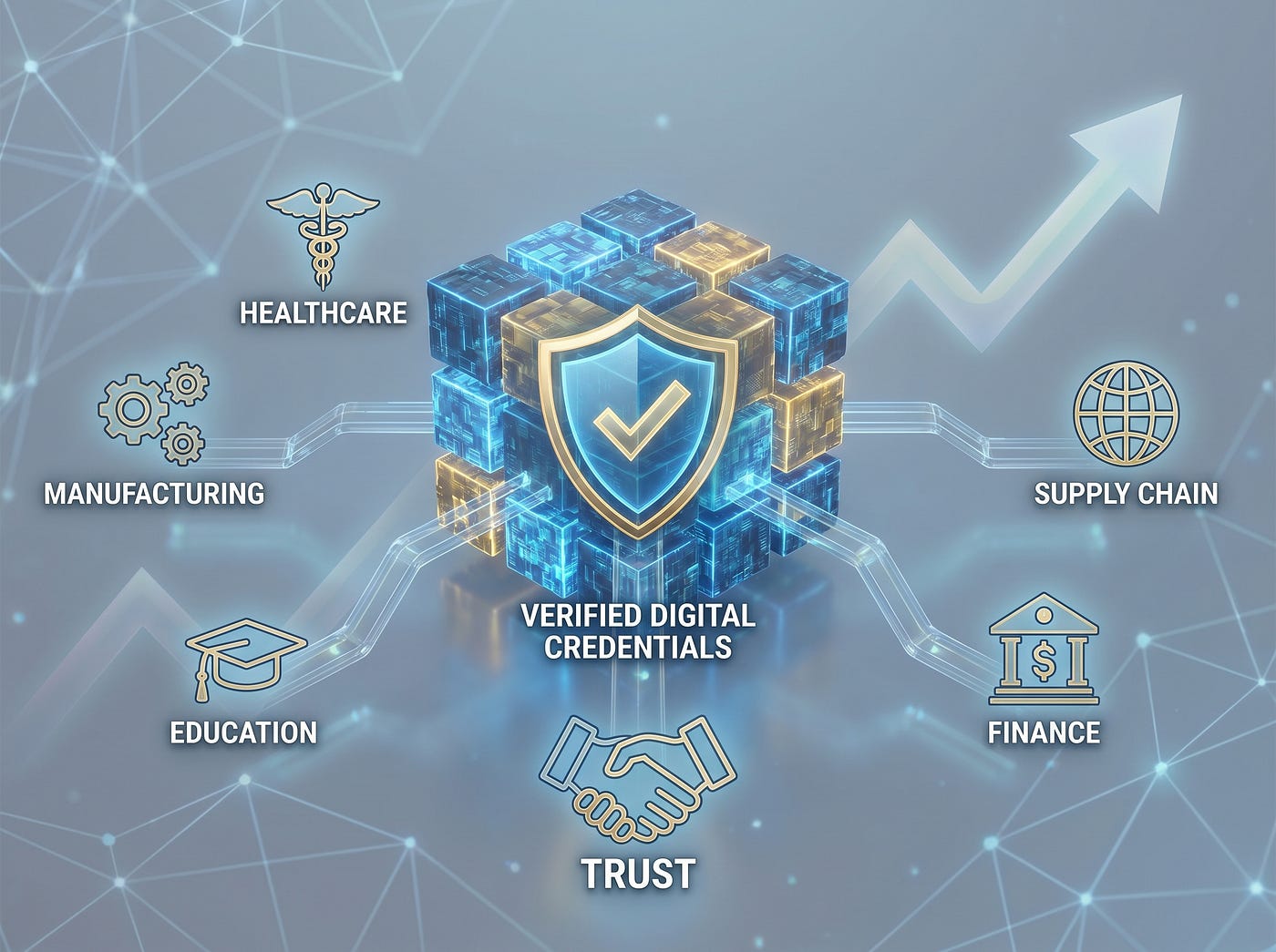
In education, universities are issuing blockchain credentials for academic certificates and degrees.
In finance, blockchain identity verification helps streamline Know Your Customer (KYC) processes while maintaining strong security standards.
The healthcare industry is also exploring blockchain identity solutions to securely manage patient records and medical credentials.
Governments around the world are also researching blockchain frameworks to build secure national digital identity systems.
Conclusion
As digital interactions continue to grow, the need for secure and reliable identity systems becomes increasingly important. Traditional systems struggle with security risks, inefficiencies, and lack of user control.
Blockchain technology offers a powerful alternative. Through blockchain identity solutions, digital credential platforms, and tamper-proof blockchain credentials, organizations can create trusted systems for issuing and verifying credentials.
The idea of proof in the chain represents a new model of trust, one where identity verification is secure, decentralized, and controlled by individuals.
As adoption continues to expand, blockchain may soon become the foundation of the future of digital identity worldwide.
메타데이터
- post_id
- 50c6cebf431a
- slug
- proof-in-the-chain-the-future-of-secure-digital-identity-and-credentials-50c6cebf431a
- url
- https://medium.com/@everycred/proof-in-the-chain-the-future-of-secure-digital-identity-and-credentials-50c6cebf431a
- canonical_url
- https://medium.com/@everycred/proof-in-the-chain-the-future-of-secure-digital-identity-and-credentials-50c6cebf431a
- author_url
- https://medium.com/@everycred
- status
- ok
- fetched_at
- 2026-06-23 17:05:31