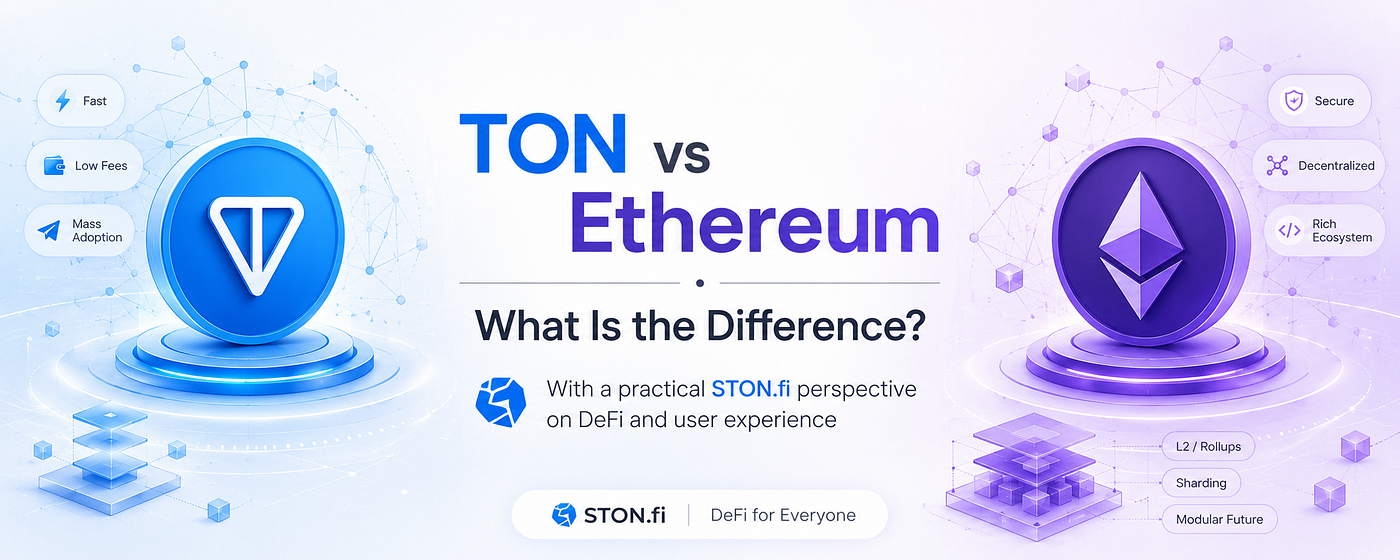
TON vs Ethereum: What Is the Difference?
TON and Ethereum both support smart contracts, tokens, and decentralized applications, but they were built around very different ideas…
TON vs Ethereum: What Is the Difference?
TON and Ethereum both support smart contracts, tokens, and decentralized applications, but they were built around very different ideas about how a blockchain should scale and how people should interact with it.
TON and Ethereum are both proof-of-stake layer 1 blockchains. They can transfer value, issue digital assets, run decentralized exchanges, support games, and execute programmable agreements.
That is where the simple similarities end.
Ethereum is the older and more established smart contract ecosystem. It has deep liquidity, mature development tools, and thousands of applications. Its main network prioritizes security and broad composability, while much of its everyday activity is moving to layer 2 rollups.
TON takes a different route. It was designed around dynamic sharding, asynchronous communication, fast finality, and consumer-facing applications that can work naturally inside Telegram. Instead of asking every contract to operate inside one shared sequence, TON allows different parts of the network to process activity in parallel.
The practical difference is not just technical. It changes what you pay, how quickly an action feels complete, what your wallet shows, how tokens work, and what happens after you press Confirm.
Key takeaways
- Ethereum uses the Ethereum Virtual Machine, while TON uses the TON Virtual Machine.
- Ethereum applications often combine several contract calls into one atomic transaction.
- TON applications communicate through asynchronous messages that can create a trace of several transactions.
- Ethereum increasingly scales through layer 2 rollups.
- TON scales its base layer through dynamic sharding.
- Ethereum fungible tokens generally follow ERC-20, while TON fungible tokens are called Jettons.
- Ethereum has a broader and more mature application ecosystem.
- TON focuses heavily on fast, low-friction mobile experiences and Telegram-native distribution.
- STON.fi is not a third blockchain. It is a decentralized exchange built on TON that makes TON’s architectural choices visible in a real DeFi workflow.
Start with the most important distinction

Ethereum and TON are networks. ETH and Gram are their native coins.
Ethereum is the blockchain, while ETH is the asset used to pay transaction fees, secure the network through staking, and transfer value.
TON is the blockchain. Its native coin was historically known as Toncoin, but a community vote renamed it Gram in June 2026. As of July 2026, official TON materials describe Gram as the native asset used for fees, validation, voting, and other network functions.
This distinction matters because people often compare “TON and ETH” as though they were the same type of thing. A more precise comparison is:
- TON versus Ethereum as blockchain networks
- Gram versus ETH as native assets
- STON.fi versus an Ethereum-based DEX as applications
Keeping those categories separate makes the rest of the comparison much easier to understand.
They solve similar problems in different ways

Both networks are programmable blockchains. Developers can deploy smart contracts that continue running according to their code without depending on a traditional company database.
On either network, a smart contract may power:
- a decentralized exchange
- a lending application
- a stablecoin
- a collectible or game item
- a payment system
- a governance mechanism
- an on-chain identity or ownership record
The networks disagree about how those contracts should communicate.
Ethereum behaves more like one large shared computer. Every node processes the same ordered state transitions. A transaction can call several contracts, move several assets, and update several balances before it finishes.
TON behaves more like a network of independent actors sending messages to one another. Each account has its own state, and contracts respond when messages arrive. An action involving several contracts can continue across multiple transactions and sometimes across multiple blocks.
Both approaches can produce a smooth application interface. Underneath that interface, however, they create very different execution paths.
Ethereum uses one shared execution environment

Ethereum smart contracts run inside the Ethereum Virtual Machine, usually shortened to EVM. The EVM provides a consistent set of rules for executing code across Ethereum nodes.
When you send a transaction to an Ethereum application, that transaction may trigger several internal contract calls. A token contract can approve spending, a router can choose a pool, a liquidity pool can calculate an exchange, and the output token can be sent back to your wallet.
These calls can occur as part of one atomic operation. Atomic means the required steps either complete together or the transaction reverts. You may still pay gas for a failed transaction because validators performed computational work, but the intended state changes are reversed.
This model helped Ethereum become highly composable. Developers often describe DeFi applications as money building blocks because one protocol can interact with another inside a single transaction.
The EVM has also become much larger than Ethereum itself. Many separate networks use EVM-compatible environments, allowing developers to reuse Solidity contracts, wallets, and tooling. Ethereum remains the original settlement network at the center of that broader ecosystem.
TON is built around messages and parallel activity
TON smart contracts run on the TON Virtual Machine, or TVM. Instead of making synchronous calls to other contracts and waiting for an immediate response, contracts communicate through messages.
Imagine that contract A needs contract B to do something. Contract A sends a message and completes its current transaction. Contract B receives that message later, processes it in a new transaction, and may send another message to contract C.
The complete sequence is called a trace.
A trace can include:
- the original request from a wallet
- a message to a token wallet
- a message to an application contract
- a response or asset transfer
- a refund or notification
- the final delivery to the recipient
TON documentation explains that one Ethereum transaction often corresponds to several TON transactions. Each TON transaction records a state change for one account after processing one message.
This design allows independent activity to be processed in parallel. It also means developers must think carefully about delayed messages, partial progress, bounced messages, refunds, and race conditions.
For the person using the application, the lesson is simpler: the first visible transaction may be only the beginning of the complete operation.
Scaling is the biggest architectural difference

Ethereum and TON both need to process more activity than a single basic blockchain can comfortably handle. Their scaling strategies are fundamentally different.
Ethereum scales through layers
Ethereum layer 1 acts as the main settlement and security foundation. Much of the actual user activity can take place on layer 2 networks.
A rollup processes transactions away from Ethereum mainnet, groups them together, and publishes relevant data or proofs back to layer 1. Ethereum documentation divides rollups mainly into two categories:
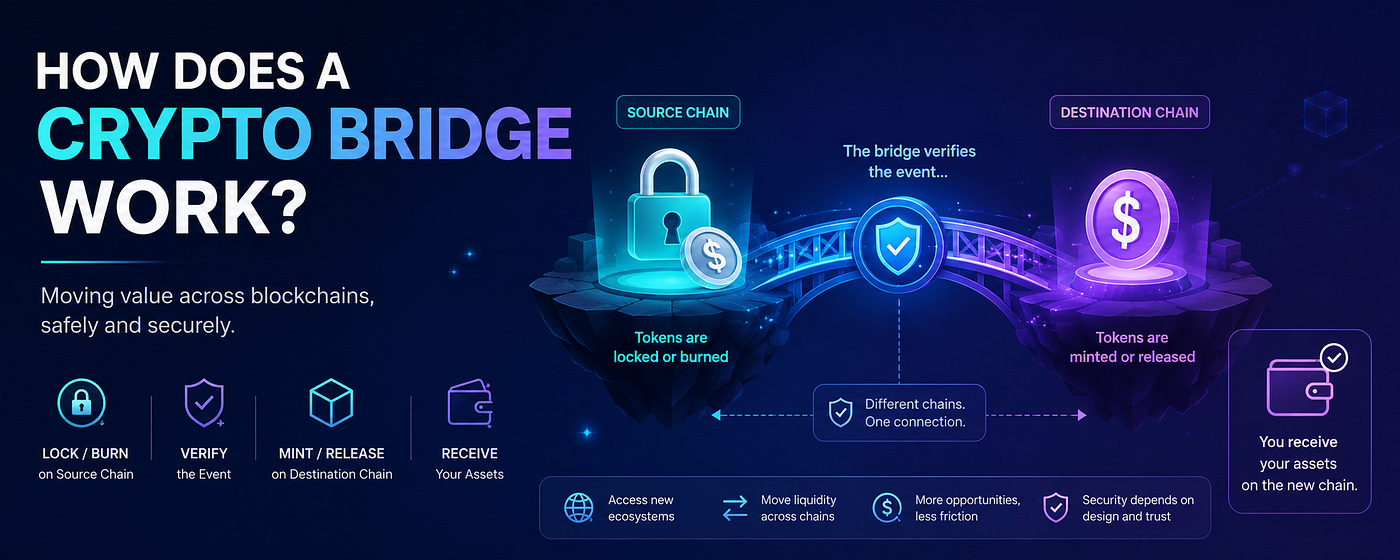
- Optimistic rollups assume transactions are valid unless someone successfully challenges them.
- Zero-knowledge rollups submit cryptographic proofs showing that their state updates are valid.
This approach allows users to access lower fees and greater capacity without placing every individual action directly on Ethereum mainnet.
The trade-off is fragmentation. A token on Ethereum mainnet is not automatically available in the same form on every layer 2. Users may need to choose a network, bridge assets, understand withdrawal rules, and find liquidity on the correct chain.
TON scales through dynamic sharding
TON was designed to divide its base network into shardchains. When activity rises, a shard can split. When demand falls, shards can merge again.
The number of shards is therefore not permanently fixed. It can adapt to current network load.
Each shard processes a portion of accounts and contracts. Because activity in different shards can be handled separately, the network does not require every transaction to pass through one execution lane. Messages allow contracts in different shards to communicate.
The user does not normally select a shard manually. The network handles that structure beneath the application.
A useful mental model is:
- Ethereum adds execution capacity above its base layer.
- TON divides execution capacity across its base layer.
That description simplifies many technical details, but it captures the main philosophical difference.
Which network is faster?

A simple speed ranking can be misleading because several different measurements are often mixed together:
- block production
- transaction inclusion
- economic finality
- application confirmation
- bridge settlement
- wallet and indexer updates
Ethereum produces slots at fixed 12-second intervals. Validators attest to blocks, while stronger economic finality develops through checkpoint voting across epochs. A wallet or application may display a transaction as confirmed before full protocol finality is reached.
TON’s current architecture uses Catchain 2.0 and is designed for sub-second block finality. Official TON materials published after the 2026 network upgrade report finality below one second under normal conditions.
That does not guarantee that every TON application updates instantly. A complex action may generate multiple messages, and an interface still needs to follow the entire trace. Slow indexing, polling, overloaded services, or wallet communication can make a fast blockchain feel slower.
Ethereum layer 2 networks can also confirm activity much faster and more cheaply than Ethereum mainnet. The exact experience depends on the rollup, sequencer, application, and withdrawal route.
The fairest conclusion is that TON is designed for fast base-layer interaction, while Ethereum combines a slower main settlement layer with faster execution environments above it.
How transaction fees differ
Both networks charge fees because computation, storage, and network communication consume resources.
Ethereum gas
Ethereum measures computational work in gas. The final fee depends on:
- how much gas the transaction uses
- the network’s base fee
- the priority fee offered to the validator
- the maximum fee selected by the sender
A simple ETH transfer uses less gas than a complex DeFi interaction. When demand for block space rises, the price of gas can increase. Layer 2 networks reduce the average cost by batching activity before publishing information to Ethereum.
TON fees
TON fees may include computation, storage, and the cost of forwarding messages. Because one action can trigger several messages, the wallet or application needs to attach enough Gram for the entire route.
Unused attached value can be returned, depending on the contract logic. If too little value is attached, later steps may not have enough funding to continue as intended.
For most users, the practical difference is visible in the wallet:
- Ethereum often presents a gas estimate for one top-level transaction.
- TON may reserve enough Gram for a sequence of internal messages.
- The amount reserved by a TON application may be higher than the amount ultimately consumed.
- A DEX trading fee is separate from the blockchain network fee.
Never spend your entire native coin balance. Keeping a small amount of ETH or Gram available prevents the common situation where tokens remain in a wallet but cannot be moved.
Tokens work differently

Ethereum’s most common fungible-token standard is ERC-20. An ERC-20 contract normally maintains balances, allowances, and transfers for all holders.
The allowance system is particularly important in Ethereum DeFi. Before a decentralized exchange can spend many ERC-20 tokens, the user first grants approval to a router or another contract. The actual swap may then require a second transaction.
Unlimited approvals are convenient, but they create additional risk. If an approved contract is compromised or behaves maliciously, the approval may expose more tokens than the user intended to trade.
TON uses Jettons, based on the TEP-74 standard. A Jetton consists of a master contract and separate Jetton wallet contracts associated with individual holders. A person’s Jetton wallet contract is distinct from the person’s main TON wallet address.
The two standards serve a similar purpose, but their internal structures are not interchangeable.

A token name or ticker is never enough to prove authenticity. Scam tokens can copy a familiar name on either network. Always verify the contract address through reliable project sources.
Wallets may look similar, but the experience is different
From the outside, both ecosystems follow a familiar pattern:
- Open an application.
- Connect a wallet.
- Review a request.
- Sign inside the wallet.
- Wait for confirmation.
Ethereum commonly uses browser extensions, mobile wallets, QR connections, and WalletConnect-compatible sessions. The same wallet may support Ethereum mainnet and many EVM networks, so checking the selected network is essential.
TON Connect is the standard connection protocol between TON wallets and applications. It can connect wallets to websites and Telegram Mini Apps while keeping signing inside the wallet. The connector transports the request, but it does not hold the private key or sign for the owner.
TON’s close relationship with Telegram gives developers a direct distribution channel for consumer applications. A person can discover a Mini App, connect a wallet, and perform an action without moving through a traditional desktop browser flow.
Convenience does not remove responsibility. Before signing on either network, check:
- the application domain or Mini App identity
- the selected network
- the asset contract
- the recipient
- the amount
- the minimum output
- the permissions being granted
A polished interface can still request a harmful transaction.
The developer experience is not interchangeable
Ethereum developers commonly write contracts in Solidity or Vyper and compile them for the EVM. The ecosystem includes mature testing frameworks, contract libraries, audit tools, infrastructure providers, and a large base of experienced developers.
TON development uses the TVM and an asynchronous contract model. Current TON documentation recommends Tolk for most new smart contract development, with the Acton toolchain supporting project creation, testing, deployment, and verification.
Moving an application from Ethereum to TON is therefore not a copy-and-paste exercise.
A developer must reconsider:
- how contracts exchange information
- how much value is attached to messages
- how failures are handled
- how refunds are returned
- how token wallets are verified
- how a full trace is monitored
- how the interface communicates intermediate states
The opposite is also true. A TON contract cannot simply be deployed on Ethereum because the EVM does not execute TVM bytecode or follow TON’s message model.
The application idea may be portable. The contract architecture usually is not.
Ecosystem size versus distribution
Ethereum’s greatest advantage is its established ecosystem.
It has a long history of decentralized exchanges, lending markets, stablecoins, derivatives, NFT infrastructure, developer libraries, security research, and institutional adoption. Assets and protocols can often interact with one another, creating deep composability and liquidity.
That maturity also creates complexity. Liquidity is spread across Ethereum mainnet and many layer 2 networks. Users must understand bridges, wrapped assets, token approvals, gas settings, and network switching.
TON’s application ecosystem is smaller, but its distribution model is unusual. Telegram Mini Apps can place blockchain services inside a familiar messaging environment. Payments, games, digital collectibles, trading interfaces, and community tools can reach users without requiring them to discover a separate Web3 website first.
Neither advantage automatically makes one network better.
Ethereum may be the stronger environment when an application depends on mature DeFi infrastructure, EVM compatibility, large pools of capital, or established developer tooling.
TON may be better suited to applications that prioritize fast consumer interactions, mobile-first design, payments, Mini Apps, and access through Telegram.
Common mistakes when comparing TON and Ethereum
Comparing TON only with Ethereum mainnet
Many Ethereum users now operate on layer 2 networks. Comparing TON fees only with Ethereum mainnet gas can exaggerate the practical difference.
Treating speed as the only useful metric
A fast network with weak liquidity may produce a worse trade than a slower network with deeper markets. Security, asset availability, wallet support, and application quality also matter.
Assuming the same ticker means the same asset
USDT, ETH, or another symbol may represent different contracts, wrapped assets, or bridged versions. Verify the network and contract.
Ignoring bridges
Moving value between independent networks introduces additional contracts, operators, or cryptographic systems. Bridge risk is separate from the security of either underlying blockchain.
Thinking a confirmed TON transaction means the whole action is finished
A TON action may continue through several asynchronous messages. Follow the full trace and check the final asset balance.
Which network should you use?
There is no universal winner. The better choice depends on what you need to do.
Ethereum may be preferable when:
- the application or asset exists only in the Ethereum ecosystem
- you need established DeFi liquidity
- you rely on EVM-compatible tools
- institutional or protocol infrastructure matters
- you are comfortable choosing among layer 2 networks
TON may be preferable when:
- the application is designed specifically for TON
- Telegram integration matters
- fast base-layer settlement is important
- the workflow is mobile-first
- the required Jettons and liquidity already exist on TON
- you want to avoid moving between several rollups
Before committing meaningful funds, test the complete workflow with a small amount. Include the deposit, application action, and withdrawal rather than evaluating only the first transaction.
TON, Ethereum, and STON.fi are not three competing blockchains

STON.fi belongs in this comparison, but not as a third network.
TON provides the blockchain infrastructure. It processes messages, maintains contract state, charges network fees in Gram, and finalizes transactions.
Ethereum provides a separate blockchain infrastructure. It processes EVM transactions, charges gas in ETH, and supports applications across mainnet and a large rollup ecosystem.
STON.fi is an application and protocol layer built on TON. It uses TON’s wallets, Jettons, smart contracts, message system, and settlement rules to let people exchange assets through decentralized liquidity.
The relationship can be summarized like this:

STON.fi does not replace TON. It gives people a practical reason to use TON.
In the same way, an Ethereum decentralized exchange does not replace Ethereum. It turns Ethereum’s general smart contract infrastructure into a specific financial service.
What a STON.fi swap reveals about TON
Consider a trader exchanging one Jetton for another on STON.fi.
From the interface, the process feels familiar:
- Connect a TON wallet.
- Choose the input and output assets.
- Enter the amount.
- Review the quote.
- Confirm the request in the wallet.
- Wait for the output asset.
That experience resembles a swap on an Ethereum DEX. The difference appears underneath.
STON.fi first calculates or simulates the route and produces values such as the offered amount, expected output, minimum acceptable output, token addresses, and router information. Its developer documentation advises integrations to reuse the simulation values when constructing the final transaction so the signed request matches the route that was quoted.
After the wallet sends the request, TON contracts exchange messages. The trader’s Jetton wallet, the STON.fi router, a liquidity pool, and the recipient’s Jetton wallet may each process part of the operation. Together, those transactions form the swap trace.
The interface turns that multi-contract message flow into one understandable action.
How the same idea commonly looks on Ethereum
On an Ethereum DEX, an ERC-20 swap often begins with an approval. The trader allows a router to spend a specific token amount, or grants a larger allowance for future use.
The swap transaction can then call the router, interact with one or more pools, update token balances, and return the output as one atomic transaction. If a required call fails, the transaction normally reverts.
On STON.fi, the flow follows TON’s asynchronous design. Instead of several synchronous calls inside one Ethereum transaction, the operation can become several linked TON transactions.
The result for the trader can be similar. The path to that result is not.
Fees in a STON.fi transaction
A STON.fi swap can include two separate cost categories:
- a DEX trading fee associated with the liquidity pool
- a TON blockchain fee paid in Gram for processing messages and computation
STON.fi documentation states that fees are configurable per pool. Its documented default model uses a total trading fee of 0.3 percent, with 0.2 percent directed to liquidity providers and 0.1 percent directed to the protocol. Individual pools can use different settings, so the current fee should be checked in the interface.
The trading fee is not the same as the network fee. A quote can be economically poor even when the blockchain fee is tiny. Thin liquidity, high price impact, or an unsuitable route may cost more than network execution.
Before confirming a STON.fi swap, review:
- the correct Jetton master addresses
- the expected output
- the minimum received
- the price impact
- the pool or route
- the trading fee
- the estimated network fee
- the final wallet request
What STON.fi adds on top of TON
TON provides the execution environment, but it does not automatically provide a market for every token. A decentralized exchange needs pools, routing logic, pricing formulas, interfaces, and liquidity providers.
STON.fi adds those application-level components.
Its liquidity pools hold assets that traders can exchange. Liquidity providers supply the assets and receive a share of applicable pool fees. The router directs a swap toward the relevant contracts, while the interface translates complex blockchain data into a quote that a person can review.
STON.fi also develops Omniston, a liquidity aggregation protocol that can query several available liquidity sources and select a route rather than limiting an integration to one individual pool or DEX source.
These features do not change TON’s underlying architecture. They operate within it.
A useful way to think about the relationship is:
- TON is the road system.
- Gram pays for using the roads.
- Jettons are assets moving through the system.
- TON Connect links the driver’s wallet to an application.
- STON.fi provides a marketplace and route for exchanging those assets.
Ethereum offers the same broad separation of responsibilities. Ethereum is the infrastructure, ETH pays for execution, ERC-20 tokens represent assets, and decentralized exchanges provide trading services.
The practical lesson from STON.fi
STON.fi makes the TON versus Ethereum comparison less abstract.
A swap on both networks may begin with the same intention: exchange token A for token B without sending funds to a centralized exchange.
Ethereum usually expresses that intention through an atomic EVM transaction, sometimes preceded by an ERC-20 approval. TON expresses it through asynchronous messages and a trace of account-level transactions. STON.fi packages that trace into a user-facing swap.
To compare the networks fairly, do not stop at block speed or headline fees. Make a small transaction on each, inspect what the wallet asks you to sign, follow the on-chain record, and calculate the final amount received.
That exercise reveals the real difference: Ethereum and TON can deliver similar applications, but the machinery beneath them follows two distinct philosophies.
Frequently Asked Questions
Is TON better than Ethereum?
Neither network is better for every situation. Ethereum offers a larger ecosystem, deeper liquidity, mature developer tools, and broad EVM compatibility. TON offers fast base-layer settlement, dynamic sharding, low-friction mobile workflows, and close integration with Telegram. The right choice depends on the application, asset, liquidity, security requirements, and complete cost of the workflow.
Is TON an Ethereum layer 2?
No. TON is an independent layer 1 blockchain with its own validators, consensus mechanism, virtual machine, accounts, token standards, and native coin. Ethereum layer 2 networks publish transaction data, commitments, or proofs back to Ethereum. TON does not rely on Ethereum to validate ordinary TON transactions.
Is TON EVM-compatible?
TON does not use the EVM as its native smart contract environment. It uses the TVM and a different asynchronous execution model. An Ethereum Solidity contract cannot be deployed directly to TON without being redesigned and compiled for TON’s environment. Some concepts can be recreated, but the contract architecture and communication flow usually need substantial changes.
What happened to Toncoin?
The native coin historically known as Toncoin was officially renamed Gram after a community vote completed in 2026. The blockchain continues to be called TON, or The Open Network. Gram is used for transaction fees, staking, validation, and other native network functions. Older applications and articles may still use the previous name.
What is the TON equivalent of an ERC-20 token?
A Jetton is TON’s standard form of fungible token. Jettons and ERC-20 tokens serve similar purposes, but their contract structures differ. An ERC-20 contract normally tracks balances and allowances centrally. A Jetton uses a master contract plus separate Jetton wallet contracts associated with holders.
Does TON have gas fees?
Yes. TON charges network fees for computation, storage, and message forwarding. The fee model differs from Ethereum gas because a TON operation may send several messages between contracts. Applications often attach enough Gram to fund the complete trace, with unused value potentially returned according to contract logic.
Why can a TON swap contain several transactions?
TON contracts communicate asynchronously. Each contract processes an incoming message in its own transaction and may send additional messages. A swap involving a wallet, Jetton contracts, router, pool, and recipient can therefore create a sequence of linked transactions called a trace.
Is STON.fi a blockchain?
No. STON.fi is a decentralized exchange and liquidity protocol built on TON. It relies on TON for smart contract execution, transaction settlement, Jetton transfers, and network security. A closer Ethereum comparison would be between STON.fi and an Ethereum-based DEX, not between STON.fi and Ethereum itself.
Does STON.fi hold the trader’s assets?
A standard STON.fi swap is initiated from the trader’s connected wallet and authorized through a wallet signature. The exchange is executed through smart contracts rather than through a traditional custodial exchange account. Self-custody does not remove risk, so the trader must still verify the application, tokens, quote, price impact, and signing request.
How can I compare a STON.fi swap with an Ethereum DEX swap?
Use small amounts and perform similar trades with established assets. Record the approval requirements, network fee, trading fee, price impact, minimum received, confirmation behavior, and final output. Inspect the Ethereum transaction and the complete TON trace. This gives a more meaningful comparison than looking only at advertised transaction speed.
Sources and Further Reading
TON Docs, Start here — Introduces TON accounts, traces, asynchronous execution, sharding, and development languages: https://docs.ton.org/start-here
TON Docs, Coming from Ethereum — Compares Ethereum’s atomic execution with TON’s asynchronous message model: https://docs.ton.org/from-ethereum
TON Docs, Blockchain sharding — Explains TON’s dynamic shard splitting and merging: https://docs.ton.org/foundations/shards
TON Docs, Jetton standard — Describes TEP-74 fungible tokens and Jetton contract architecture: https://docs.ton.org/contracts/standard/tokens/jettons/overview
TON Docs, TON Connect overview — Explains the standard protocol connecting TON wallets and applications: https://docs.ton.org/applications/ton-connect/overview
TON official website — Provides the current description of TON, Gram, Catchain 2.0, and Telegram integration: https://ton.org
Ethereum.org, Ethereum Virtual Machine — Explains the shared execution environment used by Ethereum smart contracts: https://ethereum.org/developers/docs/evm/
Ethereum.org, Proof-of-stake — Covers validators, slots, epochs, attestations, and Ethereum consensus: https://ethereum.org/developers/docs/consensus-mechanisms/pos/
Ethereum.org, Scaling — Explains layer 2 networks, optimistic rollups, and zero-knowledge rollups: https://ethereum.org/developers/docs/scaling/
Ethereum.org, Gas and fees — Explains how Ethereum calculates transaction costs: https://ethereum.org/developers/docs/gas/
Ethereum.org, ERC-20 token standard — Defines Ethereum’s main fungible-token interface: https://ethereum.org/developers/docs/standards/tokens/erc-20/
STON.fi Developer Docs, Swap v2 — Describes swap simulation, routing data, and transaction construction: https://docs.ston.fi/developer-section/dex/sdk/v2/swap
STON.fi Developer Docs, Fees — Documents configurable pool fees and the current default fee model: https://docs.ston.fi/developer-section/dex/fees
STON.fi Developer Docs, Omniston overview — Explains liquidity aggregation and swap routing across TON liquidity sources: https://docs.ston.fi/developer-section/omniston/overview
STON.fi Ultimate Guide, How to swap — Provides the practical wallet connection and token exchange flow: https://guide.ston.fi/swapping-on-ston.fi/how-to-swap-exchange-tokens-on-ston.fi
메타데이터
- post_id
- 50cbfe780189
- slug
- ton-vs-ethereum-what-is-the-difference-50cbfe780189
- url
- https://medium.com/@ivan.zimanov/ton-vs-ethereum-what-is-the-difference-50cbfe780189
- canonical_url
- https://medium.com/@ivan.zimanov/ton-vs-ethereum-what-is-the-difference-50cbfe780189
- author_url
- https://medium.com/@ivan.zimanov
- status
- ok
- fetched_at
- 2026-07-14 11:25:43