A Data-Driven Perspective on the Disappearance of MH370
By: Prisha Chhabra (Originally published on my personal notion site —…
A Data-Driven Perspective on the Disappearance of MH370
By: Prisha Chhabra (Originally published on my personal notion site — https://www.notion.so/A-Data-Driven-Perspective-on-the-Disappearance-of-MH370-2fd008b2ac6c80099945d089ab44f6ca?source=copy_link)
Prisha Chhabra presents a data-driven analysis of Malaysia Airlines Flight MH370. Drawing on radar, satellite, and oceanographic data, this work outlines an evidence-based scenario for the aircraft’s disappearance, demonstrating how careful observation, physical reasoning, and uncertainty-aware modeling can shed light on one of aviation’s most enduring mysteries.
Flight Deviation and Communication Loss
Early in the flight, radar data suggest that the aircraft deviated from its planned route while onboard systems were operating normally. Shortly afterward, all external communications — including the transponder and radio transmissions — ceased. This pattern indicates that human control may have been limited during a significant portion of the flight, rather than there being sustained manual intervention or prolonged cabin conflict.
Autopilot Flight and Fuel Exhaustion
Satellite tracking shows the aircraft continued flying for several hours in a stable manner, consistent with autopilot operation. Fuel endurance likely governed the trajectory toward a remote region of the southern Indian Ocean. As fuel was depleted, engine thrust would decrease, potentially resulting in a glide-like descent before ocean impact. This scenario aligns with the gradual breakup of the airframe and the limited quantity of debris recovered.
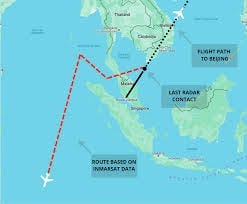
Black dotted line=planned MH370 flight path, Red dotted line=Assumed path based on satellite pings.
Ocean Currents and Debris Dispersal The disappearance occurred during a period of strong southern Indian Ocean circulation. Debris released at or near the impact site would have been influenced by the South Indian Ocean gyre and the South Equatorial Current. Over time, interaction with the Agulhas Current along the African coast may have contributed to debris reaching shores such as Réunion Island, Madagascar, and parts of mainland Africa.
Conclusion
While the main wreckage has not been located, this sequence — flight deviation, limited human control, prolonged autopilot operation, fuel exhaustion, glide-like ocean impact, and debris dispersal via known currents — offers a physically consistent and evidence-aligned explanation for the disappearance of MH370. This analysis demonstrates how careful, scientific reasoning can provide insight into one of aviation’s most puzzling mysteries.
References
Malaysia Airlines Flight MH370 — Official Press Releases, Malaysian Government.
Australian Transport Safety Bureau (ATSB) MH370 Investigation Reports.
Satellite Data and Ocean Current Studies — NOAA & CSIRO Oceanography Publications.
Peer-reviewed analysis of Southern Indian Ocean debris drift patterns (e.g., ScienceDirect, 2016–2020).
메타데이터
- post_id
- 50d369aaf89c
- slug
- a-data-driven-perspective-on-the-disappearance-of-mh370-50d369aaf89c
- url
- https://medium.com/@prishachhabra.official/a-data-driven-perspective-on-the-disappearance-of-mh370-50d369aaf89c
- canonical_url
- https://medium.com/@prishachhabra.official/a-data-driven-perspective-on-the-disappearance-of-mh370-50d369aaf89c
- author_url
- https://medium.com/@prishachhabra.official
- status
- ok
- fetched_at
- 2026-06-26 03:39:16