OKR Cost of Delay: Why Waiting to Implement OKRs is a Strategic Risk
A worked example of OKR Cost of Delay impact for a realistic scenario
OKR Cost of Delay: Why Waiting to Implement OKRs is a Strategic Risk
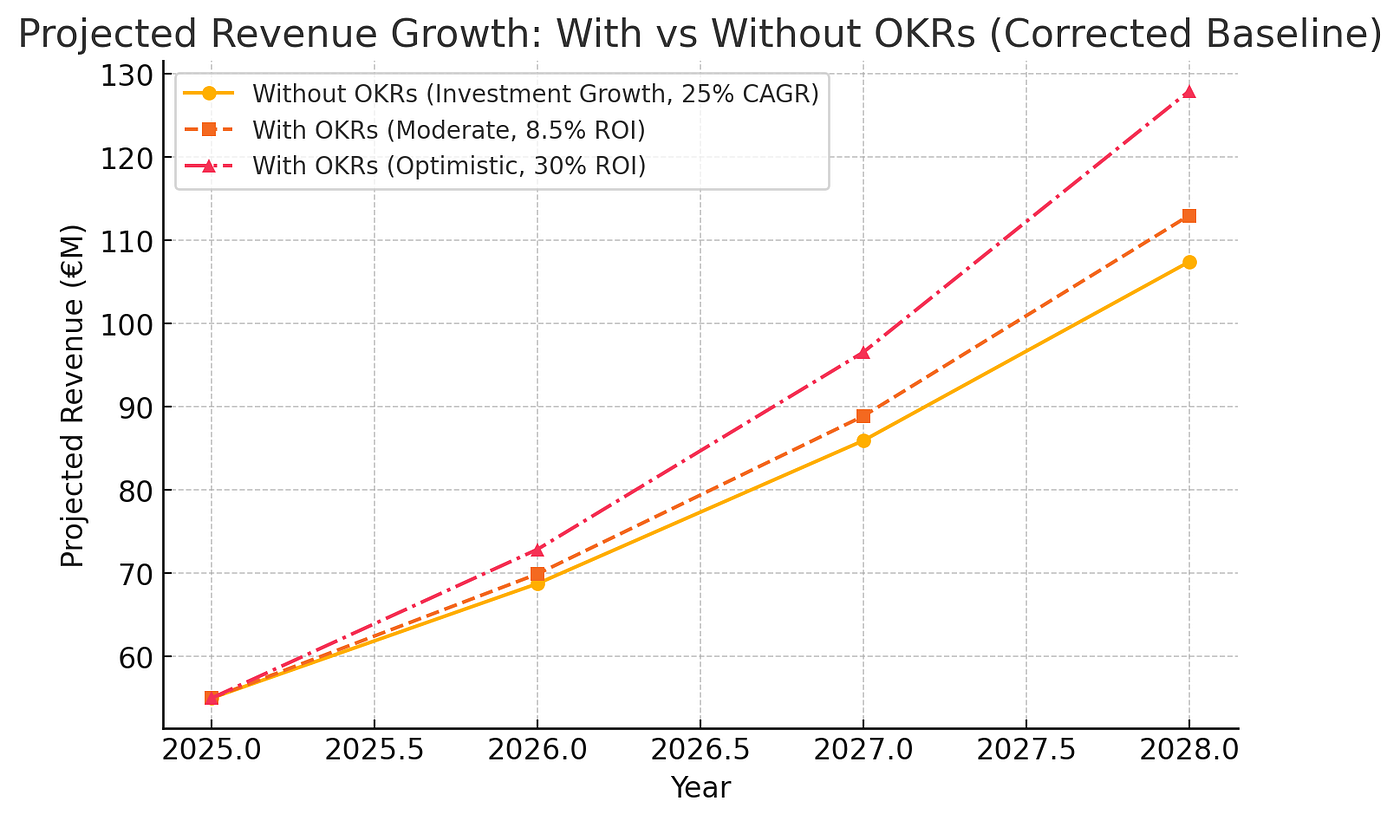
A worked example of OKR Cost of Delay impact for a realistic scenario
1. Introduction
In the fast-paced world of business, execution is everything. Companies that fail to align their teams with clear, strategic goals risk falling behind competitors, missing revenue targets, and losing market opportunities.
One of the most significant but often overlooked risks is the Cost of Delay (CoD) — the financial and operational losses incurred by not implementing critical initiatives on time. This story follows the leadership team of a fast-growing technology company debating the ROI of OKR implementation, inspired by real-world data (sources) where execution speed defines success.
2. The Leadership Debate: To Implement OKRs or Not?
The company had just secured a major private equity investment. With an ambitious growth plan, the leadership team sat in a boardroom, reviewing their strategic roadmap.
The Case Against Immediate OKR Implementation:
The VP of Sales crossed his arms. “I see the value, but is it worth the time investment? We have aggressive hiring goals, new market entries — how do we ensure OKRs don’t slow us down?”
The Head of HR added, “Introducing a new framework takes time and effort. We need buy-in from every department. If we rush this, we could end up with resistance rather than alignment.”
The Case for OKRs:
The Chief Operating Officer leaned forward. “OKRs provide the execution discipline we need. Without them, teams will stay busy but not necessarily on what matters most. Our strategy is solid, but if it’s not translated into measurable goals, execution will lag.”
The Chief Strategy Officer responded. “It’s not a question of if we implement OKRs, but when. Every quarter we delay is a quarter of misaligned execution. The data shows that companies implementing OKRs see an 8.5% revenue uplift based on case studies like Sears, with some industry examples suggesting up to 30% efficiency gains. If we delay, we risk leaving up to €20M on the table.”
The Chief of Staff’s Perspective: The Chief of Staff, who had been quietly listening, finally spoke up. “I see both sides of this argument. The reality is that we have an investment that demands results. Our investors expect not just growth but predictable, scalable execution. Without OKRs, we’re relying on gut instincts and fragmented efforts. We need a structured framework to ensure that every department is working toward the same north star.”
The CEO nodded. “Our investors expect us to scale aggressively. How do we ensure we don’t just burn through capital but actually execute effectively?”
The CFO tapped on the table. “If we break this down, the cost of delay is staggering. Based on our corrected revenue projections, every month we delay OKR implementation, we could be losing anywhere between €0.1M to €0.34M, in unrealized revenue.”
The CEO raised an eyebrow. “So that means a six-month delay could cost us anywhere from €0.6M to €2.1M?”
The CFO nodded. “Exactly. And these losses are compounding. The longer we wait, the harder it is to recover the lost momentum.”
The COO added: “With these OKRs in place, we can align teams, measure progress in real time, and drive execution discipline. Without them, priorities will drift.”
The Chief of Staff nodded. “More importantly, OKRs create a culture of ownership. Each department will not only understand their role in the strategy but also feel accountable for delivering on it. This shifts the company from reacting to problems to proactively driving results.”
The Chief Strategy Officer added: “The OKR framework provides visibility — teams will know exactly how their work contributes to these objectives, which ensures accountability and faster course correction.”
The Chief Operating Officer leaned forward. “OKRs provide the execution discipline we need. Without them, teams will stay busy but not necessarily on what matters most. Our strategy is solid, but if it’s not translated into measurable goals, execution will lag.”
3. Resolution: The OKRs That Drive Growth
The CEO turned to the team. “So we agree: without OKRs, we’re at risk of misalignment and slower execution. What OKRs should we focus on to mitigate that risk?”
4. Company-Wide OKRs Defined:
Objective: Expand Market Presence Across Key European Regions
- KR1: Launch in 2 new countries within the next 12 months.
- KR2: Increase market share by 15% in existing regions.
- KR3: Secure 3 strategic partnerships with local healthcare providers.
Objective: Improve Operational Efficiency to Support Scaling
- KR1: Automate 50% of manual finance processes.
- KR2: Reduce operational costs by 15%.
- KR3: Improve EBITDA margin from 25% to 30%.
Objective: Increase Customer Retention & Satisfaction
- KR1: Improve Net Promoter Score (NPS) from 75 to 85.
- KR2: Reduce customer churn from 15% to 10%.
- KR3: Achieve a customer satisfaction (CSAT) score of 90%+.
5. Results & Conclusion: Every Month of Delay is a Lost Opportunity
The CEO leaned back. “Alright, let’s get this rolling. We can’t afford to leave growth on the table.”
As the meeting concluded, the leadership team aligned on the immediate next steps — launching the OKR framework with quarterly reviews and tracking execution across teams.
The evidence was clear: organizations that delay OKR implementation risk millions in unrealized growth and slower execution of strategic goals. While investment and ambition set the stage for success, structured execution through OKRs ensures that strategic priorities are achieved on time and with maximum efficiency.
For any company considering when to implement OKRs, the answer is simple — the longer you wait, the more it costs.
🚀 To book a free consultation call with me please click on the link
메타데이터
- post_id
- 50d4347fc74a
- slug
- the-cost-of-delay-why-waiting-to-implement-okrs-is-a-strategic-risk-50d4347fc74a
- url
- https://medium.com/@FredPernet/the-cost-of-delay-why-waiting-to-implement-okrs-is-a-strategic-risk-50d4347fc74a
- canonical_url
- https://medium.com/@FredPernet/the-cost-of-delay-why-waiting-to-implement-okrs-is-a-strategic-risk-50d4347fc74a
- author_url
- https://medium.com/@FredPernet
- status
- ok
- fetched_at
- 2026-06-09 15:37:30