Rewriting the Code of Life: Prime Editing’s Breakthrough Approach
Every living organism is shaped by its genes.But what if I told you there was a way to essentially hack your genes?
Rewriting the Code of Life: Prime Editing’s Breakthrough Approach
Photo by Braňo on Unsplash
Every living organism is shaped by its genes. These genes are made up of deoxyribonucleic acid, or DNA.
From the smallest creature to a very large whale, DNA guides the growth, function, development, and reproduction of every living thing. When another living organism reproduces, part of its DNA gets passed on to its offspring, ensuring continuity. Therefore, you most likely have certain inherited traits from your parents through your genes.
But what if I told you there was a way to essentially hack your genes? Say you got a particular trait from a parent you don’t like, you can basically change it. Yes, welcome to the field of gene editing.
Gene editing has been a revolutionizing technology in the biotechnology field. It is a form of technology that enables scientists to change an organism’s DNA. But there is an extra interesting aspect to gene editing. Prime Editing.
What is Prime Editing?
Prime Editing is a ‘search and replace’ technique that allows for greater precision with less negative effects on editing genes. It can perform targeted small insertions, deletions, and base swaps in a precise way.
Simply put, Prime Editing can be used to edit specific parts of our DNA, causing less damage. Remember the find and replace function on Google Docs, where you search for a particular word and write out the word you want to replace it with, without changing the document’s setting? Prime editing does the same by searching for the mutated gene and replacing it.
Technical Deep Dive
The Prime Editing Guide, also known as pegRNA, and the Cas9 Nickase enzyme are the two main components of prime editing. The pegRNA searches and finds the mutated DNA, and guides the Cas9 enzyme toward the specific DNA sequence to be edited. Then, it cuts a strand of DNA, creating a flap. The Cas9 Nickase enzyme has the ability to nick and not cleave, and this makes all the difference to prime editing. Nicking allows it to only cut one strand of DNA instead of 2 which reduces the possibility of damage.
Nicking also exposes the DNA sequence for editing. After the edit has been completed, the cell’s natural DNA repair machinery completes the process by sealing the gaps and joining the edited DNA strands.
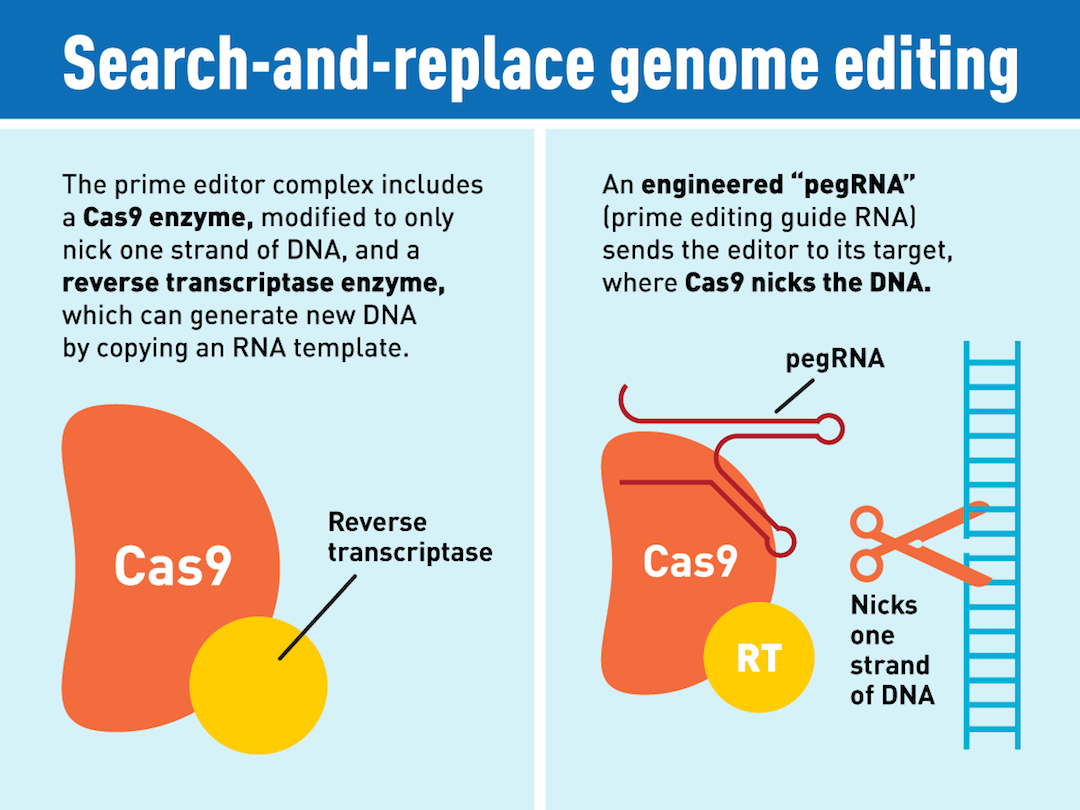
Prime Editing Infographic
Progress of Prime Editing
Prime Editing was first applied in mammalian cells and it could correct up to 89% of known gene variants related to human diseases.[1]
Additionally, a derivative system of Prime Editing, PPE has been successfully applied in editing the gene of rice and wheat respectively.[2] There is currently a lot of work going on in using and improving Prime Editing.
Companies, like Prime Medicine, have also started to take advantage of Prime Editing in addressing genetic diseases. According to the company, “We envision a world where this approach can change the course of how disease is treated to provide potentially lifelong benefit to patients and shape the future of gene editing.”
This is just one of the many biotech companies that are looking to leverage the power of prime editing in solving problems in genetic medicine.
Applications of Prime Editing
With more development and improvement, Prime Editing would shape the future of genes and help solve problems. These are some of the ways Prime Editing can be applied.
- Curing Genetic Diseases
Before the advent of gene editing technologies, the treatment of genetic diseases was limited. They often included gene therapy and supportive care which weren’t really direct, efficient, and effective.
However, with prime editing, problematic DNA sequences can be directly edited and corrected with reduced risks of unintended changes in the DNA. This would significantly improve the treatment of genetic diseases.
- Agricultural Advancement
Prime Editing allows for specific modification of crop genomes which could be used to introduce beneficial traits to crops. Traits such as disease resistance, improved yield, and environmental tolerance. This would help to promote beneficial traits in crops in a much faster and easier way, improving the quality of production.
- Gene Drive
Gene drives are genetic systems designed to quickly spread specific genes through populations. They have the potential to manage or eliminate disease-carrying organisms. Prime editing could be used to create more precise and controlled gene drive systems, allowing for targeted modifications that reduce the impact on non-target species and ecosystems.
Limitations of Prime Editing
It’s easy to get carried away with all the wonderful opportunities that Prime Editing presents to genome and gene editing. I mean you can literally edit your genes! However, Prime Editing has its limitation in relation to gene editing.
One major limitation of Prime Editing is its low editing efficiency[3]. This means that the success rate of making changes to the genome using prime editing is low so it may take multiple attempts to successfully edit a DNA sequence. Additionally, prime editing can sometimes introduce unintended mutations into the DNA.
Ethics of Prime Editing
Prime Editing also sparks ethical concerns about the future of its usage as a gene-editing tool.
One concern is that prime editing could be used to create designer babies, or children who have been genetically modified to have certain traits, such as intelligence or athleticism. Another concern is that prime editing could be used to create super soldiers or other weapons of war.
With development and refinement, Prime Editing could prove to be a valuable tool in improving the approach to gene editing. Overall, this technology has a lot of potential and I am excited to witness its growth in the coming years.
Citations
[1] Anzalone, A. V., Randolph, P. B., Davis, J. R., Sousa, A. A., Koblan, L. W., Levy, J. M., Chen, P. J., Wilson, C., Newby, G. A., Raguram, A., & Liu, D. R. (2019). Search-and-replace genome editing without double-strand breaks or donor DNA. Nature, 576(7785), 149–157. https://doi.org/10.1038/s41586-019-1711-4
[2]Lin, Q., Zong, Y., Xue, C., Wang, S., Jin, S., Zhu, Z., Wang, Y., Anzalone, A. V., Raguram, A., Doman, J. L., Liu, D. R., & Gao, C. (2020). Prime genome editing in rice and wheat. Nature Biotechnology, 38(5), 582–585. https://doi.org/10.1038/s41587-020-0455-x
[3]Zhao, Z., Shang, P., Mohanraju, P., & Geijsen, N. (2023). Prime editing: Advances and therapeutic applications. Trends in Biotechnology. https://doi.org/10.1016/j.tibtech.2023.03.004
메타데이터
- post_id
- 50d4d6d6e90a
- slug
- rewriting-the-code-of-life-prime-editings-breakthrough-approach-50d4d6d6e90a
- url
- https://medium.com/@treasuremayowa/rewriting-the-code-of-life-prime-editings-breakthrough-approach-50d4d6d6e90a
- canonical_url
- https://medium.com/@treasuremayowa/rewriting-the-code-of-life-prime-editings-breakthrough-approach-50d4d6d6e90a
- author_url
- https://medium.com/@treasuremayowa
- status
- ok
- fetched_at
- 2026-06-09 15:37:30