The Quiet Billionaire: How John Deacon Outsmarted the Music Industry
The bass player nobody talks about built the financial engine that made Queen one of the wealthiest acts in rock history — and then walked…
The Quiet Billionaire: How John Deacon Outsmarted the Music Industry
The bass player nobody talks about built the financial engine that made Queen one of the wealthiest acts in rock history — and then walked away.
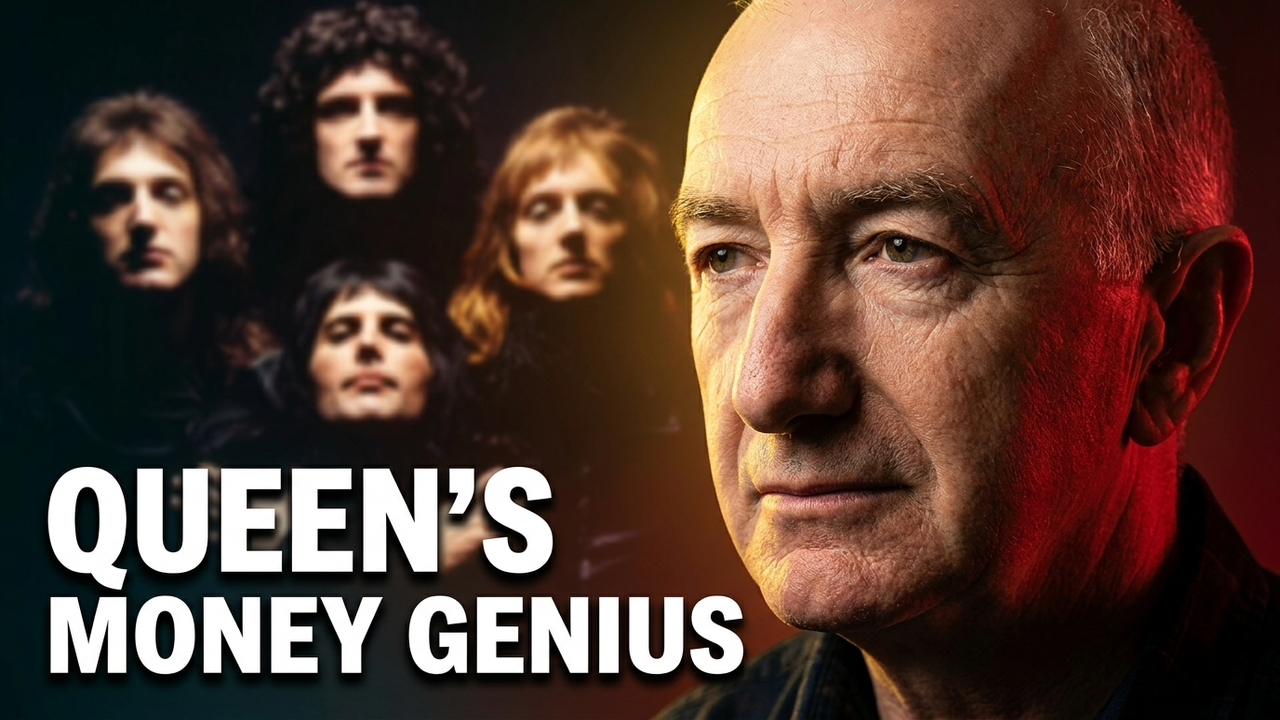
Watch the full video >> https://youtu.be/uho-mJe9FS4?si=gf6dtCPIRbBC09uq
John Deacon wrote Queen’s biggest-selling single in the United States. He sold over seven million copies of one song. He walked away from the band in 1997, hasn’t given a public interview in nearly three decades, and today is worth an estimated £130 million.
Not Freddie Mercury. Not Brian May. The bass player.
While the world remembers Freddie’s voice and Brian’s guitar, it was Deacon — the youngest member, the quiet one in the back — who read every contract, sat in every lawyer’s meeting, and quietly built the financial machine that would pay out long after the concerts stopped. This is the story of how John Deacon outsmarted everyone in rock and roll.
The Making of a Mathematical Mind
John Richard Deacon was born on August 19, 1951, in Leicester, England. His father worked in insurance. His mother was a homemaker. By all accounts, it was a quiet, studious childhood — until 1962, when his father died suddenly of a heart attack. John was eleven years old.
People who knew the family say that loss shaped everything: how he handled money, how carefully he trusted people, how fiercely he guarded his private life for the rest of his career.
He was a brilliant student. He attended Beauchamp Grammar School in Oadby and walked away with eight O-Levels and three A-Levels in physics, mathematics, and applied mathematics — all at grade A. In 1969, he enrolled at Chelsea College in London to study electronics, and in 1971 he graduated with first-class honours in electronic engineering.
Most rock documentaries skip over this detail. They shouldn’t. A first-class degree in electronics from a University of London college, earned while the rest of rock and roll was busy being rock and roll. It tells you everything about how John Deacon approached his career.
As one piece of evidence: the “Deacy Amp.” During his student years, Deacon built a small guitar amplifier from spare parts he reportedly scavenged around London. It was a modest, homemade unit — and Brian May ended up using it on nearly every Queen album for the next two decades. The warm, orchestral guitar tones on Bohemian Rhapsody, the layered sound on Killer Queen — much of that came from a circuit board John Deacon soldered together himself.
The Audition Nobody Remembers
Queen had gone through several bass players by early 1971 without finding the right fit. A mutual friend introduced Brian May and Roger Taylor to Deacon at a disco, and a few days later he auditioned in a lecture room at Imperial College London.
The audition was, by all accounts, quiet. He didn’t perform. He played. He listened. Brian May has said in interviews that what convinced them was precisely that quality — calm, technically excellent, and clearly not trying to outshine anyone. In a band that already had Freddie Mercury, that was exactly what they needed.
He officially joined in February 1971. The classic Queen lineup was complete.
The Disaster Contracts — and the Break That Changed Everything
For the first few years, Deacon was happy to let the others occupy the spotlight. He wore plain shirts while Freddie wore leotards. He stood still while the others moved. In interviews, he let his bandmates do the talking.
But behind that quiet exterior, he was paying close attention.
On November 1, 1972, Queen signed with Trident Studios — a management and production deal run by brothers Norman and Barry Sheffield. Under the agreement, each member received a weekly wage reportedly between £20 and £60, while Trident took a cut of records, publishing, and management. By 1975, after Killer Queen and three successful albums, Queen were technically famous and practically broke. Freddie couldn’t afford a decent piano. Brian May was living in a bedsit in Earls Court.
The breaking point came from something small and personal. Deacon, newly married to Veronica Tetzlaff in January 1975, asked Trident for a £4,000 cash advance to put a deposit on a house. They refused.
That refusal ended the relationship.
Queen hired a lawyer named Jim Beach and fought their way out of the Trident deal — a bitter, months-long process that so enraged Freddie Mercury he channelled it into Death on Two Legs, a song so pointed that Norman Sheffield sued the band for defamation. It settled out of court. In August 1975, Queen signed with manager John Reid, and by all accounts Deacon was in those meetings, reading every line and asking about every percentage.
The Songwriting Strategy That Built a Fortune
“You’re My Best Friend” and the Royalty Revelation
In the music industry, the person who writes a song collects royalties every time it plays — on radio, in films, in commercials, in supermarkets, in sports arenas. Freddie and Brian understood this. John Deacon, with a mathematician’s precision, understood it on an entirely different level.
He began focusing not just on writing songs, but on writing songs built to live on commercial radio for decades. Simple themes. Universal appeal. Tracks that could be licensed and re-licensed indefinitely.
His first major hit arrived in 1975. He wrote “You’re My Best Friend” for his wife Veronica, playing it on a Wurlitzer electric piano — an instrument Freddie reportedly dismissed as “tiny and horrible.” Since Freddie refused to touch it, Deacon played it himself. The song reached number seven in the UK and number sixteen on the Billboard Hot 100. It was later certified platinum in America and has remained one of the most-played Queen songs on adult contemporary radio for fifty years.
“Another One Bites the Dust” — Seven Million Copies, One Writer
In 1980, Deacon wrote “Another One Bites the Dust.” He was a devoted fan of the Chic disco sound, particularly bassist Bernard Edwards, and he wanted to pull that rhythm into rock. Freddie loved it immediately. Brian and Roger were skeptical — Roger Taylor later admitted the band were initially reluctant to release it as a single at all.
It took Michael Jackson to change their minds. Backstage at a Queen show at the Los Angeles Forum, Jackson and his brothers reportedly told them it was a fantastic track that had to come out. They released it. It hit number one on the Billboard Hot 100 on October 4, 1980, stayed there for three weeks, spent thirty-one weeks on the chart overall — more than any other song that year — and sold over seven million copies worldwide.
It is the biggest-selling single of Queen’s entire career in the United States. John Deacon wrote it entirely. He played bass, lead and rhythm guitar, piano, and handclaps on the recording. Roger Taylor added a drum loop. Brian May contributed some sound effects. That’s it. Every stadium play, every film placement, every commercial sync, every stream — those royalties flow to one songwriter.
In 2021, “Another One Bites the Dust” passed one billion streams on Spotify alone.
The Catalogue That Keeps Compounding
- “You’re My Best Friend” (1975) — platinum in the US, perennial radio presence
- “Another One Bites the Dust” (1980) — Queen’s best-selling US single, over a billion Spotify streams
- “I Want to Break Free” (1984) — global hit, one of the most-licensed songs in the catalogue
- “Spread Your Wings” (1978) — a fan favourite with consistent long-tail streaming
- “Under Pressure” (1981) — co-written with David Bowie, credited to all five writers
Each of these generates income every time it’s played, licensed, streamed, or sampled. Across decades and hundreds of millions of plays, the compounding effect is staggering.
Building the Business Architecture
“We don’t undertake anything financial without talking to him. He still keeps an eye on the finances. John Deacon is still John Deacon.” — Brian May
The Trident experience left a permanent mark on the band’s business thinking. In the years after the split, Queen formed companies to control their songs, their recordings, their likenesses, and their merchandise. Most bands of that era had signed these rights away to their labels. Queen did not.
According to Brian May, Deacon was the member most focused on getting these ownership structures right. He worked closely with Jim Beach on nearly every major financial decision. He went through royalty statements line by line. He caught errors that accountants had missed. He questioned every deduction.
Roger Taylor has credited Deacon, across multiple interviews over the years, with protecting the band’s financial interests during the most chaotic years of their career.

The Exit, and Why It Made Him Richer
When Freddie Mercury died on November 24, 1991, Queen entered a profoundly different situation — both emotionally and financially. There were assets to manage, a catalogue worth enormous sums, and deep uncertainty about what Queen could even be without Freddie.
Deacon performed with Queen for the last time on January 17, 1997, at a tribute show for ballet dancer Maurice Béjart in Paris, with Elton John on vocals. Later that year, he returned to the studio briefly with Brian and Roger to record “No-One but You (Only the Good Die Young)” as a tribute to Freddie. Then he stopped.
He didn’t join the 2005 Queen + Paul Rodgers tour. He hasn’t appeared with Adam Lambert. He hasn’t given a substantive public interview in over twenty-five years. He went home to south-west London, to his wife Veronica and their six children — Robert, Michael, Laura, Joshua, Luke, and Cameron — and he stayed there.
But here’s the critical distinction: John Deacon walked away from performing. He never walked away from ownership.
He still holds his quarter share of Queen’s collective business. He still collects full songwriting royalties on every track he wrote. He still, according to Brian May, weighs in on major financial decisions. He did none of the exhausting work of touring, promoting, or performing — and the money kept arriving anyway.
The Numbers, at the End
The 2019 Sunday Times Rich List estimated Deacon’s wealth at £130 million. Other sources have put his net worth as high as $180 million US.
When Bohemian Rhapsody grossed over $900 million worldwide in 2018, every member with songwriting and master recording rights benefited from the soundtrack sales, renewed streaming interest, and the global resurgence in Queen’s profile. Deacon, sitting at home, collected a substantial share.
Then, in 2024, Sony Music reportedly acquired Queen’s music rights in a deal valued at approximately $1.27 billion — one of the largest music catalogue transactions in history. According to reports, each of the four parties (Brian May, Roger Taylor, John Deacon, and the Freddie Mercury estate) reportedly received around $300 million before taxes and fees.
A man who stopped performing in 1997. A man who hasn’t given an interview in a quarter century. A man who reportedly walks to his local shops and spends time with his family. That man reportedly collected hundreds of millions of dollars from a single transaction — because of decisions he made in his twenties and thirties.
Decisions about contracts. About publishing rights. About ownership of master recordings. About which songs to write and how to keep control of them forever.
What John Deacon Actually Taught the Music Industry
Freddie Mercury was the voice. Brian May was the guitarist. Roger Taylor was the rhythm. John Deacon was the financial brain — not instead of being a creative one, but alongside it.
The lesson isn’t simply “read your contracts,” though that matters. The deeper lesson is about the difference between income and assets. Most artists chase performance income: touring, appearances, interviews. Deacon invested in royalty-generating assets and ownership structures, then protected them ruthlessly.
He wrote songs built for longevity, not just chart performance. He never sold his ownership when the money got tight. He stepped back from the spotlight before it cost him anything, and let the compounding do its work.
The most rock and roll thing about John Deacon isn’t the bass lines, the stadium anthems, or the decades of silence. It’s that he won the game entirely — and then walked away to have a cup of tea.
Which song do you think earned John Deacon the most money over the decades? Drop your thoughts in the comments.
메타데이터
- post_id
- 50d5f01f3a6f
- slug
- the-quiet-billionaire-how-john-deacon-outsmarted-the-music-industry-50d5f01f3a6f
- url
- https://medium.com/@backstagemelody/the-quiet-billionaire-how-john-deacon-outsmarted-the-music-industry-50d5f01f3a6f
- canonical_url
- https://medium.com/@backstagemelody/the-quiet-billionaire-how-john-deacon-outsmarted-the-music-industry-50d5f01f3a6f
- author_url
- https://medium.com/@backstagemelody
- status
- ok
- fetched_at
- 2026-06-09 15:37:30