Have People Stopped Trusting Science?
This is from the title of a NEWS FEATURE in Nature, July 1, 2026, having the subtitle of, “Some say there’s a global crisis of trust — but…
Have People Stopped Trusting Science?
This is from the title of a NEWS FEATURE in Nature, July 1, 2026, having the subtitle of, “Some say there’s a global crisis of trust — but research reveals where the real problems lie.”
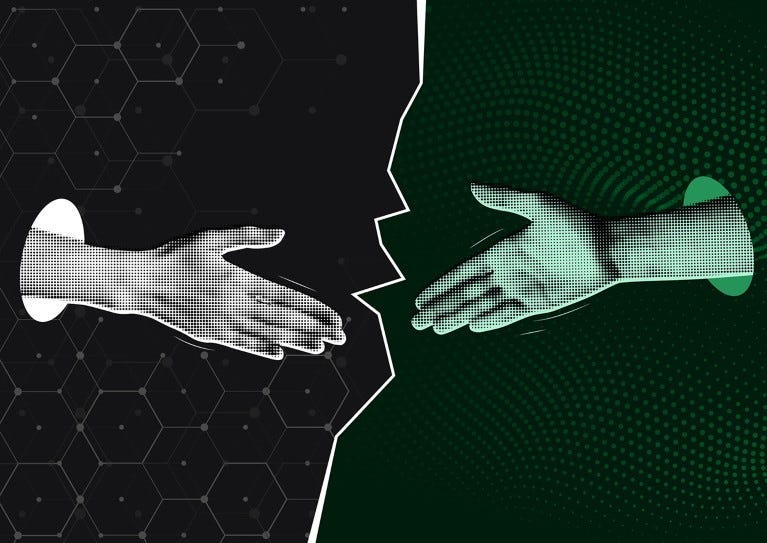
The lead graphic shows two hands failing to shake.
First comes the data that may mislead some into thinking that “science” is not as trusted as it once was (e.g. to put Americans on the Moon and in April 2020, ‘a record 87% of U.S. adults reported having at least a “fair amount” of confidence in scientists to act in the public’s best interest, with around 40% expressing “strong” trust.’) But “science” is not equal the scientists working today (most put themselves ‘on the spectrum’ of political animals). Science is the methodology of science, the endeavor to find things out, to understand the nature of things. Institutions who serve the God of Science “for the milk and cheese and profit it brings them” [Meister Eckhart] are not the methodology that serves them.
The ‘NEWS FEATURE’ isn’t news, it is an opinion piece, and it begins: [Comments in brackets added.]
From the United States to Europe to Brazil, there is a pervasive sense that trust in science has collapsed.
A UK survey published in January found that only 40% of people think that science information they hear is “generally true”. Another global poll showed that 70% of people believe at least one false or unproven claim, such as that the risks of childhood vaccines outweigh the benefits. [According to a widely cited National Science Foundation report, 2012, roughly 26% of Americans believe the sun revolves around the earth.]
In the United States, President Donald Trump and his administration are using the idea that science is not trustworthy as one reason to cut research budgets, reject evidence-based medical advice and exert unprecedented political control over research. “Over the last 5 years, confidence that scientists act in the best interests of the public has fallen significantly,” said Trump in an executive order last year.
Even the Vatican is voicing concern. This September, a meeting at the Pontifical Academy of Sciences will examine how “the crisis of trust in science has become a pressing issue”.
But is trust in science really that weak? Researchers studying this have reached some surprising conclusions. From a global perspective, public trust in science and scientists is high, they say. One of the largest studies, which surveyed nearly 72,000 people across 68 countries in 2022–23, reported a “moderately high” average trust score of 3.6 out of 5. “The idea that there’s a generalized, pervasive lack of trust in science and experts is just completely unfounded in my mind,” says David Bersoff, head of research at the Edelman Trust Institute, a think tank in New York City. [Dear Nature editor(s), 3.6 out of 5 (3.6/5=0.72) which is a C- on traditional academic tests (but in political numerology where 49.7% in 2024 was a ‘landslide victory’, so 72% seems ‘moderately high’) which today some 60% of Harvard undergraduates get A’s on as expected, being innumerate — some of whose will become professors working to lower expectations, a trend since about the 1870s to 1890s when all elite first year college students were expected to have read many books. And in one class scores dropped 50% when students were prevented from cheating.]
But trust has dropped in certain groups, notably among Republican-leaning people in the United States. And research in the United Kingdom shows that the proportion of people who have “a lot” of trust in science tends to be lower among politically right-leaning groups than those on the left. “Trust in science is politicized and becoming more so,” says sociologist Gordon Gauchat at the University of Wisconsin–Milwaukee. In many countries, people are also increasingly questioning definitive evidence on divisive issues such as vaccines, partly because scientific information is being drowned out online.
Researchers say this is a problem because it undermines support for urgent policies — such as ones that tackle climate change — and because it can lead to personal decisions that harm health, such as shunning vaccines or medical treatments. “When science rejection leads to loss of life, that’s concerning,” says Natalia Zarzeczna, who studies people’s beliefs at the University of Essex in Colchester, UK.
Do I trust “scientific information” being drowned out online and elsewhere? No.
I have, since about age 15, included science among my interests. Everything I’ve learned from those who endeavor to learn from the nature of things tells me to not trust “science” nor those paid to do science. Those who pretend to know “science” are not sources, and those who do not pretend to speak for Nature are hit and miss.
“Science is the belief in the ignorance of experts. When someone says ‘science teaches such and such’, he is using the word incorrectly. Science doesn’t teach it; experience [Nature] teaches it” (Richard Feynman, The Pleasure of Finding Things Out, p.187) or “Nature has all the answers” (H.T. Odum). Similarly, scientists don’t trust science, they trust and verify data, trust normative information/data with added veracity until there is disconfirming evidence — only logicians/mathematicians (and all linguistic thinkers/ideologues (the 99+%) get to traffic in tautological truths.
And the evidence that “science” is trusted, apart from the 3.6 out of 5 assurance, is piled high and deep:
Other data show that trust in scientists is high relative to that in other professions. A 28-country survey4 run by the Edelman Trust Institute in 2025 found that 76% of respondents trusted scientists, a proportion on a par with teachers (73%) and well above that for journalists (54%) and government leaders (49%). “Probably a lot of other sectors and professions would like to be in science’s shoes,” says Gideon Skinner, head of political research at market-research firm Ipsos in London, which has conducted international surveys that also show scientists in the top tier of trusted professions (see ‘Trust in professions’).

Kathleen Hall Jamieson, a specialist in science communication at the University of Pennsylvania in Philadelphia, argues that there’s “a rhetoric of science in crisis”, rather than an actual one — and that it’s nothing new. She traces the idea back to the widening recognition by scientists and the media in the 2010s, that many results in biomedicine and psychology could not be reproduced, a situation often portrayed as a ‘reproducibility crisis’. [Over 70% of researchers have failed to replicate another scientist’s experiment, but not trusting the published results is often why the effort and expense of trying to replicate the findings is made, so nothing to see here, folks.]
But data and experts largely point in the same direction. “Scientists are still regarded as quite trustworthy,” sums up Eileen Yam, who directs science and society research at the Pew Research Center in Washington DC. Or at least, that’s “the glass half-full rendering”, she says
The glass half-empty view, however, has data to support it, too. In a survey of people living in Britain, published in April, 84% of respondents said they had at least some trust in science. But the proportion who trusted science “a lot” dropped from 63% in 2020 to 34% — one of the “emerging fractures” in trust that the study identified. [I trust that by chance, you can’t be wrong all the time, so number me among the 84%.]
One of the most prominent changes is taking place in the United States. Here, data collected by the General Social Survey (GSS) from 1973 to 2024 show that, overall, the proportion of people with some or a great deal of confidence in the scientific community remained stably high (above 80%) over 50 years. But the proportion with a great deal of confidence declined sharply in 2022.

Two of the 13 references are to the Edelman Trust Institute (e.g. David Bersoff quoted above). The Edelman Trust Institute is a family owned ‘think tank’ since 1952 to be a collector of data, publisher of ‘insights’, and fosterer if partnerships to advance the study and measurement of trust in society. Edelman the firm is a multinational American public relations and marketing consultancy firm founded in 1952 and named after its founder, Daniel Edelman, who revolutionized PR by turning it into a strategic business function rather than simple publicity or damage control. Sorry, but the back of cereal boxes may be a better source of opinions.
I stopped reading Scientific American decades ago for the same reason I may find Nature not worth the time/effort to look for babies in the bath water.
Eric Lee, cringeworthy idiot, aka H.narrator Posting distractions like this is a distraction, but then what? Please: Take me to a useless website.
메타데이터
- post_id
- 50daed3fb832
- slug
- have-people-stopped-trusting-science-50daed3fb832
- url
- https://medium.com/@alysion42/have-people-stopped-trusting-science-50daed3fb832
- canonical_url
- https://medium.com/@alysion42/have-people-stopped-trusting-science-50daed3fb832
- author_url
- https://medium.com/@alysion42
- status
- ok
- fetched_at
- 2026-07-17 15:23:30