Do Farm Ponds Really Work? Assessing MGNREGA Farm Ponds in Northern India
Introduction
Do Farm Ponds Really Work? Assessing MGNREGA Farm Ponds in Northern India
Introduction
Most agriculture in India is rainfed, making crop health highly vulnerable to water stress during periods of high temperatures or extended dry spells. Farm ponds can provide protective irrigation during such times, supporting crops during their critical growth stages. Beyond drought conditions, these structures may also enhance productivity during normal years. In this study, we investigate the impact of farm ponds on seasonal productivity and their support during drought years.
To address water security challenges, government welfare schemes in India such as the Mahatma Gandhi National Rural Employment Guarantee Act (MGNREGA) fund the construction of water harvesting structures, including farm ponds, checkdams, trenches, and bunds, designed to provide critical irrigation during water-stressed periods and support groundwater recharge.
But do these farm ponds actually work? In this study, we used satellite imagery and field validation to assess the impact of MGNREGA farm ponds on agricultural productivity across Northern India, specifically examining:
• Impact on agricultural productivity over five years post-construction
• Performance during drought years
• Ability to reduce drought sensitivity at sites with farm ponds
What We Saw on the Ground
Our field visits to three districts, Jamui, Gaya, and Koderma, revealed a mixed picture. We encountered success stories where farm ponds visibly improved surrounding farmland productivity. However, we also found ponds with poor water retention capacity and instances where funds were disbursed but ponds were never actually constructed.

Left: A farm pond with poor water retention capacity in district Gaya, Bihar; Right: A farm pond being utilized actively to improve productivity in district Jamui, Bihar
These ground realities reinforced why systematic impact assessment matters. Without evidence-based evaluation, we cannot improve future planning or ensure resources reach those who need them most. Satellite-based monitoring offers a way to assess thousands of interventions at scale, something impossible through field visits alone.
How We Measured Impact
Study Region and Data
We focused on Agro-ecological Zone 13 (AEZ 13) covering northern Bihar and northwestern Uttar Pradesh, a region characterized by hot, wet summers and cool, dry winters where rainfed agriculture predominates. Data from MGNREGA MIS and Bhuvan showed that 2017 saw the maximum number of farm pond constructions, making it our intervention year.
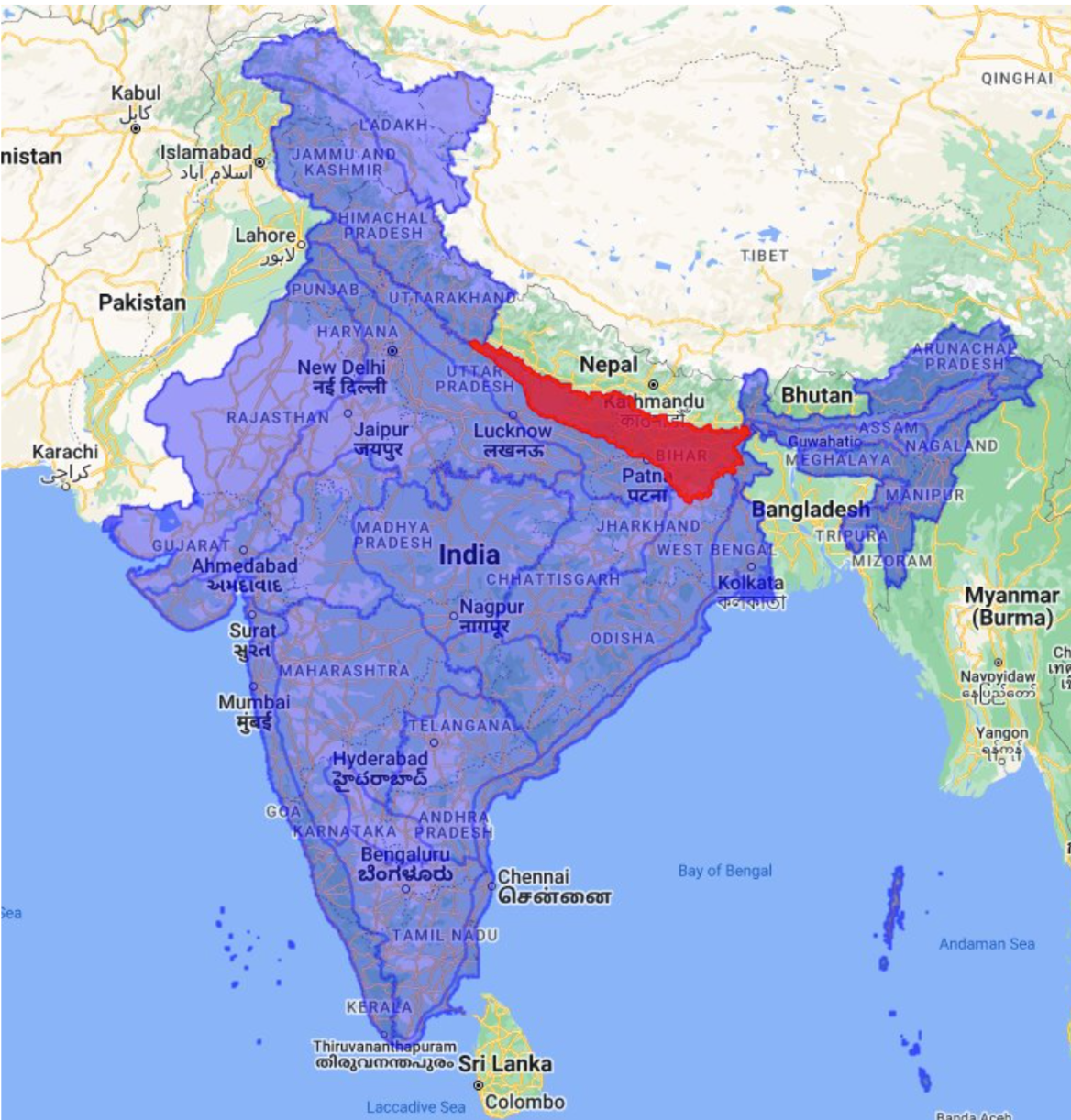
Agro-ecological Zone (AEZ) boundaries of India; AEZ 13 is shaded in red.
However, the administrative data had significant quality issues. Of 2,944 recorded farm ponds built or serviced in 2017, manual verification using Google Earth Pro revealed duplicate entries, non-existent ponds, and geo-tagging errors. After cleaning, we had a reliable dataset of 1,999 farm ponds in AEZ 13, of which 637 were constructed in 2017.

Left: Locations of the 1999 farm ponds in AEZ 13 constructed until 2022; Right: Locations of 637 farm ponds that were built in 2017 in AEZ 13
Measuring Productivity and Water Stress
Using Landsat satellite imagery processed through Google Earth Engine, we tracked three vegetation indices that serve as proxies for crop health: Normalised Difference Vegetation Index (NDVI) and Green Chlorophyll Index (GCI) as indicators of crop yield, and Normalised Difference Moisture Index (NDMI) as an indicator of crop moisture content. Our field interactions with farmers revealed that a typical farm pond irrigates 2–3 hectares, so we assessed impacts within a 100-meter radius buffer around each pond site.
Isolating the Pond’s Impact
To determine whether observed productivity changes were actually caused by farm ponds and not other factors, we used a Difference-in-Differences (DiD) methodology with Propensity Score-based Matching. This approach compares changes at sites with farm ponds (treated) against similar sites without ponds (counterfactual). We matched sites based on biophysical variables such as terrain, soil, elevation, drainage density, soil properties, precipitation, and drought incidence, factors identified through consultation with implementation organizations as crucial for farm pond planning.
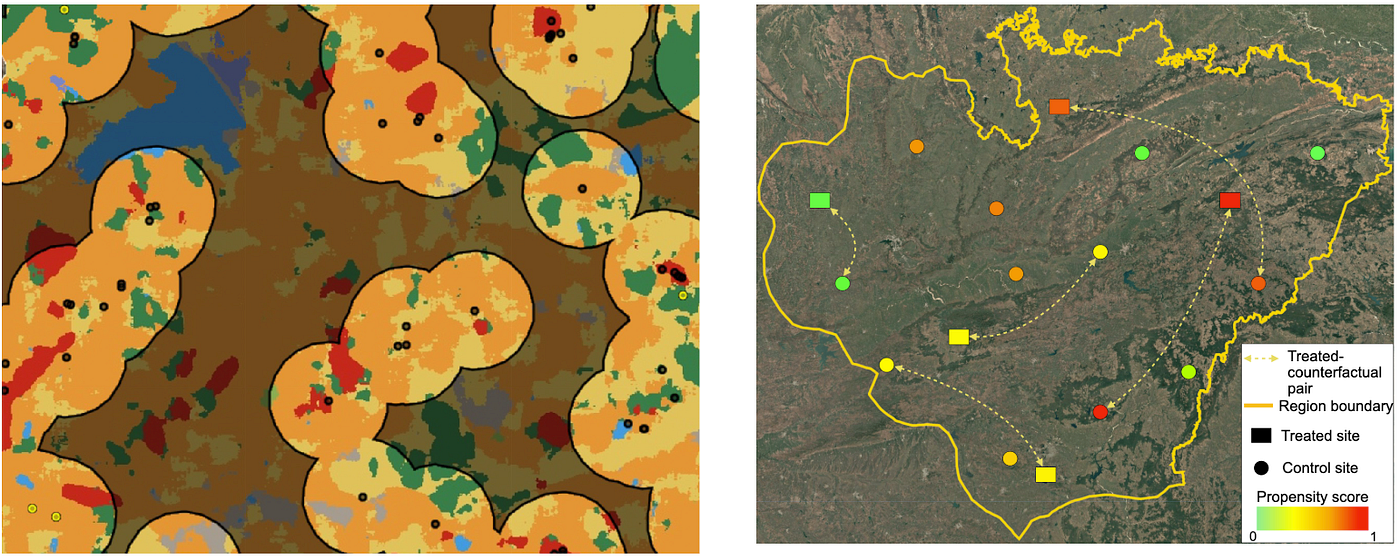
Left: Illustrating the computation of covariates and outcomes in a 100-meter radius around the treated and control sites; Right: Illustrating Propensity Score-based Matching of treated and control sites.
What We Found
Farm Ponds Boost Monsoon Season Productivity
Our results showed a positive and statistically significant impact of farm ponds on productivity during the Kharif (monsoon) season, as measured by both NDVI and GCI indicators. This confirms that farm ponds effectively support crop growth during the monsoon period.
However, during Rabi (winter) and Zaid (summer) seasons, we observed negative effects, meaning control sites showed better productivity improvements than farm pond sites. This initially counterintuitive finding likely reflects an unobserved variable: borewell access. Our control sites probably included a mix of purely rainfed farms and those with borewell irrigation. Farms with borewells would naturally outperform rainfed farms using only farm ponds during non-monsoon seasons.
Importantly, this pattern validates that farm ponds are being constructed at appropriate sites, locations genuinely lacking alternative irrigation sources.
Drought Year Performance
When we specifically examined drought years, farm ponds again showed positive and significant impacts during the Kharif season. The same seasonal pattern held, with negative or insignificant effects during Rabi and Zaid, likely due to borewell access at some control locations.
Reducing Drought Sensitivity: A Three-Week Window
Perhaps our most actionable finding concerns drought resilience. We found that farm ponds significantly reduce crop sensitivity to drought for up to three weeks of drought incidence. Beyond three weeks, crops require supplemental irrigation, as farm ponds alone cannot sustain them through extended dry periods.
For crop moisture content (NDMI), however, the story differs. Farm ponds maintained consistently positive impacts across many drought weeks, indicating that even during extended drought conditions, farm ponds help preserve crop moisture better than sites without ponds.
Conclusions and Next Steps
Our findings provide conclusive evidence that MGNREGA farm ponds improve agricultural productivity during the monsoon season and offer critical drought protection for up to three weeks. These results align with farmer feedback from our field visits, validating the importance of combining satellite-based analysis with ground-level stakeholder engagement.
The data quality issues we encountered, including duplicate entries, phantom ponds, and geo-tagging errors, highlight the need for improved monitoring systems. Administrative records alone cannot ensure accountability; satellite-based verification can help identify implementation gaps and corruption.
We are currently extending this study to other agro-ecological zones across India to capture how treatment effects vary based on farm pond characteristics, local conditions, and implementation quality. This broader analysis will help refine planning guidelines and improve resource allocation for future MGNREGA water harvesting interventions.
Further details of this study can be found in our paper:
*Assessing the impact of farm ponds on agricultural productivity in Northern India* — R. Kaur, K. Bansal, D. Garg, R. Sardana, S. Vishnubhatla, S. Agrawal, S. Kumari, P. Singla, and A. Seth. ACM COMPASS, 2024.
메타데이터
- post_id
- 50e16c041b9b
- slug
- do-farm-ponds-really-work-assessing-mgnrega-farm-ponds-in-northern-india-50e16c041b9b
- url
- https://medium.com/@ramneek1313/do-farm-ponds-really-work-assessing-mgnrega-farm-ponds-in-northern-india-50e16c041b9b
- canonical_url
- https://medium.com/@ramneek1313/do-farm-ponds-really-work-assessing-mgnrega-farm-ponds-in-northern-india-50e16c041b9b
- author_url
- https://medium.com/@ramneek1313
- status
- ok
- fetched_at
- 2026-06-09 15:37:30