Oracle APEX 26.1: Vector Tile Maps — Why This Upgrade Matters
When Oracle APEX 26.1 was announced, most of the excitement focused on AI features.
Oracle APEX 26.1: Vector Tile Maps — Why This Upgrade Matters
When Oracle APEX 26.1 was announced, most of the excitement focused on AI features.
But hidden among the release notes was a feature that can significantly improve map-based applications:
🗺️ Vector Tile Maps
If you’ve ever built applications involving locations, delivery tracking, assets, territories, or geographic analysis, this enhancement deserves your attention.
First, What Are Vector Tile Maps?
Let’s keep it simple.
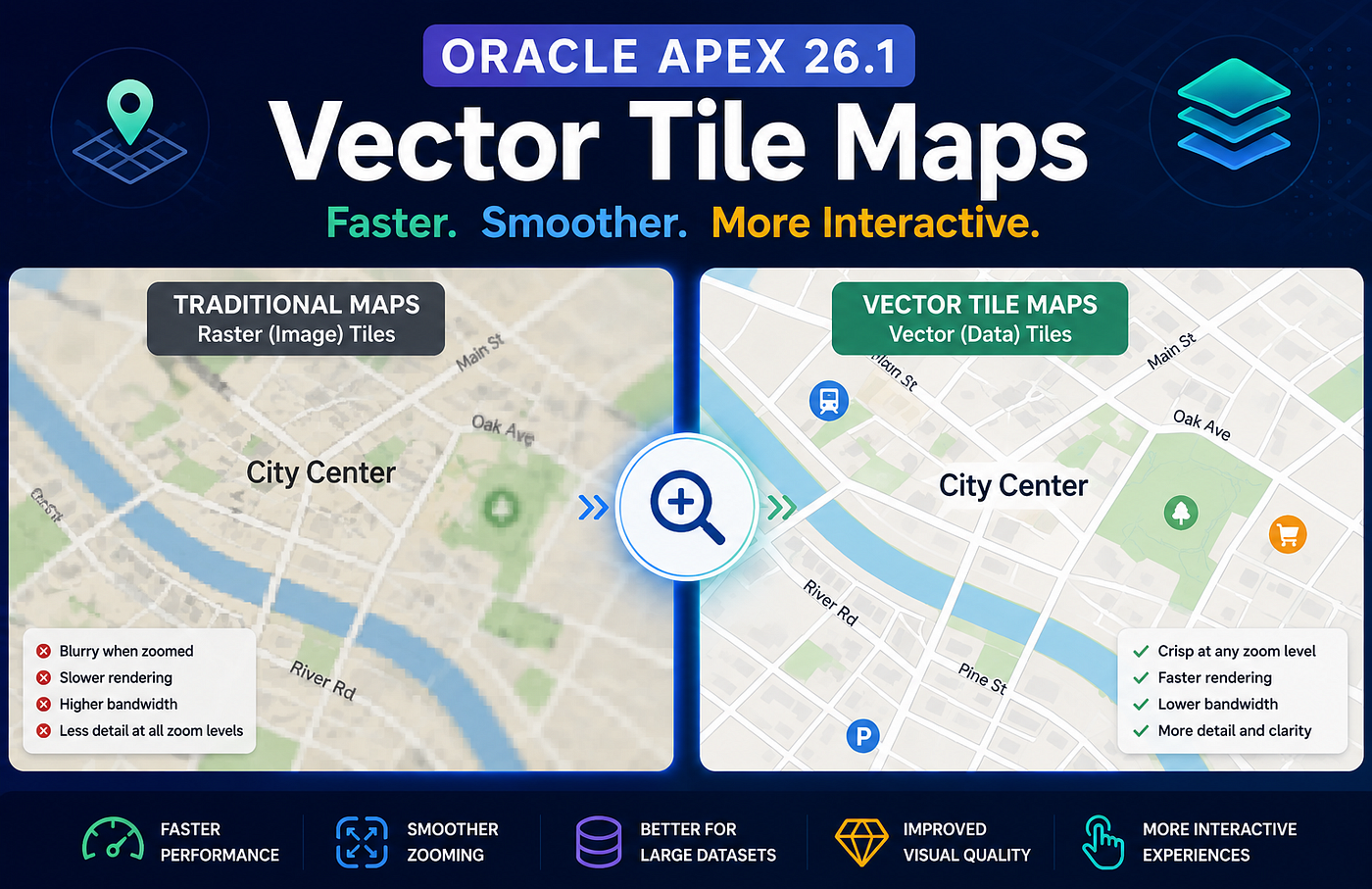
Traditional maps work like images.
When you zoom in or out, the browser downloads different map images from the server.
Think of it like viewing photographs of a city.
Vector Tile Maps work differently.
Instead of downloading images, they download map data.
The browser then draws the roads, buildings, labels, and boundaries dynamically.
Think of it like receiving the blueprint of a city instead of a photo.
Why Is This Better?
Because data is smarter than images.
Vector maps allow applications to become:
✅ Faster
✅ More interactive
✅ More scalable
✅ Better looking at all zoom levels
What Problems Did Developers Face Before?
Imagine building an application that displays:
- Thousands of customer locations
- Delivery routes
- Utility assets
- Sales territories
- Store locations
Traditional map layers could sometimes struggle with:
❌ Slower rendering
❌ Less smooth zooming
❌ Limited flexibility
❌ More bandwidth consumption
As datasets grow, these limitations become noticeable.
What’s New in Oracle APEX 26.1?
Oracle APEX 26.1 introduces support for:
Vector Tile Layers
This means maps can now render using vector tiles instead of relying only on raster images.
The result?
A smoother and more responsive experience.
Benefits of Vector Tile Maps
1. Faster Performance
Only the required map data is loaded.
This reduces unnecessary downloads.
Maps respond more quickly.
2. Smooth Zooming
Have you noticed some maps becoming blurry during zoom transitions?
Vector maps maintain sharp rendering because the browser redraws the map dynamically.
No pixelated images.
Just smooth navigation.
3. Better Support for Large Datasets
Enterprise applications often involve huge geographic datasets.
Examples:
- Utility networks
- Fleet management
- Logistics systems
- Asset tracking
Vector tiles handle these scenarios more efficiently.
4. Improved Visual Quality
Labels, roads, and boundaries remain crisp at different zoom levels.
Users get a more polished experience.
5. More Interactive Experiences
Because the map is based on data rather than images, developers have greater flexibility when building interactive applications.
This opens opportunities for richer geospatial experiences.
Real-World Use Cases
Delivery Applications
Track drivers and optimize routes.
Retail Businesses
Display store coverage areas.
Government Applications
Visualize districts and public infrastructure.
Utility Companies
Monitor assets spread across regions.
Sales Teams
Analyze customer distribution geographically.
Why Should Oracle APEX Developers Care?
Even if you don’t build map applications today, many enterprise applications eventually need location intelligence.
And when that happens, performance matters.
Users expect maps to behave like modern applications:
- Fast
- Smooth
- Interactive
Vector Tile Maps help meet those expectations.
My Thoughts
This feature probably won’t generate as much discussion as AI Agents or APEXlang.
But for developers working with geographic data, it may be one of the most impactful improvements in Oracle APEX 26.1.
Sometimes the best features aren’t the ones everyone talks about.
They’re the ones that solve real-world problems quietly and effectively.
Final Thoughts
Vector Tile Maps in Oracle APEX 26.1 bring:
✅ Faster map rendering
✅ Smooth zooming
✅ Better scalability
✅ Improved visual quality
✅ Enhanced user experiences
If your applications involve geographic information, this is definitely a feature worth exploring.
Have you used Oracle Maps in your APEX applications? I’d love to hear how you’re planning to use Vector Tile Maps.
메타데이터
- post_id
- 51130f3b59e8
- slug
- oracle-apex-26-1-vector-tile-maps-why-this-upgrade-matters-51130f3b59e8
- url
- https://medium.com/@shakyasam563/oracle-apex-26-1-vector-tile-maps-why-this-upgrade-matters-51130f3b59e8
- canonical_url
- https://medium.com/@shakyasam563/oracle-apex-26-1-vector-tile-maps-why-this-upgrade-matters-51130f3b59e8
- author_url
- https://medium.com/@shakyasam563
- status
- ok
- fetched_at
- 2026-06-23 17:05:31