How Big Tech Checks Usernames in Milliseconds: A Technical Breakdown
Have you ever seen the message “This username is already taken” while signing up for an app? It feels like a minor hiccup — but under the…
How Big Tech Checks Usernames in Milliseconds: A Technical Breakdown
Have you ever seen the message “This username is already taken” while signing up for an app? It feels like a minor hiccup — but under the hood, there’s a complex and high-performance system making that check in just milliseconds.
In this article, we’ll explore how tech giants like Google, Amazon, and Meta handle billions of username availability checks with incredible speed and precision. If you’re passionate about system design, distributed systems, or backend engineering, you’ll love this deep dive.
🚀 Key Technologies Used for Scalable Username Checks
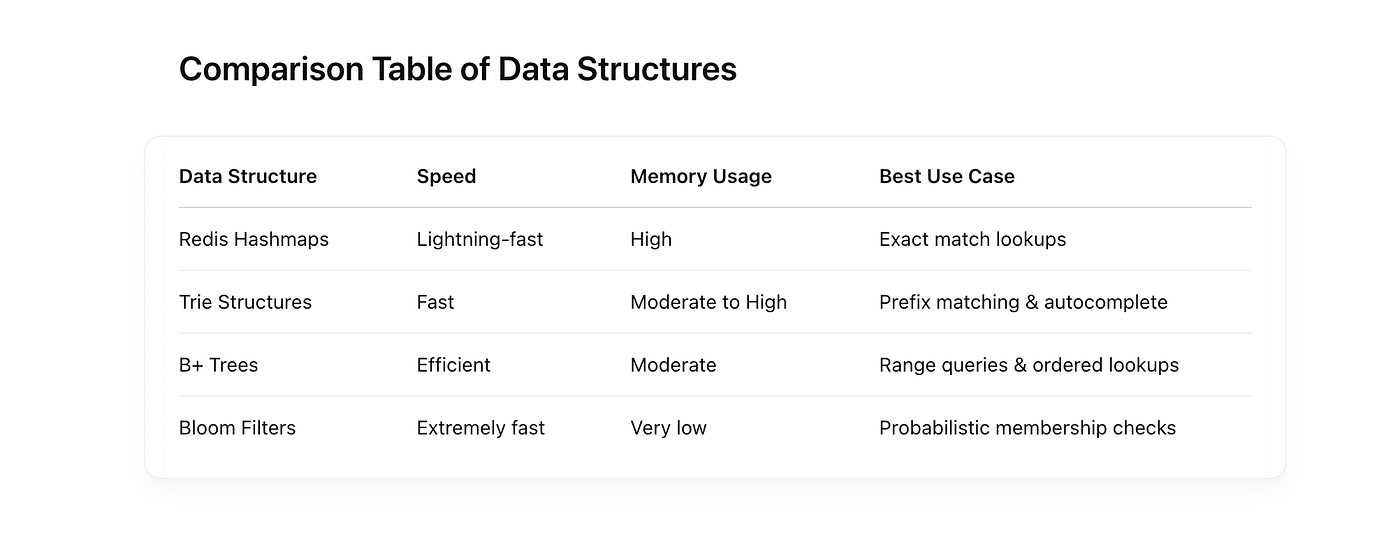
To handle billions of usernames efficiently, Big Tech employs advanced data structures and distributed systems. Here are the core components:
1. Redis Hashmaps
Redis hashmaps are in-memory data structures that store field-value pairs under a single key. For username lookups:
- Each field represents a username, while its value can be a lightweight identifier (e.g., user ID or flag).
- Queries are lightning-fast since they avoid database hits for most lookups.
- Limitations: Memory constraints prevent storing billions of usernames in a single Redis instance .
2. Trie Structures
Tries (prefix trees) are ideal for tasks like autocomplete and prefix-based searches:
- They organize strings by shared prefixes, enabling efficient lookups proportional to the length of the string (O(M)).
- Tries naturally support suggesting similar usernames when the first choice is unavailable.
- Challenges: High memory consumption if there’s limited overlap between usernames. Compressed tries (e.g., Radix Trees) can mitigate this issue.
3. B+ Trees
B+ Trees are widely used in databases for indexing large datasets:
- They provide sorted lookups in O(logn) time, making them suitable for range queries (e.g., finding the next available username alphabetically).
- High fan-out ensures shallow tree depth, enabling efficient searches even across millions of entries.
- Distributed systems like Google Spanner use B+ Trees to scale horizontally across machines.
4. Bloom Filters
Bloom filters are probabilistic data structures designed for memory-efficient checks:
- They use hash functions to determine if an item might be present in a set.
- Advantages: They never return false negatives and require minimal memory (e.g., storing 1 billion usernames with a 1% false positive rate requires ~1.2 GB) .
- Drawbacks: False positives may occur, requiring fallback checks via databases.
🧱 Layered Architecture for Username Lookups
Big Tech combines these data structures into layered architectures to maximize speed and efficiency:
1. Load Balancing
Load balancing ensures requests are distributed efficiently across global and local servers:
- Global Load Balancing: DNS-based routing directs users to the nearest regional data center.
- Local Load Balancing: Tools like NGINX or AWS Elastic Load Balancer distribute traffic among backend servers within a data center.
2. Multi-Layer Lookup Architecture
The typical flow for checking username availability includes:
- Bloom Filters: Act as the first line of defense by quickly filtering out usernames that definitely don’t exist.
- In-Memory Cache: Systems like Redis handle recent lookups or frequently queried usernames.
- Distributed Databases: For definitive checks, databases like Apache Cassandra or Amazon DynamoDB split data across machines using consistent hashing.
🌍 Real-World Implementations
Tech giants like Google, Facebook, and Amazon employ these techniques at scale:
- Google: Uses Spanner for distributed sorted key spaces backed by B+ Trees.
- Instagram: Leverages Apache Cassandra for high-speed distributed database queries.
- Amazon: Depends on DynamoDB to ensures low-latency responses through consistent hashing strategies.
🧠 Conclusion
The process of checking username availability is far more complex than it appears. By combining Redis hashmaps, tries, B+ Trees, Bloom filters, caching layers, and distributed databases, tech companies achieve scalability and speed on a global level. These systems exemplify the power of modern computer science and engineering.
For tech enthusiasts interested in system design or distributed systems, this topic offers valuable insights into real-world applications of advanced data structures.
Note: This article is based on publicly available information and aims to provide a general overview of the technologies involved in username availability checks.
✅ Want more content like this?
Subscribe to the blog for deep dives into system design, distributed architectures, and high-performance engineering.
메타데이터
- post_id
- 512dfdab6728
- slug
- how-big-tech-checks-usernames-in-milliseconds-a-technical-breakdown-512dfdab6728
- url
- https://medium.com/@devharshgupta.com/how-big-tech-checks-usernames-in-milliseconds-a-technical-breakdown-512dfdab6728
- canonical_url
- https://medium.com/@devharshgupta.com/how-big-tech-checks-usernames-in-milliseconds-a-technical-breakdown-512dfdab6728
- author_url
- https://medium.com/@devharshgupta.com
- status
- ok
- fetched_at
- 2026-06-26 03:39:16