Make This Note-Taking Switch If You Want to Learn Faster
Neuroscience shows a clear advantage for this one note-taking method
Make This Note-Taking Switch If You Want to Learn Faster
Neuroscience shows a clear advantage for this one note-taking method
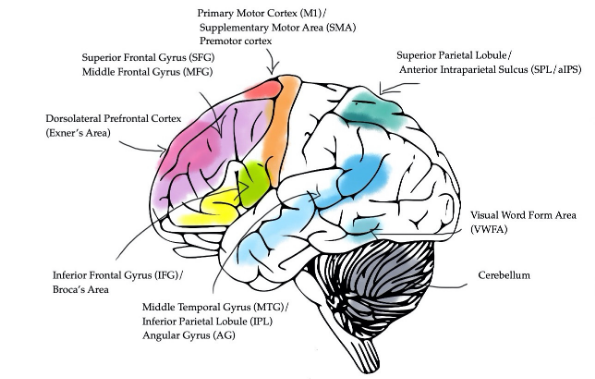
Brain regions associated with handwriting. Source: Marano et al. (2025).
Not a Medium member? Read this story for free here.
We’re exposed to more information than ever before in human history.
At the same time, it often seems that retaining information has become harder than ever. The sheer amount of information plus the distractions from technological devices (especially the “smart” ones) certainly play a role, but they’re only part of the story.
As a neuroscientist with 20+ years of experience, I’ll show you that information retention also has a lot to do with how you take your notes, so let’s look into the research.
Why it matters how you take your notes
In one study, participants watched TED Talks of approximately 15 minutes duration. During the talks, they took notes — some typed on a laptop, while others took longhand notes.
Later, the participants had to answer different questions about the TED talks without using their notes.
There were two types of questions:
- Factual: Remembering some fact that was explicitly stated in the talk.
- Conceptual: Questions that were related to the content of the talk, but that required some additional thought process or analysis.
For factual questions, there was no significant difference between typing and longhand notes. But for the conceptual questions, participants who had taken handwritten notes outperformed those who had typed on a laptop.
When the researchers analyzed the participants’ notes, they realized that the laptop group wrote more words but also had more verbatim content (i.e., they typed exact phrases from the talk) than the handwriting group.
And no, the typing group was not distracted by the internet because the laptops were disconnected. It was about how they processed the information during note-taking.
The researchers tested variations of the original experiment:
(1) They asked laptop participants to take notes in their own words rather than verbatim transcription, but this instruction was ineffective (i.e., the laptop participants still engaged in verbatim transcription).
(2) They allowed participants to study their notes before answering the questions. Still, longhand note-takers outperformed those who had typed their notes.
In another study, participants listened to word lists. They were asked to write down each word by hand, type on a laptop, or type on an iPad using the touchscreen keyboard.
After that, they had two tasks:
- Free recall: Recalling as many words as possible from the list without any hints or cues.
- Recognition: They listened to another word list and, for each word, decided whether it had been in the original list.
In the free recall task, participants recalled significantly more words after writing them by hand than after typing them. In the recognition task, no differences were observed between the note-taking methods.
So, handwriting had an advantage when people tried to actively remember something rather than deciding whether it was familiar. And this active remembering is what you want for your learning.
Brain differences: handwriting versus typing
A recent review of the evidence from various brain imaging studies found that handwriting activates more widespread brain networks than typing, suggesting it’s also more cognitively demanding.
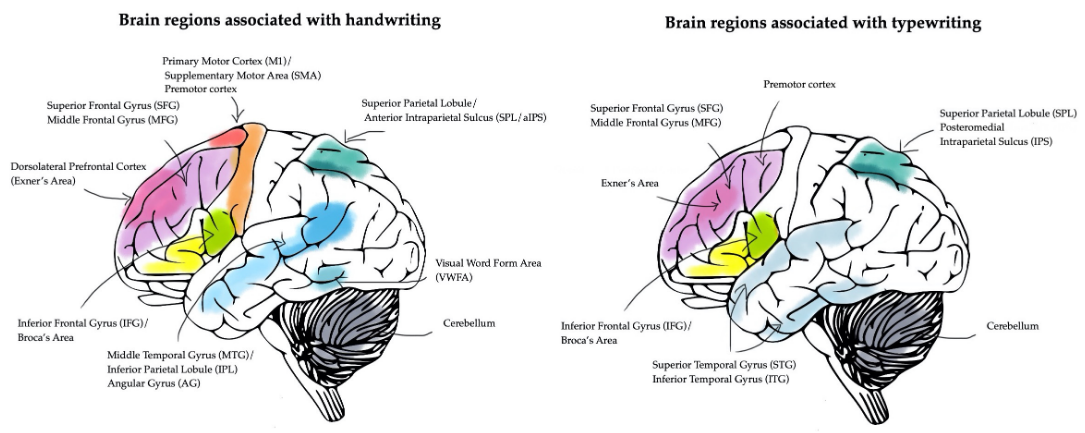
A comparison of brain activation for handwriting versus typing. Source: Marano et al. (2025).
The underlying processes are different:
- Handwriting requires fine motor coordination, and each letter or character is formed through a different hand movement.
- Typing consists of repetitive finger movements and doesn’t require the fine-tuned motor processes of handwriting.
The higher cognitive demand and the stronger brain engagement during handwriting could explain why handwritten information is remembered better than typed information.
Of course, this doesn’t mean that typing is bad for your brain; it simply means that handwriting involves a different and deeper way of information processing.
So, how should you take your notes?
It depends on your goal.
If your goal is to understand and remember ideas (not just capture information), handwritten notes are better than typing.
Still, we need to put this into perspective. Typed notes also have advantages, e.g.:
- Maintenance: There are no huge paper stacks to maintain.
- Speed: Most people type more quickly than they handwrite, so you can capture more information.
- Practicality: Digital notes are easier to organize, edit, tag, and search.
- Access: Depending on where you store your notes, you may be able to access them from different devices.
So, on the one hand, handwritten notes facilitate learning. On the other hand, typed notes also have advantages and are often more practical.
My recommendation is:
- When dealing with content you need to remember or analyze in-depth, prioritize handwriting. You can still pass your notes into a digital format later.
- If you just need to jot something down, use whichever method is more comfortable for you.
- Yet another option is to use a tablet with a stylus, if that’s your thing.
Also, it’s not only about note-taking per se because many techniques enhance memory independent of how you take your notes. Summarizing the information, organizing it, and testing yourself improve learning, regardless of your note-taking method.
Thank you for reading!
I’m Dr. Patricia Schmidt, a doctor of psychology and neuroscientist. My homepage: https://creatorschmidt.com
If you enjoyed this article and would like to support my work and my love for coffee ☕, you can buy me one here.
P.S.: I run a newsletter called “ATP — All Things Psychology”. It brings bite-sized research pieces from Psychology & Neuroscience straight to your inbox, with one goal: To help you leverage science to improve your life. You can subscribe here.
메타데이터
- post_id
- 5144b709bbf7
- slug
- make-this-note-taking-switch-if-you-want-to-learn-faster-5144b709bbf7
- url
- https://medium.com/write-a-catalyst/make-this-note-taking-switch-if-you-want-to-learn-faster-5144b709bbf7
- canonical_url
- https://medium.com/write-a-catalyst/make-this-note-taking-switch-if-you-want-to-learn-faster-5144b709bbf7
- author_url
- https://medium.com/@creatorschmidt
- status
- ok
- fetched_at
- 2026-06-16 20:05:23