🚦 Load Shedding: The Last Line of Defense
Why Saving the System Means Saying “No”

🚦 Load Shedding: The Last Line of Defense
🚦 Load Shedding: The Last Line of Defense
Why Saving the System Means Saying “No”
SEO keywords: load shedding, Spring Boot overload protection, microservices resilience, backpressure, capacity control
When traffic spikes, most systems do one thing:
They try harder.
More threads More retries More CPU More pods
And that’s exactly how they die.
Healthy systems don’t try harder under overload. They shed load.
🚨 The Fatal Instinct: Be Helpful Under Pressure
Your service is overloaded.
What does it do?
- Accept more requests
- Queue them
- Slow down
- Time out
No errors. No alarms.
Just a slow collapse.
This is not resilience. This is politeness at scale.
🧠 What Load Shedding Actually Means
Load shedding is:
Intentionally rejecting work to preserve system health.
Not failure. Not rudeness.
Self-defense.
💣 Why Scaling Is Not a Solution
Auto-scaling:
- Reacts late
- Costs money
- Amplifies bad traffic
- Spreads failure
If your system collapses before scaling triggers, you’re already down.
⚠️ Where Overload Really Happens
Not at:
- CPU 100%
- Memory OOM
But at:
- Thread pool saturation
- Connection pool exhaustion
- Queue buildup
- Event loop blocking
By the time CPU is high, it’s too late.
🔁 Load Shedding vs Backpressure

Backpressure is polite.
Load shedding is necessary.
🧪 Simple Load Shedding in Spring Boot (Semaphore)
@Component
public class LoadSheddingFilter implements Filter {
private final Semaphore semaphore = new Semaphore(100);
    @Override
    public void doFilter(
            ServletRequest request,
            ServletResponse response,
            FilterChain chain)
            throws IOException, ServletException {
        if (!semaphore.tryAcquire()) {
            HttpServletResponse resp = (HttpServletResponse) response;
            resp.setStatus(429);
            resp.getWriter().write("Too Many Requests");
            return;
        }
        try {
            chain.doFilter(request, response);
        } finally {
            semaphore.release();
        }
    }
}
This:
- Caps concurrency
- Prevents thread exhaustion
- Keeps latency predictable
⚡ Rate Limiting Is Load Shedding
@Bean
public Bucket4jConfiguration bucketConfig() {
    return Bucket4jConfiguration.builder()
        .addLimit(Bandwidth.simple(100, Duration.ofSeconds(1)))
        .build();
}
429 responses are not errors.
They are signals.
🧠 Load Shedding in Reactive Systems
@GetMapping("/data")
public Mono<Response> getData() {
    return Mono.just("ok")
        .limitRate(100)
        .onErrorReturn(
            RejectedExecutionException.class,
            fallbackResponse()
        );
}
Reactive systems must shed load early — or event loops die.
💥 Why Load Shedding Saves Healthy Traffic
Without shedding:
- All users get slow responses
With shedding:
- Some users get fast responses
- System stays alive
- Recovery is instant
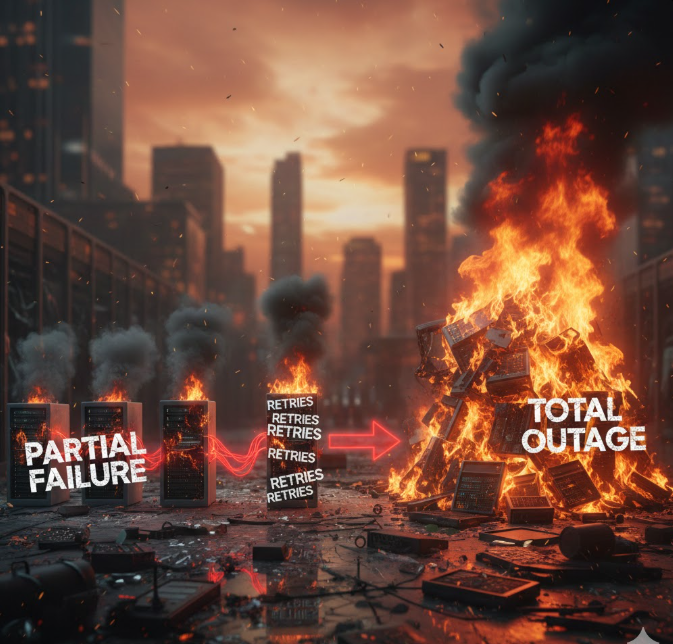
Partial failure is better than total failure.
📉 Metrics That Tell You When to Shed
Watch:
- Active thread count
- Queue depth
- Request latency slope
- Timeout frequency
Load shedding should trigger before timeouts spike.
🧠 Production Rule of Thumb
If you’re timing out:
You’re already late.
Load shedding should happen earlier.
🚀 Final Takeaway (The Line That Spreads)
Resilient systems don’t collapse gracefully. They refuse gracefully.
Saying “no” to some traffic is how you say “yes” to the system.
메타데이터
- post_id
- 517866a2f45e
- slug
- load-shedding-the-last-line-of-defense-517866a2f45e
- url
- https://medium.com/@gangoladeepa/load-shedding-the-last-line-of-defense-517866a2f45e
- canonical_url
- https://medium.com/@gangoladeepa/load-shedding-the-last-line-of-defense-517866a2f45e
- author_url
- https://medium.com/@gangoladeepa
- status
- ok
- fetched_at
- 2026-06-20 20:29:01