The Beginning of All My University Writing Courses
I use freewriting exercises and a reading from Peter Elbow at the beginning of all the writing courses I teach. Here’s why.
The Beginning of All My University Writing Courses
One of the shorter writing courses I’m teaching this semester started this week. Come December of this year, I’ll have taught an “Introduction to Writing” course of some kind nine times at the undergraduate level. While I’m no ivy-league professor, I do teach writing at two universities, one public and one private. I don’t always teach them the exact same way, and I often update my syllabus with newer readings and activities a little each semester. I do this for a few reasons. The main reason is that it helps me stay engaged when I have something new to keep up with as the students do. Also, if I don’t try new things, I’ll never know what will, could, or didn’t work better.
That being said, there is one thing that I pretty much have always done at the beginning of every single one of the writing courses. I start with a reading from Peter Elbow, “How to Improve Your Writing Through Freewriting Exercises”, and I end the class with a freewriting exercise for ten minutes. I’ve done this in both English 101 and 102 courses, and I use it in beginning workshop and more advanced workshop courses.
I should note that Peter Elbow passed away in February of this year. I didn’t know until after I had my Fall semester students do the freewriting exercise, as I googled his name to see where he got his PhD, because I always forget.
Why The Peter Elbow Article?
Of course, as a professional, I have to have real pedagogical reasons for making students read the Elbow article and for actually doing the exercise itself.
The first reason is one of the more interesting ones, I think. The pdf from Peter Elbow’s website is one page, but it’s actually the first four or so pages in his first book from 1973, (affiliate link) *Writing Without Teachers*. So right away, students read four pages feeling like they’ve only read one (okay, maybe two, or maybe not.) Reading muscles need stretched just as much has writing muscles. Students will be required to read a lot more than I think many of the newer students expect in their later courses. The entire book is a fairly accessible read as well. I recommend students grab a copy of the book if they find themselves still struggling with writing beyond English 102 or the university equivalent.
The first four pages themselves also open a door to have a discussion about the advantages and disadvantages of writing and speaking. I try to get the students to talk out the differences themselves in an open discussion. Of course, if they did the reading, they’ll know what Elbow says: that we can edit writing and we can’t really edit our speech, at least not without adding words to our speech to negate something previously stated. (Basically, we can amend speech in real life, but we can’t omit anything.) He also talks a lot about how we figure out what we want to say as we say it. He makes these arguments about writing too.
Assigning this reading also opens the door for students to look up Peter Elbow. Usually, someone will be curious enough to look him up. If not, sometimes I ask the class to tell me about him, and in 2025, all the students have laptops or phones, so after a few minutes I get a rundown on his accolades and background. (Doing this early with different readings and authors lays the groundwork for a discussion on how research starts later in the course, or at the very beginning if it’s a course heavy on research outcomes.)
When we combine Elbow’s background with these four pages, we get an even more interesting discussion. Elbow writes in the four pages and throughout the rest of the book about how we really don’t know what we’re going to write until we start writing it. A little later in the book itself, he writes about his experiences prior to the 70s about the issues with his teachers insisting that to write “good writing” we have to know what we’re going to write before we write it. He goes through great effort (writing a whole book) to show this isn’t a useful way of thinking.
Elbow himself flunked out of his graduate program because he couldn’t write the way his professors expected him to. I think this both relieves and scares students a bit. You can get into graduate school without having the necessary writing skills? Yes, you can. He did eventually go back and finish his PhD after improving his writing skills, of course.
A Door to The History of Writing
I also use this discussion about Elbow–sometimes the first day, sometimes the second or third, depending on time and how it goes with the students–to launch into a discussion of the history of writing. I include a lot of history about the discipline in my teaching (see Wardle’s textbook, (affiliate link, again) *Writing About Writing*, or her article, “Mutt Genres and the Goal of FYC: Can We Help Students Write the Genres of the University?”)
While texts that highlight other things about the field of composition other than history can certainly be used to get the attention of students, I lean heavily into readings and discussions about the history of the field with students in 101, because I’ve found that they actually like expressing their thoughts and opinions on the subject. It’s a chance for some of them to vent in an acceptable, academic way in an academic environment about the field that they love to complain about the most. They also get more of an understanding of why certain practices may have been tried in the past and why some other strategies are being used now. It also gives them some consumer understanding of their own writing education: what the experts their tuition pays for understand about the field, what’s being sold to them, and why. These are things I feel we are currently lacking in offering students in our composition programs. (When I go to a science class, I know that my professor knows the history of science and that he has some experience teaching it and has an understanding of scientific practices in a lab, knows a thing or two about beakers, what a bunsen burner is, how to use one, experience in research studies, in how theories works, etc. Many students don’t seem to know that their writing instructors know some of the history of writing, something about the current debates in the field composition, theories of practice, etc. They almost have nothing to judge their composition professors competence on other than kindness, strictness, and maybe if they’re a “good” writer or not.)
What we end up with when I use Freewriting and include history in the beginning is a first unit in a course that’s fairly accessible to just about anyone, whether they’ve had good or bad experiences with reading and/or writing. Students get more comfortable with their own mind and what they’re comfortable putting into words for others to read. They get practice reading real scholarly articles, and they get to practice research.
The Freewriting Exercise
I always do the freewriting exercise at the end of the first day of class. I tell them to write whatever is in their head and not think about it before writing it (or typing it. I tell them that I don’t care if they type it or handwrite it. If they type it, I have them submit it into a field on Blackboard or Canvas, depending on the institution, but I won’t read it. If they handwrite, I just want to see it quickly before they leave to see that they did it.) Most students type it with a laptop or they use their phone. It doesn’t matter to me. There’s also no word count minimum or maximum. I open up Google and I start a 10 minute timer, ask if there are any questions before we start, and then say, go.
Many students do struggle. Some talk a bit too much for a minute, laughing and giggling at the absurdity of what I’m asking them to do. Someone eventually blurts out “do we have a prompt,” or “what are we writing about?” I am stickler about this: I will NOT give them a prompt at first. I tell them to write what is in their head. I know some students won’t have a very loud internal monologue, but this, in my view, is a necessary struggle for these students to experience.
If, after five minutes has gone by and someone still hasn’t started moving their fingers or typing their keys, I will give something like “what do you think about freewriting?” Many of them are typing about this anyway, I think. Almost always, in the last few minutes of the exercise, someone hits a stride and really types, really goes for it. When the timer goes off, these students keep going for a few seconds. Sometimes I have to tell them to stop, that the activity is over. So far in nine iterations of this course that I’ve taught, everyone has been able to write something in ten minutes.
Afterwards, we talk a bit. Many students express a struggle to keep writing no matter what for that long. They almost all run out of gas for a moment and have to dig deep to get going again. I often ask students what they did to keep going. They say that they followed Elbow’s advice, to force themselves to write something, anything, even if it’s “I can’t think of anything to write.
The students’ opinions on freewriting change widely over the course. As we do it a few more times throughout the semester, some who loved it at first hate it by the end. Some hated it and grow to love it. Others don’t know what to make of it. It’s a tool that they can use now, though. After some practice, I know they can bang out a one or two page awful draft on some of their thoughts about an article or book if I asked them to do it with one day’s notice. What they also eventually have by the time we’re working on the first papers are some drafts — very ranty, meandering, spiraling drafts sometimes, but drafts nonetheless. They have something to read aloud to a workshop or peer-review group, something to take through the writing process–revise, edit, and eventually turn in.
And that, along with some discussions about the students’ own history with writing and/or reading, and maybe a reading about the field of writing studies that we may struggle through together with a jigsaw reading activity and an open discussion, is the first week in an Eric Shay Howard writing course (and a bit of a preview of the rest). Welcome. You don’t have to call me Professor Howard, you can call me Eric.
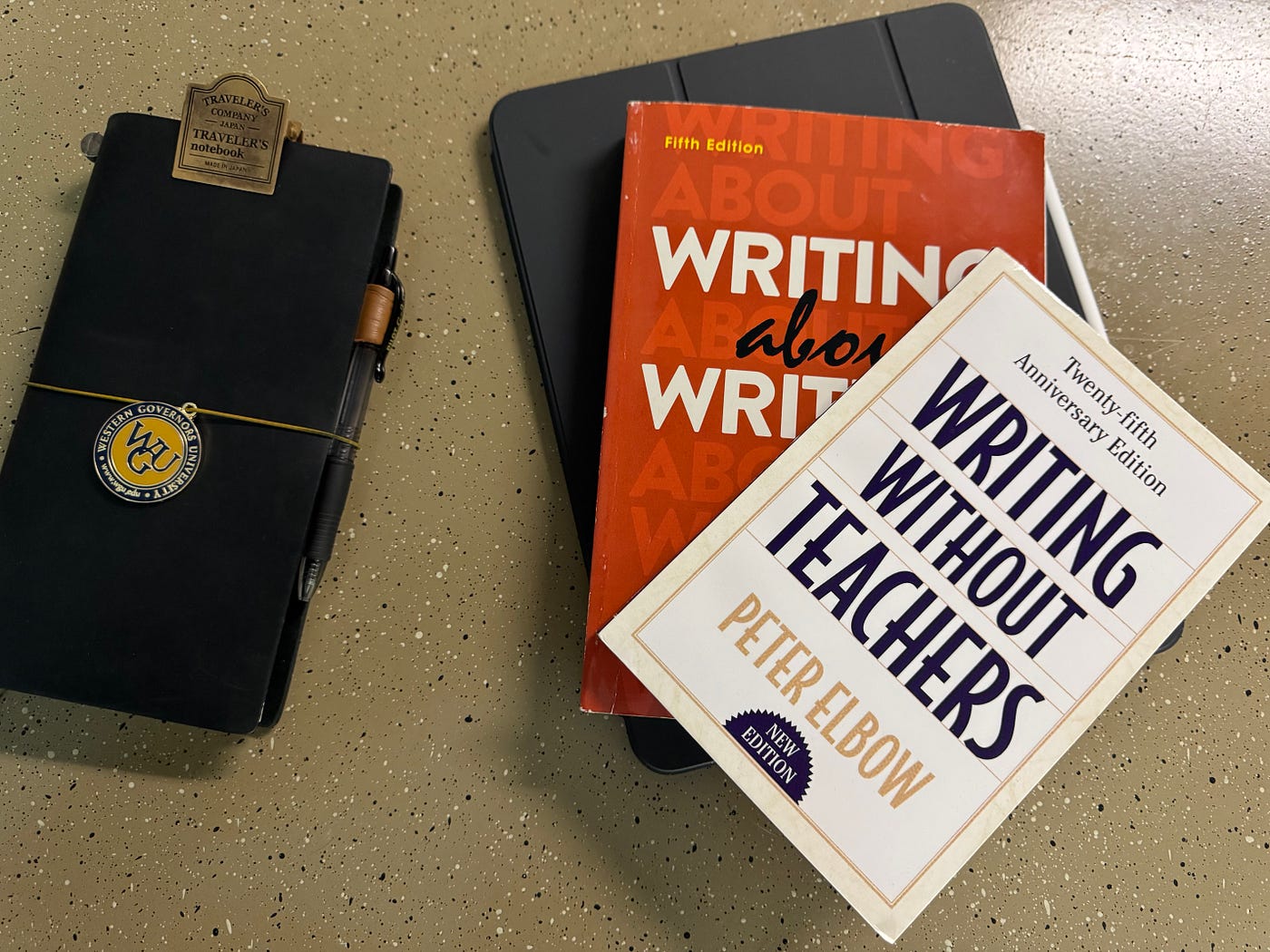
Writing Without Teachers by Peter Elbow, and Writing About Writing by Elizabeth Wardle and Doug Downs
(Thanks for reading, and please let me know if you’re interested in this sort of thing. If so, I’ll write more about teaching writing.)
메타데이터
- post_id
- 519c4e7bf6de
- slug
- the-beginning-of-all-my-writing-courses-519c4e7bf6de
- url
- https://medium.com/@ericshayhoward/the-beginning-of-all-my-writing-courses-519c4e7bf6de
- canonical_url
- https://medium.com/@ericshayhoward/the-beginning-of-all-my-writing-courses-519c4e7bf6de
- author_url
- https://medium.com/@ericshayhoward
- status
- ok
- fetched_at
- 2026-08-10 16:34:27