Cover Slipper: High-Throughput Applications for Pathology and Clinical Laboratories
“Automated cover slipping eliminates manual inconsistencies in slide preparation — delivering uniform mounting media thickness, bubble-free…
Cover Slipper: High-Throughput Applications for Pathology and Clinical Laboratories
“Automated cover slipping eliminates manual inconsistencies in slide preparation — delivering uniform mounting media thickness, bubble-free coverage, and repeatable results that protect specimen integrity across every workflow.”
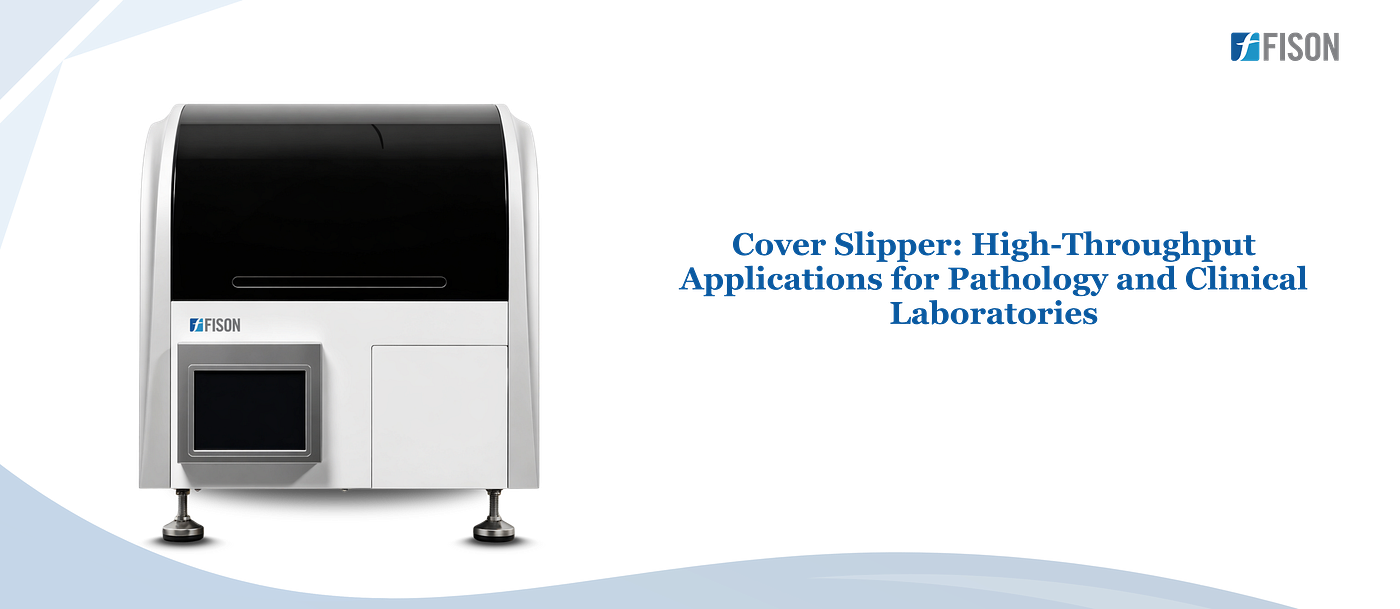
A cover slipper is an automated laboratory instrument that applies coverslips to stained histological or cytological glass slides using controlled dispensing of mounting media. It replaces manual cover slipping — a labor-intensive step prone to air bubbles, media overflow, and inconsistent thickness — with a standardized, repeatable process that maintains slide archival quality. In pathology laboratories, slide quality directly impacts diagnostic accuracy. Automated cover slipping ensures optical clarity, prevents specimen desiccation, and produces slides compatible with digital pathology scanners. The Fison Cover Slipper addresses the full spectrum of laboratory throughput needs — from small clinical settings to high-volume surgical pathology departments requiring hundreds of slides per shift. How Automated Cover Slipping Works Step-by-step workflow from stained slide to archival-quality finished preparation 1 Slide Loading Stained slides loaded via cassette rack or individual tray. Barcode reading optional for LIS tracking 2 Media Dispensing Precise volume of xylene-based or aqueous mounting media deposited by automated pump — no overflow 3 Coverslip Placement Coverslip picked from cassette and applied at controlled angle to eliminate bubble formation 4 Drying / Curing Slides conveyed through heated drying zone for media curing and coverslip adhesion 5 Output & QC Finished slides sorted to output tray; system logs slide count, media usage, and error flags

Slide Types & Specimen Compatibility Cover slippers handle diverse specimen preparations across pathology subspecialties H&E H&E Staining Routine histology; most common slide type in surgical pathology IHC Immunohistochemistry IHC & special stain slides requiring consistent media thickness Cyto Cytology Preparations Pap smears, FNA, and liquid-based cytology slides FISH FISH & Molecular Fluorescence-compatible aqueous mounting media mode Supported Coverslip Formats 24×40 mm24×50 mm24×60 mm25×75 mmXylene-Based MediaAqueous MediaUV-Cure MediaBarcode CompatibleStandard Glass SlidesCharged SlidesPoly-L-Lysine Slides Key Performance Features What sets automated cover slipping apart — six core capabilities that define lab-grade slide preparation Cover Slipper 01 High-Throughput Processing Processes large slide volumes per shift via continuous-feed rack system — eliminating batch queuing delays in high-demand surgical pathology environments Throughput Efficiency: 95% 02 Bubble-Free Application Controlled-angle coverslip placement lowers the slip progressively from one edge — displacing air laterally before media cures, achieving optically clear preparations Bubble Elimination Rate: 98% 03 Adjustable Media Volume Programmable precision pump dispenses exact media volume matched to coverslip size — preventing overflow, reducing solvent waste, and maintaining uniform thickness Reagent Waste Reduction: 90% 04 LIS & Barcode Integration Bidirectional LIS connectivity with onboard barcode reader maintains specimen ID continuity from staining through cover slipping to digital archival — full audit trail Traceability Coverage: 100% 05 Integrated Drying Zone Heated conveyor drying zone cures mounting media immediately after coverslip placement — slides exit ready for microscopy or WSI scanning without manual waiting Cure Consistency: 88% faster 06 Xylene & Aqueous Modes Supports both xylene-based media for H&E and IHC slides and aqueous mounting media for fluorescence and FISH applications — switchable via touch interface Media Compatibility: Dual-Mode Clinical Applications Where automated cover slipping delivers measurable impact across lab specialties Surgical Pathology H&E slides from biopsies, resections, and excisions require consistent coverslipping for accurate morphological interpretation by pathologists Oncology & Tumor Boards IHC panels for receptor status, Ki-67, and PD-L1 require uniform media coverage to maintain chromogen integrity during digital scanning Cytopathology Pap test slides and FNA preparations covered with aqueous mounting media for preservation of cellular architecture in cervical screening programs Research Histology Academic and pharmaceutical research labs requiring standardized slide preparation across study cohorts for reproducible quantitative image analysis Digital Pathology Workflows Whole-slide imaging scanners require flat, bubble-free slides — automated cover slipping is a prerequisite for AI-assisted diagnostic workflows Molecular & FISH Testing Fluorescence-compatible aqueous media preserves signal integrity for FISH, ISH, and immunofluorescence applications in molecular pathology Cover Slipper in the Digital Pathology Pipeline From tissue processing to AI-assisted diagnosis — where cover slipping fits Tissue Processing Fixation, dehydration, embedding, sectioning Staining H&E, IHC, special stains, FISH labeling Cover Slipping Fison Cover Slipper — automated, bubble-free, media-controlled WSI Scanning Whole-slide imaging for digital archival and remote review AI Analysis Algorithm-assisted pathology review and reporting Why cover slip quality matters for AI:Bubble artifacts and uneven media coverage introduce optical aberrations that reduce WSI scan quality — directly degrading the performance of AI diagnostic algorithms trained on clean slide data. Technical Specifications Parameter Specification Compliance Throughput High-volume batch processing per shift ISO 15189 Coverslip Sizes 24×40, 24×50, 24×60, 25×75 mm ISO 8255–1 Mounting Media Xylene-based, aqueous, UV-cure compatible EN ISO 4861 Media Dispensing Programmable volume, precision pump IEC 61010–1 Bubble Control Controlled-angle placement mechanism ASTM E1829 Display Color touch LCD interface IEC 62133 LIS Integration Bidirectional LIS, barcode reader HL7 FHIR Slide Format Standard 25×75 mm glass slides ISO 8037–1 Safety Fume extraction port, solvent-safe housing EN 61010–2–101 Quality System Full manufacturing QMS ISO 13485
Lab Setting Compatibility Hospital Pathology Labs High-volume surgical pathology processing with LIS connectivity and shift-level throughput tracking Reference Laboratories Centralized labs processing specimens from multiple facilities requiring consistent, archival-grade slide quality Academic & Research Centers Standardized slide preparation across research cohorts for reproducible histomorphometric and image analysis studies Digital Pathology Centers Scan-ready slide preparation meeting WSI scanner optical requirements for AI-assisted diagnosis pipelines Frequently Asked Questions What is the difference between xylene-based and aqueous mounting media in cover slippers? Xylene-based media (e.g., DPX, Entellan) are used for standard H&E and most special stains — they offer high refractive index matching glass for optimal optical clarity and long-term archival stability. Aqueous media are required for fluorescence applications (FISH, immunofluorescence) where xylene solvents would quench fluorescent signals. Some cover slippers support both modes via programmable media selection, making them compatible with multiplex pathology workflows. How does an automated cover slipper eliminate air bubbles compared to manual methods? Can cover slippers integrate with digital pathology and whole-slide imaging scanners? What safety features are required for xylene-compatible cover slipping instruments? How is cover slipping quality assessed in a laboratory quality management system? What coverslip sizes are compatible with automated cover slipping instruments? Upgrade Your Pathology Lab’s Slide Preparation Workflow Explore the Fison Cover Slipper — built for consistent slide quality, designed for high-throughput pathology environments.
메타데이터
- post_id
- 51abebcd2d41
- slug
- cover-slipper-high-throughput-applications-for-pathology-and-clinical-laboratories-51abebcd2d41
- url
- https://medium.com/@alexia.fison/cover-slipper-high-throughput-applications-for-pathology-and-clinical-laboratories-51abebcd2d41
- canonical_url
- https://medium.com/@alexia.fison/cover-slipper-high-throughput-applications-for-pathology-and-clinical-laboratories-51abebcd2d41
- author_url
- https://medium.com/@alexia.fison
- status
- ok
- fetched_at
- 2026-06-23 17:05:31