Kingakujin (privately financed foreign students)
Written by Motobu Naoki, translated by Andreas Quast
Kingakujin (privately financed foreign students)
Written by Motobu Naoki, translated by Andreas Quast
In contrast to *Kanshō, who were government-sponsored foreign students. privately financed foreign students were called Kingakujin. A group of Kanshō was dispatched only once during the reign of a king, but four Kingakujin were dispatched each time of bringing tribute (shinkō), and eight Kingakujin were dispatched at the time of the ship that picked up and returned the tribute envoy (sekkō*).
Shinkō was the time of the outbound trip of the tribute envoy (shinkoshi) with his entourage, while sekkō was the time when the tribute envoy was picked up in China and returned to Ryūkyū. Bringing tribute (shinkō) from Ryūkyū to China was restricted to only once every two years, but by separating the outbound ships (shinkōsen) from the return ship (*sekkōsen*) it was possible to actually dispatch ships to China every year, which was advantageous in terms of trade.
Therefore, 4 to 8 Kingakujin were dispatched to China every year. When calculating from the year Kangxi 17 (1678), more than 1,200 Kingakujin would have been sent (“Chūgoku Ryūkyū Kōryū-shi” [The History of Cultural Exchange Between China and Ryūkyū]). Because 81 Kanshō were dispatched over a period of 477 years, there were about 15 times [as many Kingakujin as there were Kanshō].
While the study destination of the Kanshō was Beijing, the Kingakujin were enrolled in Fuzhou, the provincial capital of Fujian Province. The Fuzhou Ryūkyūkan (official name: Jūeneki in Japanese, or Roujuanji in Chinese), which corresponded to a consulate, was situated in Fuzhou and the Kingakujin invited Chinese teachers to this Ryūkyūkan and studied with them. The period of their stay varies, but it seems that they could stay for several years.
There are several distinguished historical figures among the Kingakujin and they acquired knowledge and technology in various fields. Below is a list of representative persons.
- Sai Chōkō (1656–1737). Studied calendar making and when returning home to Okinawa he imported the Chongzhen calendar. Original founder of the Kojō-ryū.
- Sai On (1682–1762). He especially studied geography, astronomy, and meteorology and after returning to Okinawa, he contributed to river improvement, tree planting, and agriculture. National teacher of King Shō Kei.
- Tei Junsoku (1663–1735). Studied neo-Confucianism and brought home with him the “Liuyuyanyi” (Six Orders in Righteousness). Proposed the establishment of the Meirindō school.
- Gi Shitetsu (1653–1738). Studied medicine and after returning to Okinawa, he operated King Shō Eki’s harelip.
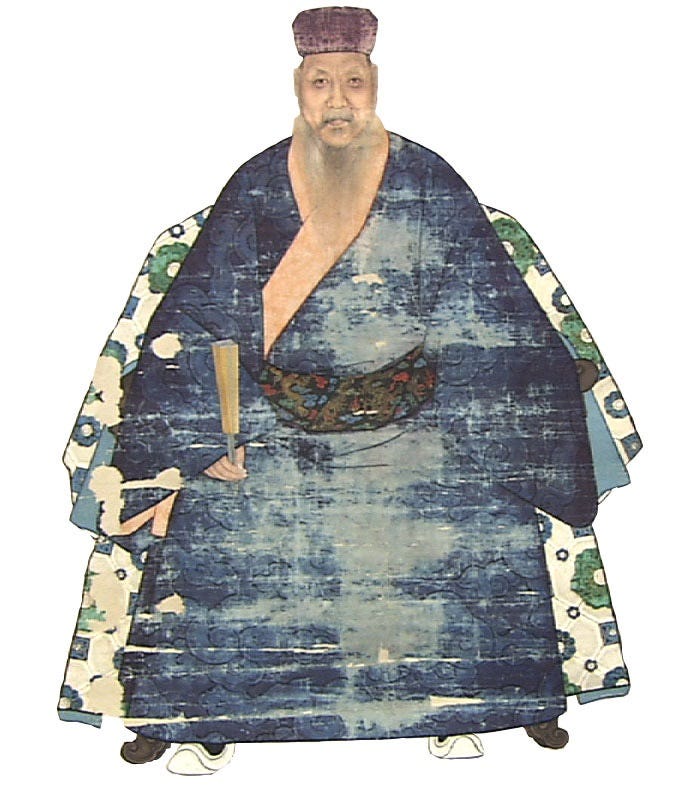
Tei Junsoku
By the way, Iha Fuyū wrote something interesting about the Kingakujin in his book “Ko Ryūkyū” (1911).
That is, after returning home the Kingakujin were superior to the ultra-elite Kanshō. Certainly, above-listed Sai On and Tei Junsoku are two of the “Five Great Men of Ryūkyū”. When speaking of persons who demonstrated ability in practical business after returning home as a Kanshō, there are only Sai Seishō and a handful others.
Before studying abroad, this Sai Seishō was told by Sai On that “If you go to Beijing, do not just indulge in literary works, but study the art of governance [literally: to govern a country well, so that the whole world is at peace].”
And when Sai Seishō returned home to Okinawa with excellent results, Kume villagers greeted him with great gratitude, but when they learned that Sai Seishō’s poetry was inferior, they quickly changed their attitude and despised him. Angered by this affront, Sai Seishō retreated into self-communion at Tōzenji temple in Kumoji for three years, diligently studying poetry and prose and triumphing over them. From this anecdote, it seems that at that time the Kanshō were evaluated by their ability in literary works rather than their ability to perform practical business.
Well, in the article “Tōdī Sakugawa” I wrote that it is impossible that Sakugawa Kanga studied abroad as a Kanshō. So, did Sakugawa study abroad as Kingakujin? This is also impossible. The reason is that according to the “Okinawa Issen-nen Shi (1000 Years of History of Okinawa)”, the Kingakujin were selected from Kume Shizoku only.

From “Okinawa Issen-nen Shi”, page 402
Sakugawa was Shuri Shizoku. Therefore, it is impossible that he was selected as a Kingakujin. Among Kingakujin, Sai Chōkō, the above-mentioned original founder of the Kojō-ryu, is said to have studied martial arts [in China]. Of course, although this is an oral tradition which we are unable to verify in historical records of that time, in comparison to Sakugawa, in whose case it is questionable if he himself studied abroad, in case of Sai Chōkō this point is clear.
Bibliography:
Jo Kyōsei, Nishizato Kikō, Uezato Kenichi: Chūgoku Ryūkyū Koryū-shi (The History of Cultural Exchange Between China and Ryūkyū). Okinawa Bunko 56. Hirugisha, Naha 1991.
Majikina Ankō, Shimakura Ryūji: Okinawa Issen-nen Shi (1000 Years of History of Okinawa). Nihon Daigaku, Tōkyō 1923.
The original Japanese article was written on October 20, 2017 on Ameblo, and the English translation was written on October 21, 2017.
Thank you for reading my story. If you would like, please follow me.
메타데이터
- post_id
- 51abf00a5649
- slug
- kingakujin-privately-financed-foreign-students-51abf00a5649
- url
- https://medium.com/motobu-ryu-blog/kingakujin-privately-financed-foreign-students-51abf00a5649
- canonical_url
- https://medium.com/motobu-ryu-blog/kingakujin-privately-financed-foreign-students-51abf00a5649
- author_url
- https://medium.com/@motobu715
- status
- ok
- fetched_at
- 2026-07-25 18:30:56