How Online Payments Actually Move Money
Why Your Payment Succeeds in Seconds but the Money Doesn’t Arrive Instantly?
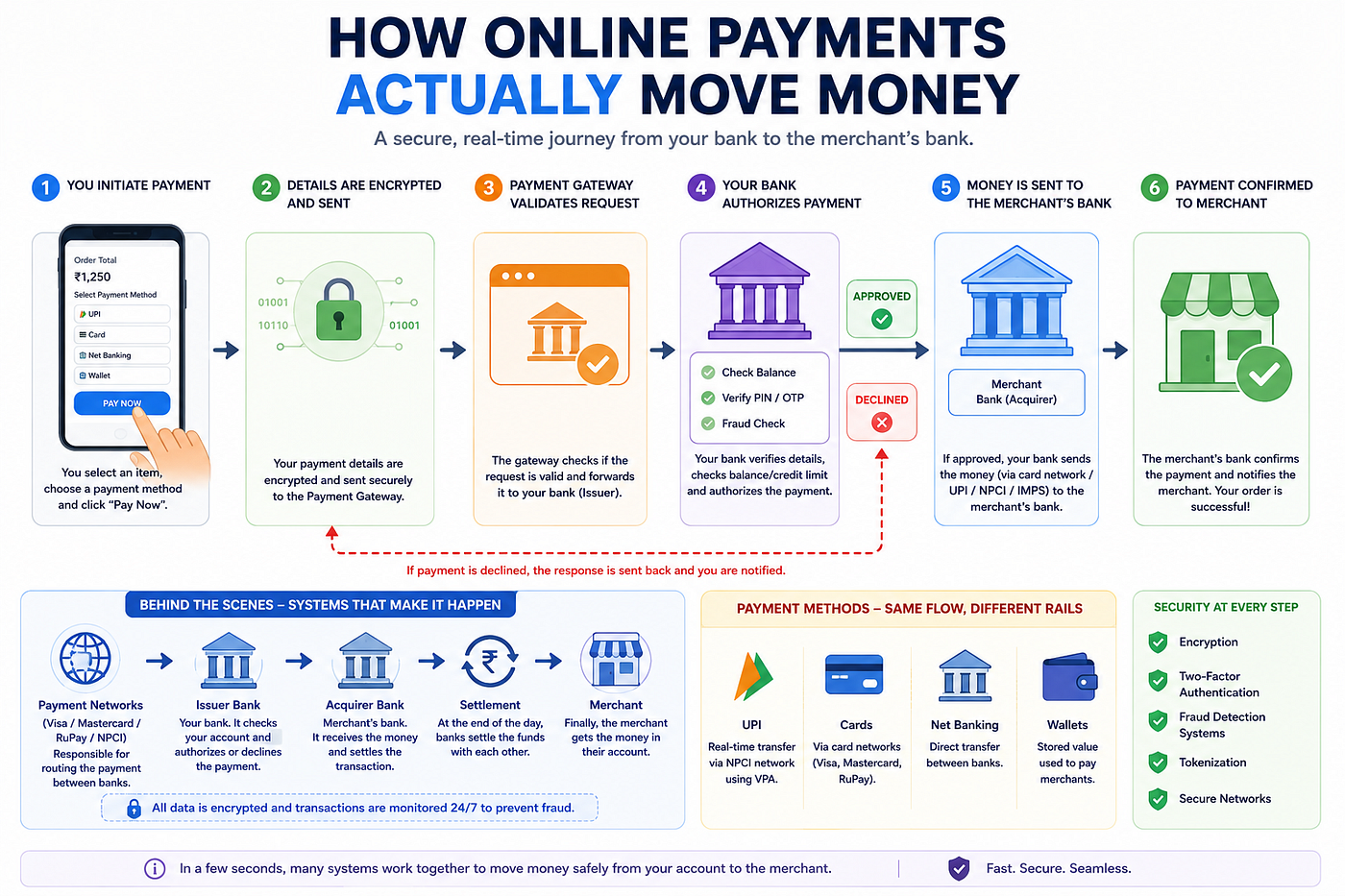
How Online Payments Actually Move Money
Why Your Payment Succeeds in Seconds but the Money Doesn’t Arrive Instantly?
You buy something online. You tap Pay Now.
A few seconds later:
✅ Payment Successful
The merchant receives an order. You receive a confirmation message. Everything seems complete.
But here’s the surprising part:
In many cases, the money hasn’t actually reached the merchant yet.
So what happened?
Let’s break down the hidden journey of an online payment and understand why payments feel instant even when the actual movement of money takes much longer.
The Biggest Misconception About Payments
Most people imagine payments like this:
Your Bank Account
        ↓
Merchant Bank Account
Money leaves one account and immediately enters another. Simple. But modern payment systems don’t work that way. Instead, there are multiple players involved:
- Customer
- Merchant
- Payment Gateway
- Payment Processor
- Issuing Bank
- Acquiring Bank
- Card Network / Payment Network
Each has a specific role.
Step 1: You Click “Pay Now”
Let’s say you’re buying movie tickets. When you click Pay:
- payment details are collected
- transaction request is created
- request is sent securely
At this point:
No money has moved yet.
The system is simply asking:
“Can this payment be approved?”
Step 2: Authorization Begins
The payment request travels through multiple systems. A simplified flow:
Customer
    ↓
Payment Gateway
    ↓
Payment Network
    ↓
Bank
Your bank checks:
- Is the account active?
- Is there enough balance?
- Is the card valid?
- Does this transaction look suspicious?
If everything looks good:
The bank authorizes the payment.
Step 3: Funds Are Reserved
This is the part most users never realize. When authorization succeeds:
Money is often reserved, not transferred.
Your bank effectively says:
“Don’t let this money be spent elsewhere.”
This is why:
- your balance decreases
- the merchant sees a successful payment
Even though settlement hasn’t happened yet.
Why Authorization Is Important
Imagine:
- Merchant ships the product
- Customer spends the same money elsewhere
Chaos.
Authorization prevents double spending by temporarily locking the amount.
Step 4: Merchant Receives Success Signal
Once authorization succeeds:
Bank
 ↓
Payment Network
 ↓
Gateway
 ↓
Merchant
Merchant receives:
Payment Approved
This usually happens in a few seconds.
That’s why:
- tickets get booked
- food orders start preparing
- subscriptions activate
The merchant trusts the authorization.
Step 5: Settlement Happens Later
Now comes the actual money movement. This process is called:
Settlement
Depending on the payment method, settlement may happen:
- later that day
- next day
- after several business days
Only during settlement does the money officially move between financial institutions.
Why Settlement Is Delayed
Because banks must:
- reconcile records
- validate transactions
- process batches
- handle disputes
Moving money securely is more important than moving it instantly.
What Happens During a Refund?
Refunds are not simply:
Merchant → CustomerInstead:
- Merchant initiates refund
- Payment networks process reversal
- Banks update balances
- Settlement systems adjust records
This is why refunds often take:
- 2 days
- 5 days
- sometimes longer
The system is unwinding multiple financial records.
Why Payments Sometimes Fail Even After Success
You’ve probably seen this:
- Money deducted
- Order not confirmed
What happened?
Usually:
Scenario 1
Authorization succeeded But:
Scenario 2
Merchant never received confirmation Maybe because:
- network failed
- server timed out
- application crashed
Now reconciliation systems step in.
The Hidden Heroes: Reconciliation Systems
Every payment platform constantly checks:
Bank Records
     vs
Merchant Records
If something doesn’t match:
- transaction is investigated
- refund may be initiated
- settlement may be corrected
Without reconciliation:
Modern payments would become unreliable very quickly.
Why Fraud Detection Runs in Real Time
Before approving payments, systems also evaluate:
- location
- device fingerprint
- spending history
- unusual behavior
- risk patterns
For example:
Normal Spending:
Mumbai

Sudden Transaction:
Brazil
The system may:
- decline
- challenge
- request verification
All within milliseconds.
Why Payments Feel Instant
The secret is:
Authorization is fast.
The actual movement of money can happen later. Most of the time, users only care about:
“Can I proceed?”
So systems optimize for rapid authorization while settlement happens behind the scenes.
The Big Takeaway
When you see:
Payment Successful
It usually means:
- authorization succeeded
- funds are reserved
- merchant has approval
Not necessarily that money has already completed its journey. The real movement of money continues quietly in the background.
Final Thought
Modern payment systems are built on trust, verification, and coordination.
What feels like a simple button press is actually dozens of systems working together to answer one question:
Can this transaction be trusted?
Once that answer is “yes,” everything else can happen behind the scenes.
And that’s why online payments feel almost instant — even when the actual financial settlement is still underway!
메타데이터
- post_id
- 51c40c8165e0
- slug
- how-online-payments-actually-move-money-51c40c8165e0
- url
- https://medium.com/@arvita-writes/how-online-payments-actually-move-money-51c40c8165e0
- canonical_url
- https://medium.com/@arvita-writes/how-online-payments-actually-move-money-51c40c8165e0
- author_url
- https://medium.com/@arvita-writes
- status
- ok
- fetched_at
- 2026-06-10 12:26:30






