Nuclear Fission: How Nuclear Power Works, Benefits & Risks
If you’ve ever driven past a power station and seen huge concrete towers releasing white “clouds,” you’ve probably thought: nuclear plant…
Nuclear Fission: How Nuclear Power Works, Benefits & Risks
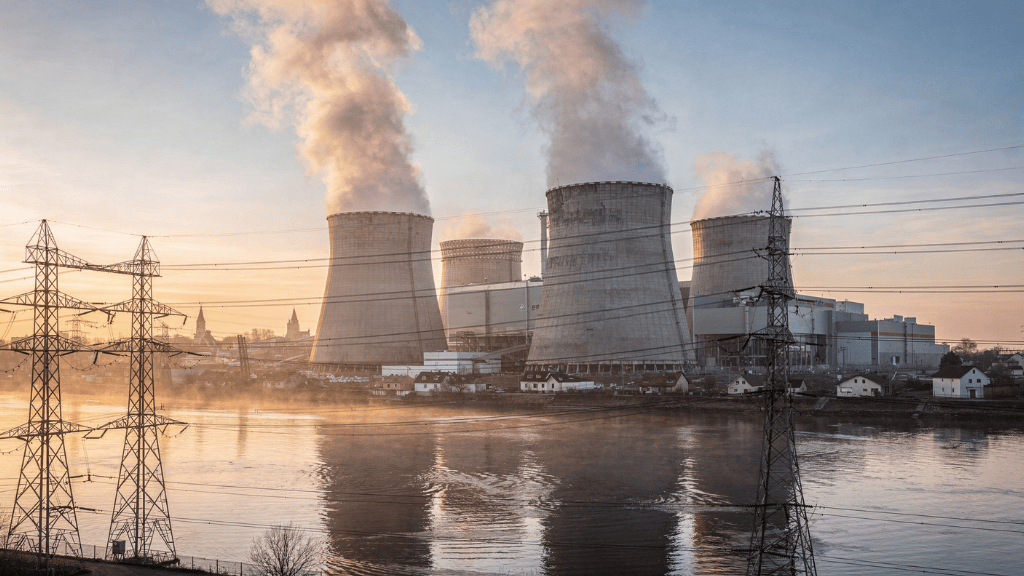
If you’ve ever driven past a power station and seen huge concrete towers releasing white “clouds,” you’ve probably thought: nuclear plant. That image is iconic — but it’s also misleading. Those towers don’t “emit smoke,” and they aren’t even exclusive to nuclear facilities. Many large heat‑based power plants (including coal and gas) may use similar cooling systems. What comes out is typically water vapor from the cooling process, not radioactive exhaust.
So what is nuclear energy — and why does it inspire both optimism and anxiety? To answer that, we need to zoom in far past cooling towers and turbines, into the tiny center of matter itself: the atomic nucleus.
The energy hidden in the heart of an atom
Every atom has a dense central core called the nucleus, packed with protons and neutrons. A powerful force — often called the strong force — helps hold this cluster together. That “glue” represents stored energy: nature’s way of binding nuclear particles into a stable structure.
The key idea is simple:
- Chemical energy (like burning coal) comes from rearranging electrons in chemical bonds.
- Nuclear energy comes from changing the nucleus itself.
That difference matters because nuclear changes can release enormous energy. Encyclopaedia Britannica notes that the energy released from fission in a single uranium nucleus is about 50 million times greater than the energy released when a carbon atom reacts with oxygen during coal combustion.
That’s why a comparatively small amount of nuclear fuel can produce very large amounts of electricity.
Nuclear fission in plain language: a controlled split
What fission is
Nuclear fission is the splitting of a heavy atomic nucleus (commonly uranium or plutonium) into two smaller nuclei. This split releases a large amount of energy and typically produces radioactive byproducts and free neutrons.
Fission can happen spontaneously in some situations, but it’s often induced — for example, when a nucleus is struck by a neutron.
A famous example: uranium‑235
A widely used fuel in reactors is uranium‑235 (U‑235). In a classic fission event, a neutron hits a U‑235 nucleus, which then splits into smaller nuclei (often illustrated as barium and krypton), releasing two or three neutrons and energy as heat and radiation.
Those extra neutrons are the “multiplier.” They can go on to strike other U‑235 atoms, triggering more fissions — very quickly.
The domino effect: chain reactions
The released neutrons can create a chain reaction — a self‑propagating series of fissions. Britannica explains that this chain reaction is the reason fission can be used in two very different ways:
- Controlled chain reaction → steady heat in a reactor → electricity for society
- Uncontrolled chain reaction → explosive release of energy → nuclear weapon
A nuclear power plant is essentially the “controlled dominoes” version: engineers design the system so the chain reaction continues at a measured pace — neither dying out nor racing out of control.
A quick backstory: how fission was discovered
Nuclear fission wasn’t discovered as a power technology first — it emerged from fundamental science, and it unfolded fast.
Britannica traces key milestones:
- 1932: James Chadwick discovered the neutron.
- 1930s: Scientists including Enrico Fermi investigated what happens when elements are bombarded with neutrons.
- 1939: Otto Hahn and Fritz Strassmann demonstrated that bombarding uranium could produce mid‑table elements like barium, helping confirm that the nucleus was splitting.
- 1939: Lise Meitner and Otto Frisch coined the term fission for this process.
- December 2, 1942: Fermi and colleagues achieved the first controlled, self‑sustaining chain reaction in the world’s first nuclear reactor (“pile”) built from uranium and graphite at the University of Chicago.
In other words: the leap from discovery to controlled reaction took only a few years — one reason nuclear technology became so influential so quickly.
How a nuclear power plant turns fission into electricity
Even though nuclear power feels futuristic, the electricity-making part is familiar. Nuclear plants are thermal power plants — they use heat to produce steam, which spins turbines connected to generators. The big difference is where the heat comes from.
Here’s the basic flow:
- Fission happens inside the reactor. Fuel (typically uranium) undergoes fission in a carefully managed chain reaction, releasing heat.
- A coolant carries heat away. Many reactors use water as the cooling agent, though some designs use liquids like molten salt or liquid metal.
- Heat produces steam. The heated coolant helps produce steam, which drives turbines.
- Turbines spin a generator. The generator converts mechanical motion into electricity for the grid.
“But what about the big white plumes?”
Stanford’s energy educators and Earth.org both emphasize a common misconception: those visible plumes are typically water vapor from cooling, not pollution or “nuclear smoke.”
The tools that keep the reaction steady
A chain reaction is powerful — but predictable and controllable with the right design.
Slowing neutrons: the moderator
For many reactors, neutrons need to be slowed down to increase the likelihood that fuel (like U‑235) will capture them and continue fission efficiently. Stanford notes that nuclear plants typically use a moderator (often water) to slow neutrons.
Stopping neutrons: control rods
To reduce or halt fission, reactors use control rods — materials that absorb neutrons. Stanford describes how control rods can stop the reaction for maintenance or emergencies.
“Neutron poisons” and fine tuning
National Geographic also describes nuclear poison materials (such as certain xenon forms) that absorb products from fission, helping manage how intensely the reaction proceeds.
Together, these tools help keep the chain reaction stable — like adjusting the flame on a stove so it’s hot enough to cook, but not so hot that it burns out of control.
From rock to reactor: how uranium becomes fuel
Uranium is common, but the useful kind is rare
Uranium exists in rocks worldwide, but not all uranium works well as reactor fuel. Two naturally occurring isotopes show up most:
- U‑238: abundant, but not directly useful for a standard fission chain reaction
- U‑235: can sustain fission, but makes up less than 1% of natural uranium
Stanford provides the common enrichment benchmark: natural uranium is about 0.7% U‑235, while most nuclear power plants need 3–5% U‑235, called low enriched uranium (LEU). (For comparison, weapons-grade uranium is typically above 90% U‑235.)
Mining and processing
Stanford describes two major uranium mining methods:
- Conventional mining (open pit or underground)
- In‑situ leach (ISL), which pumps a solution through ore underground to dissolve uranium and bring it to the surface
Fuel pellets: small, dense, and surprisingly ordinary-looking
Once enriched, uranium is made into small fuel pellets (Stanford compares them to the size of a pencil eraser). These pellets are stacked into fuel rods roughly 4 meters tall, then grouped into assemblies for the reactor core.
Fuel doesn’t get “burned up” like coal. Instead, over time, its composition changes as fission occurs and neutron-absorbing byproducts build up. Stanford notes that reactors often replace about a third of the fuel every 12–18 months.
What happens after the split: radiation and nuclear waste
Fission creates energy — but it also produces radioactive materials that must be managed responsibly.
National Geographic explains that radioactive materials are unstable nuclei that release energy and can harm living tissue, increasing risks like burns and certain diseases at high exposures.
Waste isn’t one thing
There are different types and levels of radioactive waste. National Geographic gives everyday examples of lower-level waste — protective clothing, tools, and materials that have contacted radioactive dust — and notes that some items can remain radioactive for very long periods and are regulated to prevent contamination.
IAEA’s explainer (republished by Mirage News and Farming Portal) emphasizes that nuclear power produces waste with varying levels of radioactivity, managed differently depending on level and purpose.
Used fuel and long time horizons
Used fuel (often called spent fuel) is still radioactive after it has been used in a reactor. The IAEA explainer describes fuel being usable for several years and then requiring disposal under strict guidelines, while also noting that some used fuel can be recycled into other forms of fuel in certain systems.
Earth.org highlights the long-term challenge bluntly: some highly radioactive waste can remain dangerous for tens of thousands of years, which is why storage and disposal are such a central part of the nuclear debate.
Why many countries still choose nuclear power
Despite its challenges, nuclear power is widely used for a reason: it offers a rare combination of high output and low carbon emissions during operation.
Reliable, high-output electricity
Stanford notes that nuclear supplies about 9% of global electricity and provides a large share of carbon-free electricity worldwide. It also points out that nuclear plants are typically large and run as baseload power. In the U.S., Stanford reports nuclear plants have had a 92% capacity factor, higher than many other grid resources — meaning they produce near their maximum output much of the time.
Low carbon during operation
The IAEA explainer describes nuclear as low-carbon because nuclear plants do not produce significant CO₂ during electricity generation the way fossil fuel plants do. Earth.org similarly stresses that cooling towers emit water vapor rather than greenhouse gases during normal operation.
Energy density: why a little fuel goes a long way
That “50 million times” comparison from Britannica helps explain why the fuel footprint can be relatively small compared with fossil fuels. This doesn’t automatically make nuclear “easy,” but it does help explain why nuclear can deliver large amounts of electricity without constant fuel transport on the scale of coal or gas.
The hard parts: risks, costs, and public trust
A serious discussion of nuclear power has to include the main concerns.
Accidents are rare — but can be high-impact
Earth.org points to major public alarm events such as Three Mile Island (1979), Chernobyl (1986), and Fukushima (2011), noting how nuclear accidents can have severe social and economic consequences even when the probability is low.
Waste management is not optional
The waste problem isn’t hypothetical — it’s built into the physics of fission. You get heat and useful electricity, and you also get radioactive byproducts that must be stored, monitored, and regulated for long periods.
Cost and construction time
Earth.org argues that nuclear power plants are expensive and time-consuming to build, sometimes taking many years and costing billions, even if they can be relatively cheap to operate once running.
Proliferation concerns
Because the nuclear fuel cycle overlaps with technologies relevant to weapons (especially enrichment), proliferation risk is a recurring concern. Earth.org discusses this in connection with global nonproliferation efforts such as the Nuclear Non-Proliferation Treaty (NPT).
The IAEA’s explainer also outlines the agency’s role in promoting safety standards and conducting safeguards and verification so nuclear materials are not diverted from peaceful use, and it describes international support activities across the nuclear energy lifecycle.
Fission vs. fusion: why we use one today and dream about the other
People often hear “nuclear” and think of fusion — the process that powers the Sun. Fusion combines light nuclei (like hydrogen isotopes) into heavier ones, releasing huge energy.
Orano describes the contrast clearly:
- Fission: split heavy atoms (like uranium) → mature technology used today in reactors
- Fusion: combine light atoms (like deuterium and tritium) → still experimental for electricity
Fusion is difficult because it requires extreme temperature and pressure — conditions comparable to stars. Orano notes that fusion research aims for temperatures on the order of hundreds of millions of degrees in reactor contexts.
That’s why today’s commercial nuclear electricity is almost entirely based on fission, while fusion remains a major research goal rather than a widespread power source.
Key takeaways
- Nuclear fission splits heavy nuclei and releases energy, radiation, and neutrons — neutrons can drive a chain reaction.
- Nuclear power plants use that heat the same way many plants do: to make steam and spin turbines — fission is the heat source.
- Uranium fuel must often be enriched from ~0.7% U‑235 to about 3–5% for most reactors.
- Waste and safety are central issues: radioactive materials must be managed across long time scales, and accidents can have serious consequences.
- Fusion is promising but remains experimental; fission is the mature technology used for nuclear electricity today.
References
https://www.britannica.com/science/nuclear-fission
https://www.iaea.org/newscenter/news/what-is-nuclear-energy-the-science-of-nuclear-power
https://education.nationalgeographic.org/resource/nuclear-energy/
https://understand-energy.stanford.edu/news/understand-nuclear-fission
https://www.orano.group/en/unpacking-nuclear/nuclear-fission-and-nuclear-fusion-what-you-should-know
https://earth.org/the-advantages-and-disadvantages-of-nuclear-energy/
메타데이터
- post_id
- 51db702a85e3
- slug
- nuclear-fission-how-nuclear-power-works-benefits-risks-51db702a85e3
- url
- https://medium.com/@QuarkAndCode/nuclear-fission-how-nuclear-power-works-benefits-risks-51db702a85e3
- canonical_url
- https://medium.com/@QuarkAndCode/nuclear-fission-how-nuclear-power-works-benefits-risks-51db702a85e3
- author_url
- https://medium.com/@QuarkAndCode
- status
- ok
- fetched_at
- 2026-07-13 06:23:13