Why Your Brain Lies to You: Cognitive Dissonance in Toxic Relationships
How to resolve the dissonance, see the full picture, and finally make a choice.
Why Your Brain Lies to You: Cognitive Dissonance in Toxic Relationships
Gemini
I was sitting in a lecture at work when the speaker mentioned “cognitive dissonance.” He wasn’t talking about relationships — he was talking about logic.
But as he described how our brains fight to reconcile two conflicting realities, my mind immediately went to my ex-partner.
We have this weird habit: we believe our brains are logical. We think that if someone treats us like trash today, we should see them as a “trash-treating person.” But that’s not what happens. If that same person treated us like royalty three weeks ago, our brain short-circuits.
We don’t see reality; we see the conflict.
The Conflict of Two Realities
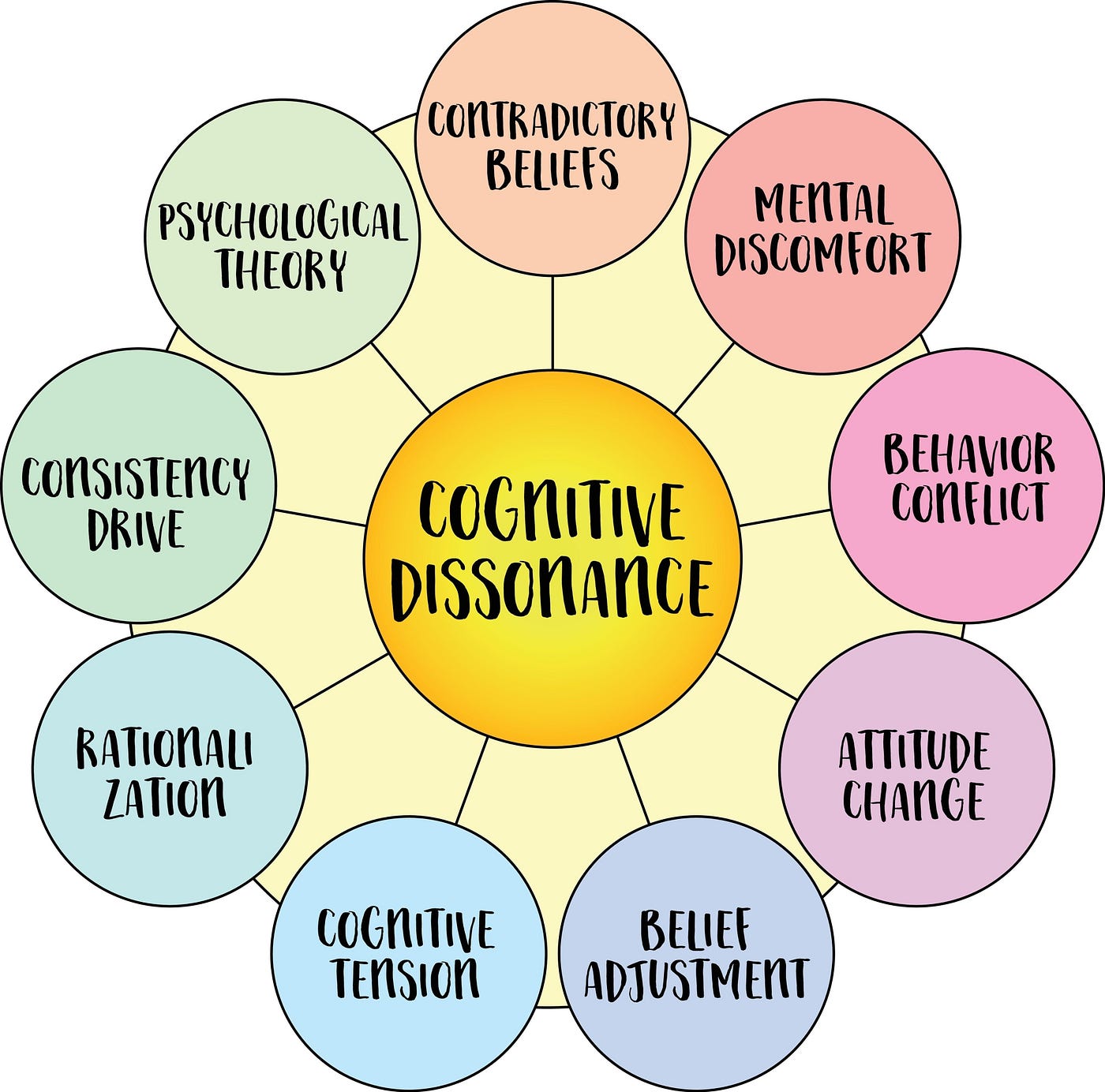
The core idea of cognitive dissonance is that our brains struggle to hold two opposing beliefs or views at the same time.
An easy case Imagine you arrive home on a sunny day. Ten minutes later, your partner walks in and tells you that outside it is hailing and a massive storm is raging. A deep sense of discord arises within you. Your brain hates this. It immediately tries to resolve the conflict.
You’ll likely walk out onto the balcony to see for yourself — to get an answer and align these two conflicting pieces of information. A sunny day and a hailstorm at the same time? It simply doesn’t add up. You might try to argue with her, convinced it’s impossible because the road was dry and sunny ten minutes ago. You might even assume it’s a joke just to end the dissonance.
The Art of Self-Deception
We do the same thing with our habits. We know smoking is bad, yet we do it anyway. How do we resolve that dissonance?
- We rationalize: “It’s not that bad, I only smoke one pack a day.”
- We compensate: “I run 10 kilometers a week, so I’m balancing my health.”
- We deflect: “My neighbor smokes like a chimney and he’s 76. It can’t be that dangerous.”
Do you see how our mind plays tricks on us to protect our comfort?
When the Toxic Person Becomes the Storm
Now, imagine a toxic person who showers you with compliments at the beginning. They admire you. They tell you how amazing you are, how successful you are in your career, and they take you on a magical weekend in Paris where you have their undivided attention.
According to Dr. Ramani Durvasula, one dream weekend, or even just one magical afternoon, is enough. Our brains latch onto that event as an anchor — a reference point — and we keep returning to it, constantly comparing the present to that moment.
Photo by The Now Time on Unsplash
Dr. Ramani calls this “trauma bonding” triggered by dissonance: the brain gets addicted to the “high” of the good moments to survive the “lows” of the bad ones.
When the negative behaviors start — the manipulation, the lies, the cold shoulder — our brains enter a state of cognitive dissonance.
The principle is identical to the hailstorm example: we refuse to accept the storm because the sun was shining so brightly just a short while ago.
When this happens intermittently, the problem compounds exponentially.
The Path to Reality
So, what is the solution?
- Should we write down every event and put it on a scale?
- Should we sit down and talk until we get to the bottom of it?
- Should we ignore everything and focus only on the “good times”?
We often try that third option, but it doesn’t really work. Not on the long run.
The real solution lies in integrating reality.
We must acknowledge both sides — both poles of the spectrum. We don’t have to erase the beautiful moments (they were real), but we must add the “dark” moments to the picture. When I finally gathered all the pieces and looked at the whole image, the dissonance vanished, because the picture finally made sense.
On one hand:
- She was kind and bought me a wonderful birthday gift.
- She went out of her way to help me, driving 500km to do me a favor.
On the other hand, I had to admit:
- She humiliated me in front of friends.
- She didn’t keep her promises.
- She refused to take responsibility.
- She neither sees nor respects my needs.
Please know this Cognitive dissonance is not a failure, you are not a failure; it is a defense mechanism. Our brains don’t want to admit we were deceived because it hurts. Admitting to the deception means admitting we made a mistake in our choice of partner.
But when you look at all these facts together, you finally see who is standing in front of you.
Now, the choice is yours. Do I accept this?
Is this what I choose for my life?
If you’ve ever found yourself stuck in this mental loop, know that you aren’t alone. How do you integrate the ‘good’ and the ‘bad’ in your own experiences? Let’s talk in the comments
메타데이터
- post_id
- 51ffcf65fa9c
- slug
- why-your-brain-lies-to-you-cognitive-dissonance-in-toxic-relationships-51ffcf65fa9c
- url
- https://medium.com/illumination/why-your-brain-lies-to-you-cognitive-dissonance-in-toxic-relationships-51ffcf65fa9c
- canonical_url
- https://medium.com/illumination/why-your-brain-lies-to-you-cognitive-dissonance-in-toxic-relationships-51ffcf65fa9c
- author_url
- https://medium.com/@hudirudi
- status
- ok
- fetched_at
- 2026-06-21 07:44:09